
 Sara Carmen
You’re not losing your mind. You’re losing yourself to a pattern that has a name, a cycle, and a way out.
Key Points
- Narcissistic abuse in relationships rarely leaves a bruise, but it leaves you doubting your own memory, your worth, and your grip on reality.
- The abuse follows a predictable 3-stage cycle, idealization, devaluation, and discard, engineered to keep you hooked through trauma bonding.
- Healing from narcissistic abuse doesn’t start with them changing. It starts the moment you can name what’s actually happening to you.
Contents
Table of Contents
We tend to picture abuse as something visible. A bruise. A raised voice a neighbor overhears. A police report with a case number attached to it.
But you know a different kind of injury.
You know the version that leaves no evidence, only a mind that no longer trusts itself.
You’ve replayed conversations at 2 a.m., searching for the exact moment you must have overreacted. You’ve apologized for things you’re still not sure you did. You’ve smiled in photos while quietly feeling like you were disappearing in real time.
This is what narcissistic abuse in relationships actually looks like from the inside. Not constant screaming, not obvious cruelty, but calculated, repeated behavior designed to keep you dependent on someone else’s version of reality instead of your own.
According to the American Psychological Association’s spotlight on narcissism, narcissistic personality patterns are marked by a persistent need for control, admiration, and a striking absence of empathy when someone challenges that control. That combination doesn’t just create an unpleasant partner. It creates a partner who, consciously or not, needs your reality to bend around theirs in order to feel stable.
In my practice, the clients who suspect narcissistic abuse are almost never the ones who are “too sensitive.” They’re the ones whose nervous systems learned, day by day, that safety depended on staying small. That’s not weakness. That’s wiring.
Understanding the mechanism behind this pattern is the first thing that starts to clear the fog. So let’s name what’s actually happening to you.
What Are the Signs of Narcissistic Abuse? 7 Hidden Red Flags

These behaviors rarely look dangerous in the moment. That’s exactly why they work. Each one, on its own, could pass as a bad day or a rough patch. Patterned together over months, they form something else entirely.
1. The Trap of Love Bombing
The claim: Early in the relationship, you were showered with affection, gifts, and a future that felt custom-built for you. Vacations were planned within weeks. “I’ve never felt this way before” came fast, and often.
The evidence: Love bombing works because it moves faster than your normal boundaries can respond. Research on high-intensity early attachment shows that rapid emotional escalation short-circuits the slower, more discerning part of the brain that would otherwise flag inconsistency.
So what: If a connection felt too complete too fast, that speed wasn’t romance. It was a shortcut around your judgment.
2. Calculated Gaslighting Examples You Didn’t Recognize at the Time
The claim: Gaslighting means rewriting shared history until you doubt your own memory. Common gaslighting examples include “I never said that, you’re misremembering things” or “You’re too sensitive, it was a joke.”
The evidence: Over time, this doesn’t just win one argument. It trains you to check with your partner before trusting your own perception, which is the exact goal.
So what: If you find yourself keeping mental notes just to prove things happened, that instinct is data. Trust it.
3. Compulsive Blame-Shifting
The claim: Every grievance you raise somehow becomes about something you did wrong. You started the conversation asking for an apology and ended it giving one.
The evidence: This isn’t accidental. Accountability threatens a narcissistic partner’s sense of control, so the conversation gets redirected before it can land.
So what: Notice how often disagreements end with you comforting them. That reversal is the pattern, not a coincidence.
4. The Provoke-and-Punish Dynamic
The claim: You get baited, criticized, ignored, or pushed until you finally react. Then that reaction becomes proof that you’re “the difficult one.”
The evidence: This dynamic lets the abusive partner point to your raised voice while conveniently erasing the twenty quiet provocations that led to it.
So what: Your reaction was never the problem. It was the intended outcome.
5. Weaponized Insecurities
The claim: Something you confided in a vulnerable moment, your body image, your past, your family, later gets used as an insult during a fight.
The evidence: This betrayal cuts deeper than a generic criticism because it targets exactly what you trusted them to protect.
So what: Safe intimacy shouldn’t come back around as ammunition. If it does, that’s not closeness. That’s information gathering.
6. The Silent Treatment and Emotional Withholding
The claim: Instead of conflict, you get cold, total absence. No explanation, no affection, sometimes for days.
The evidence: Emotional withholding functions as punishment precisely because human attachment systems interpret disconnection as threat, pushing you to work harder for reconnection.
So what: If you’ve caught yourself apologizing just to end the silence, you weren’t wrong. You were surviving.
7. Smear Campaigns and Enablers (“Flying Monkeys”)
The claim: Friends or family suddenly seem to have a version of events that paints you as unstable, dramatic, or cruel.
The evidence: Recruiting others, sometimes called “flying monkeys” in survivor communities, isolates you from outside reality checks right when you need them most.
So what: If your support system starts repeating language that isn’t yours, someone else wrote that script.
But here’s what almost no one tells you.
These seven signs of narcissistic abuse don’t usually appear all at once. They arrive in a sequence, one that’s so structured it has an actual name.
The 3 Stages of the Narcissistic Abuse Cycle
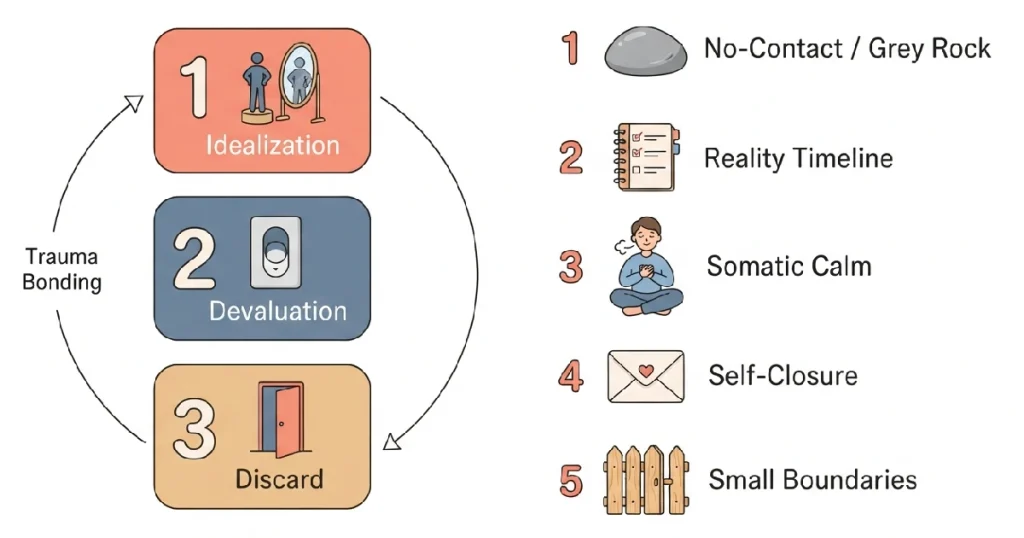
Stage 1: Idealization, the Setup
This is where love bombing lives. You feel chosen, mirrored, understood in a way that feels almost impossible. That’s because you’re being shown a reflection of your own dreams and values, not your partner’s authentic self.
Stage 2: Devaluation, the Slow Erosion
Criticism creeps in. Warmth becomes conditional. You start managing their moods instead of enjoying the relationship, convinced that if you just get it right, you can get back to Stage 1.
Stage 3: The Discard, the Cold Rupture
When the emotional supply runs low, or real accountability is finally demanded, the relationship can end abruptly and without warmth. What made this especially disorienting is that the same person who once seemed obsessed with you can appear completely indifferent within days.
Here’s something rarely said out loud: narcissistic behavior often comes from a fragile, poorly regulated sense of self-worth rather than calculated evil. That context doesn’t excuse the damage. It simply explains why the cycle repeats with such precision, because it isn’t really about you at all. It’s a survival strategy their psychology runs on autopilot, and you happened to be standing in it.
Trauma Bonding: The Neurobiology That Keeps You Stuck
This is the part that finally makes staying make sense.
Intermittent reinforcement, alternating cruelty with sudden warmth, doesn’t just confuse you emotionally. It creates a literal chemical loop. Cortisol spikes during the cruelty. Dopamine floods back during the reconciliation. Simply Psychology’s clinical guide on trauma bonding explains that this unpredictable pattern activates the same reward pathways involved in addiction, which is why leaving can feel like withdrawal, not relief.
Think of your nervous system like a thermostat that’s been quietly rewired. Every blast of cold followed by unexpected warmth doesn’t just hurt. It resets what your body considers “normal” for love. That’s not a character flaw. That’s a trauma bond doing exactly what it was conditioned to do.
Most people in this situation don’t realize that craving the relationship isn’t proof of weakness. It’s proof of a well-documented biological response. Once you see the mechanism, the shame around “why didn’t I just leave” starts to loosen its grip.
Healing From Narcissistic Abuse: 4 Safe Recovery Steps
Recovery isn’t about waiting for clarity to arrive. It’s something you build, in your body and your daily choices, starting now.
The Grey Rock Method. If full no-contact isn’t possible, because of co-parenting or shared work, practice becoming deliberately uninteresting. Flat tone, minimal detail, no emotional reaction to bait. A narcissistic partner feeds on drama, so a boring, rock-like response starves that supply.
The Reality Ledger. Keep a plain, factual timeline of what actually happened, no adjectives, no self-blame. When your mind starts romanticizing “the good old days,” this document becomes your evidence against cognitive dissonance, that uncomfortable mental tug-of-war between what you experienced and what you’re being told to believe.
Somatic Nervous System Reset. Talk therapy alone often isn’t enough, because trauma lives in the body, not just the story. Approaches like EMDR, breathwork, or simple grounding exercises, feeling your feet on the floor, naming five things you can see, help discharge stored fight-or-flight energy that’s been running in the background for months.
Self-Closure Over Waiting for Their Closure. A narcissistic partner will likely never validate your pain the way you deserve. One useful question to ask yourself: what would I need to hear to move forward, and can I say that to myself instead? Giving yourself that sentence is the ultimate reclaim of control.
One place to start today is the Reality Ledger. Open a blank note on your phone right now and write down one thing that actually happened this week, exactly as it occurred. That single entry is the first brick in rebuilding trust with your own mind.
Reclaiming Your Reality After Narcissistic Abuse in Relationships
Recognizing narcissistic abuse in relationships is one of the hardest things a person can face, and also one of the most freeing. The fog doesn’t lift all at once. It lifts one factual entry, one boundary, one boring grey-rock response at a time.
Your nervous system’s thermostat can be recalibrated. It just takes consistent, different signals, the kind you’re now equipped to give it.
You walked into this piece looking for proof you weren’t imagining things. You’re leaving with a name, a cycle, and a starting point. That’s not nothing. That’s everything.
My Closing Remarks
I’ve sat across from so many people who apologized for taking up my time while describing genuinely disturbing treatment. If that’s you, please hear this: the fact that you’re questioning it means your instincts are still working, not broken. I’ve watched clients rebuild their entire sense of self after years of this fog, and it happens. Slowly, then all at once. You’re closer to yourself than you think.
More Related Stories for You
- If you’re trying to recognize these patterns in a specific partner, this guide on common narcissist traits in men breaks down warning signs that often show up long before the relationship gets serious.
About The Author