
 Nicole Adkins
It is rarely about how he looks. It is almost always about what is happening in the invisible space between you.
Key Points
- Feeling not attracted to my husband is usually a signal from your nervous system, not a verdict on your marriage. Neuroscience shows that chronic stress, emotional over-functioning, and routine can quietly shut down the brain’s desire circuitry without you realizing it.
- Attraction is not a fixed trait. It is a living chemical process shaped by dopamine, cortisol, and oxytocin levels that rise and fall based on daily relationship dynamics, not physical appearance.
- Restoring attraction does not require your husband to change how he looks. It requires changing the emotional architecture between you, and these nine overlooked forces show you exactly where to start.
Contents
Table of Contents
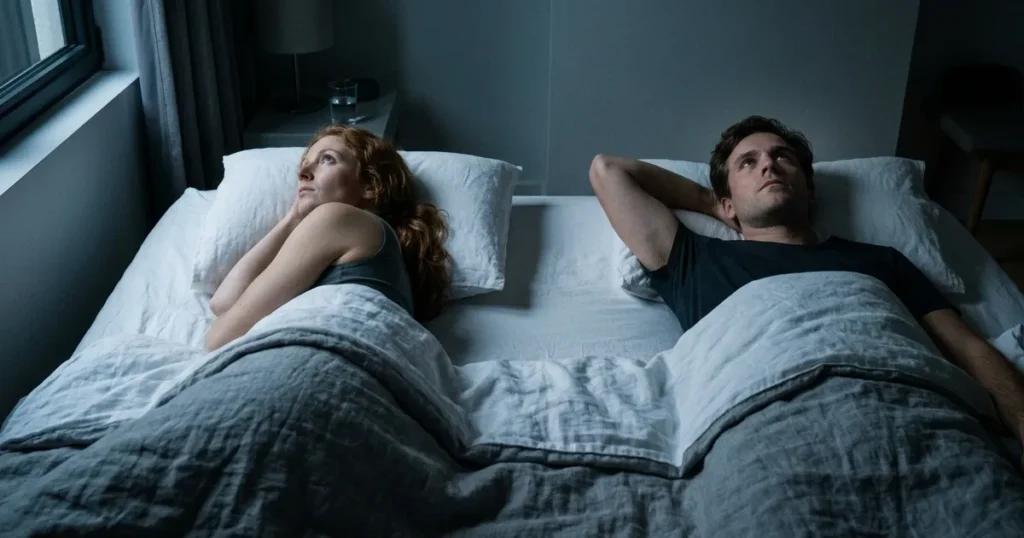
We rarely talk about the moment it happens. Not the dramatic kind. Not the affair or the screaming match or the suitcase by the door. The quiet kind. The kind where you look at the person lying next to you in bed and feel… nothing. No anger. No sadness. Just a strange, hollow flatness where desire used to live.
You still love him. You know that. You can list ten reasons he is a good man and mean every single one. But when he reaches for you at night, something inside pulls away before your body even moves.
And then the guilt starts.
You think maybe it is his weight. Maybe it is the way he chews. Maybe you have just been together too long and this is what happens. You scroll through articles about “spicing things up” and none of them land because deep down you sense the problem is not candles or lingerie.
You are right. It is not.
If you are not attracted to your husband, the real reasons are almost never the ones you can see. They are neurological. They are emotional. And they are fixable.
Why Attraction Fades: The Biology Nobody Explains
Here is something most people never learn. Attraction is not a permanent state. It is a chemical event.
Your brain produces a specific cocktail of neurochemicals when desire is active: dopamine (the anticipation and thrill molecule), norepinephrine (the alertness chemical), and oxytocin (the bonding hormone). In the early stages of a relationship, these chemicals flood your system almost automatically. Everything about your partner feels electric.
But the brain was never designed to maintain that flood indefinitely. According to biological anthropologist Dr. Helen Fisher’s research at the Kinsey Institute, the intense neurochemical surge of early romantic love typically lasts 12 to 18 months before transitioning into a calmer attachment phase. This is not a flaw in your marriage. It is how the human brain conserves energy.
The problem is what happens next. If certain invisible forces take hold in your daily relationship dynamic, your brain does not just settle into calm attachment. It actively stops associating your partner with reward. The dopamine signal dims. The desire circuitry goes quiet.
And you start Googling “not attracted to my husband” at 1 a.m.
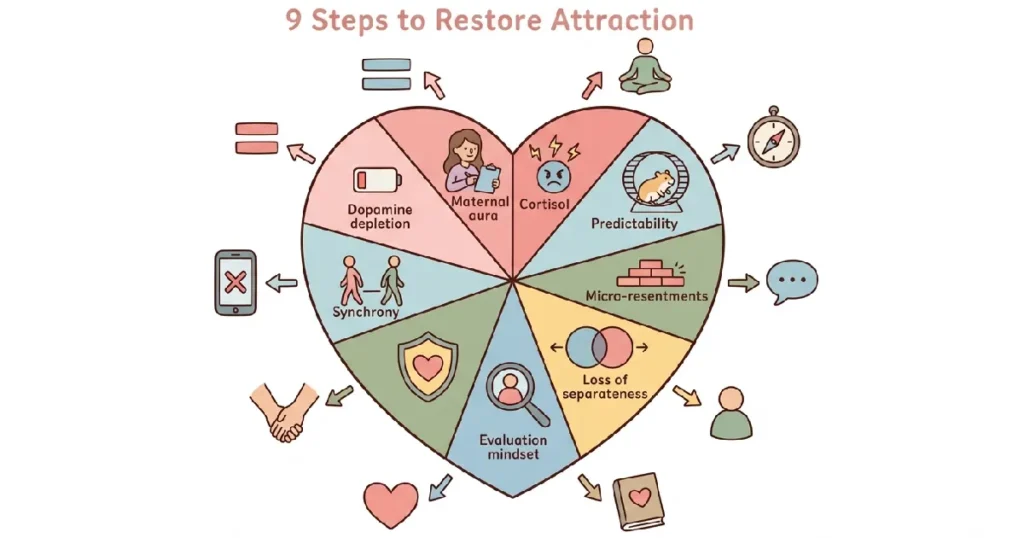
What follows are the nine forces most likely responsible. None of them are about his hairline.
1. The “Maternal Aura” Trap Is Destroying Sexual Polarity
You track his dentist appointments. You remind him to call his mother. You lay out the logistics of every weekend like a project manager running a complicated build.
You are not his partner anymore. You are his administrator. And something in your brain knows it.
This dynamic, which therapists call “over-functioning,” collapses what psychologist and relationship expert Esther Perel describes as erotic polarity. Desire requires a degree of separateness, of seeing your partner as an autonomous other. When you manage someone’s daily life, you stop seeing them as a full adult. You see a dependent. And you cannot want someone you feel responsible for raising.
What to do: Step back from managing his calendar, his meals, and his to-do list completely. Let him handle his own responsibilities. Yes, some things might fall through the cracks. That is the cost of reclaiming desire. It is worth it.
2. Chronic Cortisol Is Shutting Down Your Libido Network
You are not disinterested in your husband. You are exhausted.
When cortisol, the primary stress hormone, stays elevated day after day, it directly suppresses the hypothalamic-pituitary-gonadal axis. That is the hormonal pathway responsible for producing the sex hormones that drive desire. In plain terms: when your body is stuck in survival mode, it deprioritizes reproduction. Your brain literally decides that intimacy is not safe enough to pursue right now.
A 2016 study published in the Archives of Sexual Behavior found that women reporting higher chronic stress levels showed significantly reduced sexual desire independent of relationship satisfaction. You could be perfectly happy with your husband and still feel nothing because your nervous system is running on cortisol fumes.
What to do: Dedicate 20 minutes to independent decompression after work before interacting with each other. Walk. Breathe. Sit in the car with the radio on. Let your nervous system shift out of fight-or-flight before you try to connect.
3. Hyper-Predictability Has Put Your Brain to Sleep
Think of attraction like a smoke detector. It activates in response to novelty. When everything in your environment is completely expected and entirely safe, the detector has nothing to register. It goes dormant.
This is what happens in relationships that run on autopilot. Same dinner rotation. Same Saturday errands. Same conversation about the kids’ schedules. Your brain stops producing dopamine in response to your partner because there is zero new information to process.
This is not boredom with your husband. It is neurological habituation. Your brain has literally adapted to his presence the way it adapts to background noise.
What to do: Introduce what researchers call “structured novelty.” This means doing something unfamiliar together on purpose. A rock-climbing class. A weekend in a town neither of you has visited. A cooking style you have never tried. The activity matters less than the newness. Novelty reactivates the dopamine pathways that feed desire.
4. Micro-Resentments Are Building an Invisible Wall

I want to tell you about a woman I will call Sarah. She came into my practice saying she was “just not attracted” to her husband anymore. She described him as kind, present, a wonderful father. But she felt nothing physically.
When we started talking, something emerged. She had not told him that his habit of interrupting her in front of friends embarrassed her. She had not told him that she felt invisible when he scrolled his phone during dinner. She had not told him that she was still upset about a comment he made about her career eight months ago.
None of these things were catastrophic on their own. But stacked together, they formed a wall. And desire cannot pass through resentment.
These are micro-resentments. Small, unvoiced frustrations that accumulate silently. Each one is a tiny brick. You do not notice the wall until you realize you cannot feel anything on the other side of it.
What to do: Implement a weekly “state of the union” check-in. Sit down for 15 minutes and each share one thing that bothered you during the week and one thing that made you feel loved. Clear the small stuff before it calcifies.
5. You Have Lost the Space That Makes Longing Possible
Here is the part that sounds counterintuitive. Too much closeness kills attraction.
Psychoanalyst Stephen Mitchell wrote extensively about this paradox. We want security from our partner and we want excitement. But security comes from closeness and excitement comes from distance. When you do absolutely everything together, when you share every meal, every errand, every hobby, there is no space left for longing.
Longing requires absence. You cannot miss someone who is always there.
What to do: Cultivate solo passions deliberately. Spend an evening with your own friends. Take a class he has no interest in. Travel alone for a weekend. The goal is not to create distance for its own sake. It is to give your brain the space to remember that your husband is a separate, interesting person you chose. Not an extension of yourself.
6. The Evaluation Mindset Keeps You in Critic Mode
This is the force that almost no one talks about, and in my experience it may be the most destructive.
At some point, you started evaluating your husband. Not consciously. But you began keeping a mental scorecard. How he loads the dishwasher. How he parents. How he dresses. How he handles money. You started treating him like a performance review rather than a person.
When you are in evaluation mode, your prefrontal cortex is running the show. That is the analytical, judgment-oriented part of your brain. Desire, on the other hand, lives in the limbic system, the emotional and sensory brain. These two systems compete for dominance. You cannot critique someone and want them at the same time.
Think of it this way: desire is like a campfire. The evaluation mindset is like standing over it with a clipboard, measuring flame height and fuel efficiency. You are so busy assessing that you forget to feel the warmth.
What to do: Start a daily practice of intentional focus. Each night, write down one specific micro-action your husband did that you genuinely respect or appreciate. Not something big. Something small. “He made the kids laugh at breakfast.” “He carried in all the groceries without being asked.” This is not about ignoring real problems. It is about retraining your brain to see the person instead of the project.
7. Emotional Shielding Is Blocking the Vulnerability Desire Requires
Attraction needs vulnerability the way fire needs oxygen. When you stop sharing your real inner world with your partner, when conversations become logistical instead of emotional, desire suffocates.
Many women shield themselves emotionally after years of feeling unheard, dismissed, or simply too tired to open up again. The shielding is protective. It makes sense. But it also creates an invisible barrier that blocks not just pain but also desire.
You cannot want someone you are hiding from.
What to do: Share one vulnerable truth with your husband that has nothing to do with the house, the kids, or logistics. A fear you have been carrying. A hope that feels embarrassing. A memory that still stings. Vulnerability is the doorway back to emotional intimacy, and emotional intimacy is the doorway back to desire.
8. Low Behavioral Synchrony Is Eroding Subconscious Trust
There is a concept in relationship neuroscience called behavioral synchrony. It describes the way partners unconsciously mirror each other’s movements, breathing patterns, and rhythms. When synchrony is high, the brain registers safety and connection. When it is low, when you are moving at completely different speeds, eating at different times, going to bed hours apart, your subconscious begins to treat your partner as a stranger.
Research from the University of California, Davis found that couples who displayed higher levels of behavioral synchrony reported greater relationship satisfaction and physical attraction, even when controlling for other variables.
What to do: Create physical alignment intentionally. Spend five minutes each day in deliberate synchrony. Hold hands while walking and match your pace. Make eye contact during conversation. Sit close enough to feel each other’s warmth. These are not romantic gestures in the traditional sense. They are neural recalibration exercises. Your brain needs physical data to remember that this person is your person.
9. Dopamine Depletion From Screens Leaves Nothing for Real Intimacy
Your brain has a finite amount of dopamine available on any given day. Every TikTok scroll, every Instagram refresh, every Netflix binge takes a small withdrawal from that account.
By the time you are lying in bed next to your husband at 10 p.m., your reward system is spent. You have nothing left to feel excitement with. He is competing against an algorithm designed by thousands of engineers to be more stimulating than real life. That is not a fair fight.
This is not a willpower problem. It is a neurochemical depletion problem.
What to do: Implement a digital fast in the bedroom. Phones stay outside the door. No exceptions. Give your brain 30 to 60 minutes of screen-free time before bed. This allows your dopamine reserves to partially replenish, making it neurologically possible to feel interest, curiosity, and yes, desire toward the actual human beside you.
What to Do This Week: Three Practical Starting Points

You do not need to overhaul your entire relationship tonight. You need one entry point.
The Cortisol Reset. Tomorrow after work, take 20 minutes alone before engaging with your husband or your household. No phone. No task list. Just stillness. Notice how differently you feel walking into the room afterward.
The Campfire Practice. Tonight, write down one small thing your husband did today that you respect. Do this for seven days. By day five, you will notice your brain starting to search for these moments automatically. That shift from critic to observer is the beginning of desire waking back up.
The Vulnerability Bridge. This week, share one thing with your husband that feels a little uncomfortable to say out loud. Not a complaint. A truth about your inner life. Something that reminds both of you that you are more than co-managers of a household. A useful question to ask yourself: “What have I been feeling that I have not said?”
You Are Not Broken. Your Wiring Is Responding to Your Environment.
Remember that hollow flatness we started with? That moment of lying next to someone you love and feeling nothing?
That was never a verdict on your marriage. It was your nervous system sending a signal. A signal that something in the invisible space between you needs to change. Not his body. Not his personality. The dynamic.
Most people in your situation assume the problem is permanent. That desire, once gone, does not come back. The neuroscience says otherwise. Your brain is built for neuroplasticity, the ability to rewire itself in response to new experiences, new patterns, new inputs. The same brain that learned to stop associating your husband with excitement can learn to start again.
Not attracted to your husband does not mean the story is over.
It means the next chapter requires a different kind of attention.
My Closing Remarks
I will be honest with you. I have sat across from women who whispered this exact fear to me like it was the worst thing they had ever admitted. “I am not attracted to my husband anymore.” And every time, I watched their shoulders drop with relief when they learned that this does not make them shallow, broken, or destined for divorce. It makes them human. Your desire is not dead. It is buried under layers of stress and silence and routine that no one taught you to clear. The bravest thing you can do right now is stop blaming yourself and start getting curious about what your body and brain are actually telling you. The fire is still there. You just need to stop standing over it with a clipboard.
More Related Stories for You
- If you are working on rebuilding emotional closeness, you might also find it helpful to learn how to reassure your partner when vulnerability feels risky for both of you.
About The Author