
 Nicole Adkins
Most emotional coldness is not a missing conscience. It is a protective circuit that has quietly flipped off, and knowing which one changes everything about how you respond.
KEY POINTS
• A lack of empathy is often a systems failure in the brain and body, not a moral failure in the person.
• Five hidden drivers, including alexithymia, empathy burnout, masking fatigue, chronic inflammation, and early-life epigenetic changes, can switch off emotional mirroring without anyone choosing it.
• Learning to tell “cannot feel” from “will not care” protects your heart and gives you a far more accurate map of the person in front of you.
Contents
Table of Contents
We tend to treat empathy like eye color. Either a person has it or they don’t. So when someone close to you goes flat while you are coming apart, the conclusion feels obvious and final. They don’t care about you. You replay the moment for weeks, telling yourself you are overreacting, then telling yourself you are not, and the two thoughts keep swapping places in your head.
Here is what rarely makes it into that conversation. A lack of empathy is very often a wiring problem, not a values problem.
Someone might look at your husband and see a man who stared at the wall while you cried. What they don’t see is that his heart rate spiked past 120 within seconds and his nervous system chose shutdown over flooding.
Someone might see your mother offer advice instead of comfort when you told her about the miscarriage. What they don’t see is a woman who was raised in a house where feelings were a liability, and whose body never learned that softness was safe.
Someone might see a friend who asks logistical questions after a funeral. Did you eat. Who is handling the paperwork. What they don’t see is a person reaching for the only bridge to you she knows how to build.
None of that makes the coldness hurt less. But it does change what you do next.
Empathy Is a Circuit, Not a Character Trait
Empathy is not one thing. It runs on at least three separate systems, and any one of them can go offline while the others keep running.
There is affective empathy, which is feeling something along with another person. There is cognitive empathy, which is accurately working out what someone else is thinking or feeling without necessarily sharing the sensation. And there is compassionate concern, the motivation to actually do something about it.
You can have all three. You can have one. In my practice, the most misunderstood people are the ones with strong cognitive empathy and almost no affective empathy, because they understand your pain perfectly and still look unmoved by it.
That gap is where marriages go quiet.
Researchers Geoffrey Bird and Richard Cook made a case in 2013 that changed how many clinicians think about this. In their work on what became known as the alexithymia hypothesis, they argued that many empathy deficits assumed to be part of autism were actually driven by a separate condition sitting alongside it: an inability to read one’s own internal emotional signals. Different mechanism entirely. Different treatment path too.
Left unexamined, this pattern doesn’t only create distance. It slowly trains you to stop bringing your real feelings home, and that is usually the beginning of the end.
So let’s look at what is actually flipping the switch.
1. Interoceptive Blindness: When a Lack of Empathy Starts With Not Feeling Your Own Body
Some people cannot name what they feel because they cannot detect it in the first place.
The clinical term is alexithymia, which means having no words for feelings. It affects roughly one in ten people and it is not the same as suppression or denial. The signal never arrives clearly. There is tightness in the chest, a churn in the stomach, a heat behind the eyes, and no label attached to any of it.
Here is the mechanism that matters. Your brain builds its understanding of other people’s emotions partly by simulating them in your own body. If you cannot read your own interoceptive cues, meaning the internal sensations of heartbeat, breath, gut, and muscle tension, you have no reference library to match against. You are trying to translate a language you have never heard spoken.
Marcus came to therapy at 43 because his wife told him she felt like she was married to an appliance. He agreed with her. When she cried, he felt something happening physically, a pressure behind his sternum, but he described it as “static.” He had assumed his whole life that other people were performing emotions they didn’t really have. Six months into interoception work, he told me that he had figured out the static had two versions, and one of them was sadness. His wife cried when he said it. He noticed. That was the point.
What this means for you: if the person in your life seems blank rather than dismissive, you may be dealing with a translation failure, not indifference. Blankness and contempt look similar from the outside. They come from completely different places.
2. Empathy Burnout: How Caring Too Much Causes a Lack of Empathy
The most caring people you know are the most likely to run out.
Chronic exposure to other people’s distress produces what clinicians call secondary traumatic stress or compassion fatigue, a concept first named by Charles Figley in the mid-nineties. Under sustained emotional load, the amygdala and anterior insula, the brain regions that generate the felt sense of another person’s pain, begin to downregulate. They turn their own volume down.
This is not laziness. It is triage. A nervous system that cannot afford another emotional hit will stop generating the response that costs it the most.
Think of the ER nurse who cannot cry at her own father’s bedside. The single father who feels nothing at his daughter’s graduation because he has been in survival mode for four years. The caseworker whose partner says she has become “hard.”
What this means for you: if the coldness is new, ask what happened in the twelve to eighteen months before it started. Empathy burnout has a timeline. Cruelty rarely does.
3. Neurodivergent Masking Fatigue: A Lack of Empathy That Is Really Depletion

Spontaneous empathy is expensive. It requires available bandwidth in the prefrontal cortex, the part of the brain that manages attention, impulse control, and social processing.
Now imagine spending most of your waking hours consciously running social software that other people run automatically. Tracking eye contact. Timing your responses. Monitoring your tone. This is masking, also called camouflaging, and a well-cited 2017 study led by Laura Hull found that autistic adults describe it as exhausting, identity-eroding, and unsustainable over time.
By the time a masking person gets home, the account is overdrawn. What is left is often accurate cognitive empathy with nothing attached to it. They know you are upset. They cannot generate the warm response the moment requires.
What this means for you: the flatness you get at 8pm may be the price of the warmth someone else got at 2pm. Timing matters more than you think.
The Output Illusion: Why an Apparent Lack of Empathy Is Sometimes Emotional Overload
This is the part almost no one talks about, and it is the reason so many people get misdiagnosed by the people who love them.
You are not measuring someone’s empathy. You are measuring their empathic output, which is a completely different variable.
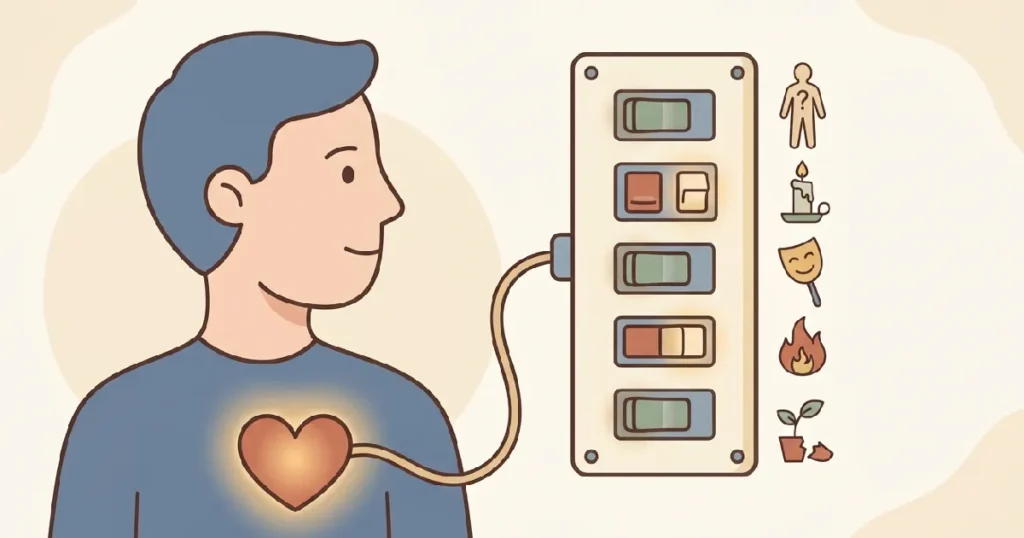
Some people go still because they feel nothing. Others go still because they feel far too much and their system hits an emotional circuit breaker. In a house, a breaker trips when the current surges, and the lights go out to protect the wiring. From inside the dark room, no power and too much power look identical.
That’s not coldness. That’s a tripped breaker.
So the question is not “does this person feel.” The better question is “what happens in their body in the sixty seconds after I show pain.” Flooding and emptiness lead to the same silence, and only one of them means you are unloved.
4. Chronic Inflammation and the Physical Roots of a Lack of Empathy
Empathy has a metabolic price tag, and a body under chronic biological stress starts refusing to pay it.
Prolonged cortisol elevation and low-grade body-wide inflammation are increasingly linked to changes in the brain networks that handle social thinking, including the default mode network, the system that activates when you think about yourself, other people, and what other people might be thinking. When that network’s connectivity shifts, social cognition gets slower and more effortful.
The experimental evidence here is striking. In work by Naomi Eisenberger’s team at UCLA, healthy participants given a substance that produced a temporary inflammatory response reported feeling more socially disconnected within hours, alongside measurable changes in amygdala responses to social cues. No trauma. No personality disorder. Just inflammation.
What this means for you: untreated sleep apnea, autoimmune conditions, long COVID, chronic pain, and years of grinding stress are not separate from someone’s emotional availability. Sometimes the empathy problem lives in the bloodstream.
5. Early-Life Epigenetic Attenuation: A Lack of Empathy Programmed in Childhood

The last cause is the quietest, and it starts before memory does.
Severe childhood neglect, and the hyper-independence conditioning that often follows it, does more than shape beliefs. It leaves chemical marks on genes. Research on toxic stress from Harvard’s Center on the Developing Child has shown how sustained early adversity alters the biological systems that regulate stress and connection for decades.
One target is the oxytocin receptor gene, often shortened to OXTR. Oxytocin is the chemical that makes closeness feel rewarding rather than threatening. A 2012 study by Unternaehrer and colleagues found that methylation of that gene, meaning the chemical tagging that turns gene activity up or down, shifted measurably within ninety minutes of a single stressful event. Now extend that across a childhood.
The result is not a person who decides not to bond. It is a person whose biological reward for bonding was turned down before they could speak.
What this means for you: “I just don’t need people” is often not a preference. It is an adaptation that outlived the danger it was built for.
What to Do When You Meet a Lack of Empathy in Real Life
Understanding causes is only useful if it changes Tuesday night. Here are three tools you can use immediately.
The N.A.M.E. Check (for the person who feels flat). Notice one physical sensation. Anchor it to a single word, even a wrong one. Match it to what the other person might need right now. Evaluate your load and say so out loud. It sounds like this: “My chest is tight. I think that’s overwhelm. You probably need me to sit down and listen. I have about ten minutes of good attention in me before I go blank.” That last sentence is not a rejection. It is honesty, and it is worth more than a performance.
The Capacity Test (for the partner on the receiving end). Ask yourself one question: does this person show warmth in other settings while withholding it from me specifically? A husband who is tender with his mother and stone with you has capacity and is making a choice. A husband who is flat everywhere, including with people he clearly loves, has a capacity problem. Same behavior, opposite meaning, completely different response required from you.
The Cost Conversation. Rather than “you have no empathy,” which invites defense, try naming the cost and the request. “When I cried and you kept scrolling, I felt alone in my own living room. I don’t need you to feel it with me. I need you to put the phone down and stay.” People with low affective empathy can often deliver behavior even when they cannot deliver feeling, and behavior is not nothing. Behavior is a lot.
A useful question to sit with this week: have I been asking this person for a feeling when what I actually need is an action?
And one more, gently: if they cannot give either, how long am I willing to wait?
Because none of this is a permission slip. Explanation is not absolution. A person can have a genuine neurological reason for their emptiness and still be responsible for getting help with it.
The Room Is Not Empty. The Power Is Just Out.
Go back to that moment. You were crying. They went blank. For weeks you carried it as proof that you were unloved.
You now have a better instrument than that. You can ask whether the signal is missing or scrambled. You can ask whether this is new or lifelong. You can ask whether it is everywhere or just with you. You can tell the difference between a house with no wiring and a house with a tripped breaker, and that difference determines whether you spend the next year negotiating or grieving.
Some people truly will not care. That exists, and you are allowed to walk away from it.
But most people who seem to have no heart are simply running on a breaker that flipped years ago. Go find the switch.
My Closing Remarks:
I will be honest with you about something I got wrong for years. Early in my career I labeled a lot of people cold who were actually terrified, exhausted, or numb in ways they had no words for. I was measuring their faces and calling it their souls. The day I stopped doing that, my work changed. So did my marriage, frankly. Please do not spend a decade grieving a person who is standing right there, unreachable for reasons neither of you has named yet.
More Related Stories for You:
- Struggling to give warmth when your partner needs it most? Read how to reassure your boyfriend in a way that actually lands.
About The Author