
 Nicole Adkins
These Tiny Daily Practices Don’t Just Calm You Down. They Change The Architecture Of How Your Brain Processes Stress, Emotion, And Connection.
Key Points
- Mindfulness is not about clearing your mind. It is about training your brain to notice where your attention goes and gently redirect it, which strengthens the same neural circuits responsible for self-control, emotional regulation, and better relationships.
- The most effective mindfulness habits are short, specific, and woven into your existing routine. Three minutes of focused breathing done consistently rewires your brain more powerfully than an occasional hour-long meditation retreat.
- Mindfulness changes not just how you feel, but how you relate to others. When you learn to observe your own thoughts without being controlled by them, you stop reacting to the people around you and start actually responding.
Contents
Table of Contents
You Are Not Broken. You Are Just on Autopilot.
You are sitting at your desk, staring at a screen you stopped actually reading four minutes ago. Your jaw is clenched. Your shoulders are somewhere near your ears. You have already checked your phone twice since this paragraph started, or at least thought about it.
And underneath all of that low-grade noise, there is a feeling you cannot quite name. Not quite anxiety. Not quite boredom. Something more like a constant hum of being slightly behind, slightly overwhelmed, slightly disconnected from the person you meant to be today.
You are not falling apart. But you are running on autopilot. And that autopilot is burning fuel you did not agree to spend.
Why Your Brain Defaults to Distraction
Here is what most people get wrong about mindfulness: they think the goal is to feel peaceful. It is not. The goal is to notice what is actually happening inside you before your brain makes a decision for you.
Your brain is a prediction machine. It runs on shortcuts. Neuroscientists call these automatic cognitive patterns “default mode network” activity, which is the brain’s tendency to wander into rumination, worry, or mental rehearsal when not focused on a specific task. This default mode is not a flaw. It evolved to help you plan and survive. But in a world saturated with notifications, social comparison, and information overload, it misfires constantly.
A landmark study published in the Proceedings of the National Academy of Sciences by Brewer et al. found that experienced meditators showed significantly reduced activity in the default mode network. The practice did not silence their minds. It gave them the ability to catch the wandering sooner, and return to the present faster.
That is the real shift mindfulness offers. Not bliss. Not emptiness. Awareness with agency.
And the habits that build that awareness are far simpler than you have been led to believe. But they do need to be specific.
The 9 Mindfulness Habits That Rewire Stress, Focus, and Connection
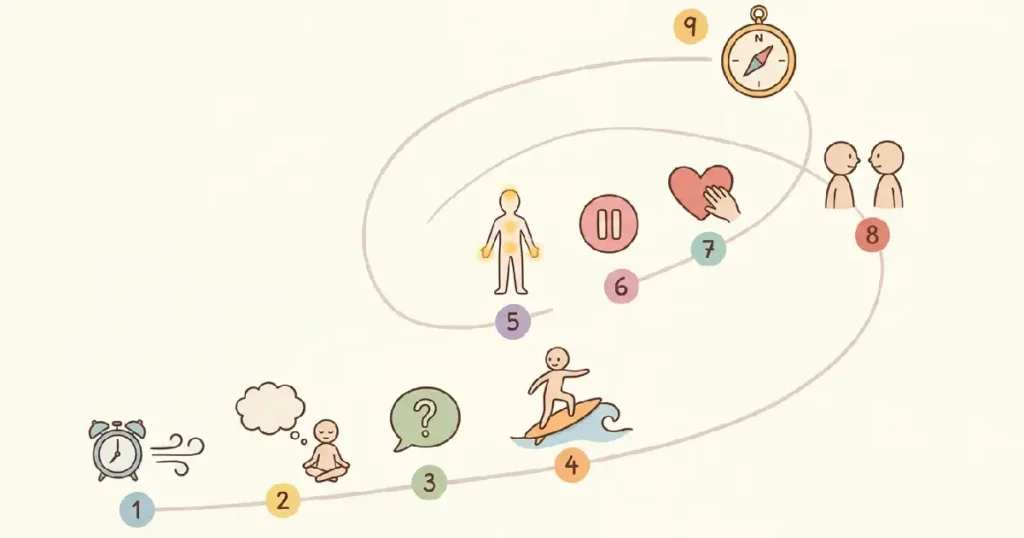
1. Micro-Dosing Your Focus: The Three-Minute Reset
You do not need to meditate for thirty minutes to change your brain. You need three minutes, done three times a day.
This approach is rooted in what researchers call Focused Attention (FA) training. FA involves directing your attention to a single object, typically your breath, and returning to it every time your mind drifts. That return is the exercise. Not the focus itself. The noticing, the catching, the coming back. Each “rep” strengthens the anterior cingulate cortex, a brain region that governs executive function and impulse control.
Consider a woman named Priya. She is a project manager, a mother of two, and someone who describes herself as “allergic to meditation.” In my practice, I encouraged her to try three-minute focus windows: once before her morning coffee, once after lunch, once before bed. No apps. No cushion. Just breath. Within three weeks, she reported something unexpected. Not calm. Clarity. “I started noticing when I was about to snap at my kids,” she told me. “Like there was a half-second gap that was not there before.”
That half-second gap is everything.
Try this: Set three quiet alarms on your phone. When one goes off, close your eyes and attend to your breathing for three minutes. When your attention drifts, and it will, gently bring it back. That is the whole practice.
2. The Decentering Pause: Watching Thoughts Instead of Believing Them
You have probably had a thought like this: “I am going to fail.” Or: “They do not really care about me.” And in the moment, it did not feel like a thought. It felt like a fact.
This is what psychologists call cognitive fusion, the state of being so merged with a thought that you cannot distinguish between the thought and reality. Mindfulness-based cognitive therapy addresses this through a skill called decentering, the ability to observe your thoughts as mental events rather than truths.
The practice is deceptively simple. When a painful thought surfaces, you add a prefix: “I am having the thought that I might fail.” That small linguistic shift activates the prefrontal cortex, which modulates the amygdala’s fear response. You are not arguing with the thought. You are stepping beside it.
Think of it this way: your thoughts are like a river. Most of the time, you are in the water, being pulled by the current. Decentering is climbing onto the bank and watching the water move. The river does not stop. But you are no longer drowning in it.
3. Cognitive Reappraisal: Choosing a Different Story in the Gap

Mindfulness does not mean accepting everything passively. It means creating enough space between a trigger and your response to ask one powerful question: “Is there another way to see this?”
This is cognitive reappraisal, a well-studied emotion regulation strategy where you consciously reinterpret a situation to change how it affects you. Unlike suppression, which pushes feelings down and often backfires, reappraisal works with the emotion rather than against it.
When your boss sends a terse email, your brain’s first interpretation might be: “She is angry at me.” Mindfulness creates a pause. In that pause, reappraisal offers alternatives: “She might be overwhelmed.” Or: “This is just her communication style.” Your emotional response shifts not because you forced it, but because you gave your brain a second option.
The next time you feel triggered, pause and ask: “What is the story I am telling myself right now? And is there at least one other story that is equally plausible?”
4. Urge Surfing: Riding the Wave Without Acting on It
Every impulse has a lifespan. The craving to check your phone. The urge to say something cutting. The pull toward the pantry at 10 p.m. These feel permanent in the moment, but they are waves. They rise, they peak, and they fall.
Urge surfing, a technique originally developed by psychologist Alan Marlatt for addiction recovery, teaches you to observe the physical sensation of an urge without acting on it. You notice where it lives in your body. Chest tightness. A buzzing in your hands. A pull in your stomach. And you watch it shift.
This is not willpower. Willpower is holding a beach ball underwater. Urge surfing is letting the ball float on the surface and watching it drift away on its own.
Practice this: The next time an urge arises, set a mental timer. Notice the sensation. Rate its intensity from 1 to 10. Wait ninety seconds and rate it again. Most people are surprised to find it has already dropped.
5. Interoceptive Body Scanning: Your Built-In Early Warning System
Your body knows you are stressed before your mind does.
Interoceptive awareness is the ability to sense internal bodily signals: your heartbeat, your breath, subtle tension in your muscles. Research shows that people with higher interoceptive awareness are better at regulating their emotions because they catch dysregulation earlier.
A rapid body scan, done two or three times a day, trains this skill. Start at the top of your head and move downward. Notice without judgment. A tight jaw. Shallow breathing. A clenched fist you did not realize was clenched. These are data points, not problems. They tell you what your nervous system is doing before your conscious mind catches up.
The shift here is subtle but profound. You move from reacting to emotions after they have already hijacked your behavior to noticing the early warning signals and regulating sooner.
6. Mindful Eating: Using Your Meal as a Mirror

Most people eat the way they live: fast, distracted, and barely tasting anything.
Mindful eating is not a diet. It is a feedback system. When you slow down enough to notice what food actually tastes like, how your stomach signals fullness, and how different meals affect your energy two hours later, you start making choices from awareness instead of habit.
For one meal today, put your phone in another room. Chew slowly. Pause halfway through and ask yourself honestly: “Am I still hungry, or am I eating because the food is still there?” This is not about restriction. It is about restoring the connection between your body’s signals and your conscious choices.
7. Warm Mindfulness: Adding Kindness to Awareness
Here is what no one tells you about traditional mindfulness. For some people, it makes things worse.
If you carry a deep habit of self-criticism, sitting quietly with your thoughts can feel like being trapped in a room with your harshest judge. Pure observation without warmth becomes another opportunity for self-punishment.
This is why the integration of self-compassion into mindfulness practice has become one of the most important developments in the field. Researcher Kristin Neff’s work on self-compassion demonstrates that speaking to yourself with kindness during difficult moments activates the brain’s soothing-affiliation system, the same neural circuitry that responds to comfort from a trusted friend.
When you notice suffering or failure, try placing a hand over your heart and saying: “This is hard right now, and it is okay to struggle.” It will feel awkward at first. That awkwardness is not a sign that it is not working. It is a sign that your brain is not used to receiving kindness from you.
That is exactly why it needs it.
8. Relational Presence: Mindfulness That Strengthens Your Relationships
Mindfulness is often framed as something you do alone. But some of its most powerful effects show up in how you connect with the people around you.
Relational presence means bringing non-judgmental awareness into your conversations. It means noticing when you have stopped listening and started rehearsing your reply. It means catching the moment you begin defending yourself instead of trying to understand.
In your next important conversation, try this: every time you notice your mind formulating a response while the other person is still talking, gently redirect your attention to their voice, their face, their tone. You are not trying to be a perfect listener. You are training yourself to actually be in the room with the person in front of you.
Most relationship conflict is not about the content of the disagreement. It is about the feeling of not being heard. Relational presence is how you change that pattern.
9. Value-Driven Intention Setting: The Anchor That Makes It All Stick

Without clear intention, mindfulness becomes just another self-improvement task you feel guilty about skipping.
Value-driven intention setting is what turns a collection of scattered habits into a coherent practice. Before starting a difficult task or entering a stressful situation, you pause and state your reason: “I am doing this because I value connection.” Or growth. Or integrity. Or being the kind of parent who is actually present.
This is not a motivational trick. Neuroscience shows that aligning action with personal values activates the brain’s intrinsic reward system, making the behavior feel meaningful even when it is hard. You stop relying on external validation or short-term pleasure to keep going.
Each morning, ask yourself: “What do I value most today, and what is one small action that reflects that value?” This single question can redirect an entire day.
Where to Start Without Getting Overwhelmed
You do not need to adopt all nine habits at once. That would defeat the purpose. Mindfulness is about paying attention, and attention is a limited resource.
The One-Habit Anchor: Choose one habit from this list that speaks to the area of your life that feels most out of alignment right now. If your mind races constantly, start with the three-minute focus reset. If your relationships feel strained, begin with relational presence. Practice it daily for two weeks before adding anything else.
The Check-In Question: At the end of each day, ask yourself: “Was there a moment today when I noticed what was happening inside me before I reacted?” If the answer is yes, even once, that is progress. That noticing is the practice working.
The Compassion Clause: When you forget to practice, and you will, notice how you speak to yourself about forgetting. If the response is harsh (“I can never stick with anything”), that is your cue to practice habit number seven. The forgetting is not the failure. The self-attack is.
You Already Have What You Need
Remember that moment at your desk. The clenched jaw. The wandering mind. The low hum of disconnection you could not name.
You can name it now.
And more importantly, you now have nine specific, research-backed ways to interrupt the autopilot and choose something different. Not something perfect. Something present.
Mindfulness is not about becoming a calmer version of yourself. It is about becoming a more honest one. Someone who notices the tension before it becomes a fight. Who feels the urge without obeying it. Who listens to another person and actually hears them.
You do not need more time, more willpower, or a quieter life to begin.
You just need three minutes. And the willingness to notice what is already there.
My Closing Remarks
I spent years thinking mindfulness was for people with more patience than me. People who could sit still. People who did not have racing thoughts or a schedule that felt like it was on fire. I was wrong. The most meaningful shift I have experienced did not come from a retreat or a perfect morning routine. It came from a single moment in my car, after a terrible meeting, when I noticed my hands gripping the steering wheel hard enough to hurt, and I chose to let go. Not of the frustration. Of the grip. That was my first real moment of mindfulness. It lasted maybe four seconds. And it changed the direction of my entire practice as a clinician. Start there. Start with four seconds. That is enough.
More Related Stories for You
- If these nine habits spoke to you, you might also appreciate this deeper look at building a sustainable mindfulness practice that fits your real life, not the idealized version.
About The Author