
 David Wall
The Science-Backed Path from Self-Criticism to Self-Kindness Starts with These 7 Practices
Key Points
- Mindful self-compassion is not about letting yourself off the hook. It is a neurobiologically grounded practice that shifts your brain from threat mode to care mode, reducing anxiety, depression, and chronic self-criticism.
- These seven mindful self-compassion practices are drawn from the clinical program developed by Drs. Kristin Neff and Christopher Germer, with research showing measurable improvements in emotional resilience after just eight weeks.
- Learning to treat yourself with the same warmth you would offer a close friend is not a luxury. It is a psychological skill, and one you can start building today.
Contents
Table of Contents
You are lying in bed at 2 a.m., replaying something you said at dinner. The exact words. The awkward pause that followed. Your stomach tightens. A voice inside you, familiar and sharp, delivers its verdict: You always do this. What is wrong with you?
You know the voice well. It has been with you for years. Maybe decades.
And somewhere along the way, you started believing it was keeping you safe. That if you stopped criticizing yourself, you would fall apart. Become lazy. Lose your edge.
But what if that voice is not protecting you at all? What if it is the very thing keeping you stuck?
Why Your Inner Critic Is Louder Than Your Inner Ally
Here is something most people never learn: self-criticism activates the same brain system as being attacked by someone else. When you berate yourself for a mistake, your amygdala, the brain’s threat-detection center, fires up. Cortisol floods your bloodstream. Your body enters a fight-or-flight state.
You are, in a very real neurological sense, both the attacker and the one under attack.
This is where mindful self-compassion comes in. Developed by Dr. Kristin Neff, a researcher at the University of Texas at Austin, and Dr. Christopher Germer, a clinical psychologist at Harvard Medical School, Mindful Self-Compassion (MSC) is a structured practice built on three pillars: mindfulness, common humanity, and self-kindness.
According to a 2019 meta-analysis published in the journal Mindfulness, self-compassion interventions significantly reduce anxiety, depression, and stress while increasing overall well-being. The effect sizes were not small. They were clinically meaningful.
But here is the part that surprises most people: self-compassion does not make you weaker or less motivated. Research consistently shows the opposite. People who practice mindful self-compassion are more likely to take responsibility for their mistakes, not less. They bounce back faster after failure. They try again sooner.
The reason is biological. When you offer yourself kindness during a painful moment, you activate the mammalian caregiving system rather than the threat-defense system. This releases oxytocin and endorphins instead of cortisol. Your nervous system calms. Your prefrontal cortex, the part of the brain responsible for clear thinking and decision-making, comes back online.
Think of it this way: self-criticism is like trying to drive a car with the emergency brake on. You can press the gas harder, and you might move forward, but the friction is constant. Mindful self-compassion releases the brake. The engine stays the same. You just finally stop fighting yourself.
Left unexamined, chronic self-criticism does not just drain your energy. It can quietly become the foundation of anxiety disorders, burnout, and relationship breakdown.
So what does it actually look like to practice this? Here are seven specific, evidence-based techniques you can begin using today.
7 Mindful Self-Compassion Practices That Change How You Relate to Yourself
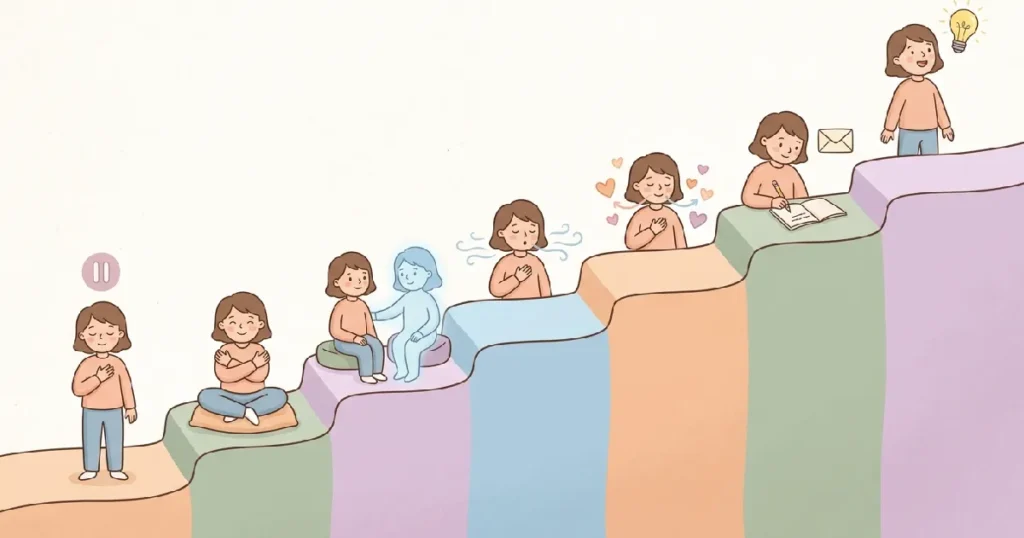
1. The Self-Compassion Break: Three Sentences That Shift Everything
This is the cornerstone practice of the entire MSC program, and it takes less than sixty seconds.
The next time you notice yourself in a difficult moment, whether it is a conflict with your partner, a mistake at work, or a wave of shame about your body, pause and say three things to yourself:
“This is a moment of suffering.” This is mindfulness. You are not exaggerating the pain or pushing it away. You are simply naming what is real.
“Suffering is part of being human.” This is common humanity. You are reminding yourself that struggle is not a sign of personal failure. It is a universal experience.
“May I be kind to myself.” This is self-kindness. You are choosing to respond with warmth instead of punishment.
In my practice, I have seen clients resist this exercise at first. It feels too simple. Almost naive. But that simplicity is the point. You are interrupting a deeply automatic pattern of self-attack with a deliberate act of care. Over time, this small interruption rewires the habit loop.
One client, a woman named Mara, came to therapy after years of perfectionism that had slowly eaten away at her relationships and her health. She was a high-achieving attorney who could articulate compassion for her clients but had none left for herself. The first time she tried the self-compassion break, she cried. Not because it was painful, but because no one, including herself, had ever spoken to her that gently. Within weeks of daily practice, Mara noticed her inner dialogue shifting. The critic did not vanish. But it was no longer the only voice in the room.
2. Soothing Touch: Using Your Body to Calm Your Brain
Your nervous system responds to physical warmth the same way it responds to emotional warmth. This is not a metaphor. It is physiology.
When you place a hand over your heart, gently hold your own face, or wrap your arms around yourself, your body releases oxytocin, sometimes called the “bonding hormone.” This hormone directly counteracts cortisol and signals to your brain that you are safe.
Try this the next time you feel a wave of stress or self-judgment: place both hands over your heart. Feel the warmth of your palms against your chest. Feel your heartbeat. Stay there for three slow breaths.
It may feel strange at first. That is normal. Most of us were never taught that we could be our own source of comfort. But your body does not distinguish between a hug from someone else and a hug from yourself. The calming signal is the same.
3. The Compassionate Friend Exercise: Seeing Yourself Through Kinder Eyes

Here is a question that often stops people in their tracks: Would you say the things you say to yourself to someone you love?
Almost always, the answer is no.
This practice asks you to close your eyes and imagine a deeply compassionate presence sitting beside you. It might be a real person, a mentor, a grandparent, or an idealized figure whose kindness feels unconditional.
Now imagine this being looking at you, seeing everything you are ashamed of, everything you think makes you “too much” or “not enough.” And they are not turning away. They are not judging. They are offering you exactly the words you need to hear.
What would they say?
This is not wishful thinking. It is a form of cognitive restructuring, a well-established therapeutic technique where you practice generating alternative, more balanced perspectives. The difference is that in this version, you access that perspective through warmth rather than logic alone.
4. Affectionate Breathing: Turning Your Breath Into a Safe Place
Most people have heard of mindful breathing. This practice goes one step further.
Sit comfortably and close your eyes. Allow your breath to settle into its own natural rhythm. Do not try to control it. Now bring your attention to the physical sensation of breathing, the rise and fall of your chest, the gentle expansion of your belly.
As you breathe, silently offer yourself a phrase of comfort. Something like: “I am here for you” or “You are allowed to rest.”
The goal is not to change anything. It is to let your breath become a source of safety rather than something you have to manage. This practice draws on interoception, your brain’s ability to sense internal body signals, and uses it to build a felt sense of self-care.
Even five minutes of affectionate breathing can measurably lower heart rate and reduce perceived stress. It is particularly helpful before sleep, during transitions, or any time you notice your inner critic gaining volume.
5. Giving and Receiving Compassion: The Breath That Connects You to Others
This practice is rooted in the ancient Tibetan meditation called Tonglen, adapted for modern therapeutic use.
As you inhale, breathe in an awareness of your own pain. Name it silently: loneliness, fear, shame. Acknowledge that this feeling is real, and that you are not the only person on the planet feeling it right now.
As you exhale, imagine breathing out warmth, relief, and compassion, first to yourself, then to every other person who is carrying the same burden.
This may sound counterintuitive. Why would you breathe in pain? Because avoidance is what feeds isolation. When you allow yourself to face what hurts and simultaneously remember that millions of people share your experience, you break the lie that your suffering makes you uniquely broken.
That is not weakness. That is wiring.
A 2020 study in the journal Clinical Psychology Review found that compassion-based meditation practices like this one reduce feelings of loneliness and increase prosocial behavior. You are not just helping yourself. You are training your brain to stay connected to others even in pain.
6. Writing a Self-Compassion Letter: Words That Heal What Silence Cannot

Choose something that causes you pain. A breakup. A career setback. A part of your body you struggle to accept. A parenting moment you regret.
Now write yourself a letter, not from your own perspective, but from the perspective of an unconditionally loving friend who knows every detail of your situation and does not judge any of it.
This friend does not minimize your pain. They do not say “just get over it.” They do not compare you to someone who has it worse. They say: I see what you are going through. It makes sense that you feel this way. You are doing the best you can, and that is enough.
Write at least one full page. Do not edit. Do not censor. Let the words be as kind as you would want someone else’s to be.
Research from Dr. Kristin Neff’s lab shows that this single exercise, even done once, can reduce self-criticism and negative affect for up to a week. When done regularly, it helps restructure the default narratives you carry about your own worthiness.
7. Asking What You Really Need: Replacing Shame-Based Motivation with Self-Compassionate Motivation
Most of us were taught to motivate ourselves through fear. If I do not push harder, I will fail. If I am not hard on myself, I will become complacent. This inner drill sergeant feels productive, but it runs on cortisol and shame, two chemicals that are terrible long-term fuel.
Mindful self-compassion offers a different engine.
The next time you catch yourself in a cycle of self-judgment, pause and ask: “What do I really need right now to take care of myself?”
Maybe the answer is rest. Maybe it is a boundary. Maybe it is permission to try again tomorrow without calling yourself a failure today.
This is not about lowering your standards. It is about fueling your ambition with care instead of contempt. When your motivation comes from a desire to thrive rather than a fear of being worthless, you last longer, perform better, and stop burning out.
How to Begin Your Mindful Self-Compassion Practice Today
You do not need to master all seven practices at once. In fact, trying to do so would work against the spirit of self-compassion entirely. Here is how to start gently.
The One-Practice-Per-Week Method: Choose one practice from this list and commit to trying it once a day for seven days. Start with whichever one felt most resonant as you read it. After a week, reflect on what shifted. Then try another.
The Pause-and-Choose Approach: The next time your inner critic speaks up, pause and ask yourself: “If I were going to respond to this moment with compassion instead of criticism, what would that look like?” You do not need a formal exercise. You just need the question.
The Letter Ritual: Once a week, set aside fifteen minutes to write yourself a compassionate letter. Keep them. Reread them on hard days. You are building a written record that your own kindness is available to you whenever you need it.
A useful question to carry with you: “Am I treating myself like someone I care about right now?” If the answer is no, you have your invitation to begin.
You Were Never Meant to Be Your Own Enemy
Remember that voice at 2 a.m., the one replaying your mistakes and delivering its harsh verdict? It was never trying to destroy you. It was trying to protect you the only way it knew how: by bracing for the worst before the worst could arrive.
But you have a new option now. You have practices, grounded in neuroscience and clinical research, that can teach your nervous system a different response. Not suppression. Not avoidance. Something more radical than either.
Gentleness.
The emergency brake is not who you are. It is just a habit. And habits, even the ones that feel permanent, can change.
Self-compassion is not something you earn by becoming a better person first. It is the thing that helps you become one.
My Closing Remarks
I will be honest with you. For a long time, I thought self-compassion was the soft option, the thing people turned to when they did not have the grit to push through. I was wrong. Learning to speak kindly to myself was the hardest psychological work I have ever done, harder than any academic program, harder than any clinical training. Because it meant confronting the belief that I did not deserve kindness unless I had earned it perfectly. If anything in this article made you flinch, or made your eyes sting, pay attention to that. That is not a sign of weakness. That is the sound of something in you asking to be heard. Start there.
More Related Stories for You
- If you are looking to deepen your daily mindfulness practice, these guided approaches can complement everything you have learned here.
About The Author