
 Sara Carmen
Your mind may already know it is over. Your nervous system is still waiting for a signal that will never come.
Key Points
- Letting go of past relationships is a rewiring process, not a personality test, and your brain treats the loss like withdrawal from a reward it still expects.
- Digital residue, no-closure endings, and your attachment style keep the old bond active long after the relationship has ended.
- A 90-day stabilize, reconnect, and rebuild plan gives your nervous system a new path to walk until the old one grows over.
Contents
Table of Contents
We treat heartbreak like a character test. We tell ourselves that if we were stronger, wiser, or less attached, we would already be finished with it. Then 2 a.m. arrives, the phone lights up with nothing, and a song you swore you deleted starts playing in your head anyway.
You are not failing at moving on. Your brain is still running a program it built for someone who is no longer there.
Someone might think you are obsessed because you keep opening an old chat thread. But what they don’t see is the way your chest tightens before you even unlock the screen, as if your body is searching for a person the way lungs search for air.
Someone might think you are fine because you went back to work, answered texts, and even laughed at dinner. But what they don’t see is the hollow stretch of evening when the performance ends and the old loop starts again.
Someone might think starting over after a breakup is a choice you make one clean morning. But what they don’t see is that letting go of past relationships is less a choice and more a recoding of a bond your brain still ranks as essential.
Here is the short truth. Romantic loss activates the same reward circuits that once lit up when that person texted back. Until those circuits stop expecting the old payoff, willpower will keep losing to biology. Healing is not waiting. Healing is giving your brain a new route.
Why Letting Go of Past Relationships Feels Physically Impossible
Your attachment to an ex is not a mood. It is a well-worn path through a forest. You walked it so many times the ground packed down and nothing else grew there. Letting go is not deciding the path does not exist. It is walking a new route long enough that the old one finally grows over.
That is why “just stop thinking about them” fails. Thought is not the whole system.
Harvard Health has described the science of heartbreak in plain terms: romantic loss can raise stress hormones, disrupt sleep, and keep the body in a state of alert long after the last conversation. Researchers using brain scans have also shown that intense romantic rejection lights up reward and craving regions, including the ventral tegmental area. That is the dopamine hub involved in wanting. In everyday language, dopamine is the chemical that makes you lean forward and hunt for a hit of relief. When the person disappears, the wanting does not vanish with them. It looks for them.
This is why getting over an ex can feel like withdrawal. You are not dramatic. You are detoxing from a living reward signal.
Memory makes it worse. The brain is a sloppy historian after a breakup. It files the late-night talks, the inside jokes, and the one perfect weekend near the front. It shelves the contempt, the confusion, and the nights you felt invisible. That positivity bias is why you keep idealizing someone you already decided to leave, or someone who already left you.
Maya, 34, sat in my office three months after a slow fade that never became a real conversation. She could list every reason the relationship was over. She still reached for her phone at 10:47 p.m., the exact minute he used to send a goodnight text. She called it weakness. It was not. Her body had learned a schedule. The schedule outlived the man.
That’s not weakness. That’s wiring.
Ambiguous Loss and Moving On After a Breakup With No Closure
Many modern endings do not give you a scene you can point to. Ghosting, situationships, and on-again off-again cycles create what psychologist Pauline Boss called ambiguous loss: grief without a clean ending. The person is gone enough to hurt and present enough, in your phone, your city, or your hope, to keep the bond half alive.
You cannot complete a funeral for a relationship that never received a death certificate.
This is why “give it time” can stall. Time heals a wound with an edge. Ambiguous loss has no edge. Your mind keeps writing alternate endings. Maybe they will explain. Maybe they are hurting too. Maybe if you send one more message, the story will snap into place.
It will not. Closure is not a delivery you wait for. It is a sentence you write.
A self-closure ritual helps when the other person refused to end things cleanly. Write the letter you never got to send. Put the facts on the page, including what you wanted and what you will no longer chase. Then give the letter a physical ending. Shred it, bury it, or burn it somewhere safe. You are not being theatrical. You are giving your nervous system a finish line it can feel.
After that, assign the ending yourself. Not the fantasy ending. The true one. “This relationship ended because the care was uneven, and I am done auditioning for consistency.” Read it when the old hope tries to reopen the case.
Digital Detox: How to Let Go of an Ex Online
In daily life, the old forest path gets walked every time you tap a profile, replay a voice note, or scroll a shared album “just to see.” Digital residue is not nostalgia. It is rehearsal. Each check tells your reward system the person is still available.
The American Psychological Association’s guidance on coping with a breakup stresses active recovery, not passive waiting. Online, active recovery means cutting the cues that keep the craving warm.
Digital Severance Checklist
- Mute, unfollow, or block on every platform for at least 30 days. Muting is the minimum. Blocking is kinder to an anxious nervous system.
- Archive shared photo albums and cloud folders. Do not doom-scroll them first. Move them out of daily reach in one sitting.
- Delete or hide chat threads and old voice notes. If you need records for practical reasons, export them and store them off your phone.
- Remove shared playlists, location sharing, and “close friends” access.
- Separate passwords, subscriptions, and devices. Shared logins are open doors.
- Put a screen-time lock on the apps you used to monitor them. Make checking inconvenient for the first month.
You are not erasing history. You are stopping the daily rehearsal that keeps the old path worn smooth.
Your Attachment Style Changes How You Let Go of an Ex
A one-size plan for emotional detachment fails because people do not break the same way. Attachment style is the pattern you learned early about closeness and safety. It shows up loudly after a breakup.
| Pattern | What gets stuck | What actually helps |
|---|---|---|
| Anxious attachment | Rumination, checking, protest texts, panic when they go quiet | A timed worry window, hard digital locks, and one trusted person who will not analyze the ex with you |
| Avoidant attachment | Numbness, overwork, sudden anxiety months later, a body that “randomly” falls apart | Scheduled feeling time, somatic check-ins, and permission to grieve without calling it neediness |
| Secure-leaning | Sadness without self-erasure | Steady routines, honest talk, and no self-attack for still missing them |
If you lean anxious, your bottleneck is rumination. Rumination is the mind’s loop of replaying, scanning, and problem-solving a wound that cannot be solved. Use a worry window. Give the grief 15 minutes at a set hour, on paper only. When the loop returns at midnight, tell it the appointment is tomorrow at 7 p.m. Then switch the body with slow breathing. You are not suppressing. You are containing.
If you lean avoidant, your bottleneck is frozen grief. You may look functional and then feel blindsided by a song six months later. Put 10 minutes on the calendar to feel it on purpose. Name one sensation. Chest. Throat. Stomach. Stay with it without fixing it. Suppressed grief does not disappear. It waits in the body and returns as irritability, insomnia, or a numbness you cannot explain.
Most people in this situation do not realize their “type” is not a life sentence. It is a habit of protection. Habits can be retrained.
Somatic Healing After a Breakup: Why Thinking Positive Is Not Enough
You can understand the whole story and still wake up with a clenched jaw. That is because grief is stored as physiology, not only as narrative.
Polyvagal theory, developed by Stephen Porges, describes how the nervous system shifts between safety, mobilization, and shutdown. In plain language, your body has a smoke alarm. After a breakup it keeps smelling smoke. Talking to the alarm helps a little. Completing the stress cycle helps more.
You cannot think your way out of a body that is still waiting.
Try these three five-minute resets. They are small on purpose. Small is what a raw nervous system will actually do.
Box breathing. Inhale for 4, hold for 4, exhale for 4, hold for 4. Repeat for five minutes. This gives the smoke alarm a metronome.
Progressive muscle release. Tense your fists, shoulders, and jaw for five seconds, then drop them. Move down the body. Grief often lives as bracing. Bracing needs an off-switch.
Cold on the wrists. Run cold water over your inner wrists or hold an ice cube there. The temperature shift can trigger a dive reflex that slows the heart and interrupts a panic spike.
Do one of these at the hour you usually spiral. For Maya, that was 10:47 p.m. She put her phone in another room, ran cold water, and stood at the sink until the urge to check passed. The urge still came. It stopped running the night.
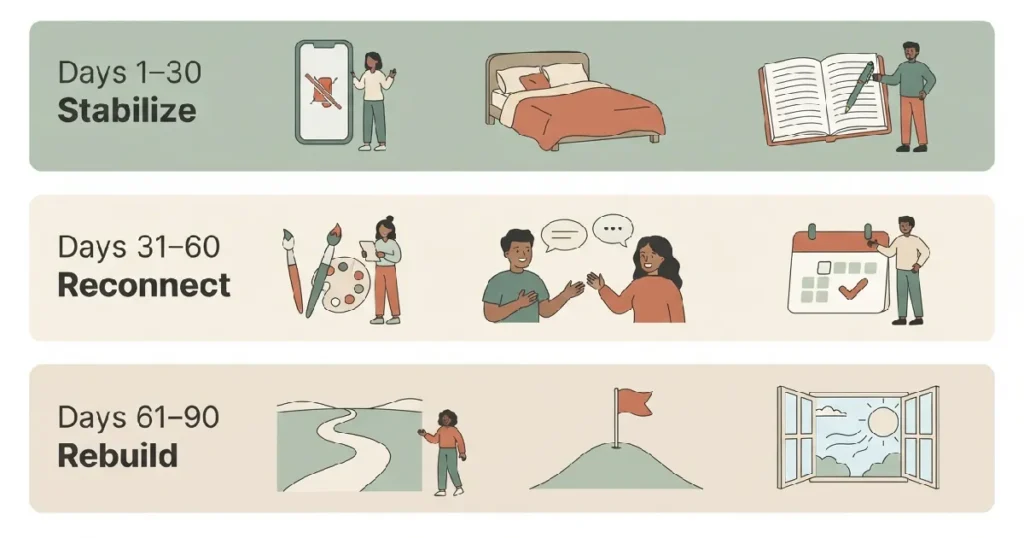
The 90-Day Plan for Starting Over After a Relationship

Identity research and habit work from University College London found that new routines often take roughly 66 days to feel automatic, with a practical window closer to 90. That is your horizon. Not “someday.” Ninety days of walking the new path.
Days 1–30: Stabilize
Grieve on purpose. Set the digital locks. Sleep and food become non-negotiable, not as self-care slogans but as nervous-system fuel. Tell two people the truth and stop performing fine. If family keeps poking, use a short line and repeat it: “I appreciate your concern. I am handling this in my own time and I do not want to discuss it right now.”
Days 31–60: Reconnect
Return to three pieces of yourself you parked during the relationship. A friendship. A hobby. A goal that did not need their approval. Put them on the calendar like appointments. This is how you treat starting fresh as identity work, not as a rebound strategy.
Maya rejoined a Thursday pottery class she had quit because he thought it was “a lot.” The first two weeks she cried in the car after. By week six she stayed for coffee with two people who had never met him. That mattered more than any insight about “loving herself.”
Days 61–90: Rebuild
Add one new social circle or weekly ritual that has no history with the old couple identity. Update dating-app boundaries only if you want them, not to prove you are healed. Set one 90-day goal that is measurable and yours: a course, a trip fund, a fitness block, a creative project. Neuroplasticity, the brain’s ability to form new pathways, needs repetition more than inspiration.
Left unexamined, the old loop does not only hurt. It becomes the reason you accept the next almost-relationship that feels familiar.
Mutual Friends, Family Questions, and Social Re-Entry After a Breakup
Letting go is also social. A large share of newly single people feel awkward walking back into rooms where they were once half of a pair. You may want to disappear. Isolation keeps the old path quiet, but it also keeps it unchallenged.
You do not owe anyone the recap. If you used to keep your relationship private, you can keep the ending private too.
Try these scripts without extra explanation.
To a mutual friend: “I care about you, and I am not going to trade updates about them. Let’s talk about literally anything else.”
To a parent: “I know you want details. What I need is normal conversation, not a postgame.”
To someone pushing you to date: “I am not available for that yet. I will say when I am.”
Research indexed through the Journal of Social and Personal Relationships keeps returning to the same point: recovery speeds up when your social world stops forcing you to perform either bitterness or sainthood.
When Heartbreak After a Past Relationship Becomes a Clinical Concern

Normal grief after a breakup can include crying spells, appetite changes, and days when work feels heavier. Watch the line where grief becomes a shutdown of your life.
The National Institute of Mental Health outlines how depression can take hold when pleasure disappears and function collapses. The Mayo Clinic’s guidance on grief and loss is also clear: support is a strength move when the pain stops moving.
Use this as a self-check, not a diagnosis.
- You cannot feel pleasure in anything for more than three weeks.
- Sleep is wrecked for a month, too little or too much.
- You cannot meet basic work or care duties.
- You are using alcohol, substances, or reckless contact with the ex to blunt the ache every day.
- You have thoughts of hopelessness or of not wanting to be here.
If several of these are true, talk with a licensed therapist. Cognitive behavioral therapy can interrupt the rumination loop. EMDR can help when specific memories keep hijacking the body. Grief counseling can hold the loss without rushing you into forced positivity.
Seeking help does not mean you loved too hard. It means the load got bigger than one nervous system should carry alone.
Starting Fresh After a Past Relationship Is Not Erasing. It Is Expanding.
Go back to that 2 a.m. phone-check for a moment. The urge may still visit. The difference is that you now know what it is. It is a GPS ping toward a house that no longer exists. You do not have to follow it down the old path.
You came here wanting permission to hurt and a map out of the hurt. You have both. Your pain is physiological. Your attachment style has a bottleneck you can work with. Your phone can stop being a shrine. Your next 90 days can grow grass over a path you no longer need.
Letting go of past relationships is not deleting who you were with them. It is becoming someone the old story no longer gets to narrate.
The path grows over when you stop walking it.
My Closing Remarks
I have sat with people who did every “right” thing and still felt hijacked by a name on a screen. I have also watched the night they realized the ping had gone quiet, not because they became colder, but because they finally stopped feeding the loop. If you are in the thick of it, I will not insult you with “you’ll be fine.” I will tell you this instead. Your longing is evidence you can bond, not proof you are broken. Walk the new route tomorrow at the hour you usually collapse. Then walk it again. That is how a life starts belonging to you.
More Related Stories for You
If the end of a relationship has left your private world feeling suddenly public, this piece on how to keep your relationship private will help you set cleaner boundaries around what you share next
About The Author