
 Sara Carmen
Learn to read the quiet signals of emotional withdrawal before distance becomes the default setting of your relationship.
Key Points
- An avoidant attachment style often looks like independence on the surface, but underneath it’s a nervous system bracing against closeness.
- These five behaviors reveal deactivation strategies that most partners mistake for falling out of love.
- Small, repeatable tools can interrupt the anxious-avoidant attachment loop and rebuild real safety between you.
Contents
Table of Contents
We’ve all loved someone who pulled the blinds down right when things got warm. One week you’re planning a future together. The next, they’re suddenly obsessed with their gym schedule, their solo trips, their need for “space.” You start replaying the last conversation, searching for the moment you did something wrong.
Here’s the part nobody tells you at that stage. You probably didn’t do anything wrong.
Someone might think their partner is simply busy, tired, or going through something at work. But what they don’t see is a nervous system quietly sounding an alarm the moment intimacy starts to feel like too much. Someone else might think a partner’s sudden nitpicking means the relationship is ending. What they don’t see is a defense mechanism trying to create enough distance to feel safe again.
This is the strange, painful contradiction of loving someone with an avoidant attachment style. They want connection. Their body just doesn’t always agree.
This guide walks you through the five behavioral patterns that reveal an avoidant attachment style hiding under the surface of everyday life. You’ll also learn what triggers this shutdown response, and what actually helps two people stay close instead of caught in a cycle of chase and retreat.
The Core Psychology Behind an Avoidant Attachment Style
Attachment theory, first developed by psychologist John Bowlby and later expanded by Mary Ainsworth, describes the blueprint we build in early childhood for how safe love feels. If a caregiver was consistently responsive, a child usually grows into a securely attached adult who can ask for closeness and tolerate distance without panic.
If a caregiver was emotionally unavailable, dismissive, or hyper-critical of a child’s needs, that child often learns a different lesson entirely. Needing someone is dangerous. Depending on people leads to disappointment. The safest move is to depend on yourself.
That lesson doesn’t disappear with age. It becomes what psychologists call a dismissive-avoidant attachment pattern, a set of automatic behaviors built to keep emotional needs quiet and manageable. Extreme self-reliance becomes a shield. If you never really need anyone, no one can really let you down.
This isn’t rare, and it isn’t a character flaw. According to research summarized by WebMD, roughly 20 percent of adults navigate some form of avoidant attachment style. That means one in five people you’ve dated, worked with, or grown up alongside learned early on that closeness comes with a cost.
Understanding this doesn’t excuse hurtful withdrawal. But it does explain it. The behaviors below aren’t proof of a lack of love. They’re a survival strategy still running on outdated instructions.
5 Hidden Signs of an Avoidant Attachment Style Partner
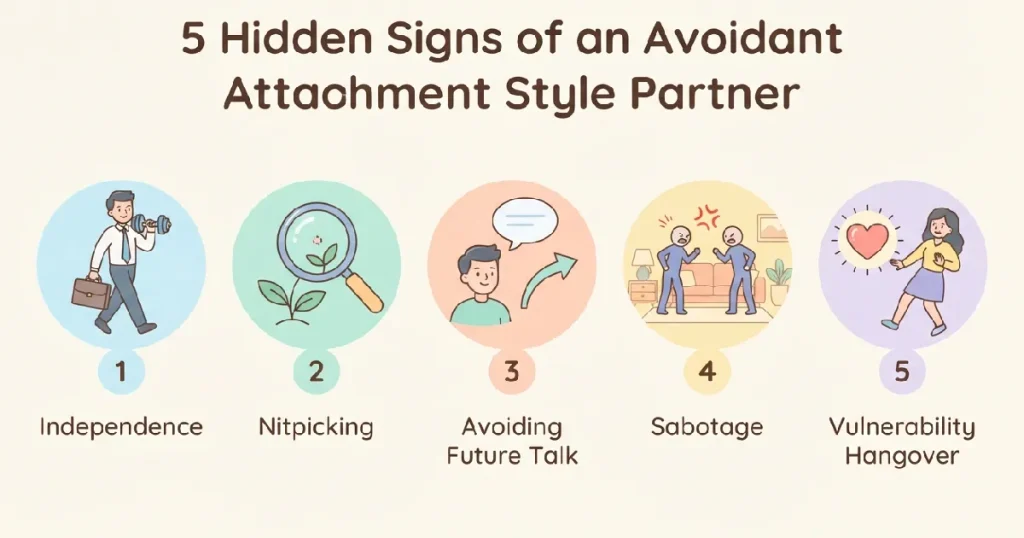
These signs rarely show up as obvious coldness. They show up in small, deniable moments that are easy to dismiss until you notice the pattern repeating.
1. Reinforcing Hyper-Independence
Avoidant partners often protect a rigid version of independence that goes beyond healthy autonomy. They keep separate finances long after “we” makes more sense than “mine.” They fill their calendar with solo hobbies even when you’ve asked for shared time.
A partner named James, for example, insisted on splitting every bill down to the cent three years into a serious relationship. It wasn’t about money. It was about keeping one foot permanently out the door.
The lesson here is simple. Healthy independence adds to a relationship. Defensive independence exists to protect against one.
2. Defensive Flaw-Finding (The “Ick” Factor)
Right when a relationship starts to feel stable, long-term, or officially committed, an avoidant partner may suddenly become fixated on small, previously unbothersome flaws. The way you laugh. The way you chew. A habit they never mentioned before the milestone hit.
Therapists sometimes call this the “ick” response, and it tends to spike right after major commitment markers like moving in together or getting engaged. It’s not really about your laugh. It’s the nervous system manufacturing a reason to create distance from something that suddenly feels too permanent.
If criticism appears out of nowhere right after a big step forward, the timing is the clue, not the content.
3. Evading Structural Future Planning
An avoidant partner can be genuinely fun, warm, and engaged during a casual dinner or a spontaneous weekend trip. Ask them where the relationship is headed in a year, though, and watch the subject change fast.
This inconsistency confuses anxiously attached partners the most. The connection feels real on Tuesday. On Friday, the moment you mention moving in together, they suddenly need to check their phone.
That gap between day-to-day warmth and future-tense silence is one of the clearest markers of an avoidant attachment style in action.
4. Preemptive Relational Sabotage
Things are going well. Genuinely well. And then, seemingly out of nowhere, a fight starts over something small like a dish left in the sink.
This isn’t random bad luck. Avoidant partners can unconsciously generate conflict specifically when closeness feels good, because “good” registers as a threat to their independence. Chaos, strangely, feels more familiar than peace.
Picking a fight the day after an incredible vacation isn’t a coincidence. It’s often a nervous system pulling the emergency brake on intimacy.
5. The Vulnerability Hangover
This is the sign most partners miss entirely. After a deeply connected moment, an emotional conversation, a vulnerable confession, or physical intimacy, an avoidant partner may suddenly go quiet, distracted, or physically distant.
This is sometimes described as vulnerability hangover symptoms, a real emotional and physiological crash that follows closeness the same way a hangover follows a night of drinking. The connection felt good in the moment. Afterward, the body registers it as overwhelming and needs to recover by pulling back.
If your partner seems to withdraw specifically after the best moments, not the worst ones, that pattern deserves your attention.
What Triggers Deactivation Strategies in Relationships

Understanding the signs only helps if you also understand what sets them off. Psychologists call the shutdown response deactivation, a term describing the moment an avoidant nervous system suppresses attachment needs to regain a sense of control.
Picture a thermostat set too low for warmth. The moment closeness pushes the temperature past a certain point, the system doesn’t get angry or dramatic. It just clicks into cooling mode, automatically and without much conscious thought.
Three situations tend to trigger this shift most often.
Suffocation via rapid enmeshment. Demanding immediate vulnerability, constant check-in texts, or a rushed timeline toward “I love you” can overstimulate an avoidant partner’s internal boundaries fast.
Perceived criticism spikes. A gentle request like “I wish you’d call more” can land as “you are failing at this relationship,” even when that was never the intended message.
Nervous system burnout. Trying to perform as the perfect partner around the clock eventually exhausts an avoidant person, resulting in a sudden out-of-sight, out-of-mind shutdown to recover.
Here’s what most anxiously attached partners don’t realize about this cycle. The more you pursue in response to withdrawal, the more threatening closeness starts to feel, which speeds up the very retreat you’re trying to prevent. This creates what researchers describe as an anxious-avoidant attachment loop, a self-reinforcing chase-and-retreat pattern where one partner’s pursuit accidentally fuels the other partner’s escape.
Mikulincer and Shaver, two of the most cited researchers in adult attachment, have documented this exact dynamic across decades of study: anxious pursuit and avoidant withdrawal tend to intensify each other unless one partner interrupts the pattern on purpose.
4 Actionable Strategies to Heal the Anxious-Avoidant Attachment Loop
Good news first. Attachment patterns are not permanent identities. They’re learned responses, which means they can be gently unlearned with consistent practice.
1. Structured timeout agreements. Instead of a partner disappearing mid-argument with no explanation, agree on clear terms in advance. Something like, “When I need space, I’ll say so and return to finish the conversation within two hours.” This gives the avoidant partner room to regulate without the anxious partner spiraling into fear of abandonment.
2. A shared safe language. Create a phrase that names the internal experience without blame, something like “I’m starting to feel deactivated” instead of “you’re pulling away again.” This turns a moment of conflict into a moment of information.
3. Micro-dose vulnerability drills. Rather than forcing deep emotional conversations, practice small, low-stakes sharing on a regular basis. A two-minute check-in about the day, or one small memory shared over coffee, slowly widens what therapists call the “window of tolerance” for closeness.
4. Nervous system co-regulation. Try short periods of quiet physical touch or synchronized breathing, just a few minutes of sitting together without conversation or screens. These nervous system co-regulation exercises retrain the body to associate proximity with safety instead of threat.
As highlighted in an overview from Psych Central, secure attachment isn’t something you’re simply born with or without. It’s built gradually, through consistent, shared practice between two willing partners.
Moving Beyond the Avoidant Attachment Label
An attachment style describes a pattern, not a permanent sentence. It’s a description of how you learned to survive closeness, not a verdict on your capacity to grow into it.
Real change asks something of both people. The avoidant partner practices tolerating closeness in small, manageable doses. The anxious partner practices offering autonomy without treating it as rejection.
Left unexamined, this loop doesn’t just create tension. Over time, it can quietly become the reason a relationship that had real love in it still comes apart.
But you now know what to look for. You know the difference between a partner who needs a quiet Sunday and a partner whose nervous system is bracing against connection itself. That thermostat can be reset. It just takes patience, the right language, and two people willing to sit in the warmth a little longer each time.
My Closing Remarks
In my years working with couples, the moment everything shifts is never the day someone stops withdrawing completely. It’s the day they say, “I think I just deactivated,” instead of silently disappearing for a week. I’ve watched partners cry with relief just from having a name for what was happening to them. You’re not asking your partner to become someone else. You’re asking them to bring their real, guarded self into the room, and stay a little longer each time. That’s enough to start.
More Related Stories for You
- If you’re trying to understand difficult relationship patterns beyond attachment style, it can also help to recognize the warning signs found in men who show narcissistic tendencies, which sometimes overlap with, but are distinct from, avoidant withdrawal.
About The Author