
Get Past the 21 Days to Form a Habit Myth (Here’s How)


Why did Day 22 feel like starting over, and how long do habits really take to stick?
Key Takeaways
- The idea of 21 days to form a habit began as a surgeon’s remark about self-image, not habit research.
- Real data shows a median of 66 days, a spread from 18 to 254, and gym habits that take months.
- A buffer, a friction check, a two-minute floor, and a monthly batting average carry you through the days motivation disappears.
Quick Answer: The idea of 21 days to form a habit is a myth. A University College London study found a median of 66 days, with individuals ranging from 18 to 254. Simple behaviors automate faster, while complex ones like gym attendance can take four to seven months of steady repetition.
Contents
Table of Contents
We have all done it. Three weeks of daily journaling, or cold showers, or a 6 a.m. run, every square crossed off, and then Day 22 arrives and the whole thing feels like pulling teeth.
If that sounds familiar, you may have concluded something unflattering about your discipline. A fairer reading is that you were handed a timeline that was never built for habits. The promise of 21 days to form a habit has derailed more good intentions than laziness ever has, because it turns normal difficulty into a personal verdict.
The mechanism underneath is automaticity, the point where a stable cue triggers a behavior with little deliberation. It builds at different speeds depending on how complex the behavior is and how steady your surroundings are. That is why the same person can lock in a water habit in three weeks and still struggle with a gym habit months later.
Below, you will see where the 21-day idea came from, what researchers actually measured, and four named strategies to test starting tomorrow.
Where the “21 Days to Form a Habit” Myth Began (And Why It Won’t Die)
From Post-Surgery Healing to Pop-Psychology: How 21 Days Make a Habit Became Gospel
In 1960, plastic surgeon Maxwell Maltz published Psycho-Cybernetics. He noticed that amputees needed a minimum of about 21 days to stop sensing a phantom limb, and that patients took roughly three weeks to get used to a new face. Both were observations about self-image adjusting to a physical change.
Then the self-help telephone game kicked in. Speakers dropped the words “minimum” and “about,” swapped self-image for behavior, and a clinical aside became a universal rule for automating anything from flossing to writing a novel.
The 21 days to form a habit rule lasts because a tidy deadline is comforting. Three weeks fits a challenge format, a sales page, and a calendar grid, while slow, uneven neurological change fits on none of them.
A pitfall we frequently see is people treating Day 21 as a finish line. They loosen their tracking, drop the cue that was working, and quietly dismantle the scaffolding before it has finished its job.
What Modern Behavioral Science Really Says About the Days to Form a Habit

The most-cited evidence is the landmark 2010 study on habit formation. Phillippa Lally and her University College London colleagues followed 96 volunteers for 12 weeks as each chose a daily behavior, such as drinking water at lunch or running before dinner. Participants rated every day how automatic it felt.
The median time to plateau was 66 days, and individuals ranged from 18 to 254. That top figure was extrapolated, since the study only ran 84 days, so read it as a sign of how wide the spread is rather than a precise forecast.
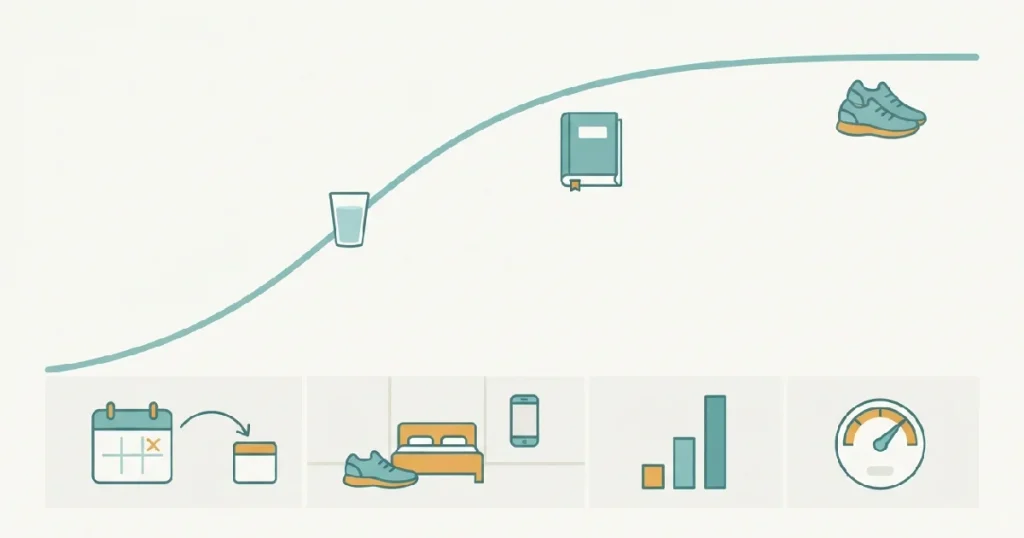
Automaticity followed an asymptotic curve. Gains came fast early on, then shrank until the line flattened. The long tail of the habit formation timeline feels like nothing is happening, yet that is when the behavior keeps attaching itself to its cue.
What this means for you tomorrow morning: judge your habit by whether it feels a little easier than last week, not by whether it feels automatic yet.
Complexity is the variable most articles skip. A glass of water after waking is one motion in one place, and it can settle within roughly three weeks, which may be exactly why the myth feels true to people who start with easy habits. Putting on running shoes in freezing rain for a four-mile run is a different neurological job.
That gap shows up at scale. A 2023 machine learning habit study in PNAS analyzed large datasets of gym visits and found that gym-going took roughly four to seven months of continuous repetition to consolidate.
What this means for you tomorrow morning: if your habit involves changing clothes, leaving the house, or discomfort, budget half a year and stop grading yourself at three weeks.
Overcoming the “Day 22 Cliff”: The True Days to Build a Habit
The Novelty Drop and the Effortful Brain
In the first weeks, a new behavior runs on novelty, fresh resolve, and deliberate planning from the prefrontal cortex, the region that handles effortful control. When the novelty fades, that same system is still doing the work because the behavior has not yet attached to a dependable cue.
No study pins this to day 21 exactly. It is a pattern we see repeatedly, usually around week three, and it explains why the cliff feels personal when it is really a handoff problem.
Broken Streak Syndrome
Habit forums are full of the same confession: “I missed day 34 and just stopped.” Streak counters make the number the whole point, so a single zero feels like erasing everything.
That is the all-or-nothing fallacy with a progress bar attached. A streak measures perfection, while habit formation depends on repetition in a stable context, and those are different things.
Willpower Versus Environmental Scaffolding
Willpower makes a shaky foundation because motivation swings with sleep, stress, and weather. Scaffolding, meaning stable cues and low friction, keeps working on the days you feel nothing at all.
Beyond the Myth: 4 Rules for the Realistic Days to Create a Habit
Rule 1: The 48-Hour Buffer (Why Missing One Day Barely Matters)
Lally’s team found that missing a single opportunity did not materially affect the habit formation process. The 48-hour buffer is our practical extension: one miss is data, and two in a row is where habits tend to slip. That second half is a working rule from coaching, not a study result.
Consider testing this script: “If I miss today, the first thing I do tomorrow is the Floor version, before I open my phone.”
Illness or travel can erase several days at once, so it helps to write a re-entry plan in advance. That way the return feels routine rather than guilty.
Rule 2: Friction Inversion Over Willpower
Friction inversion means the habit you want takes under 20 seconds of effort, and the distraction takes deliberate effort. It matches the context and friction research published by the American Psychological Association, where Wendy Wood describes habits as responses to stable contexts rather than products of motivation.
One place to begin is putting running shoes beside the bed and charging your phone in another room. For reading, try placing the book on your pillow and logging out of your two highest-pull apps.
A trade-off worth knowing: heavy friction on the whole phone backfires if you need it for work. Pick one or two apps, not the device.
Rule 3: The “Floor and Ceiling” System
Set two versions of the habit. The Ceiling is your ideal, such as a four-mile run. The Floor is a two-minute version, such as shoes on and a walk to the corner and back.
On low-energy days the Floor keeps the cue and response connected and protects your identity as someone who shows up. A useful line to keep nearby: “On a bad day, I only owe myself the Floor.”
The risk is living at the Floor for weeks. If more than half your days across two weeks are Floor days, consider shrinking the Ceiling or moving the habit to a time of day with more energy.
Rule 4: The Rolling Monthly Batting Average
Swap the streak counter for a ratio. Mark any day at Floor or better as a hit, then each Sunday count your hits across the last 30 days.
A baseball hitter who connects three times in ten is considered elite, which gives a healthy sense of what imperfect consistency looks like. For habits, 80 percent is one target worth testing, though that is our rule of thumb rather than a research threshold.
Each Sunday, consider asking: “What got in the way on the days I missed, and what could I change about the cue or the friction?” Notice that the question looks at your environment instead of your character.
Frequently Asked Questions About Habit Timelines
Is it really 21 days to break a habit?
No. Lally’s work studied forming habits, but the same logic applies: old cue-response links rarely vanish and are usually overridden by replacement behaviors. Expect weeks to months, depending on how strong the cue and reward are.
What is the 21 days theory in psychology?
It traces to Maxwell Maltz’s 1960 observation that patients needed a minimum of about 21 days to adjust to a changed self-image. Later authors stretched it into a rule for all behavior, which research does not support.
What is the 21 day habit rule?
It claims that 21 consecutive days makes any behavior automatic. Research shows a median of 66 days, with a range of 18 to 254, depending on complexity and context.
Stop Counting Days, Start Building Context
Back to Day 22. That flat feeling was never proof of weak discipline, it was the moment the habit needed a cue more than it needed enthusiasm. The 21 days to form a habit promise skipped that handoff, and now you have a map for it: a stable trigger, low friction, a Floor for bad days, and a 30-day average that forgives a miss.
A habit is not a countdown you win, it is a context you keep returning to.
My Closing Remarks
Most people who talk with me about habits arrive apologizing for a challenge they quit around the third week. I usually tell them the same thing: you were running a three-week plan on a four-month problem. Be kind to the version of you who stopped, because that person was working from a bad map. Pick one habit, set the Floor today, and let tomorrow’s version of you walk in without needing a speech.
More Related Stories for You
If this changed how you think about consistency, you may also enjoy this guide to the mindset and habits behind lasting success.
About The Author

Related Articles