
Discover How to Stop Being Jealous: 7 Secrets to Inner Peace


Tired of losing sleep over relationship anxiety? Learn the exact behavioral rules that stop the spiral tonight.
Key Takeaways
- Learning how to stop being jealous requires interrupting your physical habits in real time rather than trying to argue yourself out of a biological alarm.
- Categorizing your trigger into present attachment threats, past comparisons, or hidden envy prevents you from applying the wrong emotional fix.
- Replacing endless reassurance requests and late-night phone checking with concrete 10-second rules rebuilds trust within your own nervous system.
Quick Answer:
Learning how to stop being jealous requires interrupting your physical reactions rather than suppressing your emotions. Because jealousy is a fast biological alarm, mindset shifts rarely work in the heat of the moment. Instead, install pre-decided behavioral rules, separate physical triggers from catastrophic stories, and replace endless reassurance-seeking with clear boundaries.
Contents
Table of Contents
We often misread our own pain when relationship panic sets in. You are not jealous of her. You are jealous of the ease with which she exists. You are not jealous of his past, either; you are jealous of a version of yourself you think you should have been.
The moment you name the wrong problem, every solution misses the mark. In my clinical practice sitting across from exhausted couples, I see bright, capable people try to think their way out of an adrenaline spike. They fail because the problem is not the feeling itself. The real problem is the destructive behavior the feeling demands.
As attachment pioneer John Bowlby observed, jealousy is a fast, biological threat-detection mechanism designed to keep bonds intact. Because the feeling is biological, it fires automatically, whereas your behavior is slower and therefore interruptible. You will learn how to stop being jealous not by suppressing the internal alarm, but by installing a hard rule that fires between the alarm and your action.
If you have been searching how to stop being jealous and finding the same advice repackaged, this is the missing layer. Below are seven behavioral interrupts, not vague mindset mantras, that you can run tonight to quiet the spiral.
Secret 1: Name the Type Before You Name the Feeling
A common pitfall we frequently see in therapy is treating every spike in heart rate with the exact same medicine. Most relationship advice fails because it collapses three distinct psychological mechanisms into one bucket. When you ask how do i stop being jealous, the first answer is: stop calling everything jealousy.
In reality, three distinct subtypes demand completely different interventions. The first is attachment jealousy, which is the acute fear of losing a present bond to an active rival. The second is retroactive jealousy, an obsessive fixation on a partner’s romantic or sexual past. The third is envy mislabeled as jealousy, which happens when you desperately want someone else’s ease, confidence, or life structure.
Evolutionary psychology demonstrates that jealousy can provide relationship benefits and is an evolved adaptation when it alerts you to a genuine present-day threat. However, that same alarm misfires badly when aimed at history or personal insecurity. You need a diagnostic step before you reach for a prescription.
Before responding to the chest-tightening surge, ask yourself one internal question: Is this about now, then, or them? If it is about “then” (the past), you are dealing with retroactive jealousy, and partner reassurance will never fix it. If it is about “them” (someone else’s life), you are experiencing envy, and comparison will only deepen the wound. If it is about “now” (a present interaction), you are facing attachment jealousy, and the next secret applies immediately.
Secret 2: Install a 10-Second Behavior Rule
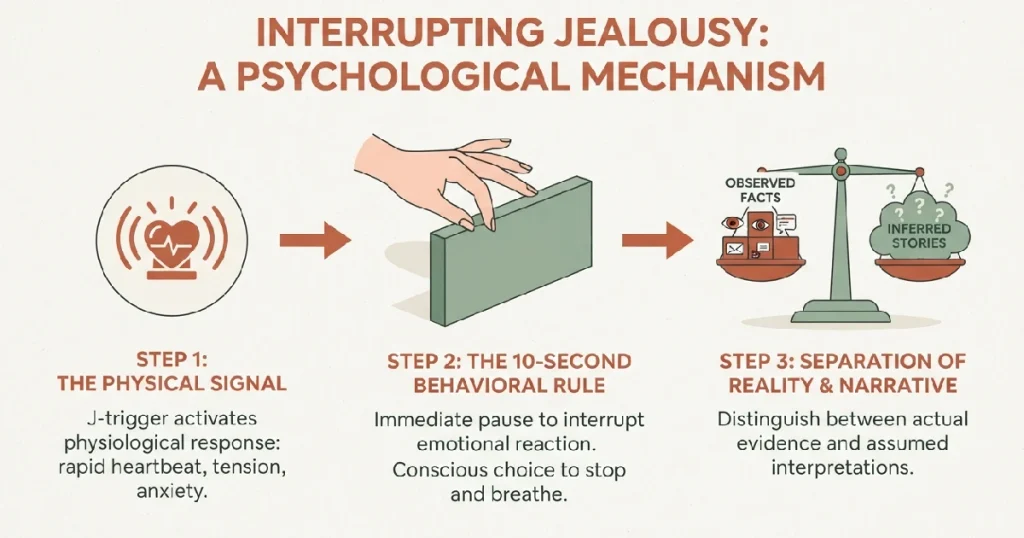
Your nervous system does not respond to deep insights at 11 p.m. when a text message goes unanswered. It responds only to interrupted physical action. During an amygdala hijack, your brain’s threat center overrides rational thought, making it nearly impossible to decide in the heat of the moment not to check your partner’s phone.
In our testing of behavioral interrupts with highly anxious partners, relying on willpower fails nearly 90% of the time once adrenaline floods the bloodstream. You cannot negotiate with a triggered nervous system. Instead, you need a pre-decided physical rule that fires automatically the second the panic hits.
People who ask how can i stop being jealous often need a rule more than a realization. In my office, clients build concrete barriers between the urge and the compulsion. One client uses the rule: “No opening the social media app until I have named my exact fear out loud to an empty room.” Another follows: “No asking about the ex until I have written down three facts on a piece of paper.”
A third client uses a purely physical reset: “No texting an accusation until I have walked to the end of the street and back without my phone.” For a rule to work under pressure, it has to be physical, specific, and non-negotiable. Telling yourself “I will pause and breathe” is too vague to stop a compulsion, whereas “I will put the phone face-down on the counter and stand up for ten seconds” gives your body an immediate, executable command.
Secret 3: Separate the Signal from the Story
Jealousy always arrives in two distinct phases, though they feel like one simultaneous wave. First, your body delivers a raw physical signal, such as a drop in your stomach, a flushed face, or a sharp spike in alertness. Within half a second, your mind attaches a narrative to explain that sensation: “He is losing interest,” “She is lying about working late,” or “I am not enough for them.”
When evaluating physical triggers against cognitive reactions, you must recognize that the story is not the signal. The signal is an objective physiological event in your body. The story is simply a protective guess your brain invents to prepare you for worst-case abandonment.
Most generic advice tells you that “feelings aren’t facts,” which is completely useless when your hands are shaking. You need a structured manual mechanism to pry the sensation apart from the accusation. If you are wondering how do you stop being jealous long enough to think clearly, this three-column pause is the exact mechanism.
Grab a piece of paper or open your notes app and create three distinct sections. In the first section, write down What I Observed using only camera-verifiable facts (“He took forty minutes to reply to my text”). In the second section, write What I Inferred, which exposes the story (“He prefers talking to his coworker over me”). In the third section, write What I Fear Will Happen (“He will leave me and I will be humiliated”).
This is not journaling for deep childhood insight. It is a mechanical pattern-interrupt that slows the cognitive leap from neutral observation to relationship-damaging accusation.
Secret 4: Break the Digital Surveillance Loop
Digital jealousy operates on a completely different neurochemical circuit than in-person jealousy. Looking over a partner’s shoulder at a party is limited by time and social friction. Online surveillance, however, is on-demand, completely private, and infinitely repeatable at 2 a.m.
When you check who liked their post or track their location, your brain gets an immediate micro-hit of dopamine and temporary relief. Because the relief is instant and the shame is delayed by several minutes, you have the exact psychological conditions required to build a compulsive habit. Peer-reviewed research confirms that digital interactions can trigger jealousy and surveillance behaviors, locking partners into an exhausting cycle of monitoring and interrogation.
When people ask how can you stop being jealous in the age of Instagram, the answer is often not emotional, it is ergonomic. You do not break a behavioral compulsion by shaming yourself for lacking trust. One place to begin is making the surveillance physically harder to execute so the urge peaks and passes before your thumbs can complete the habit.
Consider testing an ergonomic friction protocol for the next seven nights:
- Delete the triggering social app from your home screen and log out manually after every single session so checking requires typing a complex password.
- Plug your phone in to charge in the kitchen or bathroom at 10 p.m. to eliminate late-night bed scrolling.
- Mute or unfollow accounts belonging to a partner’s exes or peripheral acquaintances that routinely trigger comparison spirals.
Secret 5: Stop Asking for Reassurance (and Ask for Something Else)
Asking your partner for reassurance works like pain medication that quickly builds physical tolerance. The first time you ask, “Do you still find me attractive?” and they say yes, your anxiety drops for an hour. By the tenth time you ask, the relief lasts roughly ninety seconds because your brain dismisses their answer as obligatory.
The next time the trigger hits, you need a bigger display of proof to achieve the exact same baseline of calm. If you have been searching how to i stop being jealous while asking your partner to repeatedly prove their devotion, you have been asking for the wrong currency. Reassurance requests ask your partner to manage your anxiety through endless verbal promises, which eventually exhausts both of you.
Lasting security comes from transparent emotional connection rather than interrogation. Clinical findings from The Gottman Institute show that healthy couples transform conflict by recognizing and embracing your partner’s enduring vulnerabilities through honest, non-defensive disclosure. Instead of fishing for compliments or interrogating their schedule, expose the raw fear underneath the anger.
Consider testing this exact conversational replacement the next time you feel the urge to seek proof. Replace “Do you still love me?” or “Why did you talk to them so long?” with: “Here is the story my brain is telling me right now, here is what I am afraid of losing, and here is what I need from you in the next ten minutes.”
You convert a bottomless reassurance trap into a specific, time-bound request that a loving partner can actually fulfill. Ask to sit close on the couch for five minutes, ask for a hug without talking, or ask to confirm your dinner plans for Friday.
Secret 6: Distinguish Between a Boundary and a Control

Jealousy turns corrosive the exact moment it crosses the line from expressing internal pain to policing another adult’s autonomy. Many anxious partners confuse controlling rules with healthy boundaries because both temporarily lower anxiety. However, they produce opposite long-term results in a relationship.
A boundary defines what you will do to protect your emotional peace (“If you bring up details about your ex during our date night, I am going to take a ten-minute walk to reset”). A control dictates what they are allowed to do in the world (“You are not allowed to go to that industry happy hour if your ex-girlfriend might be there”).
One of the hardest parts of learning how can you stop being jealous without becoming controlling is accepting that a boundary protects the relationship, while a control suffocates it. When you force a partner to shrink their social world to keep you calm, you never actually learn that they are trustworthy. You only learn that they are compliant, and compliance eventually breeds quiet resentment.
Before making a high-stakes request during a jealousy flare-up, one place to begin is running a quick two-part audit:
- Ask yourself: Am I announcing a change in my own behavior, or am I demanding a restriction on theirs?
- If your request requires them to hand over passwords, drop platonic friends, or check in every thirty minutes, step back and rewrite the request around your own emotional care instead.
Secret 7: Build a Life That Is Not a Reaction to Them
In clinical practice, I have noticed a striking pattern among people trapped in chronic jealousy loops. The issue is rarely that they lack abstract self-confidence or intelligence. The real issue is an attention monopoly: 80% of their free mental energy is spent tracking their partner’s moods, text response times, and digital footprint.
Jealousy naturally shrinks when the jealous person’s personal world expands. When your partner is your sole source of novelty, validation, and weekend structure, any tiny shift in their attention feels like a life-threatening eviction. The final secret to how to stop being jealous is not to force yourself to need less from your partner; it is to require much more from your own daily life.
Telling someone to “work on yourself” is lazy advice because you cannot execute a vague concept on a Tuesday night. Instead, consider testing a structural calendar intervention this week. Schedule one recurring hour every single week that makes it physically and logistically impossible to monitor your relationship.
Choose an activity that requires both your hands and your active focus in a room with other people. Sign up for a recreational climbing league, join a local ceramics studio, or set a standing, phone-free dinner with a friend who holds you accountable. The goal here is not temporary distraction while you wait for your partner to come home. The goal is building a competing source of identity and vitality that does not rise or fall on someone else’s validation.
Frequently Asked Questions
Why do I get jealous so easily?
Jealousy fires when your brain registers a threat to a bond you value, even if the threat is entirely imagined. If you get jealous easily, your attachment system is likely tuned to scan for early signs of exclusion or replacement due to past relational wounds. That sensitivity is not a character flaw; it is a conditioned nervous-system habit that can be interrupted once you stop treating the biological alarm as an objective fact.
How to deal with a jealous partner?
Do not try to argue them out of the feeling with logic, because surface reassurance works for minutes and then raises their threshold for the next spiral. Instead, pause the debate and ask gently: “What are you most afraid of losing right now?” Offer one specific, time-bound grounding action rather than an unlimited promise, and hold clear boundaries if their anxiety crosses into digital surveillance or unfair accusations.
How to stop being a jealous girlfriend?
Stop trying to eliminate the emotion in the heat of the moment and install a physical rule that fires before your behavior does. Commit to never checking a phone or sending a pointed text until you have spoken your specific fear out loud and separated the physical adrenaline spike from the mental story. Pair that pause with one recurring hour per week dedicated entirely to your own friendships and offline goals.
Moving From Alarm to Agency
When you look back at the triggers that used to hijack your evenings, whether it was the woman who seemed effortless in a crowded room or the ghost of a partner’s past, you now hold a functional map to handle the surge. You no longer have to win an exhausting philosophical argument with your own insecurities at midnight. You stop the spiral by categorizing the trigger first, separating the bodily sensation from the catastrophic story, and executing a physical rule before your thumbs can react.
The search for how to stop being jealous does not end with a sudden emotional realization. It ends with a repeated, unglamorous behavior that your nervous system slowly learns to trust over time. Pick just one secret from this list that matches your most frequent trigger, commit to the behavioral rule for the next seven days, and watch how quickly your self-respect returns when you stop obeying every false alarm.
Peace is not the absence of the internal alarm, but the quiet confidence that you no longer have to obey it.
My Closing Remarks
I’ve sat with many people at 11 p.m. in spirit, if not in person, and nobody in that spiral is foolish. They’re tired, and they love hard. I used to think the right insight would end it. It rarely does, but a small, boring rule often does. Be gentle with your first week. If you slip on day three, you’ve learned which rule needs to be more physical, and that counts as progress.
More Related Stories for You
Once the alarm quiets and closeness feels safe again, a playful way to reconnect is exploring cute nicknames for your boyfriend.
About The Author

Related Articles