
How to Set Healthy Boundaries in Relationships (No Guilt)


Why does saying no feel like betraying someone you love, and what can you say instead?
Key Takeaways
- How to set healthy boundaries in relationships starts with one overlooked split: a request asks them to change, a boundary states what you will do.
- The guilt you feel after saying no is often borrowed, and there is a three-sentence script for the moment it hits.
- Respecting someone else’s limit is quieter than most of us think, and far less like giving up.
Quick Answer: How to set healthy boundaries in relationships comes down to three moves: name what you need, make one clear request, and state what you will do if it is ignored. A boundary is an action you control, not a demand on them. Expect guilt, and follow through anyway.
Contents
Table of Contents
The Yes That Felt Like Losing Something
We have all said yes while our chest tightened. The sentence we meant (“I can’t do this tonight”) dissolved behind our teeth, and what came out was “sure, no problem.”
That swallow feels like kindness, but it is usually an alarm. Attachment research, going back to John Bowlby (1969), shows that humans treat a threat to a bond as a threat to survival, so a disappointed face can register as danger.
If you are searching for how to set healthy boundaries in relationships without feeling like the villain, you have been taught to confuse guilt with kindness.
Below is a three-step protocol that separates a request from an enforceable boundary. It includes a script for the pushback and a way to respect your partner’s limits without disappearing.
Why Saying No Feels Like Betrayal (And Why It Isn’t)
Psychology Today’s clinical writing on boundaries points to the core distortion: we feel guilty because we believe limits are mean, wrong, or selfish. Whose voice is that? Often it belongs to a parent who sulked when you refused, a culture that rewards self-sacrifice, or an earlier partner who punished every no.
One test helps here. True guilt appears when you actually harmed someone, and it points toward repair. Borrowed guilt appears when you absorb someone else’s disappointment, and it points toward nothing at all.
Skipping the boundary has a cost too, and it compounds. A common pitfall we frequently see is the person who says yes to dodge a five-minute argument, then pays for it with weeks of quiet resentment.
The guilt of holding a limit is brief and tends to fade on its own. The guilt of abandoning yourself is chronic, and it leaks out as sarcasm, withdrawal, or a sudden blowup over something small.
Before you set anything, it helps to know which of three tools you are holding.
Request vs Boundary vs Ultimatum: The Distinction That Ends Guilt

The Gottman Institute lays out the difference between a request and a boundary in a way that quietly removes most of the guilt. We have translated it into plain scenarios here.
A request asks the other person to change. “Can you speak more calmly?” It is collaborative, and it cannot be enforced, because they are free to say no.
A boundary states what you will do if the behavior continues. “If the yelling continues, I’ll pause this conversation and come back in an hour.” It is unilateral and enforceable, because it depends only on you.
An ultimatum threatens the relationship to force compliance. “Stop yelling or we’re done.” It is a demand with a penalty attached, and it usually produces panic or defiance rather than change.
Most people who struggle with how to set a boundary in a relationship are actually making requests and calling them boundaries. When the request is ignored, they feel powerless, because they never had a boundary in the first place.
Here is the part that dissolves the guilt. A boundary is not a demand on them. It is a promise to yourself.
How to Respect Boundaries in a Relationship (Without Becoming a Doormat)
If you want to know how to respect boundaries in a relationship, start by accepting that respect is not passive agreement. It is active non-interference.
Say your partner tells you, “I need space tonight.” Replying “Why? Did I do something?” is a negotiation wearing a worried face. The respectful reply is “Okay. I’m here when you’re ready.”
Respect does not mean silencing your own needs. You can honor their space and still say, “I’d like to talk about it tomorrow. Can we pick a time?” That is one need meeting another, and neither person is erased.
We often see a trade-off with anxious partners. An open-ended “I need space” can sound like abandonment, while “I need tonight, can we talk at breakfast?” gives the limit a return time. The limit is the same, but it lands softer.
It also helps to hold your own limits with some flexibility. Boundaries protect but can isolate if turned into walls, so the aim is a limit with a door in it.
When They Don’t Respect the Boundary: Signs and Scripts
This is not about diagnosing anyone. It is about spotting a pattern of non-accountability: entitlement, hearing your limit as an insult, minimizing (“you’re too sensitive”), and punishing you with withdrawal or guilt-tripping.
That last one matters, because it is often what makes you doubt yourself. Psychology Today’s piece on setting limits makes the case that guilt is not a reliable signal that you have done something wrong. Sometimes it only signals that you changed a pattern someone else liked.
Then there is the one-time exception trap. A genuine lapse looks like this: they forgot, they apologized, and they adjusted. A pattern of testing looks like a new excuse each time, an apology with no change, and your limit slowly turning into a negotiation.
The protocol allows for a repair conversation. It does not allow endless renegotiation.
When the sigh, the argument, or the silence arrives, try a calm, repeatable line:
“I hear that you’re frustrated. My answer is still the same.”
“I’m not asking you to agree. I’m letting you know what I’ll do.”
The No-Guilt Boundary Protocol: 4 Strategies to Try This Week
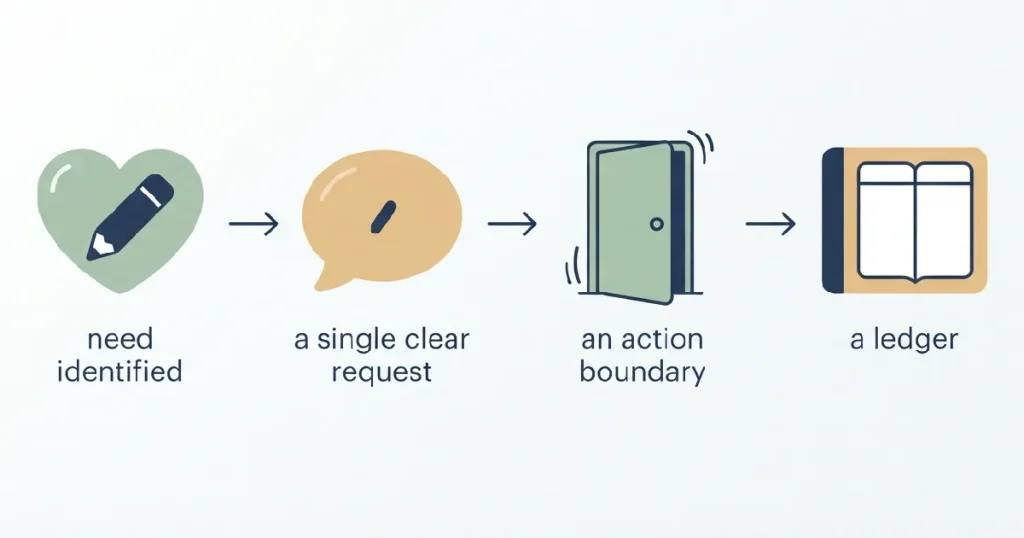
Strategy 1: The True Need Sentence
One place to begin is a single sentence: “I need ______ in order to feel safe, steady, or respected in this relationship.”
Then check what the sentence protects. A boundary guards a value, like sleep, sobriety, or emotional safety. A rule built to control the other person (“you can’t talk to your ex”) is a different thing, and it tends to backfire.
“I need my phone to stay private to feel respected” passes the test. Consider testing yours before you say anything out loud.
Strategy 2: The One-Ask Script
Gottman’s research found that the first three minutes of a difficult conversation predicted its outcome in roughly 96 percent of cases (Gottman & Silver, 1999). So how you open matters more than how well you argue.
Here are three scripts you can copy into your Notes app.
For a partner who checks your phone: “When my phone gets checked, I feel watched instead of trusted. Could we agree to ask each other directly when something worries us?”
For a friend who trauma-dumps without warning: “I care about you and I want to listen well. Could you text ‘Do you have room for something heavy?’ first? If I don’t, I’ll tell you honestly.”
For a family member who criticizes your parenting: “I know you want what’s best for the kids. I’m not looking for feedback on how I parent. If it comes up, I’ll change the subject.”
This is the practical answer to how do you set boundaries in a relationship without starting a war. You ask clearly, once, and you give a reasonable window for change, often a week or two for habits that have run for years.
Strategy 3: The Action Boundary
The boundary is the action, not the sentence. If the yelling continues, you leave the room. If the drinking continues, you sleep elsewhere. If the criticism continues, you end the call.
Say it once, calmly, then do it. “I’m going to hang up now. Talk soon.” No speech, no scorekeeping.
Then comes the guilt sit, the minutes after enforcement when your stomach drops. Try this internal script: “This is discomfort, not danger. I am not punishing them, I am protecting my limit. They are allowed to be upset, and I am allowed to hold this.”
One caution. If a partner’s behavior involves threats or physical harm, a boundary conversation is not the right tool. In the US, the National Domestic Violence Hotline (1-800-799-7233) can help you plan safely.
Strategy 4: The Guilt vs. Resentment Ledger
Guilt is a physiological habit, not a moral verdict. The goal is not to stop feeling it, but to act on your values while it is present.
For one week, jot down two things. First, one moment of guilt after holding a boundary. Second, one moment of resentment you avoided because you held it.
By day seven, the ledger usually shows what the body cannot yet believe: the discomfort passes, and the self-respect adds up.
A boundary is not a wall. It is the door you install so you can choose when to open it. The people who love you will learn to knock, and the people who only loved your lack of limits will protest. Both responses are information.
Frequently Asked Questions
What are the 5 normal boundaries in a relationship?
The five core boundaries are physical (space, touch, rest), emotional (not owning someone’s mood), sexual (consent without pressure), digital (privacy and response times), and time (work, solitude, friendships). These are normal, non-negotiable foundations, not favors you earn by being agreeable.
What are the signs of poor boundaries in relationships?
You say yes when you mean no, then resent it. You over-explain simple decisions, feel responsible for your partner’s emotions, and tolerate disrespect to keep the peace. Poor boundaries are a learned habit of choosing short-term harmony over long-term self-respect, not a character flaw.
What kind of person doesn’t respect boundaries?
Someone who hears a limit as an attack, negotiates it, minimizes it (“you’re too sensitive”), or punishes you for holding it. One lapse is human. A pattern of testing, where your no becomes a problem to solve, is the red flag worth taking seriously.
Back to the Swallowed No
Think of that tight chest and the sentence that never left your mouth. You now have what was missing then: a way to tell a request from a boundary, a line for the pushback, and a three-sentence answer to the guilt.
Learning how to set healthy boundaries in relationships is not a one-time conversation. It is a practice of returning to yourself, one enforceable sentence at a time.
Before you close this tab, write your Step 1 sentence: “I need ______ in order to feel safe, steady, or respected in this relationship.” That one line is the whole beginning.
A boundary is a promise you keep to yourself, out loud.
My Closing Remarks
I spent years believing that being easy to love meant being easy to say yes to. It cost me more than any single no ever did, and the people who stayed through my first awkward limits became the ones I trust most.
Your first attempt may come out clumsy. That is fine. Clumsy and honest still beats smooth and silent, so go gently with yourself while you practice.
More Related Stories for You
If old relationships still shape how you handle limits today, read how to let go of past relationships and the patterns they leave behind.
About The Author

Related Articles