
 Sara Carmen
You crave closeness, then create distance the moment you find it. Here’s the real reason why, and how to finally stop.
Key Points:
- Self sabotage behavior in relationships usually starts as protection, not rejection, of the love you actually want.
- Insecure attachment styles and old wounds can quietly convince you to leave before you get left.
- A handful of deliberate, uncomfortable habits can retrain your nervous system to tolerate real intimacy.
Contents
Table of Contents
We all want the same thing when it comes to love. We want someone who stays, who truly sees us, and who keeps choosing us even on the ordinary, unremarkable days. And yet so many of us are quietly skilled at making that person want to leave.
You’ve tried. You’ve really tried. You told yourself this relationship would be the one that lasts. Then, right when things start to feel good, something inside you flinches.
Maybe you pick a fight over nothing. Maybe you go quiet for three days straight. Maybe you suddenly start noticing every small flaw in your partner like it’s evidence in a trial. Whatever the specific move, the ending feels familiar. Too familiar.
Someone caught in this pattern might think, “I just have high standards.” But what they don’t see is that they’ve been the common thread in every relationship that fell apart in almost the same way.
Someone else might think, “I only pull back when I sense danger.” But what they don’t see is that the danger hasn’t happened yet. It’s a memory from an old relationship, or an old home, borrowing their current partner’s face.
This is self sabotage behavior in relationships. It isn’t a character flaw, and it isn’t proof you’re incapable of love. It’s a misguided defense system, built from old lessons your mind refuses to forget.
If any of this feels uncomfortably familiar, you’re in good company. This pattern shows up across genders, ages, and relationship histories, far more often than people admit out loud.
Left unexamined, though, this pattern doesn’t just strain a relationship. It can quietly become the reason it ends.
Here’s the short version before we get into the why. Your mind would rather end things on its own terms than risk being blindsided by someone else ending them first. That single, quiet motive drives almost every behavior on the list you’re about to read.
The Root Psychology Behind Self Sabotage Behavior in Relationships
This pattern isn’t random, and it isn’t a personal failing. Psychologists have studied it for decades, and the research keeps pointing to the same source: what you learned about love long before you ever fell into it.
Insecure Attachment Styles and the Battle Between Closeness and Fear
Attachment theory, first developed by psychologist John Bowlby, explains how your earliest bonds with caregivers shape how safe closeness feels to you as an adult. If those early bonds were inconsistent or unpredictable, your nervous system may have learned that closeness comes bundled with risk.
This tends to show up in two main ways. If you lean anxious, you might become hyper alert to any shift in your partner’s tone, reading rejection into a delayed reply. If you lean avoidant, you might shut down emotionally the moment a relationship asks for real depth, mistaking distance for independence.
Most people caught in this cycle don’t realize their attachment style is running the show. They just feel the anxiety or the numbness and react to it, without ever asking where the reaction actually came from.
Fear of Vulnerability: How Old Trauma Protects Self-Esteem
There’s a second driver working alongside attachment style, and it has to do with protecting your self-esteem. Psychologists call this self-handicapping: creating an obstacle in advance so that if things fail, there’s something else to blame besides yourself.
If you sabotage a relationship before your partner can reject you, some part of you gets to believe it wasn’t because you weren’t enough. It was because you ruined it. That belief still hurts, but it hurts less than the alternative.
Research available through the National Library of Medicine has examined how fear of vulnerability and insecure attachment interact to increase behaviors that damage closeness, especially once a relationship starts to feel emotionally significant. The mind treats emotional exposure a lot like physical danger, and it reacts accordingly.
In my practice, I’ve sat with people who describe this exact moment: the relationship starts to matter, and something in them starts quietly looking for the exit.
Self sabotage behavior in relationships works a lot like an emotional ejection seat. It’s built to fire the instant turbulence hits, even when the plane is nowhere near crashing. It doesn’t wait for real danger. It launches the moment something merely resembles a danger you’ve already survived once.
That’s not weakness. That’s wiring.
And wiring can be changed. But first, you need to recognize exactly what it looks like when it’s firing.
5 Relationship Self-Sabotage Signs You Might Be Missing

Based on patterns people describe again and again in therapy rooms and online support communities, these are the five most common ways this shows up.
1. Instigating Unnecessary Conflict (The Fault-Finding Trap)
This looks like picking a fight over something small the moment things start going well. A partner takes twenty extra minutes to reply to a text, and suddenly it becomes a referendum on the whole relationship.
The conflict isn’t really about the text. It’s a way to create distance before closeness gets too comfortable, or too threatening.
If you notice arguments tend to start right after a genuinely good week together, that timing is not a coincidence.
2. Preemptive Emotional Distancing (The Push-Away Response)
This is withdrawing warmth, touch, or conversation exactly when a relationship starts to deepen. A partner brings up moving in together, and you suddenly go quiet or busy.
It often feels like protecting your independence. In reality, it’s usually protecting yourself from a commitment that quietly terrifies you.
Notice if your withdrawal tends to follow moments of real intimacy rather than moments of real conflict.
3. Hyper-Criticism and Moving Goalposts
This shows up as fixating on small, surface-level flaws, like the way someone laughs or chews, and using them as proof the relationship “isn’t right.”
Underneath the complaint about the laugh is usually a much bigger, much scarier feeling: this person could actually matter to me, and that’s dangerous.
If your list of dealbreakers keeps growing every time things get closer, the goalposts are moving on purpose, even if you don’t consciously mean for them to.
4. Testing a Partner’s Limits
This is acting cold, canceling plans, or picking hostility to see exactly how much a partner will tolerate before they leave.
Underneath it is a theory waiting to be confirmed: everyone eventually leaves. Testing feels like control, because if you can predict the ending, it can’t blindside you.
The problem is that a healthy partner eventually stops taking the test, and the prophecy fulfills itself.
5. Chasing Novelty or Total Disengagement
This looks like checking out mentally, burying yourself in work, or turning down serious conversations about the future to hold onto a sense of freedom.
It’s easier to disengage from something than to risk fully investing in it and losing it later.
If you find yourself avoiding depth in every relationship, the common denominator worth examining isn’t your partners. It’s the avoidance itself.
The Overlooked Driver: Why Certainty Feels Safer Than Hope
Here’s the piece most conversations about this topic get wrong. It isn’t really about a fear of love.
It’s about a fear of not knowing what happens next.
Your nervous system doesn’t just hate pain. It hates uncertainty even more. A relationship with a guaranteed bad ending, one you engineered yourself, actually feels more tolerable to your brain than a relationship with an unknown outcome, even a likely good one.
That’s why sabotage can feel almost like relief once it happens. The waiting is over. The uncertainty resolves. And you get to be right about how it ends, which somehow feels safer than being surprised by love that lasts.
The Hidden Fallout: How Self Sabotage Reshapes Your Relationship
None of this happens in a vacuum. Every one of these behaviors lands on someone else, and it reshapes the relationship in ways you may not fully see from the inside.
The push and pull creates what’s often called a whiplash effect. One week your partner feels closer to you than ever, and the next week they’re met with silence or a fight out of nowhere. That instability wears down even the most patient, secure partner over time.
It also erodes trust. A partner who never knows which version of you they’ll get starts choosing their words carefully, bracing for the next shift. That’s not a foundation. That’s survival mode disguised as a relationship.
And often, your partner ends up carrying blame that was never theirs to carry. They start wondering what they did wrong, when the honest answer is that the pattern started long before they ever walked into the room.
Breaking Toxic Relationship Cycles: 4 Steps to Build Secure Bonds
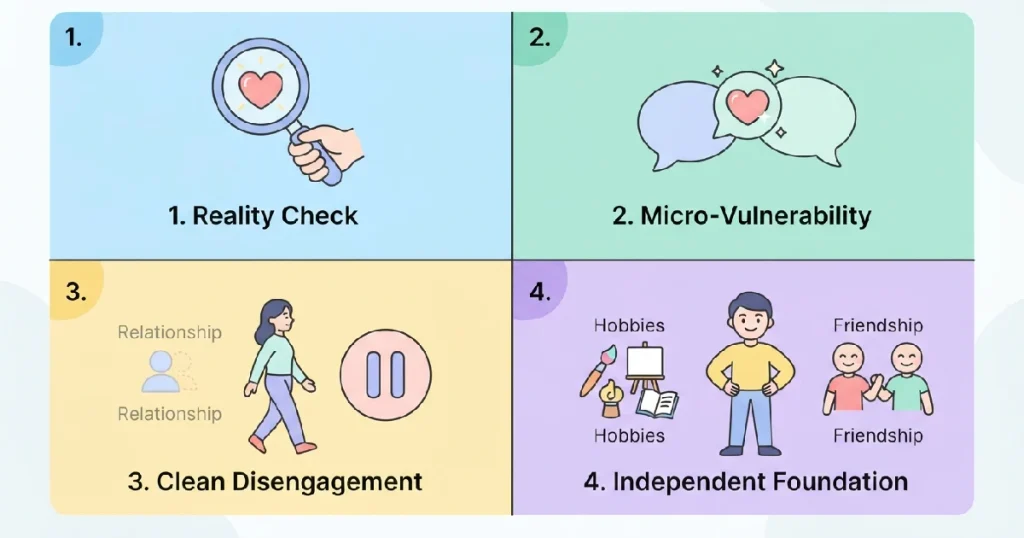
Recovery from this pattern requires more than understanding it intellectually. Peer support communities and clinicians agree on this point: change happens through repeated, uncomfortable action, not through more analysis alone.
1. Run an Evidence-Based Reality Check
The next time the urge hits to pull away or start a fight, pause and write two lists. On one side, name the fear driving the urge. On the other, list the actual evidence of how your partner has treated you.
One place to start is a simple question: is this a real red flag, or a familiar feeling wearing a red flag’s costume? Most of the time, it’s the second one.
2. Practice Micro-Vulnerability Early
Instead of bottling feelings until they explode, share small, honest updates about your internal state before they build up. Something as simple as “I’m feeling a little anxious today, and it’s not about you” can change everything.
This small habit teaches your nervous system that honesty doesn’t lead to abandonment. Over time, that lesson matters more than any single conversation.
3. Learn the Art of Clean Disengagement
When an argument starts circling the same ground, train yourself to step away before it turns into old wounds and personal jabs. Say plainly, “I need twenty minutes, and then I want to keep talking.”
This isn’t avoidance. Avoidance walks away and never comes back. Clean disengagement walks away to come back calmer.
4. Build a Stable Independent Foundation
Relying entirely on a relationship to hold your sense of worth puts pressure no partnership can survive. Invest time in hobbies, friendships, and if it feels right, a licensed therapist who can help you unpack where these patterns started.
A useful question to ask yourself is who you are outside of being someone’s partner. The stronger that answer, the less your relationship has to carry alone.
If you want to see how these dynamics show up in real, everyday moments, this video offers a closer look at how sabotage quietly takes over conversations that should feel safe.
Conclusion: Choosing Connection Over Protection
That ejection seat only fires because some part of you once needed it to. It kept you safe in a moment when safety wasn’t guaranteed. But you’re not in that moment anymore.
Every time you catch yourself mid pattern, whether it’s the fight over nothing or the sudden silence, you’re standing at a choice point. You can let the old wiring fire, or you can stay one more minute than feels comfortable.
That one extra minute, repeated enough times, is what starts to rebuild trust in yourself and in the people who are actually safe to love.
You now know what this pattern looks like, where it comes from, and what to do the next time it shows up. That knowledge alone puts you ahead of where you started today.
Real love was never going to feel perfectly safe. It was only ever going to feel worth the risk.
My Closing Remarks
I’ve watched people spend years blaming their taste in partners, when the real story was a wiring that fired long before the relationship ever began. What moves me most is how many people believe they’re the only one who does this. They’re not. Once people stop calling themselves broken and start calling this a pattern with a beginning and a reason, something shifts. You are not too much. You’re just protecting yourself from a war that already ended.
More Related Stories for You
- If self sabotage in your own relationships sounds familiar, it’s worth understanding how these patterns can also show up in a partner. Learn to spot the narcissist traits in men that often get mistaken for confidence.
About The Author