
 Nicole Adkins
Is she independent, or quietly building walls? Here’s how to read the signs before they read you.
Key Points Box
- Emotional unavailability in women rarely looks like coldness. It often looks like competence, humor, and a full calendar.
- The five patterns below hide inside behaviors most partners mistake for confidence or maturity.
- Understanding the psychology behind emotional unavailability in women gives you a way to respond instead of just react.
Contents
Table of Contents
You noticed it before you could put a name to it. The way she laughed off your last real question instead of answering it. The way three months in, she still hadn’t asked what actually keeps you up at night. You told yourself she’s private. Independent. Not the clingy type. Then the relationship reached its natural next step, and something in her quietly closed.
Here’s the short version: what reads as independence is often a nervous system that treats closeness like a threat. This guide breaks down five quiet signs of emotional unavailability, the ones that look like personality traits but actually point to something deeper.
If this sounds familiar, you’re not imagining things, and you’re not the problem for noticing. Most partners in this exact spot spend months questioning their own perception before they ever question the pattern sitting in front of them. That confusion is usually the first real clue.
Clinical psychologists have studied this pattern for decades under a specific name: avoidant attachment. Understanding it doesn’t mean diagnosing your partner from a distance. It means finally having language for what you’ve been sensing for a while.
Understanding the Root: Why Emotional Unavailability in Women Develops
Emotional unavailability rarely comes out of nowhere. It gets built, one protective decision at a time, long before you ever met her. Two forces usually drive it: how she learned to attach as a child, and how she learned to survive as an adult.
The Avoidant Attachment Style in Women, Explained
Attachment theory, first developed by psychiatrist John Bowlby, explains how the early bond between a child and caregiver shapes the way that person relates to closeness for the rest of their life. You can read more about the foundation of this theory if you want the full clinical background. When a caregiver was inconsistent, dismissive, or emotionally unavailable herself, a child often adapts by learning not to need too much.
That adaptation becomes what psychologists call an internal working model, a mental blueprint for what relationships are supposed to feel like. A woman with an avoidant attachment style in women learned early that expressing need led to disappointment, so she stopped expressing it. As an adult, she may want connection just as badly as anyone else. Her body, though, still reacts to closeness the way it once reacted to danger.
Hyper Independence Trauma Response: The Armor No One Sees
Not every emotionally unavailable woman fits the classic avoidant mold. Some built their distance through achievement instead of avoidance, and it can look a lot more like strength than protection.
Picture a woman who handles her own finances, her own moving boxes, her own hospital visits, without ever asking for backup. From the outside, that looks like confidence. Underneath it, there is often one quiet, understandable belief: if I don’t need anyone, no one can let me down.
Therapists increasingly refer to this pattern as a hyper independence trauma response. It tends to develop after childhood environments where asking for help was met with punishment, absence, or ridicule. The child learns a hard early lesson: relying on someone else is a liability, not a comfort.
By adulthood, that lesson runs quietly in the background of every relationship. She may genuinely want a partner. She may also, without fully realizing it, structure her life so she never actually needs one. The “strong, independent woman” story gets celebrated everywhere, from film to social media, which makes this particular defense almost impossible to challenge from the outside. Nobody stages an intervention for someone who seems to have it all together. That celebration is exactly what makes it one of the most well disguised forms of guarded behavior in relationships.
5 Hidden Signs of Emotional Unavailability in Women
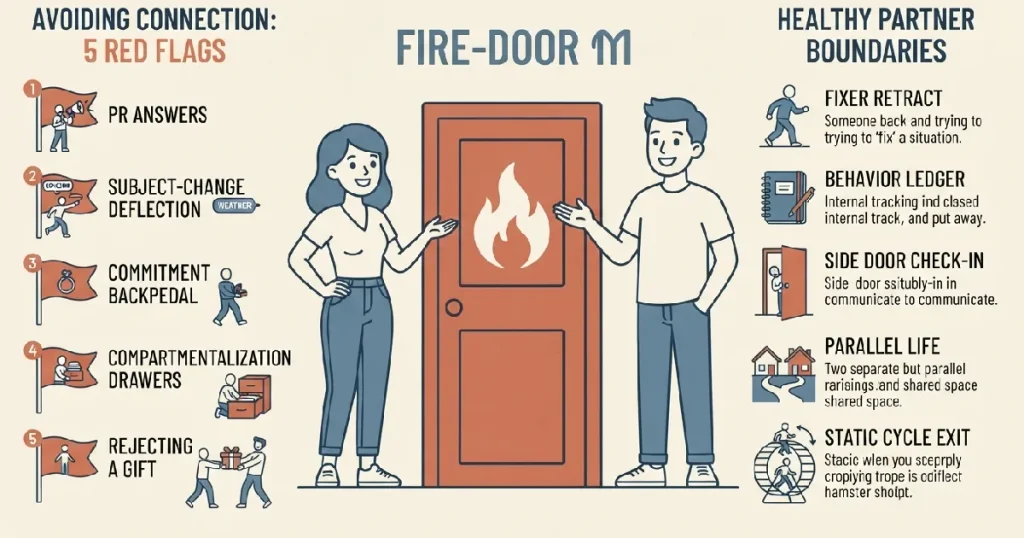
These next five patterns rarely show up as obvious red flags like ignored texts or canceled plans. They hide inside behaviors that look mature, easygoing, or even flattering on the surface.
But here’s what most partners get backward.
They wait for coldness, when what they should be watching for is a very specific kind of control over how close anyone is allowed to get.
1. The “PR Answer” Breakup History
Ask her about past relationships and you get a smooth, rehearsed answer where every ex was somehow the entire problem. There’s no mention of her own missteps, no gray area, no moment of “honestly, I handled that badly too.” It sounds polished because she’s told this story many times, mostly to herself.
This isn’t confidence. It’s an absence of relational accountability, meaning she’s never had to sit with her own part in conflict. If she can’t own friction from the past, she likely won’t know how to own it with you either.
2. Deflection of Intimate Curiosity
She rarely asks what’s actually going on underneath your surface: your fears, your history, what you actually want out of life. Conversations stay on logistics, plans, and jokes. The moment a topic drifts toward something emotionally real, she changes the subject, cracks a joke, or suddenly remembers an errand.
This one is easy to miss because she may be warm, funny, and attentive in every other way. The pattern only shows up in what she avoids, not in what she does.
3. The Commitment Backpedal
Right when the relationship hits a natural next step, meeting friends, a label, a key, she pulls back hard or invents a new rule about how slow things need to go.
This is where the nervous system research gets genuinely interesting. Psychologist Stephen Porges’ polyvagal theory describes how the body constantly scans for safety or danger below conscious awareness, a process called neuroception. For someone wired toward avoidance, growing closeness can register as danger, triggering the same flight instinct you’d feel walking toward a cliff edge. She’s not always choosing distance so much as her body is choosing it for her.
That doesn’t excuse a disappearing act. It does explain why logic rarely works in the moment. You can’t reason someone out of a threat response with a well-worded text.
4. Guarded Behavior in Relationships: Extreme Compartmentalization
She keeps her friend groups, family, and you in separate, sealed compartments, and her emotional tone rarely moves much in either direction. You still haven’t met her closest friends after months together. She stays even keeled through good news and bad news alike, and you’ve started to wonder if she feels things as strongly as you do.
This flat baseline is often a managed performance, not an absence of feeling. Keeping her worlds separate keeps you from getting full access to any one part of her life, which keeps her feeling safe.
5. Deep Discomfort with Receiving Care
A heartfelt compliment or an unprompted kind gesture makes her stiffen, deflect, or grow suspicious instead of simply receiving it. You bring her soup when she’s sick and she immediately asks what you want in return. You tell her something you genuinely admire about her and she changes the subject within seconds.
For someone with this wiring, warmth can feel like a setup rather than a gift. If tenderness makes her more guarded instead of more relaxed, that reaction is worth paying attention to.
Think of her emotional world like a lighthouse. The beam sweeps toward you every so often, warm and full, then rotates away right when you reach for it. You’re never in complete darkness with her, but you’re rarely standing in steady light either.
The Hidden Toll: How Emotional Unavailability Shapes Your Relationship

Loving someone who stays at arm’s length creates a specific, tiring dynamic that psychologists call the pursuer-distancer cycle. The more you reach for connection, the more she needs distance to feel safe, which makes you reach harder. Neither person is doing this on purpose. Both are simply running protective wiring at full speed.
Many partners fall into what I’d call a Superman complex, believing that enough patience, love, or perfect communication will eventually heal her guardedness. In my practice, this is one of the most common and most painful traps I see couples build together.
Research backs up why this takes such a toll on you specifically. Chronic validation seeking from an emotionally distant partner has been linked to higher rates of anxiety and depressive symptoms, according to relationship research published through the American Psychological Association. Being in this relationship can feel lonelier than actually being single, because you’re doing the emotional labor for two people.
How to Deal With an Emotionally Unavailable Partner: 5 Boundaries That Work
None of this means you’re stuck waiting for her to change. This is where you get to take your own power back, one boundary at a time.
Retire the fixer role. Stop functioning as her unpaid therapist. If she brings up something hard, try: “That sounds hard. I’m here if you want to say more.” Then stop talking and let her sit with it.
Trust actions over potential. Base your sense of safety on what she consistently does, not on what she says she wants to become. Anyone can promise growth. Consistency is the only real evidence worth counting.
Use low-pressure check-ins. During tense moments, try a short written message instead of demanding an in-person talk right away. Something like, “No pressure to respond, just thinking about us,” gives her room to process without triggering a shutdown.
Protect your own support system. Keep friendships, hobbies, and possibly your own therapist active and separate from this relationship. A useful question to ask yourself: if this ended tomorrow, would I still have people and things that make my life feel full?
Know your walk-away point. Decide, in a calm moment, what ongoing guardedness would eventually cost you too much to accept. Awareness alone won’t change her nervous system, but it will absolutely protect yours.
Moving Forward From Emotional Unavailability in Women
A relationship with real closeness needs two people showing up, not one person understanding and one person hiding. Emotional unavailability in women often comes from real pain and real history. That truth deserves compassion. It doesn’t require you to stay in a cycle that leaves you lonelier than solitude ever did.
Go back to that lighthouse for a second. You can appreciate its light without organizing your whole life around waiting for the beam to swing back your way. You get to decide whether you want a relationship with occasional light, or a home with someone standing fully in the room with you.
That decision was never about fixing her. It was always yours to make.
My Closing Remarks
In years of sitting across from couples in this exact spot, I’ve noticed the partners who do best are the ones who stop treating her guardedness as a puzzle to solve. You can love someone with compassion while still protecting your own heart. Emotional unavailability makes sense once you understand where it came from. Understanding it, though, isn’t the same as agreeing to live inside it forever. Wanting more doesn’t make you difficult. It makes you honest.
More Related Stories for You
- If you’re trying to read where your relationship actually stands, you might also want to know the signs he’s going to propose, especially if commitment has felt like a moving target for both of you.
About The Author