
 Sara Carmen
You’re not imagining the distance. Here’s how to name it, understand it, and finally decide what comes next.
Key Points
- Learning the real signs your partner is emotionally unavailable turns confusing mixed signals into a pattern you can actually read.
- Emotional distance is often nervous system survival mode, not proof that you’re unlovable or too much.
- By the end of this guide, you’ll know exactly which behaviors point to real change, and which ones mean it’s time to walk away.
Contents
Table of Contents
We all know what it feels like to reach for a hand that pulls back just slightly. Not enough to call it rejection. Just enough to notice.
You feel it too, sitting across from the person who shares your bed, your bills, maybe your last name, and still feels like a locked door.
Someone might think a quiet partner is simply low-key, not the emotional type. But what they don’t see is the three-day silence after a hard conversation, the flinch when you say “I love you” first, the way plans for next month get made while plans for next week keep sliding.
Someone else might think their partner’s independence is a strength worth admiring. But what they don’t see is a person who would rather solve every problem alone than let anyone close enough to help, even when help is exactly what’s needed.
This kind of loneliness inside a relationship has a name, and it has nothing to do with you being too needy or too sensitive. Signs your partner is emotionally unavailable rarely announce themselves in one clean moment. They hide in plain sight, disguised as personality quirks, a demanding job, or “just how he is.” By the end of this guide, you’ll be able to read those signs like a map instead of a mystery.
The Psychology of Distance: Why It Isn’t a Character Flaw
Emotional unavailability isn’t always permanent. Someone grieving a parent, drowning in a work crisis, or moving through a depressive episode can go quiet for a season and come back. That’s situational distance, and it deserves patience.
Chronic emotional distance is different. It’s a pattern, not a phase, and it usually traces back further than this relationship.
Many emotionally distant partners carry what psychologists call an avoidant attachment style, a way of relating to closeness that gets learned early, often in childhood, when depending on a caregiver felt unreliable or even unsafe. The nervous system adapts. It quietly decides that needing someone is the risky part, not the loneliness.
Here’s the reframe that changes everything. Research on adult attachment, including work published through the National Center for Biotechnology Information, describes this withdrawal as a form of defensive emotional deactivation. In plain language, the brain learns to numb feelings before they can overwhelm the system. It’s the body’s nervous system in survival mode, treating closeness the way it might treat a physical threat.
That’s not weakness. That’s wiring.
In my practice, I’ve watched clients mistake this defensive shutdown for a lack of love, when it’s really an old alarm system doing exactly what it was built to do. Even mainstream reporting has caught up with this shift, with a recent Time feature on emotionally unavailable partners outlining what therapists want people to notice before they blame themselves.
Understanding the mechanism doesn’t excuse the loneliness you’re living inside. But it does move you from asking “what’s wrong with me” to a more useful question: is this someone capable of rewiring that response, or someone who has stopped trying altogether? Left unexamined, this pattern doesn’t just create distance. It can quietly become the reason the relationship ends.
15 Signs Your Partner Is Emotionally Unavailable

Most people in this situation don’t realize how many of these patterns can exist quietly inside a relationship that still looks fine from the outside. Here’s the full checklist, grouped so you can spot your own story inside it.
Early-Stage Red Flags
1. The Love Bomb Cliff. They open the relationship with intense passion and rapid vulnerability, then pull back sharply the moment real commitment gets close.
2. The Future-Faking Pivot. They love talking about someday in the abstract, a future home, a future trip, but go vague or defensive the second you try to pick an actual date.
3. Conditional Dating Intent. The relationship stays limited to physical closeness, fun, or validation, with little interest in blending your actual lives together.
4. Inconsistent Action Loops. Sweet texts arrive on schedule. So do last-minute cancellations. The words and the follow-through never quite match.
5. The Emotional Island Escape. Their calendar is packed with hobbies, side projects, or screens, conveniently leaving no room for anything that requires emotional presence.
Communication and Conflict Subversion
6. Deflecting Personal Questions. Ask about their childhood or their feelings and you get a redirect back to you, or a summary so short it tells you nothing real.
7. Defensive Apology Inversion. Bring up something that hurt you, and somehow you’re the one apologizing by the end of the conversation.
8. Blanket Apology Shields. “I’m sorry for everything” ends the fight fast, but it never names what actually happened or what changes next time.
9. Chronic Negative Relationship Language. Mention marriage, moving in, or long-term plans, and the response defaults to cynicism, jokes, or a flat “we’ll see.”
10. Intentional Response Lag. Messages sit unanswered for days, not from being busy, but as a quiet way of managing how close you’re allowed to get.
But the pattern hiding underneath these ten signs is one most guides never explain.
The Push-Pull Paradox Nobody Explains
Here’s what almost no one tells you about an emotionally distant partner: the hot-and-cold behavior usually isn’t manipulation. It’s two threat detectors firing at once.
One part of their nervous system fears abandonment, so it reaches for you. Another part fears engulfment, the sense of losing themselves in closeness, so it shoves you away. You’re not dealing with inconsistency for its own sake. You’re watching a body argue with itself in real time.
This doesn’t make the behavior less painful to live with. But it explains why logic rarely fixes it. You can’t out-argue a nervous system.
Intimacy Barriers
11. Weaponized Independence. Needing another person gets treated as a fatal flaw, with real pride attached to never relying on anyone for anything.
12. Awkwardness Around Pain. Tears, vulnerability, or a request for reassurance gets met with a joke, a change of subject, or total silence.
13. Surface-Level Mirroring. They echo your emotional language back to you, using your exact words, without ever adding anything original or following through.
14. Zero Inner-World Curiosity. You report your own week, your wins, your worries. They rarely ask first, and almost never dig deeper on their own.
15. Aversion to Non-Sexual Touch. Sex is easy. Lingering, cuddling, the quiet kind of touch that requires just being present, is where they stiffen and pull away.
Underneath all fifteen patterns is really one design. Think of connection like a thermostat. A partner capable of real emotional intimacy adjusts it with you, warmer when you need warmth, cooler when you both need space. An emotionally unavailable partner has only one setting: just enough heat to keep you from leaving, never enough to make the relationship feel like home.
5 Ways to Talk to an Emotionally Distant Partner
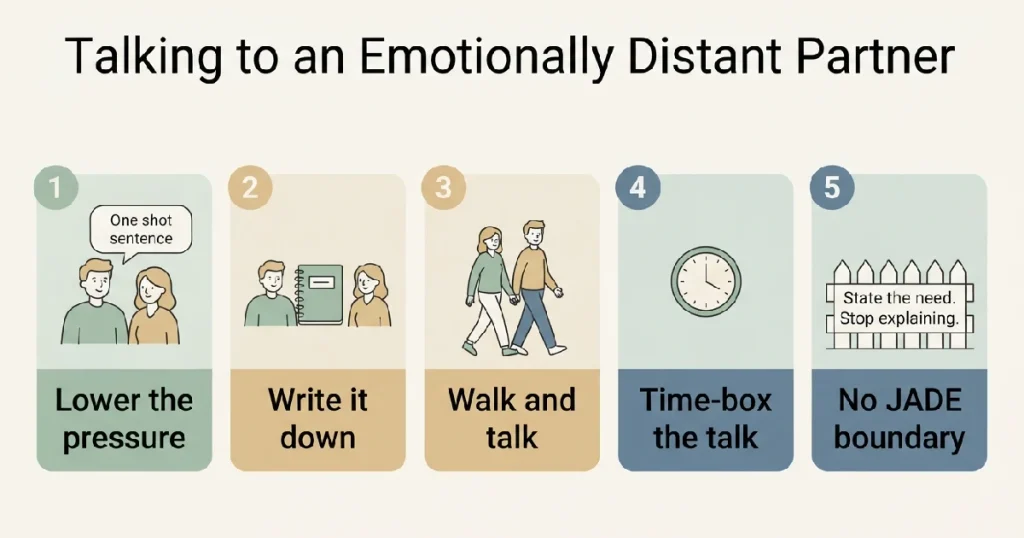
Communicating with someone on an emotional island means removing whatever triggers their internal alarm. These five approaches lower the temperature enough for real conversation to actually happen.
1. Lower the Pressure and Stop Probing. Rapid-fire emotional check-ins feel like an interrogation to an avoidant nervous system. Ask one question, then let it sit, rather than trailing them for a fuller answer.
2. Use an Asynchronous Written Medium. Try a shared notebook. Write one emotional question, hand it over, and give them a week to write back on their own time, without eye contact or pressure.
3. Remove Face-to-Face Intensity. Bring up hard topics while driving, walking, or sitting side by side in low light. Less eye contact often means a smaller physiological defense response.
4. Anchor Discussions to Safe Time Windows. Save heavy talks for the middle of the day, never right before bed, and agree ahead of time roughly how long the conversation will last.
5. Adopt the No-JADE Boundary Script. State your need directly without the urge to Justify, Argue, Defend, or Explain it. “I need us to see a therapist together” needs no ten-minute preamble to be valid.
One place to start tonight is picking just one of these five and trying it on the next small disagreement, not the biggest one. A useful question to ask yourself afterward: did the pressure actually go down, even a little?
5 Signs Your Relationship Has Real Viability
Deciding whether to stay or go often comes down to one thing: are you seeing ownership, or permanent resistance? Watch for these concrete markers of relationship viability.
1. Sustained Self-Awareness. They research attachment patterns or start therapy on their own, without you having to run the whole project of fixing them.
2. Action-Backed Repair Attempts. After a rupture, they name the specific behavior that hurt you and you can actually see it change over the following weeks.
3. Clear Articulation of Limits. Instead of ghosting or getting defensive, they can say, “I feel flooded right now and need an hour, but I promise we’ll finish this tonight.”
4. Shrinking Withdrawal Cycles. The gaps between their shutdowns get shorter over time, and their stamina for staying present during hard moments keeps growing.
5. A Shift Away From Defensiveness. Your needs stop landing as an attack. Slowly, you can feel them protecting the relationship instead of just protecting their walls.
If you recognized yourself in half this list, you are not alone, and you are not overreacting. What you’re looking for isn’t perfection. It’s evidence that the nervous system in front of you is actually capable of learning a new setting.
Reclaiming Your Emotional Agency
Understanding a partner’s attachment history offers real clarity. It never obligates you to live on emotional rations forever.
You deserve a partner who can actually turn the heat up, not just enough to keep you from leaving. Compassion for their wiring and honesty about your own needs can exist in the same sentence.
Walking away from someone who cannot meet you isn’t giving up. It’s often the most self-respecting decision you’ll ever make.
My Closing Remarks
I’ve sat across from so many people who thought loving harder would eventually thaw someone out. It rarely works that way. What actually changes things is a person choosing their own growth, on their own timeline, not being loved into it. You can hold real compassion for someone’s history and still refuse to spend your one life waiting outside a locked door. Both things can be true at once.
More Related Stories for You
- If some of these patterns feel less like distance and more like control, it may be worth reading about narcissist traits in men to understand where the line sits.
About The Author