
 Sara Carmen
Chemistry gets you to the altar. Shared values decide whether you can still stand each other when life stops being cute.
Key Points
- Real compatibility has almost nothing to do with matching playlists. The core values every couple should share involve money, conflict, and family, not hobbies.
- Small daily friction, like who remembers to book the dentist appointment, is often the visible tip of a much deeper value mismatch.
- This checklist gives you the language to test alignment now, before a wedding contract makes disagreement a lot more expensive to untangle.
Contents
Table of Contents
We fall in love with the parts of a person that are easiest to see. The laugh that catches you off guard mid-sentence. The way they order for the table without asking. The playlist you both somehow already know every word to.
None of that is wrong. It’s just not the whole story.
You can build a wonderful few years on chemistry alone. But you build an entire marriage on something quieter and far less romantic: whether your two nervous systems agree on how to handle money, family, conflict, and the days when neither of you is at your best.
In short: the core values every couple should share before marriage include financial philosophy, conflict resolution style, division of labor, family planning, and emotional safety, among 15 total categories. These are the load-bearing beliefs that decide whether a couple grows closer under pressure or slowly grows apart.
Why Shared Hobbies Can’t Save a Marriage, But Shared Values Can
Here’s the pattern I see constantly in my practice. A couple comes in after eight or ten years together, both exhausted, both convinced something is “broken” between them.
Usually, nothing is broken. They simply never checked whether their core values matched before they built a life on top of the assumption that they did.
This isn’t a character flaw. It’s a predictable psychological blind spot. Researcher Dr. John Gottman has spent decades studying married couples, and his data shows something surprising: roughly 69 percent of relationship conflicts are perpetual. That means they never fully resolve. They’re not really about the dishes or the in-laws. They’re about a values gap underneath the surface argument.
This matters because most couples confuse a surface preference with a core value. A surface preference is something like liking mornings versus nights, or preferring the mountains to the beach. You can compromise on that forever without losing anything essential.
A core value is different. It’s a belief so central to your identity that compromising on it doesn’t feel like flexibility. It feels like erasure.
Once you can tell the difference, the rest of this checklist becomes a lot more useful.
The Financial and Lifestyle Foundations
1. Financial Philosophy Alignment Predicts More Than Your Bank Balance
Money isn’t really about money. It’s about security, control, and whose voice matters in big decisions.
Before marriage, you need real numbers on the table: student loan balances, credit card debt, credit scores, and how each of you was raised to think about saving versus spending. According to the Pew Research Center, financial stability is now one of the top predictors couples themselves cite for whether a marriage lasts.
You also need to decide on account structure. Joint, separate, or a hybrid where you split shared bills from one account and keep personal spending money in another. There’s no universally correct answer here. There is only the answer that matches how much autonomy and how much merging each of you actually wants.
2. Division of Labor and Equity Determines Who Quietly Burns Out First
This one hides in plain sight. It’s not just about who does the dishes. It’s about who remembers the dishes need doing, who tracks the pediatrician appointments, who notices the fridge is empty.
Psychologists call this the mental load: the invisible, ongoing cognitive work of managing a household, separate from the physical labor itself. One partner can do “half the chores” and still carry 80 percent of the mental load, and that imbalance breeds resentment faster than almost anything else on this list.
The couples who last don’t split labor 50/50 on a rigid ledger. They treat the household as a shared project with flexible roles that shift based on who has capacity that week.
3. Life Pace and Ambition Need to Point in the Same Direction
One of you wants a slow Sunday-morning kind of life. The other wants to chase the next promotion, the next city, the next milestone. Neither is wrong. But if you never name it out loud, one partner ends up feeling dragged and the other ends up feeling held back.
Talk specifically about relocation, career intensity, and what “success” looks like at 45. This is a timeline conversation, not a personality judgment.
Emotional Maturity and Conflict Systems
4. Conflict Resolution Style Is the Skill That Saves Everything Else
You will disagree with your spouse for the rest of your life. That’s not pessimism. That’s just marriage. What matters is whether you fight the problem or fight each other.
Gottman’s research identifies four communication patterns so corrosive he calls them the Four Horsemen: criticism, contempt, defensiveness, and stonewalling, which is emotionally shutting down and withdrawing from a conversation entirely. Couples who learn to catch these patterns early, a method outlined in The Gottman Institute’s work on marital communication, have a real, teachable framework for disagreeing without dismantling each other.
If one of you is a “talk it out immediately” processor and the other needs to walk away and think, that’s not incompatibility. It’s a difference that needs an agreed-upon system, not a winner.
5. Ego Minimization and Teamwork Keep Score Off the Table
The healthiest couples I’ve worked with share one habit: they stop trying to win the argument and start trying to protect the relationship.
Think of it like two people on the same jersey. If you’re both trying to outscore each other, the team loses regardless of who “wins” the point.
Watch for a partner who keeps a mental ledger of who was right last time. That habit erodes goodwill slowly, one small resentment at a time.
6. Emotional Safety and Vulnerability Decide What Never Gets Said
Emotional safety means you can say “I’m scared” or “I failed at this” without your partner using it against you later or laughing it off.
Couples who lack this often don’t fight more. They talk less. Fears get buried instead of shared, and buried fears don’t disappear, they just show up later as distance.
Ask yourself honestly: can you say your ugliest, most embarrassing thought out loud to this person? If the answer is no, that’s information worth sitting with.
Family Dynamics and Extended Networks
7. Family and Childrearing Dynamics Cannot Be a “We’ll Figure It Out Later” Topic
Whether to have children isn’t a preference you compromise on. It’s closer to a core identity decision, and it needs full agreement, not one partner hoping the other changes their mind.
Beyond that, talk about discipline style, education priorities, and what values you want modeled at home. Waiting until a baby arrives to discover you disagree on all of it is a genuinely risky bet.
8. In-Law and Extended Family Boundaries Test Whether You’re a Team
A healthy marriage requires a united front toward outside pressure, even loving pressure from parents.
This means agreeing in advance on holiday splits, how much say extended family gets in major decisions, and who speaks up when a boundary gets crossed. The partner whose family is overstepping should usually be the one to address it, gently but firmly, so it never turns into an “us versus your family” dynamic.
Here’s the piece most compatibility quizzes never ask about. Most couples check whether they value the same things. Almost none check whether their partner actually behaves according to those stated values under pressure.
I call this the value enactment gap: the space between what someone says they believe and what they actually do when it costs them something. Someone can say “family comes first” and still let a parent dictate your wedding guest list. Watch behavior during stress, not declarations during calm. That’s where the real answer lives.
9. Social and Community Needs Should Match Your Actual Energy Levels
If one of you recharges by hosting a full house every weekend and the other recharges by locking the door and watching a show in silence, that gap needs a plan, not a fight.
Neither style is superior. The goal is a rhythm where the extrovert doesn’t feel isolated and the introvert doesn’t feel constantly depleted.
Character, Autonomy, and Personal Values

10. Autonomy and Individual Growth Keeps You From Disappearing Into Each Other
Your partner cannot be your only friend, your only hobby, and your only source of identity. That’s not romantic. That’s a setup for quiet resentment on both sides.
The strongest marriages actively protect each partner’s separate interests, friendships, and solo time, even as their shared life grows.
11. Everyday Intentional Kindness Is What Actually Sustains Love Long-Term
Grand gestures are easy. Noticing your partner made coffee again this morning and saying thank you, twelve years in, is the harder and more important skill.
Long-term satisfaction is built on small, repeated moments of appreciation, not the occasional big romantic display.
Resentment doesn’t announce itself. It just moves in quietly and stays.
12. Moral Compass and Character Show Up in Small, Observable Moments
Forget asking whether someone is “a good person.” Watch how they treat a waiter who got the order wrong, or a stranger who’s struggling. That single behavior tells you more about their integrity than any conversation could.
Shared character means shared standards for honesty and accountability, especially when no one else is watching.
13. Spiritual and Existential Compatibility Doesn’t Require Identical Beliefs
If one of you holds a traditional faith and the other identifies as secular or agnostic, the goal isn’t conversion. It’s mutual respect that creates harmony instead of ongoing tension, especially around holidays, rituals, and how you’ll raise children spiritually if you have them.
This works when both partners genuinely feel free to hold their own worldview without judgment.
Long-Term Resilience and Crisis Response
14. Crisis Management and Resilience Reveal Who You Really Married
Anyone can look compatible during easy years. The real test is a layoff, a diagnosis, or a sudden loss.
Couples who weather hardship well usually share an openness to outside support, including therapy, without treating it as failure. The American Psychological Association notes that couples who build these coping habits early tend to handle major stressors with far less damage to the relationship itself.
15. Intellectual Curiosity Keeps a Decades-Long Relationship From Going Flat
The couples who stay genuinely interested in each other at year thirty share one habit: they keep asking questions. They stay curious about how their partner’s mind is changing, not just what happened during the day.
This curiosity is the quiet armor that keeps a long marriage from feeling stale.
A Story That Sounds Familiar
Mara and Diego dated for three years and rarely argued. They assumed that meant they were deeply compatible. Then Diego’s mother suggested moving in with them, and Mara realized they had never once discussed extended family boundaries.
The disagreement that followed wasn’t really about square footage. It was about whose voice carried more weight in their own home. They worked through it with a counselor, mapped out their actual values instead of their assumed ones, and realized they agreed on almost everything, they just had never said it out loud.
Six months later, they got married with a much clearer picture of who they actually were as a team.
How to Structure the Conversation Without It Feeling Like an Interrogation
You don’t need a therapist’s office to have this conversation, though one can help. One place to start is a low-stakes environment, like a long car ride or a weekend away, where the conversation can unfold naturally instead of feeling like a courtroom cross-examination.
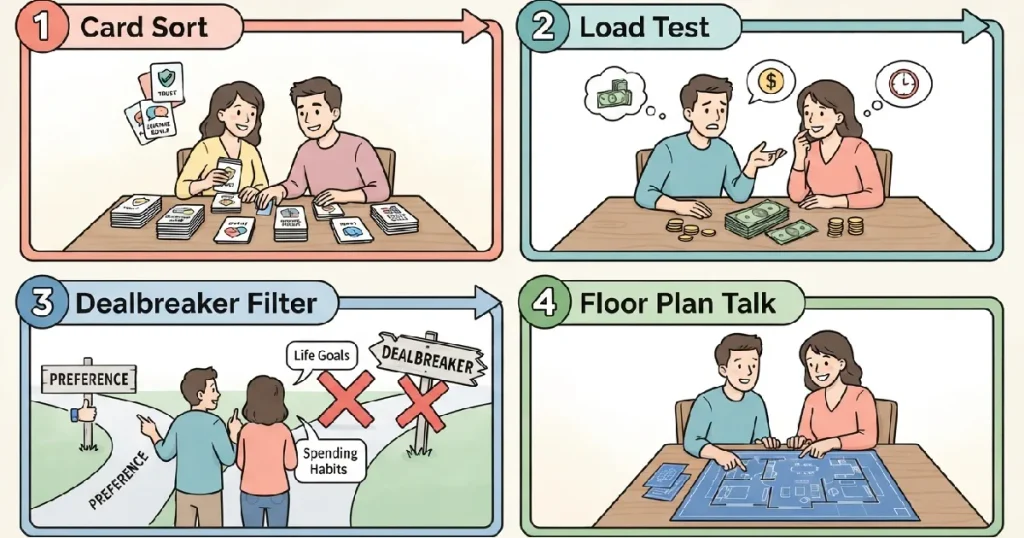
The Card Sort Exercise. Write twenty values on individual cards, things like security, adventure, faith, ambition, family closeness. Each of you ranks them privately from most to least important, then compare lists together. The surprises usually matter more than the matches.
The Non-Negotiable Filter. For every disagreement, ask one question together: is this a preference we can flex on, or a core value neither of us can compromise without resentment? Naming the category out loud removes a shocking amount of heat from the conversation.
The Weekend Values Audit. Pick one topic from this list per week, over fifteen weeks, and give it thirty real minutes of focused conversation, no phones, no distractions.
Structured premarital conversations aren’t just useful anecdotally. Research on premarital education programs, including a well-cited study by Stanley and colleagues, found that couples who go through structured relationship education report meaningfully higher marital quality years down the road compared to those who never had the conversation at all.
Building a Life on Common Ground
Values are the load-bearing walls of a marriage. Hobbies are just the paint color.
You can repaint a hundred times over forty years and still be standing strong, as long as the walls underneath were built to hold weight together in the first place.
The laugh that caught you off guard, the playlist you both know by heart, none of that has to disappear. It just isn’t what will carry you through the hardest years. That job belongs to the fifteen things on this list, and now you know exactly what to ask before you build a life around them.
A marriage doesn’t fall apart over the small stuff. It falls apart over the big stuff no one ever said out loud.
My Closing Remarks
I’ve sat across from enough couples to know that the ones who struggle most rarely lacked love. They lacked language for what they valued differently. If you take one thing from this, let it be permission to ask the uncomfortable question now, while it’s still just a conversation, and not later, while it’s a courtroom.
More Related Stories for You
- If you want more grounded, real-world tools for building a stronger partnership, this guide on good advice for a relationship is a great next stop.
About The Author