


It is a Tuesday evening. You are staring at your phone as the typing bubbles appear, disappear, and appear again. Your stomach is in knots, your heart rate is spiking, and you feel entirely trapped. We have all been there. You finish an interaction and feel like your life force was just drained right out of your chest. If you are desperately wondering how to shut down toxic people, you are in the right place.
This is not going to be another soft, feel-good list of gentle boundary-setting tips. As a therapist, I see incredible, kind-hearted people constantly caught in the empathy trap. You think if you just explain your feelings clearly enough, this difficult person will finally get it, apologize, and change. Here is the hard truth: they will not. The modern reality of handling high-conflict personalities requires a completely different toolset. You need behavioral exit ramps that provide immediate emotional safety and stop the physiological damage these interactions cause. You do not need their understanding. You only need their compliance.
The Real Cost of Toxicity: Why How to Shut Down Toxic People is a Survival Skill
Let us look past the emotional exhaustion and focus on the biological facts. Interacting with highly manipulative individuals is not just annoying, it is physically destructive. Modern behavioral science has completely redefined what it means to manage difficult relationships. We now know that chronic social stress literally ages your cells.
Table of Contents
Recent clinical data utilizing DNA methylation-based biological aging clocks reveals a staggering reality. Having even one persistently manipulative person in your close social network actively accelerates your biological aging by roughly 1.5%. The physiological mechanism is rooted in chronic inflammation. When you are walking on eggshells, your body is trapped in a constant stress response, pumping out cortisol and disrupting your emotional regulation.
In clinical terms, the mathematical reality of this stress can be modeled simply:
Age(bio) = Age(chron) × (1 + (0.015 × n))
In this formula, “n” represents the number of primary toxic “hasslers” in your immediate daily life. On average, individuals carrying the weight of these relationships are biologically nine months older than their chronological peers.
“Grief is a common experience when we realize a toxic person will never be the person we need them to be.” – Dr. Ramani Durvasula. This acceptance is the first necessary step toward freedom. You have to mourn the relationship you wanted so you can finally deal with the reality standing right in front of you.
When you understand this, removing yourself from a circular argument is no longer just about avoiding a headache. It becomes a non-negotiable medical necessity. It is about protecting your DNA, your heart, and your peace of mind. Let us look at exactly what happens when you finally decide to enforce a limit.
A Familiar Story: The Turnaround

Let me tell you about Sarah. Sarah is a thirty-four-year-old marketing executive who struggled deeply with a highly volatile family member. Every Sunday night at exactly 8:00 PM, like clockwork, the phone would ring. Sarah had a nervous habit of clicking her pen repeatedly whenever this person called, a small physical tick revealing her immense anxiety.
For years, Sarah was the default rescuer. Every week brought a brand new manufactured crisis, ranging from sudden financial emergencies to blown-up social drama. These calls would regularly drag on for three grueling hours, leaving Sarah completely depleted. She started noticing real physical symptoms. Her chronic headaches were returning, and her sleep was wrecked. Sarah was terrified of setting a boundary because she deeply feared the inevitable backlash.
During our work together, she finally applied a new tactic. When the Sunday call came in with the latest disaster, she stopped clicking her pen. She took a deep breath, kept her voice completely flat, and said, “I am not available to discuss this today, but I am sure you will handle it. OK.” Then, she hung up the phone.
The family member initially exploded, blowing up her phone with angry texts. We call this the extinction burst. But Sarah held the line. After three weeks of consistent, boring neutrality, the panicked calls stopped. The family member moved on to someone else. Sarah’s headaches vanished within a single month, and she took her Sundays back.
7 Actionable Steps to Shut Down Toxicity Immediately
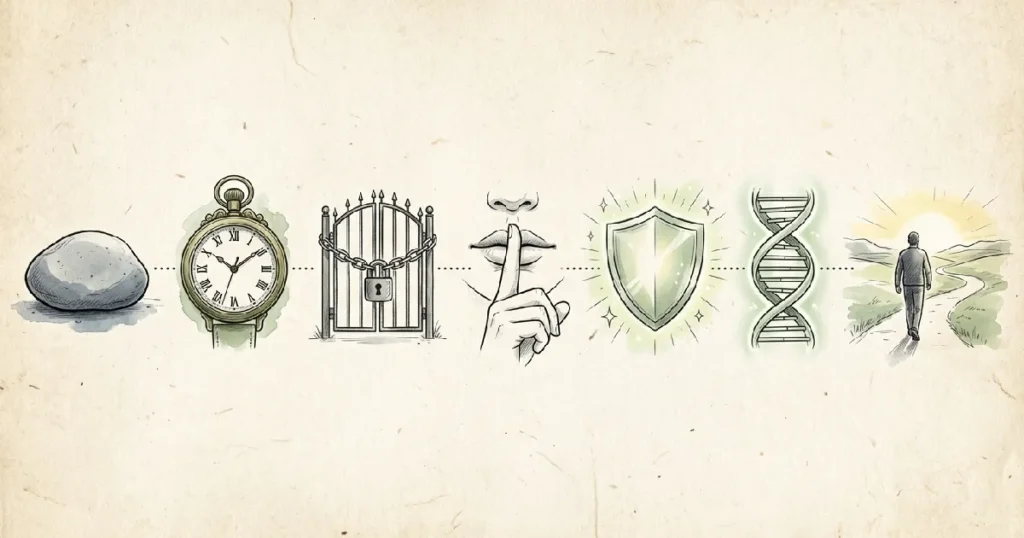
To win your peace, you must use linguistic finality. These are not requests. They are non-negotiable scripts engineered to starve a manipulator of the emotional supply they are desperately seeking.
- Step 1: Use “No.” as a complete sentence.
- Do This: Say “No” and let total silence follow.
- Not That: Offer a polite excuse like, “I am sorry, I cannot right now because I have to work.”
- Why It Works: Explaining gives a manipulator immediate leverage points to argue against. When you add a reason, their brain switches to solution-finding mode to overcome your excuse. A naked “No” stops their cognitive processing entirely. There is nothing for them to grab onto.
- Step 2: Deploy “I remember this differently.”
- Do This: State it calmly and immediately move on to a different topic or leave the room.
- Not That: Try to prove your memory by digging up old text messages or bringing in other witnesses.
- Why It Works: This creates a linguistic dead-end. It anchors your internal reality without entering a circular conversation trap where facts are constantly twisted.
- Step 3: Enforce “I am not available for this conversation.”
- Do This: Physically leave the space, hang up the phone, or close the digital chat window.
- Not That: Wait for them to give you permission to stop talking, or keep engaging while saying you want to stop.
- Why It Works: This enforces temporal sovereignty. You, and only you, control exactly when and where your energy is spent.
- Step 4: Say “I am not debating my reality.”
- Do This: Use this exact phrase when you are being told you are “crazy” or “too sensitive.”
- Not That: Defend your sanity or explain why your feelings are completely justified.
- Why It Works: This stops DARVO (Deny, Attack, Reverse Victim/Offender) dead in its tracks. It is a powerful gaslighting and manipulation tactic defense that refuses to legitimize their distorted version of events.
- Step 5: Master the flat “OK.”
- Do This: Deliver it with a neutral, completely flat, and boring tone.
- Not That: Say it sarcastically, roll your eyes, or yell, “OK, fine!”
- Why It Works: This is the ultimate Grey Rock method anchor. It provides absolutely zero emotional supply. Without your visible distress, the manipulator loses their entire audience and quickly gets bored.
- Step 6: State “That is not what I said, please do not rewrite my words.”
- Do This: Call out the distortion immediately as it happens, keeping your voice steady.
- Not That: Allow them to continue their long, exhausting rant where they twist your past statements into weapons.
- Why It Works: It actively prevents context collapse, a common tactic where your words are violently twisted into fake evidence against you.
- Step 7: Conclude with “I need to make different choices for my health.”
- Do This: Use this when permanently terminating a relationship or setting a major, final limit.
- Not That: Use blaming “You” statements like, “You are making me physically sick with your drama.”
- Why It Works: It centers entirely on your autonomy and the biological reality of stress. No one can argue with your personal health requirements.
Boundary Setting vs. The Empathy Trap
There is a massive difference between genuine compassion and allowing unlimited access to your nervous system. Many people confuse the two. You have likely been told your whole life to “be the bigger person.” But when dealing with high-conflict personalities, being the bigger person usually just means being the punching bag.
“Boundaries are not a punishment, they are a framework for how you want to be treated.” – Nedra Glover Tawwab. This mindset shift changes everything. You are not being mean, you are simply laying down the rules of engagement for your own survival.
When you are stuck in the empathy trap, your goal is to modify the other person’s behavior through your own suffering. You use “You” statements focusing on blame, and the result is that you feel constantly exhausted and deeply misunderstood. Authentic boundary setting abandons the goal of changing them. Instead, the goal is the complete preservation of your peace. You use “I” statements focusing heavily on your personal limits, leaving you grounded and in total control.
To successfully manage this, I highly recommend adopting the 15-Minute Rule. Set a quiet timer on your phone for any necessary interaction with a difficult person. When that timer goes off, you use phrase number three (“I am not available for this conversation”) and you immediately exit. Furthermore, you must practice digital culling. Mute notifications for toxic contacts immediately. Response time balance is a major indicator of manipulation. If they demand instant replies but take days to answer you, that is a control tactic. Put them on silent.
Common Mistakes and How to Avoid Them

Even with the best scripts, it is incredibly easy to slip back into old habits when your adrenaline is pumping. Here are the biggest errors I see people make, and exactly how to fix them today.
Mistake 1: Seeking Closure from a Gaslighter
Many people remain trapped in terrible cycles for years because they are desperately waiting for the other person to finally admit they were wrong. This is a fatal error. A manipulator’s reality is often completely rewritten by their own deep shame avoidance. They are genuinely unable to see themselves as the bad guy. You will never get that satisfying apology movie moment.
How to avoid it: You must accept that you will be the absolute villain in their version of the story. Let them have their false narrative.
The exact message to use: “I have made my decision based on my needs, and I am comfortable with that.”
Mistake 2: Responding to Reactive Abuse Provocations
A highly difficult person will intentionally poke at your deepest insecurities until you finally snap. Once you raise your voice or say something harsh out of pure frustration, they immediately point to your reaction as proof that you are actually the abusive one. This phenomenon, known widely as reactive abuse, is a trap designed to make you feel crazy.
How to avoid it: Practice the observing ego technique. View their provocation strictly as a test of your neutrality, almost like watching a toddler throw a tantrum from behind glass.
The exact message to use: “I can see you are trying to get a reaction out of me. I am taking a 15-minute break.”
Mistake 3: Explaining Your Boundaries
A very common error is believing that your boundary requires a rationalization to be valid. It does not. Explaining exactly why you have a limit gives a toxic person the minutia they need to argue against your reasoning. Your mental health boundaries are valid simply because you set them.
How to avoid it: Use the broken record technique. Repeat the exact same boundary continuously without ever adding a new explanation or justification.
The exact message to use: “I am not comfortable with that. [Wait in silence]. As I said, I am not comfortable with that.”
Mistake 4: Participating in Word Salads
Word salads (sometimes called a Gish Gallop) are designed to completely overwhelm your cognitive load. The person will rapidly jump from one entirely unrelated grievance to another, bringing up things you supposedly did five years ago to distract from what they did five minutes ago.
How to avoid it: You must use narrow focus communication. Absolutely refuse to discuss more than one single topic at a time, no matter what they throw at you.
The exact message to use: “We are currently talking about X. I will not discuss Y until X is resolved. If we cannot stay on X, I am ending the talk.”
Frequently Asked Questions
How do you shut down a toxic person who is a family member?
Shutting down a toxic family member requires a strict low-contact method. Use the DESC framework to manage interactions. Describe their specific behavior, express how you feel without blaming, specify the exact change you need, and state the behavioral consequence if they cross the line. Consistency is the only way to enforce this psychological boundary successfully.
What is the fastest way to stop a circular argument?
The absolute fastest way to stop a circular argument is using the phrase “I remember this differently.” This simple statement creates an immediate linguistic dead-end. It signals that you are absolutely no longer debating the facts. Once spoken, immediately change the subject or exit the room. This effectively starves the argument of its necessary drama.
How does Grey Rocking work in text messages?
Grey Rocking via text message involves dramatically increasing your response time while decreasing your emotional intensity. Use simple one-word answers like OK, Fine, or Thanks. Do not use emojis, never ask follow-up questions, and definitely refuse to explain your delayed replies. This specific behavior makes you incredibly boring to someone who actively seeks immediate emotional reactions.
What is reactive abuse and how do I stop it?
Reactive abuse is a manipulation tactic where someone intentionally provokes you into an emotional outburst to use that reaction as proof of your instability. To stop it, use the observing ego technique. Recognize the provocation as a calculated strategy, not a personal attack. Disengage completely before your natural fight-or-flight stress response takes over your brain.
Can a toxic person ever change their behavior?
While any human being can change, research into high-conflict personalities suggests they frequently lack the necessary self-reflection to recognize their own harmful behavior. They usually rewrite reality entirely to avoid deep feelings of shame. Your personal strategy must focus strictly on protecting yourself, rather than hoping they will eventually wake up and clearly see your perspective.
Why do I feel guilty after setting a firm boundary?
You feel guilty because you were heavily socialized into the empathy trap. Manipulative individuals frequently use love bombing followed quickly by intense devaluation to create a strong trauma bond. Your guilt is simply a symptom of that unhealthy bond, not a sign you did anything wrong. Remind yourself constantly that saying no is basic, essential self-care.
Final Takeaway
Neutralizing this kind of behavior is not a one-time event, it is a biological imperative. The next time you are faced with a conversation that makes your chest tight and your mind race, remember that your only job is chronic stress reduction. Starting this Monday morning, identify the one person in your life who accelerates your biological clock the most. Your assigned task is to use phrase number three (“I am not available for this”) during their very first attempt to draw you into a drama cycle.
Do not explain yourself. Do not apologize for your limits. Simply state your total unavailability and observe the immediate reduction in your own heart rate. Taking your peace back is the most effective anti-aging treatment available today.
My Closing Remarks
Listen to me carefully. Stop setting yourself on fire just to keep other people warm. The most dangerous lie you were ever sold is that being a good person means quietly tolerating bad behavior. It does not. I have watched too many beautiful, kind-hearted people literally make themselves physically ill trying to love the toxicity out of someone else. You cannot heal them, but you absolutely can protect yourself. Drop the guilt right now. Walk away, reclaim your peace, and do not you dare look back. You deserve a life that feels entirely safe.
More Related Stories for You
- Understand the root of behavior with these personality traits that shape how we all interact.
- Learn how to build better relationships by cultivating good personality traits in your daily life.
- See exactly how these concepts play out with personality traits examples in real life.