
 Nicole Adkins
 Have you ever noticed that you do not just listen to a friend’s bad day, but you actually physically feel their stress tightening in your own chest? Identifying the Personality Traits of an Empath is not just about finding out if you are a sensitive person. It is about recognizing the exact moment when your physical body begins absorbing heavy feelings that simply do not belong to you. Too many of my clients sit on my couch looking completely exhausted. They think their deep capacity to love others is draining them dry.
However, that is not exactly true. The standard internet advice to just “think positive thoughts” is completely failing us right now. You cannot just magically turn off a biological response. It is time we start treating your sensitivity like the hardwired neurological reality it is, rather than some mystical curse.
An empath is an individual with high affective mirroring who involuntarily absorbs the emotional and physical states of others through hyper-responsive mirror neuron systems in the brain. Key identifiers include deep sensory sensitivity, intense intuition, and a profound need for regular solitude. Without rigid personal boundaries, these highly perceptive individuals inevitably face physical exhaustion, chronic compassion fatigue, and dangerous nervous system overload.
We are going to decode the hard science of your sensitivity. I will help you identify the specific behaviors signaling a boundary emergency, and I will give you a modern blueprint for transforming from an emotional sponge into an empowered filter.
Decoding the Modern Empath
We need to move far past basic dictionary definitions. When we talk about highly sensitive individuals, we are dealing with a phenomenon known in psychology as Action-Perception Coupling. Your brain is quite literally wired differently than the average person walking down the street.
Table of Contents
The brain regions responsible for emotional processing (specifically the prefrontal cortex, the anterior cingulate cortex, and the insula) operate in a state of hyper-synchrony with the outside world. This involves hyper-responsive mirror neuron systems that do not just recognize someone else is in pain, but actually replicate that pain within your own neural pathways.
“Empaths have an extremely reactive neurological system. We don’t have the same filters that other people do.”
Dr. Judith Orloff explains this perfectly. You cannot simply decide to ignore stimuli when your brain is physically built to process it at a higher volume.
Recent studies from social neuroscience laboratories have identified something called the Empathy Perception Gap. This is a very common trap where sensitive people consistently underestimate the caring capacity of their peers. Because you feel things at an intensity of ten, you assume your friend who feels things at a level of four does not care at all. This creates a terrible cycle of isolation. You start believing you are the only one who can fix the world’s problems, which pushes you further into emotional debt.
The Empathy Perception Gap in a Digital-First World
The volume of emotional data we consume today has reached a critical, highly toxic threshold. Social media algorithms are specifically designed to prioritize high-arousal emotions like anger, outrage, and grief because that is what keeps people clicking. For an individual with a hyper-active nervous system, scrolling through a timeline is not just consuming content. It is a persistent neurological assault.
This leads to the Compassion Illusion. You might watch a sad video online and feel a massive wave of grief. Your brain processes this simulated digital pain as a real-world crisis, dumping stress hormones into your bloodstream. But because you cannot actually help the person in the video, your brain never gets the closure of a resolved problem. You are left with deep neural depletion.
This digital weariness is why low-resolution digital signals (like vague text messages or chaotic group chats) force you to work twice as hard to “read the room.” You desperately need analog reset periods. Putting your phone in another room is not just a trendy lifestyle choice. For you, it is a clinical necessity.
The Physical Toll: Your Gut-Brain Axis Under Fire
Data from recent physiological studies confirms what I see in my therapy office every single week. People are experiencing physical bodies breaking down despite their mental toughness. We can trace this directly back to Corticotropin-Releasing Factor (CRF) neurons in your prefrontal cortex.
When you repeatedly observe trauma, these specific neurons store those experiences as physical emotional memories. This effectively keeps your body trapped in a chronic state of sympathetic nervous system activation. You are stuck in fight-or-flight mode over someone else’s argument.
This physical stress heavily damages the microbiome-gut-brain connection. Gut microbes directly influence the vagus nerve and the production of neurotransmitters that regulate your stress response. Chronic emotional absorption causes severe neuroinflammation. You might start experiencing random stomach issues, shallow breathing, or chest tightness. This is your physical biology begging you to stop engaging in a self-sacrifice loop where you mistakenly believe suffering for others is a noble act of care.
The Turnaround: A Simplified True Story

Let me tell you about David (name changed for his privacy). David is a thirty-two-year-old middle school teacher who came to my office on a cold, rainy Tuesday morning. He sat on the far edge of my gray linen couch, constantly cracking his knuckles. That repetitive nervous habit was a dead giveaway of a hijacked nervous system.
He felt completely invaded by his students’ daily stress. He was losing his appetite, struggling to sleep past 3:00 AM, and he could not stop obsessing over his students’ chaotic home lives. He was dangerously close to walking away from the career he loved due to severe compassion fatigue.
We realized David was practicing excessive adaptation. His physical body was treating other people’s emergencies as his own personal threats. So, we instituted a firm new protocol. We applied a strict thirty-minute listening cap during all parent-teacher conferences. We also started a physical practice I call Internal Anchoring. Before any difficult conversation, David had to feel his feet flat on the floor and intentionally slow his exhales.
Within just three short weeks, the dark bags under David’s eyes began to fade. His cortisol levels finally stabilized. He reported a massive increase in his social confidence. Strong limits did not make him a bad teacher. Boundaries actually made his empathy sustainable rather than sacrificial.
Managing the Personality Traits of an Empath With 7 Actionable Steps
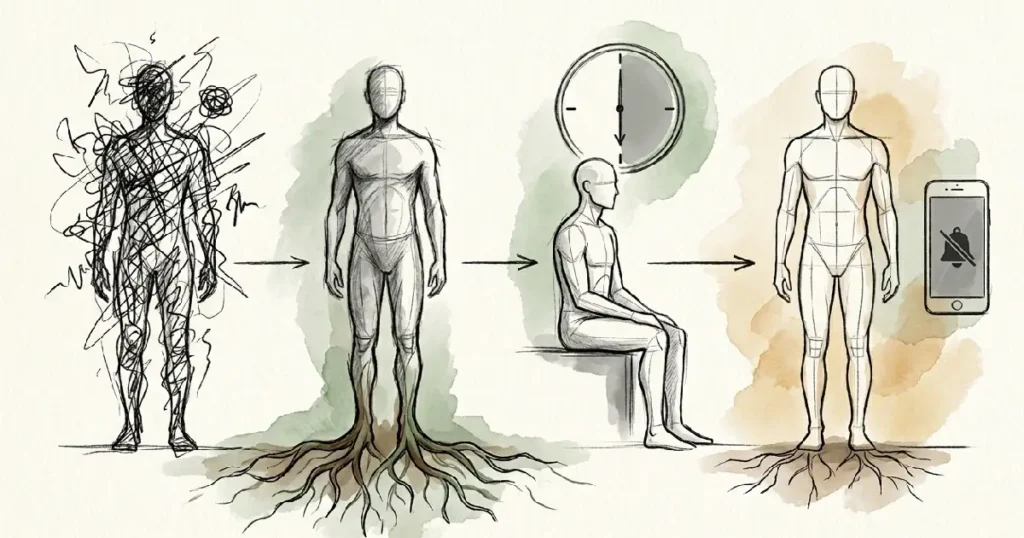
If you want to transition from being an emotional sponge to a strong filter, you must build somatic boundaries. You cannot think your way out of a physical response. Here is your step-by-step guidance to stop the bleeding.
Step 1: Internal Anchoring
Your brain is naturally scanning the environment for threats or negative moods. You have to bring your awareness back inside your own skin.
- Do This: Notice the exact sensation of your feet pressing flat onto the floor. Purposely slow down your exhale during intense conversations to signal safety to your heart rate.
- Not That: Do not physically “lean in” or stare intensely trying to read the other person’s micro-expressions.
Step 2: Role Naming
You have to consciously separate yourself from the outcome of someone else’s life choices.
- Do This: When a friend starts venting, silently tell yourself in your head, “I am their friend, not their savior.”
- Not That: Do not immediately start brainstorming solutions to fix their emotional outcome unless they explicitly ask for advice.
Step 3: The Return Phase
Emotional residue is real. If you do not actively wash it off, you carry it into your next interaction.
- Do This: Take exactly five minutes after a heavy meeting to name which emotions are yours, and which emotions belong to your coworker.
- Not That: Do not move straight to the next task on your checklist while still holding the physical tension of the last conversation.
Step 4: Digital Gray-scaling
Your phone is a massive trigger for your nervous system. You need to lower the visual intensity.
- Do This: Go into your phone settings right now and switch your screen to grayscale. This cuts the dopamine-rage cycle fueled by bright colors.
- Not That: Do not mindlessly scroll through comment sections when your nervous system is already feeling shaky and overstimulated.
Step 5: Tactile Micro-interactions
When you get hit with a wave of affective matching, your body needs a physical shock to break the loop.
- Do This: Splash freezing cold water on your wrists or use a heavy, textured fidget tool to force an autonomic arousal reset.
- Not That: Do not try to logically reason your way out of a sudden panic response. Logic fails when the nervous system is panicked.
Step 6: Time-Capped Listening
You have to put a hard limit on how much venting you will accept before you redirect the conversation.
- Do This: Tell your friend upfront, “I have about thirty minutes to chat today before I have to log off.” Stick to it.
- Not That: Do not listen for three straight hours until you feel completely numb, floaty, or disconnected from reality.
Step 7: The “Small No” Practice
Building boundary muscle memory takes repetition. You have to start small.
- Do This: Decline exactly one minor social invitation this week just to practice the feeling of saying no without giving a long excuse.
- Not That: Do not wait until you are having a full mental breakdown to finally start setting healthy limits with the people around you.
Common Mistakes and How to Avoid Them

Even when you know understanding the true definition of empathy requires separation, it is easy to fall back into old habits. Here’s the idea. We need to identify the exact traps that are keeping you stuck in the victim role.
Mistake 1: Relying on the Savior Complex
Many sensitive people secretly tie their self-worth to how useful they are in a crisis. You think if you can fix their problem, you will finally feel safe. This is a massive mistake. You are robbing the other person of their own resilience, and you are destroying your own health.
The Fix: Use a clear transition script when someone starts dumping their issues on you. Say this exact phrase: “I am so sorry you are dealing with this. I do not have the emotional bandwidth to give this the attention it deserves right now, but I am thinking of you.”
Mistake 2: Fearing Boundary Guilt
You probably feel incredibly guilty when you tell someone no. You worry that setting a limit makes you a mean or selfish person.
“Daring to set boundaries is about having the courage to love ourselves, even when we risk disappointing others.”
Brené Brown hits the nail on the head here. Your fear of upsetting a friend is the exact trap that keeps your nervous system in a state of absolute chaos. Establishing rigid personal boundaries is the most loving thing you can do, because it prevents you from building up quiet, toxic resentment toward them.
Mistake 3: Ignoring Digital Weariness
You cannot consume three hours of tragic global news and then wonder why you feel like crying in the grocery store. Absorbing the pain of strangers through a screen provides zero actual help to the victims, but it completely drains your ability to care for the people in your actual house.
The Fix: Limit your news intake to twenty minutes a day, read text-based news instead of watching high-emotion videos, and ruthlessly unfollow any social media accounts that rely on outrage to get views.
Mistake 4: Practicing Affective Overload Instead of Cognitive Empathy
Affective matching is when you physically feel their sadness. Cognitive empathy is when you intellectually understand their sadness without letting it enter your own body. You want the latter. When you absorb their pain, you become useless to them because now there are two panicked people in the room.
The Fix: Practice healthy communication skills by offering perspective rather than absorption. Use this script: “I hear how frustrated you are, and that makes total sense. What do you think your next step is going to be?” This pushes the responsibility for the solution back onto them.
Frequently Asked Questions
What are the neurological traits of an empath?
Empaths possess hyper-active mirror neuron systems in the inferior frontal gyrus and inferior parietal lobule. These specific neurons fire intensely both when the empath acts and when they observe others in distress. This biological mechanism leads to embodied simulation, which is the literal physical sensation of another person’s emotional state happening right within their own body.
Why do I feel physically drained in large crowds?
This deep exhaustion happens because of severe sensory overload and emotional contagion. In large crowds, an empath’s brain is forcefully required to process a massive influx of conflicting emotional data points simultaneously. Without strong grounding boundaries firmly in place, this intense cognitive load quickly leads to severe sympathetic nervous system activation and immediate physical fatigue.
How do empaths differentiate their own feelings from others?
The most highly effective method is a psychological practice called the Name the Source technique. When a mood shifts suddenly, simply ask yourself if you were feeling this exact way five minutes ago. Ask if this emotion connects to a clear event in your own life. If the answer is no, it is likely external emotional static.
Can being an empath cause chronic physical illness?
Yes, chronic excessive adaptation to the intense emotional needs of others can absolutely lead to severe immune system dysfunction. Physical bodies literally break down over time due to persistent stress and ongoing cortisol dysregulation. Empaths frequently report experiencing constant shallow breathing, chronic digestive issues, and completely fretted nerves when their personal boundaries remain dangerously thin.
Is being an empath a diagnosed psychological disorder?
Being an empath is definitely not a clinical diagnosis listed in the standard DSM-5. It is simply a highly specific personality trait characterized by profound empathic concern and intense affective mirroring. However, this unique trait is highly correlated with emotional hyper-attunement, which is a common survival adaptation frequently found in sensitive individuals with a childhood trauma history.
Final Takeaway
You have to completely reframe how you view your sensitivity. It is a biological data-gathering tool, not a mandate to fix the brokenness of everyone you encounter. When you finally stop practicing excessive adaptation, you will discover a profound sense of nervous system safety that you have likely never felt before.
Remember, creating a regulated environment requires active, daily management. You must utilize tactile grounding techniques, enforce strict digital cut-offs, and get incredibly comfortable with the awkwardness of saying no. Your goal is no longer trying to be less sensitive. Your goal is to build a life architecture so strong that your deep intuition becomes a massive asset, completely separated from the danger of self-destruction.
My Closing Remarks
Listen to me very closely right now. You are not a dumping ground for the unresolved pain of everyone else around you. I spent years destroying my own physical health because I mistakenly thought suffering alongside my clients made me a better therapist. It did not. It just made me sick. Setting a boundary will shock people at first. Let them be shocked. Your deep capacity for love means absolutely nothing if your body is too broken to experience it. Protect your peace. You owe them nothing.
More Related Stories for You
- Understand the psychology behind your actions with our guide on Personality Traits
- Protect your future by identifying Red Flags Before Marriage
- Build a stronger foundation by learning the Core Values Every Couple Should Share
About The Author