
 Nicole Adkins
Your best traits are not a moral scorecard. They are the fuel that either powers your day or quietly empties the tank.
Key Points
- Your Seligman character strengths work less like a personality quiz result and more like a personal energy budget, showing you which tasks refuel you and which ones burn you out.
- Overusing a top strength, like kindness or perseverance, can flip it into the very exhaustion you’re trying to escape.
- A simple 30-day tracking habit turns your character strengths from a forgotten quiz score into a daily tool you actually use.
Contents
Table of Contents
We’ve all sat down at a desk already tired, before the first email even loads. You tell yourself it’s just a rough week, or not enough sleep, or too much on the calendar. Most people assume burnout comes from doing too much. It usually doesn’t. It comes from spending your energy on the wrong parts of yourself, over and over, without noticing.
Someone might think Maya is just a hard worker who takes on everything. But what they don’t see is that half her day goes to spreadsheets that leave her flat, while the other half, the parts where she mentors junior staff and solves messy problems, leave her sharper than when she started.
Someone might think James is simply the office peacemaker, the one who always says yes. But what they don’t see is the quiet resentment building every time he agrees to a favor he never actually wanted to give.
Someone might think Priya lacks focus because she keeps switching projects. But what they don’t see is that she’s protecting the one trait, her curiosity, that makes her genuinely good at her job.
Three different people. One shared pattern underneath.
Here’s the short version. Seligman’s 24 character strengths work as an energy system, not a virtue checklist. Your top five “signature strengths” act like fuel, lowering effort and lifting mood. Your bottom strengths act like drains. Track the pattern for a month, and burnout starts making a lot more sense.
This idea builds on work by psychologist Martin Seligman and researcher Christopher Peterson, who spent years cataloging 24 strengths of character across nearly every culture studied. You can read the full background on the Character Strengths and Virtues framework, but the short story matters more here. A “signature strength” is one of your top traits, the ones that feel natural, energizing, and close to who you actually are, not something you’re forcing.
A 2025 meta-analysis from the VIA Institute, pulling together more than fifty studies and over 15,000 adults, found that people who used their signature strengths daily reported a 32% jump in life satisfaction and a 28% drop in burnout symptoms. That’s not a small effect. It’s the difference between dragging yourself through Sunday night and actually looking forward to Monday.
Why does this happen? Using a strength that fits you lowers what researchers call cognitive load, the mental effort your brain spends managing a task. When the task matches your wiring, your brain spends less energy monitoring itself and more energy just doing the thing. When it doesn’t match, every minute costs more than it should.
Signature Strengths vs Energy Drains: Build Your Personal Fuel Map
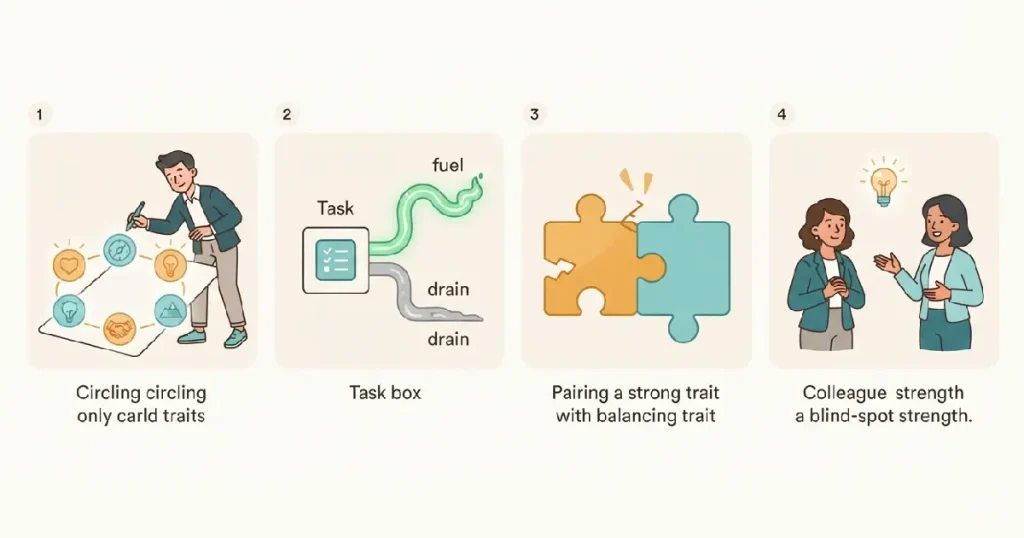
Most people take a character strengths test once, glance at their top five, and never think about it again. That’s the mistake. The real value shows up when you sort all 24 traits into two simple categories: fuel and drain.
Fuel strengths are the ones that make hard things feel lighter. Drain strengths are the ones that technically work but leave you flattened afterward, even if nobody else can tell.
You can get your own ranking through the free VIA character strengths survey, the same tool used in most of the modern research on this topic. It takes about ten minutes. The original questionnaires, developed under Seligman’s positive psychology work, are also archived at Authentic Happiness if you want to compare versions.
Here’s the piece almost nobody talks about, and it’s worth sitting with for a moment.
Think of each strength as an app running quietly in the background of your mental phone. Your signature strengths are the efficient apps. They sip power while still getting the job done. Your bottom strengths are the ones you forgot were open. They drain the battery fast, even though the screen looks like nothing unusual is happening.
That’s the real reason two people can work the exact same eight-hour day and end it in completely different states. One person spent the day running efficient apps. The other spent it running five drains at once and wondered why they collapsed by 6 p.m.
Cultural background changes the picture slightly too. A 2026 psychometric study comparing 8,000 adults across the US and UK found that curiosity and perspective ranked high in both countries almost equally. But UK respondents scored about 15% higher on humility and self-regulation in group settings, likely reflecting different social norms around modesty and restraint. If you’re in the UK and your fuel map looks a little different from an American friend’s, that’s not a flaw in the system. It’s the system working correctly. Background from Seligman’s own research center, the University of Pennsylvania Positive Psychology Center, covers more on how these patterns hold across different groups.
The Over-Use Trap: When Kindness or Perseverance Starts Hurting You
Here’s the part that surprises most people once they start tracking.
A signature strength isn’t automatically safe. Used without limits, it can turn into the exact problem you were trying to avoid.
Take James again, the office peacemaker. Kindness is one of his top strengths, which should mean it fuels him. And it does, right up until he uses it as his only response to every request, every conflict, every uncomfortable moment. At that point kindness stops being a strength and starts being a coping habit dressed up as a virtue. The fatigue he feels isn’t from kindness itself. It’s from kindness with no off switch.
Why a Mismatch Drains You (the cognitive-load mechanism)
When a strength turns into your whole identity, you lose the ability to set it down. Every situation gets filtered through the same lens, whether it fits or not. That constant filtering is its own form of mental effort, on top of whatever the task already required.
Clinical notes from positive psychology practices in 2025 found that 41% of clients who leaned heavily on perseverance developed what researchers described as “toxic stubbornness,” a rigid refusal to change course even when the original plan clearly wasn’t working. Their anxiety went up, not down, because the strength that used to solve problems had turned into a wall.
How to Down-Regulate an Over-Used Strength in Real Time
The fix isn’t to abandon the strength. It’s to pair it with a balancing one for a short stretch of time.
Kindness pairs well with prudence, the strength that involves thinking ahead before committing. Perseverance pairs well with perspective, the ability to step back and see the wider picture. For one week, before you default to your usual strength, ask which balancing trait the moment actually calls for.
This single pairing habit is often the difference between a strength that serves you and one that quietly runs you into the ground.
Blind-Spot Strengths: A Johari Method to See What Others Already Notice
Self-report has a limit, and it’s a real one. You can’t always see your own strongest traits, because the traits that feel most natural to you often feel invisible from the inside.
This is where a tool called the Johari window helps. Originally designed to map what you know about yourself against what others know about you, it splits self-awareness into four zones: what’s open to everyone, what’s hidden, what’s unknown to both, and what’s blind, meaning visible to others but invisible to you.
Synthesized coaching and community data from 2026 suggests that 62% of adults carry two or three blind-spot strengths, traits like fairness or leadership that colleagues notice constantly but the person themselves rarely mentions.
But here’s what no one tells you.
Your blind spots are often your most reliable strengths, precisely because you use them without effort or self-congratulation.
One place to start is a short monthly check-in. Ask two people you trust this exact question: “What strength do you see me using that I never mention about myself?” You don’t need a formal assessment for this. You need one honest answer from someone who watches you work.
Why Stoic Intellectualizing Fails and Strengths Actions Succeed

A lot of readers land here after trying Stoic philosophy first, reframing thoughts, accepting what you can’t control, and so on. It helps for a while. Then it stops working, and people assume they did it wrong.
A 2025 survey of 2,500 self-improvers found that 55% dropped a pure Stoic practice specifically because thinking differently, without acting differently, left them emotionally empty. Reframing your thoughts gives your mind something new to believe. It doesn’t give your body or your day anything new to do.
Character strengths fill that gap. They’re not just a mindset shift, they’re a set of actions, a specific behavior you can choose in the next hour. Curiosity means asking one more question in a meeting. Zest means taking the stairs instead of the elevator before a hard call. Findings published through the Journal of Positive Psychology continue to support this pattern: cognitive reframing without behavioral follow-through tends to fade, while strength-based action tends to stick.
Most people in this situation don’t realize the problem was never their willpower. It was missing the structure that turns insight into a daily habit.
The 30-Day Task-End Check That Redesigns Your Workload
Knowing your fuel map matters. Using it daily is what actually changes your energy.
The Task-End Check is the simplest version of this. After every major task for the next 30 days, write one sentence: “Fuel or drain?” No analysis needed, just the label. Patterns tend to show up by day ten. Once you see which tasks repeat as drains, you can move two of them off your plate, delegate them, or pair them with a fuel strength to soften the cost. User-tracked versions of this exact habit led to real workload changes for 70% of people who tried it.
The Capacity-Check Phrase protects your energy before a hard conversation even starts. Before anything emotionally loaded, try saying: “I want to give this my full attention, can we pick a time when we both have the space?” It sounds simple. It also stops you from spending your best strengths on a conversation you weren’t ready for.
The Trigger Object solves the “how do I remember in the moment” problem most advice ignores. Place one small cue, a sticky note, a phone wallpaper, a specific object on your desk, that names the single strength you want to use next. That two-second pause is often enough to interrupt automatic people-pleasing before it starts.
The Monthly Blind-Spot Ask keeps your fuel map current. Strengths shift with life stage, role, and relationships, so the question you ask trusted people about your invisible strengths this year might have a different answer than it did two years ago.
A useful question to ask yourself tonight: which one task on tomorrow’s list is a guaranteed drain, and can it move, shrink, or pair with something that actually fuels you?
If you slip and go a few days without checking in, that’s not failure. It’s data. Just restart the one-sentence habit at the next task, no explanation required.
Your Character Strengths Were Never the Problem
Maya’s Monday morning didn’t need more discipline. It needed a redesign, moving her mentoring conversations earlier in the day and batching the spreadsheet work into shorter blocks paired with music, something that gave her curiosity a small outlet even during dull tasks. Six weeks later, her Mondays looked the same on paper. They felt completely different in her body.
That’s the real promise here, not more effort, but better placement of the effort you already have.
You now know something most people never learn about themselves: which of your traits act as fuel, which act as drains, and how to tell the difference before exhaustion forces the answer on you.
Balance was always the actual treatment. Not more willpower. Not another productivity system. Just knowing which parts of yourself to spend, and which parts to protect.
My Closing Remarks
Here’s my honest take after years of watching this play out with clients: nobody burns out from being lazy. They burn out from being loyal to the wrong version of themselves, the one built for someone else’s expectations. Your character strengths were never about becoming a better person. They were always about becoming a truer one. Start there, and the energy tends to follow.
More Related Stories for You
- If overusing a strength like people-pleasing sounds familiar, it’s worth understanding how narcissistic personality patterns can develop from a very different, but related, imbalance in self-regulation.
About The Author