
 Nicole Adkins
The traits that make you magnetic are not niceness, positivity, or a well-edited self. They are five friction-tested habits.
Key Points
- The good personality traits that last are self-awareness, accountability, coachability, authenticity, and active empathy, not a polished public face.
- These good personality traits hold up in meetings, dating, and hard conversations because they survive discomfort instead of hiding from it.
- You can build them with small daily protocols, not a personality overhaul or a better performance.
Contents
Table of Contents
We spend years collecting the right answers about who we should be. Kind. Positive. Easy to work with. Agreeable in meetings. Bright on first dates. Unbothered in conflict. Then we walk into a room that actually costs us something and feel the split between the person we rehearsed and the person who showed up.
Someone might think the colleague who never disagrees is the most mature person at the table. But what they do not see is the quiet resentment stacking up behind that smile, and the trust that never forms because nothing real is ever risked.
Someone might think the dating profile that looks effortless is magnetic. But what they do not see is how much of that ease was edited, and how fast attraction thins out when the unedited version arrives.
Someone might think staying endlessly optimistic is strength. But what they do not see is that people stop bringing you the truth once they know you will reframe it before you hear it.
The five good personality traits that travel well through real life are self-awareness, accountability, coachability, authenticity, and active empathy. They work because they survive friction. They do not need a perfect mood, a perfect audience, or a perfect version of you.
That gap you feel is not a character flaw. It is a design problem. Most of us were trained to perform goodness, not practice it. Ego defense, the mind’s habit of protecting a flattering self-image in the short term, keeps you looking composed while blocking the very data you need in order to grow. Digital life makes this worse. Feeds reward a curated self. Hybrid work rewards a smooth self. Dating apps reward a filtered self. Left unexamined, this pattern does not just strain relationships. It can quietly become the reason they end.
Personality researchers have a useful map for this. The Big Five personality traits describe broad patterns such as conscientiousness, which is the tendency to be organized, reliable, and follow through. Those patterns are not a life sentence. According to work by psychologist Wiebke Bleidorn and colleagues, traits can shift through repeated, intentional practice. The five traits below are how that shift looks in daily life. They are not slogans. They are behaviors you can watch, count, and repair.
Why Traditional Good Personality Traits Fail in Real Life
“Be kind.” “Stay positive.” “Just be yourself.” These lines sound clean. They collapse the moment social cost appears.
Kindness without courage becomes people-pleasing. Optimism without honesty becomes denial. “Being yourself” without self-awareness becomes a mood with a microphone. You have seen this. You may have been this. Most people in this situation do not realize they are confusing likability with maturity.
A performed personality is a storefront. The lighting is good. The display is neat. Customers smile as they walk past. These five good personality traits are the workshop behind it: louder, less pretty, and the only place anything real gets made.
Hiring managers, partners, and close friends are not starving for more charm. They are starving for people whose insides match their outsides under pressure. That is the standard this piece uses. Not “Are you nice?” but “Do you stay real when it would be easier to perform?”
Self-Awareness: The Foundation of Good Personality Traits
Self-awareness is honest inward looking. It is the ability to notice what you feel, what you avoid, and what you protect, without immediately dressing it up.
Without it, every other good trait turns into theater. Accountability becomes a speech. Empathy becomes a script. Authenticity becomes a brand. You cannot change what you refuse to see.
Deficits here are rarely about intelligence. They come from ego defense. Your mind would rather keep you looking competent than let you stay accurate. Add a culture that rewards highlight reels, and you get people who can describe everyone else’s patterns and go blank on their own.
The practice is not another meditation streak. It is an ego-control audit.
Keep a daily friction log. After any moment that made you defensive, write three lines: what happened, what you wanted to protect, and one honest flaw in your response. Do this for two weeks. The pattern will stop hiding.
Maya, 34, was the “easy” one on her product team. She never missed a deadline. She never raised her voice. In my practice I have sat with people like her who look composed from the hallway and feel invisible in the room. After a promotion passed her by, she started the friction log. The first week was ugly. She saw how often she smiled instead of disagreeing, then replayed the meeting in her head for hours. By week three she could name the trigger: being seen as difficult. That single piece of self-awareness did more for her career than another productivity system. She was no longer managing an image. She was managing herself.
Accountability: The Good Personality Trait That Repairs
Accountability is your actions mapping to your words, plus immediate repair when they do not.
Trust is not built by the apology. It is built by the next concrete move. Superficial sorry-theater is exhausted. People can smell the difference between “I feel bad that you feel bad” and “I said Tuesday, I missed it, here is the new time and the extra step I am adding.”
This is hard because many of us treat a broken promise as a self-esteem injury. The moment you miss, your mind races to explain. Explanation is not repair. Repair is specific, fast, and visible.
Run a weekly promise audit. Write down what you committed to, at work and at home. Mark delivered, delayed, or dropped. For every delayed or dropped item, send a repair that names the miss and the next action. No atmosphere words. No “been so slammed.” Just the gap and the fix.
This is also how conscientiousness becomes livable instead of dry. The Cleveland Clinic’s overview of the Big Five treats conscientiousness as a core pattern linked to follow-through and health. Accountability is that pattern in motion. You are not trying to become a rigid person. You are trying to become a reliable one.
Coachability: A Good Personality Trait High Performers Practice
Coachability is the capacity to absorb hard feedback without making the other person manage your ego.
Call it intellectual humility if you want the clinical term. It means you treat your own views as incomplete, even when you feel sure. In hybrid teams and close relationships, this is a sharp edge. The person who can hear a critique, restate it cleanly, and use it will outpace the person who is only talented.
Why it fails: feedback threatens identity. If your worth is fused to being the smart one, the kind one, or the one who already knows, then new information feels like an attack. That reaction is common. It is also expensive.
Use a weekly feedback ask. Choose one person who has seen you under pressure. Ask a narrow question: “What is one thing I do that makes collaboration harder?” Then do the hard part. Before you explain, restate their point in their language until they say you have it. Hold the opinion lightly for 24 hours. Decide later what to keep.
Life works better when you treat it as a continuous learning experiment instead of a courtroom where you must win.
Authenticity: Good Personality Traits Versus Performance
Authenticity is messy, unoptimized realness. It is the opposite of a personal algorithm.
This is not oversharing. It is congruence, the match between what you feel, what you say, and what you do. Research on well-being keeps returning to this kind of honest connection. A PNAS paper on cultivating well-being ties awareness and connection to a life that actually feels better, not just a life that looks better.
Digital overload trains the opposite skill. You learn to sand down edges, time your vulnerability, and present a self that photographs well. Offline friction is how you reverse that training.
Try an algorithm detox in small blocks. One conversation a day with no performance goal. No impressive story. No careful recap later. Ask a real question and let the silence sit. Leave one slightly unpolished message that is still kind and clear. Meet one person offline first when you can.
When Maya Stopped Performing Maturity
After the missed promotion, Maya tried a different experiment. She stopped sending the bright recap emails that made every delay sound like a win. In a Thursday standup she said, “I underestimated the data-cleaning time. I will miss Friday. I can deliver Monday with a cleaner set, or Friday with gaps. Which do you want?” The room went quiet. Then her manager said thank you, because now he could plan. That night she told a friend she was lonely in a way her busy calendar could not explain. No lesson. No bow on it. Two weeks later the same friend asked her to dinner without the usual “we should.” Authenticity did not make Maya instantly beloved. It made her locatable. People finally knew where to find her.
Spotting and Breaking the Toxic Positivity Trap
Toxic positivity is the demand that every feeling be upgraded before it is allowed in the room. It sounds supportive. It trains people to lie.
You can spot it in yourself when your first move is a reframe. “At least.” “It could be worse.” “Good vibes.” Those phrases can be useful later. They are harmful as a first response, because they skip the human in front of you.
The break is simple. First name the real thing. “That sounds heavy.” “I can see why you are angry.” Sit there for one full breath. Only then ask if they want help, a plan, or just company. Authenticity includes the unpretty feeling. If you skip it, people experience you as a mood manager, not a person.
That’s not growth. That’s branding.
Active Empathy: The Good Personality Trait With Courage

Empathy by itself can stay passive. You feel with someone and still do nothing that costs you.
Active empathy is compassion plus the courage to act when it is inconvenient. Perspective-taking, the skill of seeing a situation from another person’s vantage point, is the start. The trait becomes real when you use that view to protect, speak, or share the load.
Leadership work keeps ranking this kind of people-first behavior for a reason. Teams do not break from a lack of slogans. They break when nobody will stand in the draft.
This is more common than you think: you sense the slight in the meeting, feel a flash of loyalty, and stay quiet because the social math is ugly. That silence trains everyone, including you.
Micro-Experiments for Courage-Dependent Empathy
Start below the level of heroics.
Name one inconvenient advocacy this week. Credit a quieter colleague’s idea in the room where it was ignored. Tell a friend the plan they are excited about will hurt them, kindly and directly. Ask the waiter to remake a wrong order for someone who hates making a scene. Sit next to the person who got left out, without announcing it.
After each one, note two things: the cost you feared, and the cost that actually arrived. The gap between those two numbers is where your courage grows.
Trait theorists have argued for decades that personality shows up as stable patterns of behavior, a point laid out clearly in OpenStax’s chapter on trait theorists. Active empathy is not a feeling you wait to have. It is a pattern you repeat until it becomes who you are known to be.
How to Build Good Personality Traits With Daily Protocols
These five traits collapse when you chase them as identities. They stick when you treat them as reps.
Use this weekly system. It is small on purpose.
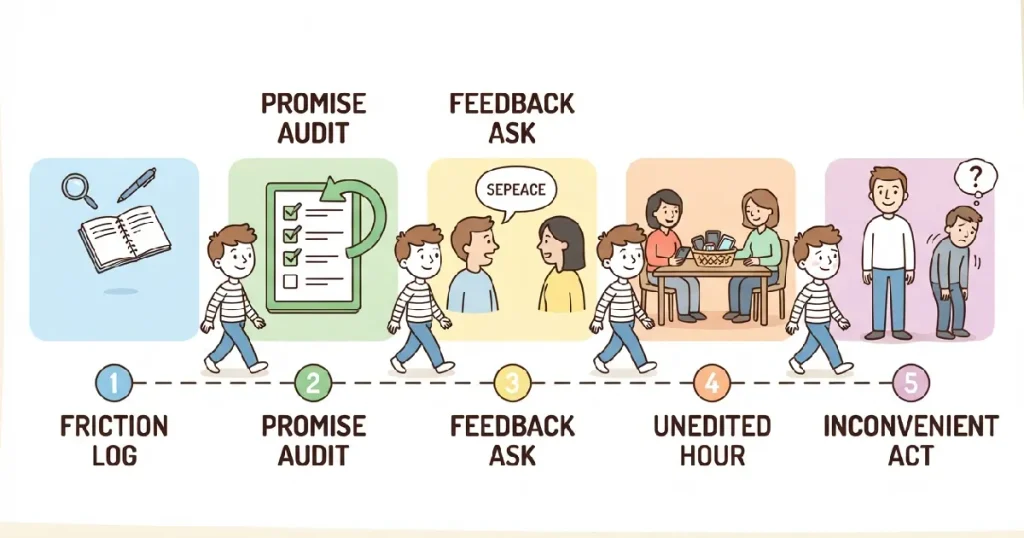
The Friction Log. Each night, one trigger, one ego-protection, one honest flaw. This builds self-awareness.
The Promise Audit. Once a week, review commitments and repair gaps the same day. This builds accountability.
The Feedback Ask. Once a week, request one hard note and restate it before you reply. This builds coachability.
The Unedited Hour. Once a week, one offline or unoptimized interaction with no image goal. This builds authenticity.
The Inconvenient Act. Once a week, one small protective move that costs you a little comfort. This builds active empathy.
Progressive overload applies here the same way it does in training. Start tiny. Track consistency, not intensity. Pair with one person who will ask you what you logged, not how you feel about your personality in the abstract.
Relapse is part of the design. You will perform again under stress. That is not proof the traits are fake. It is proof the storefront is still tempting. Return to the workshop the same day. Do not wait for Monday.
A useful question to ask yourself tonight: Where did I protect my image instead of my relationships?
The next time a hard note lands, try this sentence first: “Let me make sure I have it.” Then repeat what you heard. That single delay is often enough to keep your ego from driving.
One place to start in the next 24 hours is the friction log. Three lines. No audience. If you do nothing else this week, do that.
The five-factor model described by Britannica can make personality sound fixed and distant. Daily protocols bring it back to the scale of your actual Tuesday. You are not rewriting your soul. You are changing what you repeat.
The Payoff of Good Personality Traits in Career and Love
These traits compound.
At work, self-awareness keeps you from becoming the person everyone manages around. Accountability makes you easy to trust with real stakes. Coachability makes you promotable in rooms you are not in. Authenticity cuts the exhaustion of maintaining two selves. Active empathy makes people bring you the truth early, which is a career advantage no software replaces.
In dating and close relationships, the same pattern reads as a green flag. Not because you are smooth. Because you repair fast, hear hard things, and will stand up when it costs you. People relax around that. They stop scanning for the edit.
In your own emotional life, the payoff is quieter. Neuroticism, the tendency toward worry and emotional volatility, often eases when you stop fighting every uncomfortable signal. You get a self you can live with in private, not only a self you can post.
Remember the storefront. You can keep polishing the glass. Or you can walk into the workshop, pick up one tool, and make something that lasts after the lights on the street go out.
You already know the meeting, the date, and the hard conversation that opened this. You do not need a new persona for them. You need one honest look, one kept word, one piece of feedback you do not swat away. Real is not a mood. Real is a practice, and it is already within reach.
Become locatable. People cannot love, hire, or follow a storefront.
My Closing Remarks
I have watched capable people spend years becoming easier to like and harder to know. I did a version of that myself, especially early in my clinical work, when I confused calm with honesty. What changed me was not a breakthrough. It was getting tired of translating myself back into a person after every room I left. If you are tired in that same way, you are not behind. You are ready. Start with three honest lines tonight. That is enough to turn toward the workshop and leave the mannequin in the window.
More Related Stories for You
- If you want a simple companion practice for the friction log, these mindfulness exercises can help you notice defensiveness before it runs the conversation.
About The Author