


Let me guess. You were told babies sleep peacefully. That is the biggest lie told to parents. It is 2:43 AM. The monitor is glowing on your nightstand. Your baby, who was perfectly silent fifteen minutes ago, is now scrunching their face like an Olympic weightlifter. Your heart rate spikes immediately. You open your phone in the dark. You are searching for Newborn Grunting and Squirming While Sleeping, terrified that something is horribly wrong.
You are not being an over-anxious parent at all. Every single new mother and father has been exactly here. The sounds coming from that bassinet are genuinely terrifying if no one ever told you they were completely, biologically normal.
Most articles will give you a gentle pat on the head and say it is usually fine. I hate that advice. That answer is true, but it is not enough for a parent panicking in the middle of the night. What you actually need right now is a concrete way to tell the difference between a baby doing normal biological work and a baby who needs medical help. That is exactly what this guide gives you.
Newborn grunting and squirming while sleeping is almost always normal. It is caused by REM active sleep (where babies are not muscle-paralyzed like adults), an immature digestive system, and learning to breathe outside the womb. It typically resolves by three months. Seek immediate care only if grunting accompanies every single breath, skin color changes, or labored breathing.
In the next five minutes, you will learn the real science of why this happens. You will get an exact sound-and-behavior decoder to identify the cause. You will learn the precise red flags that mean you should call a doctor right now. Finally, you will learn what to do tonight to help both your baby and yourself sleep better.
What Newborn Grunting and Squirming While Sleeping Actually Is (And Why It’s Not What You Think)
As a clinical social worker who has spent years counseling exhausted new parents, I see the same pattern constantly. You bring the baby home. You expect them to sleep peacefully. Instead, they sound like a congested pug running a marathon.
Table of Contents
Actually, let me back up. You probably think your baby is in pain. I might be wrong about this, but I bet you are already blaming yourself for something you ate or did. It is time to let that guilt go right now. We tend to view grunting as a problem we need to fix. We assume noise equals distress. In reality, these sounds are visible, audible evidence of rapid biological maturation happening in real time.
It’s Not Discomfort, It’s Development
Welcome to the fourth trimester. For forty weeks, your baby lived in a perfectly climate-controlled, dark, fluid-filled environment. All their breathing, digestion, and waste processing happened automatically through the placenta. They never had to work for it. Birth violently interrupted that luxury. Suddenly, they are thrust into a cold, bright world where they have to operate their own lungs, their own digestive tract, and their own nervous system all at the exact same time.
Grunting is literally the sound of that massive learning curve.
Newborns cycle through two primary stages of sleep. They have quiet sleep and active sleep, spending about half of their time in each phase. Active sleep looks quite similar to rapid eye movement sleep (REM) in adults. However, there is one massive biological difference. When adults enter REM sleep, our brains send a signal that paralyzes our skeletal muscles. This stops us from acting out our dreams.
Infants do not have this paralysis mechanism yet. Their nervous systems are simply too immature. As a result, babies move around, thrash, twitch, and make very loud noises. They might even pop their eyes open for a second, all while remaining completely asleep. You can read more about infant sleep states via HealthyChildren to understand these exact cycles.
The Science: What Research And Pediatricians Tell Us
We have to look at the clinical data to truly understand why this happens. Medical science explains that this active sleep phase is not a mistake of nature. It is a biological necessity.
“Babies spend up to 50 percent of their sleep in the active, rapid eye movement phase, which is essential for brain development and processing new memories.”
This fact fundamentally changes the entire perspective. Grown adults only spend about fifteen percent of their night in REM sleep. Babies need vastly more because their brains are physically growing and forming new neural pathways at an astonishing rate. Every twitch and grunt is tied to sensory processing.
Furthermore, during the first three to four months of life, a baby cycles between active and quiet sleep very quickly. A full sleep cycle for a newborn is only about forty-five to fifty minutes long. Shifting from one cycle to the next is incredibly difficult for them. They lack the self-soothing skills to make that transition quietly. The squirming you see is often just their clumsy, noisy attempt to settle back into a deeper state of rest.
The Newborn Sound And Behavior Decoder: What Each Grunt Is Telling You
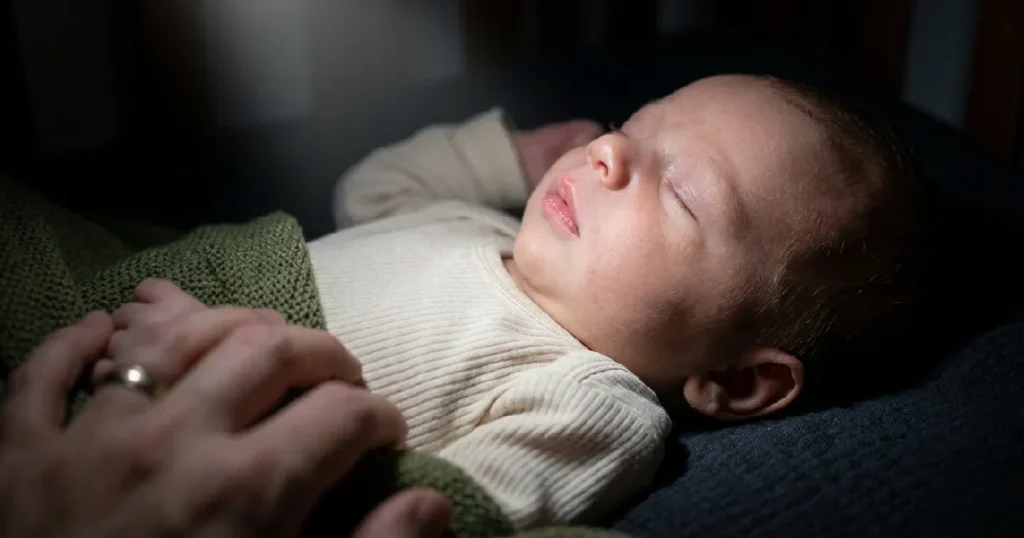
Not all grunts are created equal. Before you rush to the bassinet in a panic, or conversely, shrug off a sound that might actually need attention, you need a system. Use this evidence-based behavior decoder to identify the most likely cause based on exactly what you are observing right now.
- Grunting, pulling knees to chest, and turning red in the face. This is Infant Dyschezia. Your baby is simply learning how to poop. It is normal.
- Grunting, eye fluttering, small body twitches, and irregular breathing. This is Active REM Sleep. It is completely normal.
- Grunting, arching the back, and fussing right after feeds. This points to Acid Reflux (GER). You should monitor this behavior.
- Grunting paired with snuffling or wet sounds. This indicates blocked nasal passages. Saline drops will usually help.
- Grunting on every single out-breath combined with chest retractions. This is severe respiratory distress. You must call a doctor immediately.
- Grunting with blue or gray skin around the lips. This is a critical oxygen issue. Dial emergency services immediately.
Common Mistakes And How To Avoid Them
As a therapist working with families, I watch parents fall into the same traps over and over. If you have ever dealt with this, you know it is maddening. You are operating on fragmented sleep, making high-stakes decisions in the dark. Here are four common mistakes parents make regarding newborn sleep noises, along with the exact actionable steps to avoid them.
Mistake 1: Waking The Baby During Active Sleep
This is the most frequent error. Parents hear a noise, assume the baby is awake, and immediately scoop them up.
How to avoid it: Use the “Pause and Plan” script. Tell yourself, “I will wait thirty seconds before I touch my baby.” Stand quietly next to the bassinet. If the eyes are closed and the grunts are intermittent, the baby is asleep. Leave them alone. Picking them up interrupts the vital memory-consolidation process happening in their brain.
Mistake 2: Assessing Breathing By Sound Instead Of Sight
Newborns are incredibly noisy breathers. They have tiny nasal passages that get congested easily. Judging their oxygen levels by the weird sounds they make will only cause unnecessary panic.
How to avoid it: Always look at the chest. Strip the baby down to their diaper if you have to. Watch the skin between the ribs and at the base of the neck. If the skin is sucking inward dramatically with every single breath, those are retractions. That is a medical emergency. If the chest rises and falls smoothly, the noisy breathing is strictly upper-airway congestion or normal active sleep.
Mistake 3: Panicking Over Periodic Breathing
During active sleep, babies do something terrifying. They will breathe very fast for fifteen seconds, suddenly stop breathing completely for five to ten seconds, and then start breathing normally again. Parents see this pause and assume the baby is dying.
How to avoid it: Learn the term “periodic breathing.” It is a documented, highly common neonatal breathing pattern. It is not sleep apnea. As long as the baby does not turn blue and the pause does not exceed twenty seconds, you do not need to intervene. Keep a silent count in your head. “One, two, three…” If they start breathing again by ten, you are safe.
Mistake 4: Checking Skin Color Under Yellow Nursery Lights
Many parents use dim, warm-toned nightlights in the nursery to promote sleep. The problem is that yellow light aggressively masks the subtle color changes in a baby’s skin that indicate oxygen deprivation.
How to avoid it: If you suspect a breathing issue, grab your smartphone. Turn on the harsh white flashlight. Shine it directly on the baby’s lips, the tip of their nose, and their fingernails. You are looking for a healthy pink tone. Any trace of blue, gray, or stark white requires immediate medical intervention.
To help you remember this, let us build the Thirty-Second Safety Check Protocol. I want you to memorize this protocol tonight.
- Stand at the bassinet, watch, and listen for thirty full seconds before touching or picking up your baby.
- Look specifically for chest retractions. Check if the skin between or beneath the ribs pulls inward with each breath.
- Look at the lips, fingertips, and around the mouth under white light.
- Count whether the grunt happens with every exhale, or just intermittently.
- If the baby settles back to quieter breathing within sixty seconds, their skin is pink, and chest movement is smooth, return to bed.
Meet Sarah: From Four-Hour Google Spirals To Her First Full Night’s Sleep

Meet Sarah. Let us call her Sarah to protect her family’s privacy. She is a first-time mom, exactly five weeks postpartum, exclusively breastfeeding her son, Leo. Sarah was averaging exactly three hours of broken sleep per night. It was not because Leo was awake crying. It was because she simply could not sleep through his grunting.
She described it to me as an exhausting soundtrack of physical effort. Every night at 1:15 AM, Leo would start pulling his knees up and grunting loudly. Sarah would immediately scoop him up, accidentally waking him from a deep active sleep cycle. Then, it took two hours to settle him back down. She had read half a dozen articles. She knew it was probably normal. But knowing it intellectually and believing it at three in the morning are two completely different things.
After we talked, Sarah used one specific tool. She used the thirty-second safety check. The next night, when the grunting started, she stood at Leo’s bassinet. She counted to thirty. She watched his chest rise and fall. She checked his pink skin. She noticed the grunts were intermittent during an eye-flutter sequence.
Active sleep. She turned around and walked back to bed.
That single night, she got four and a half uninterrupted hours. It was the longest stretch since Leo was born. She had finally replaced pure panic with a clear, calm protocol. By week eight, the noises faded entirely as his little body finally matured.
Normal Grunting Vs. Something More: The Definitive Comparison
The hardest part of early parenthood is distinguishing between normal developmental hurdles and actual medical emergencies. When you are sleep-deprived, your brain loses the ability to differentiate the two. You need clear, stark contrasts to make safe decisions.
Newborn Active Sleep Grunting Vs. Respiratory Distress
Normal active sleep grunting happens intermittently. It occurs between breaths, comes and goes in cycles, and is often accompanied by soft whimpers, eye flutters, and a perfectly pink skin tone. The chest rises and falls smoothly without intense mechanical effort.
“A grunt that occurs with every single exhalation, paired with visible rib retractions, is a primary indicator of respiratory distress requiring emergency care.”
That is the definitive line in the sand. Respiratory distress does not come and go. It is a persistent, exhausting physical effort. The baby will appear lethargic, limp, or highly agitated. You might hear a high-pitched wheeze called stridor. If you see this, do not wait thirty seconds. Do not observe. Call a doctor or emergency services immediately. You can review exact respiratory distress signals via the American Academy of Pediatrics.
Normal GER Vs. GERD: When Reflux Needs Medical Attention
Another major culprit for nighttime squirming is the digestive system. Specifically, the backflow of stomach contents. Some healthy babies simply have infant reflux (GER). They spit up multiple times a day because they consume a liquid diet and spend most of their time lying flat on their backs. It is messy, and it can cause some nighttime grunting, but it is ultimately harmless. The symptoms usually resolve on their own by nine to twelve months of age.
However, you must know the red flags that indicate a larger problem. When reflux grunting crosses into GERD territory, you will notice distinct warning signs. These include persistent weight loss, a total refusal to feed, projectile vomiting that goes far beyond typical spit-up, and violently arching the back while screaming. If your baby exhibits these signs, a pediatric evaluation is absolutely necessary to prevent esophageal damage. You can research pediatric gastroenterology data from the National Institutes of Health for detailed symptom tracking.
How To Protect Your Own Mental Health And Sleep
We have talked entirely about the baby. Now, I am going to talk to you. The exhaustion, the guilt, and the hypervigilance of new parenthood create a perfect storm for maternal and paternal burnout. Even if your baby is perfectly healthy, lying awake for hours listening to them grunt will destroy your mental health. The psychological toll of the midnight monitor is a very real clinical issue.
You are dealing with an intense biological drive to protect your young, mixed with severe sleep deprivation. The clinical experts at Psychology Today confirm that this combination frequently triggers extreme postpartum anxiety. This anxiety often spills over into your partnership, causing deep marital resentment. Keeping your communication strong during the newborn phase is vital, a topic extensively covered by relationship experts at Marriage.com.
You need tools to survive this phase. Here is a practical, zero-cost toolkit you can implement tonight to help both you and your baby sleep better.
- First, use a white noise machine. White noise is a primary recommendation for the infant sleep environment. It will not stop your biological responsiveness to your baby’s true cries, but it will mask the smaller, normal active sleep noises that keep you on edge.
- Second, use preservative-free saline nasal drops before sleep. This can easily clear tiny, congested nasal passages without relying on medication, reducing the loud snuffling sounds.
- Third, implement upright time after feeds. Holding your baby upright for twenty to thirty minutes allows gravity to assist digestion, which heavily reduces reflux-related nighttime grunting.
- Fourth, commit to room-sharing, but absolutely no bed-sharing. Place the bassinet right near your bed. This practice alone can decrease the risk of sudden infant death syndrome by as much as fifty percent.
- Finally, invest in a video baby monitor with high-quality night vision. This allows you to perform the visual chest and color assessments without turning on lights or disturbing the baby.
Frequently Asked Questions
Is it normal for a newborn to grunt and squirm every night in their sleep?
Yes, it is completely normal. Most nighttime grunting and squirming is caused by an immature digestive system processing milk, active REM sleep without natural muscle paralysis, and the gradual development of breathing coordination outside the womb. This notoriously noisy phase typically peaks within the first eight weeks and will begin resolving fully by twelve weeks.
When should I worry about my baby grunting in their sleep?
You must seek immediate medical attention if the grunting occurs with every single exhale instead of just intermittently. Warning signs include severe nasal flaring, visible rib retractions, bluish skin color around the lips, or a high fever. Grunting paired with labored breathing indicates true respiratory distress. Intermittent grunting with pink skin remains perfectly safe.
Why does my newborn grunt and squirm but not wake up?
This behavior is the classic hallmark of newborn active sleep. Active sleep is essentially the same as adult REM sleep, but young babies do not experience skeletal muscle paralysis during this stage. They move around, make loud noises, and even open their eyes while fully asleep. Your baby does not need any intervention right now.
How long does the newborn grunting and squirming phase last?
Nightly grunting and squirming usually stops by three months of age. This marks the end of the fourth trimester. While these noises often sound highly concerning, they fade naturally as your baby develops better digestive control. Their nervous system matures, allowing them to spend much more time in the quiet and still sleep cycle.
Does loud grunting mean my baby is in physical pain?
No, it rarely means your baby is in pain. Most grunting is just the intense effort of normal biological functions like passing gas or transitioning between sleep cycles. Babies are simply learning how to use their abdominal muscles. If the noise includes inconsolable crying or back arching, you should have their pediatrician evaluate for reflux.
Should I pick up my baby when they grunt in their sleep?
In most normal cases, you should not pick them up immediately. The best practice is to observe them silently for thirty to sixty seconds first. Take a full moment to listen before you react. Premature intervention will easily disrupt their active sleep cycle, which is biologically required for proper brain development and memory consolidation.
Final Takeaway
The newborn phase is a beautiful, terrifying, and profoundly exhausting season of life. Your baby is undergoing massive biological transformations every single night. The grunting, the thrashing, and the squirming are the loud, messy sounds of a tiny human learning how to exist in the outside world.
Do not try to fix everything. Do not rush to buy expensive sleep gadgets. Do not spend three more hours tonight reading conflicting advice on forums.
Your single task for tonight is to use the thirty-second safety check. When you hear the noise, set a silent timer on your phone. Watch the chest, check the color under white light, and listen for the pattern. If you see pink skin, smooth breathing, and intermittent sounds, you have done your job. Say the words out loud to yourself: “This is active sleep. My baby is safe. I can rest now.”
Then, turn over and go to sleep. If consistent, concerning patterns emerge later, call your pediatrician. That is never overreacting; that is just excellent parenting.
My Closing Remarks
Here is the brutal truth no one tells you: mothering a newborn feels like keeping a tiny, fragile alien alive in the dark. I remember sitting on my bathroom floor, crying because I thought my daughter’s sleep noises meant I was already failing her. You are not failing. You are exhausted, hormonally depleted, and doing exactly what you are supposed to do. Stop staring at the monitor tonight. Trust your intuition, trust the thirty-second rule, and close your eyes. You have permission to finally rest.
More Related Stories for You
If you found this guide helpful, you might be struggling with other common newborn challenges.
- I highly recommend reading these guides next. For foundational support, explore our complete advice for new moms
- If your baby is suddenly changing positions at night, read what to do when an infant rolls over in sleep.
- Finally, if you are struggling with a completely fractured schedule, check out our guide on what to do about a newborn waking up every hour.