
 Sara Carmen
Real love isn’t measured by viral rules or grand gestures, it’s measured by what happens in the ordinary, unglamorous moments in between.
Key Points
- The healthy relationship qualities that last show up in repair, honesty, and emotional safety, not in a conflict-free life.
- Clarity of intentions and matching words with actions will tell you more than chemistry ever will.
- You attract a healthier partner when you stop dating from old hunger and start choosing from a steadier self.
Contents
Table of Contents
You’ve read the lists. Trust, communication, respect, honesty. You could recite them in your sleep at this point.
And yet you still find yourself replaying last night’s argument, wondering why it felt so unsafe even though nobody raised their voice. You start to wonder if something is wrong with you.
There isn’t.
What you’re noticing is real. Most of the advice floating around about healthy relationship qualities is technically true and practically useless. It names the destination without ever describing the road.
Here’s the short version, the one you can carry with you before we go deeper: a healthy relationship is built on emotional safety, matching words with actions, and two people who choose to repair things after conflict instead of protecting their pride. Everything else is decoration.
What Healthy Relationship Qualities Actually Mean Beneath the Surface
Somewhere along the way, “healthy relationship” became a marketing term. Scroll through any dating app bio or self-help feed and you’ll see the same four traits recycled endlessly: trust, communication, respect, honesty.
None of that is wrong. It’s just incomplete.
In my practice, I’ve noticed that the couples who actually last don’t talk about these traits in the abstract. They talk about behavior. They talk about what happened on a random Tuesday when one of them came home in a bad mood and the other one didn’t take it personally.
That’s the gap almost nobody addresses. Healthy relationship qualities aren’t a personality type you either have or don’t have. They’re a set of repeated behaviors, small and unglamorous, that either build safety over time or slowly erode it.
Psychologists call the felt sense of being able to be fully yourself without fear of punishment or abandonment “emotional safety.” According to the American Psychological Association, this sense of safety, more than chemistry or shared interests, predicts whether a relationship holds up under stress. That’s the mechanism behind almost everything in this piece, so keep it in your back pocket.
The Viral Relationship Rules Everyone’s Following, and Where They Fall Short
If you’ve spent any time in relationship corners of the internet, you’ve seen the numbers. The 7-7-7 rule. The 5-5-5 rule. The 3-3-3 rule. Each one prescribes a specific rhythm for date nights, deep talks, or solo time.
They’re catchy. They’re also not backed by any peer-reviewed research from institutions like the Gottman Institute, which has spent decades studying what actually predicts relationship longevity.
That doesn’t mean the rules are useless. It means they’re training wheels, not medicine.
The 7-7-7 and 5-5-5 Rules: What They Get Right (and Wrong)
The appeal of these rules is obvious. They give anxious, overthinking brains a container. Instead of wondering “are we spending enough quality time together,” you get a checkbox.
The problem shows up when the checkbox becomes the point. Forcing a scheduled deep talk every seven days can feel performative if the underlying safety isn’t there yet. A couple with genuine emotional attunement doesn’t need a countdown to check in with each other, they do it because it feels natural.
A useful reframe: treat these viral formulas as conversation starters, not diagnostic tools. Ask what a version of the rule might look like for your specific relationship, then throw out the parts that don’t fit.
Emotional Safety Now Includes How You Communicate on a Phone
Here’s something the older relationship advice never had to account for. So much of modern intimacy happens through text, and text has its own psychology.
Digital emotional safety is a real, measurable thing. It includes response consistency, the absence of weaponized silence, and not using read receipts as a passive-aggressive weapon.
Think about the last time a partner left you on read during an argument. That silence isn’t neutral. To an anxious nervous system, it can feel like a small, repeated abandonment, even if the other person just fell asleep.
Consider Maya, a composite of clients I’ve worked with over the years. She dated someone who never yelled, never insulted her, and by every traditional metric looked like a “healthy” partner. But he’d go quiet for eighteen hours after any disagreement, offering no explanation. Maya spent that time spiraling, checking her phone every few minutes, convinced she’d done something unforgivable. The relationship looked calm from the outside. Internally, she was in a constant state of low-grade alarm. When she finally named the pattern out loud, he was surprised, he thought silence meant he was being mature. Once they built an actual agreement about how they’d handle distance during conflict, the anxiety dropped almost immediately.
That’s the piece most lists miss entirely. Safety isn’t just about what happens face to face anymore.
Clarity Over Chemistry: Why Situationships Are Losing Their Appeal
If you’ve spent any time dating recently, you already know the exhaustion of ambiguity. Weeks or months of undefined status, never knowing if you’re building something or just filling time.
This is why “clarity of intentions” now ranks above romance for a lot of people navigating dating apps. Chemistry is easy to fake in the short term. Clarity is not.
A practical filter here: give any new connection roughly two to three weeks before you ask directly what the two of you are building together. Not to force commitment, but to get information. Someone unwilling to answer that question honestly by week three has usually already answered it.
But the third sign is the one most people miss entirely, and it has nothing to do with what someone says.
It’s whether their actions match their words within a reasonable window. Someone can tell you they want something serious and still consistently disappear for days at a time. Watch the pattern, not the sentence.
How Healthy Partners Actually Handle Conflict

This is where most advice gets it dangerously wrong. Somewhere, someone convinced an entire generation that healthy couples don’t fight.
That’s not what the research shows. In fact, John Gottman’s long-term studies of couples found that the presence or absence of conflict barely predicts whether a relationship lasts. What predicts it is something he calls “repair attempts,” meaning any statement, gesture, or joke that interrupts an escalating argument and pulls the conversation back from the edge.
Here’s an easy way to picture it. A relationship’s health isn’t measured by the size of the storms it weathers. It’s measured by how quickly the boat rights itself afterward.
What Repair Looks Like Mid-Argument
Repair isn’t a grand apology delivered after the dust settles. It’s small and immediate. It sounds like “I got defensive just now, can we back up,” or “I don’t think this is coming out right, give me a second.”
Consider Elena, another composite from cases I’ve observed. Early in her marriage, every disagreement with her husband turned into a full withdrawal, sometimes lasting days. In couples counseling, they practiced one script: naming the escalation out loud, apologizing specifically for tone rather than just outcome, then proposing one concrete next step. The first few times felt awkward and scripted. Within a few months, it became instinct. Their arguments didn’t disappear. They just stopped spiraling into multi-day standoffs.
That’s the shift. Not conflict-free. Conflict-repairable.
Functional Equality: Sharing Life, Not Just Love
There’s a specific kind of exhaustion that comes from being someone’s partner and their unpaid project manager at the same time. If you’ve ever felt like you’re parenting your partner instead of partnering with them, you already understand this section.
Functional equality means the daily labor of a shared life, chores, planning, financial transparency, emotional check-ins, doesn’t rest disproportionately on one person’s shoulders. Search interest in phrases like “partner who isn’t looking for a parent” has climbed noticeably, particularly among women in their twenties and thirties.
Try a quick audit. Who initiates plans most often? Who remembers appointments, birthdays, and bills? Who does the emotional labor of smoothing over conflicts with in-laws or friends?
If the answer to all three is the same person, that’s not romance. That’s an unpaid job description.
Values Over Hobbies: The New Compatibility Standard
Here’s the part that surprises most people, including plenty of therapists who still recommend shared hobbies as a compatibility test. It turns out that liking the same things matters far less than being curious about each other’s different things.
Attachment theory offers a useful lens here. Attunement, meaning the capacity to notice and respond accurately to a partner’s internal state, is one of the strongest known predictors of relational satisfaction. Foundational research by Hazan and Shaver, later expanded through decades of study on adult attachment, connected this capacity for attunement directly to how securely two people bond over time.
Translated into plain terms: it’s not about matching interests, it’s about matching curiosity. A partner who asks real questions about the thing you’re obsessed with, even if they don’t share the obsession, is demonstrating something far more valuable than compatibility. They’re demonstrating attunement.
That’s the differentiator almost no other guide on this topic mentions. Two people who love hiking together can still feel completely alone inside their relationship. Two people with nothing in common on paper can feel deeply seen, simply because they’re each genuinely curious about the other’s inner world.
Healing First: Why Self-Work Determines the Partner You Attract
Most people in this situation don’t realize that the relationship they keep attracting is often a mirror of the relationship they have with themselves.
If you grew up needing to manage a parent’s moods, or earn love through performance, those patterns don’t just disappear because you turned eighteen. They show up quietly in adult relationships as anxiety, hypervigilance, or a tendency to mistake intensity for intimacy.
This is why so many people, particularly those recovering from complex trauma, search for whether a healthy relationship is even possible for them. It is. But research on attachment, some of it available through the National Institutes of Health’s public research database, consistently shows that attachment patterns can shift with awareness, therapy, and consistent corrective experiences.
A period of conscious singleness, paired with therapy that focuses on attachment or on internal patterns rather than just surface behavior, tends to change the entire trajectory of who someone attracts next. You start filtering differently once you’re not dating from a place of unmet need.
Left unexamined, this pattern doesn’t just strain relationships, it can quietly become the reason they end, over and over again, with different people wearing the same role.
Where to Start This Week

You don’t need to overhaul your entire relationship history overnight. A few small starting points tend to create outsized change.
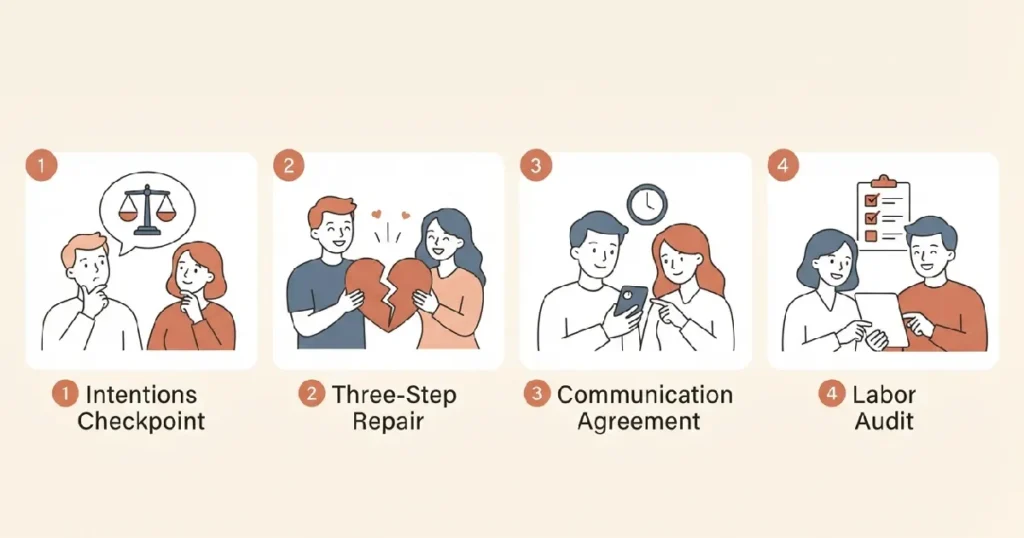
The Intentions Checkpoint. Somewhere around the two to three week mark of a new connection, ask directly what the two of you are building. Notice whether the answer matches the pattern of their actions, not just their words.
The Repair Script. The next time an argument starts to spiral, try naming it out loud: “I’m getting defensive, can we restart this.” Apologize for tone before you defend content. Then offer one small, concrete next step.
The Communication Agreement. If digital silence causes you anxiety, have an explicit conversation about it. Something as simple as “if you need space during a conflict, tell me how long, so I’m not guessing” removes an enormous amount of unnecessary suffering.
The Labor Audit. Every few months, sit down and actually list who’s handling what. Not to keep score, but to catch imbalance before resentment builds around it.
A useful question to ask yourself this week: in your current or most recent relationship, was safety something you felt, or something you were hoping for?
The Relationship You’re Ready For Now
You started this piece replaying an argument, wondering if something was wrong with you. It wasn’t.
What was missing wasn’t your capacity for love. It was a map of what healthy relationship qualities actually look like once you get past the slogans, the specifics of repair, safety, clarity, and attunement that no viral rule can fully capture.
A relationship isn’t healthy because the storms never come. It’s healthy because the boat knows how to right itself.
You now know what to look for, in a partner and in yourself. That’s not a small thing. That’s the entire difference between repeating old patterns and finally building something that holds.
My Closing Remarks
Here’s the part I don’t say enough out loud: the healthiest relationship I’ve ever watched wasn’t the quietest one. It was the messiest one that kept choosing to come back to the table. If you’re waiting for a relationship with zero friction before you call it healthy, you’ll wait forever, and you’ll miss the good ones standing right in front of you.
More Related Stories for You
- Before you commit to anything long-term, it helps to know what to discuss before marriage so clarity comes before the vows, not after them.
About The Author