
 Nicole Adkins
Why status, talent, and a packed calendar keep failing good people, and what actually holds up when life gets hard.
Key Points
- What makes a person successful in today’s job market has almost nothing to do with how busy or polished you look.
- The seven traits below are the ones psychology and real-world resilience research keep pointing back to, and every single one is learnable.
- You will leave this piece with a concrete way to build each trait into your week, starting tonight.
Contents
Table of Contents
We were sold a loud version of success. Packed calendars. Public wins. A personality that never powers down. We chased that version until our sleep thinned and our focus splintered, then we treated the leftover emptiness like a character flaw.
You know the aftertaste. You hit the number. The relief lasts less than an hour. Then the next demand walks in wearing a smile.
Someone might think the most successful people are the ones who never stop. But what they don’t see is how often that pace is panic wearing a productivity costume.
Someone might think raw talent is the deciding factor. But what they don’t see is how often talent folds the moment the work turns repetitive and no one is clapping.
Someone might think staying visible is how you stay valuable. But what they don’t see is the tax that visibility charges your working memory every single day.
What makes a person successful is a small set of internal traits that protect your attention, your judgment, and your word when conditions get hard. Image and talent are loud. These traits are quiet. They are what remains after the applause stops.
Your brain is not broken for wanting the loud version. It is old wiring doing an old job. Social rank once kept you inside the tribe. Immediate reward once kept you alive. Digital feeds now press those same circuits all day. That is why hustle can feel like safety even while it drains you. Left unexamined, this pattern does not just tire you out. It can quietly become the reason less flashy people pass you.
Psychologists who study emotion regulation, the skill of noticing a feeling without immediately acting on it, have found that a short pause between trigger and response protects judgment under stress. That pause is not a personality gift. It is a trainable trait. And it is only the first of seven.
Think of these traits as the keel of a boat. You never post a picture of the keel. Without it, the first hard wind turns you over.
Success Beyond Status, Image, and Raw Talent
People search for what makes a person successful when the old scoreboard stops making sense. The promotion arrived. The follower count grew. The tools got faster. You still feel one notification away from coming apart.
Visible success is a performance. Structural success is what you can still do on a bad Tuesday, with a delayed project, a sharp email, and a brain that wants to scroll.
Most people in this situation don’t realize they are measuring the wrong layer. They keep polishing the cabin while the keel is cracking.
Why Hustle Culture Fails When Real Pressure Arrives
Hustle culture trains you to treat rest like a leak and urgency like a virtue. It pairs well with algorithmic feeds because both reward speed, outrage, and comparison. Your nervous system pays the bill.
Toxic productivity is not ambition. It is a loop: more input, thinner attention, worse decisions, more input to outrun the last bad decision. Under real pressure, that loop does not make you formidable. It makes you reactive.
The people who look “on” all the time are often running on attentional residue, the leftover focus that clings to the last tab, the last slight, the last unfinished message. Residue is not laziness. It is a crowded mind trying to hold too many open files.
Why Quiet Execution Beats Public Recognition
Online, high performers keep repeating a simple consensus. Pick one skill and stay with it. Build a daily structure and keep it on the days you do not feel inspired. Do what needs doing when mood is absent.
That is not a vibe. It is private execution. Private execution is work that does not need an audience to continue. Public recognition can follow it. It cannot replace it.
If your sense of progress depends on being seen, you have outsourced your compass. The moment the feed goes quiet, so do you.
7 Traits That Make a Person Successful Under Pressure
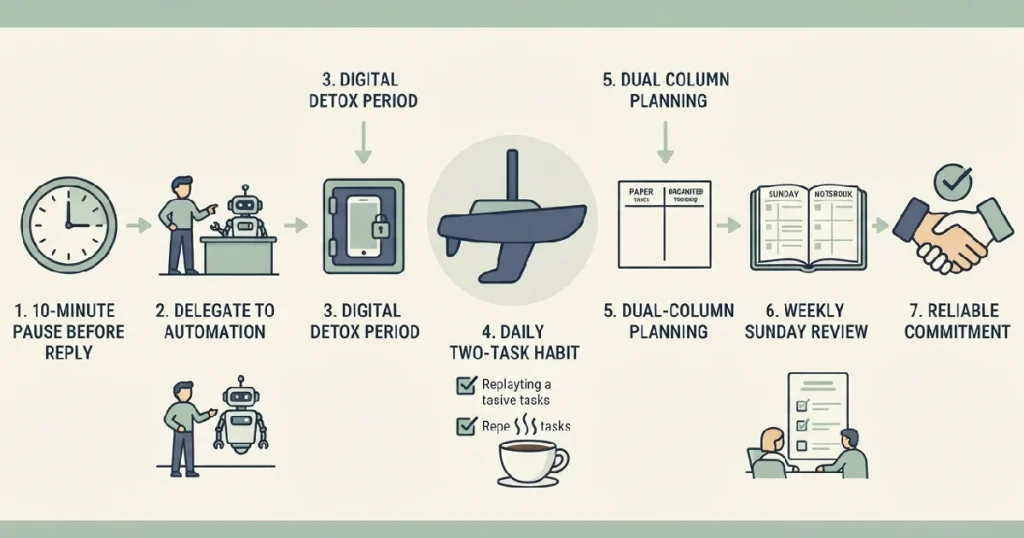
These seven traits are not a personality type. They are operating skills. You acquire them the way you acquire any skill: small, repeated, slightly inconvenient practice.
1. Radical Emotional Freedom
Radical emotional freedom is sovereignty over your reactions. It is the ability to say no without a guilt hangover, and to delay a reply until your thinking brain is back online.
Reactive decision-making wrecks careers in slow motion. A sharp Slack message. A public slight. A family demand dressed as an emergency. You answer from heat, then spend three days repairing a sentence that needed ten minutes of air.
The 10-Minute Emotional Buffer Window. When something digital or personal hits a nerve, you wait ten minutes before you respond. You stand up. You drink water. You write the unsent draft if you must. Then you decide.
In my practice I have watched capable people lose months of goodwill because they treated every ping like a fire alarm. A buffer is not coldness. It is adult timing.
Most people do not lack kindness. They lack a gap between feeling and sending.
2. Symbiotic AI Adaptability
The people who stall treat automation like a verdict. The people who keep moving treat it like a junior partner with no ego and infinite stamina. Success belongs to the human director: the person who can prompt, filter, and apply machine output without handing over judgment.
This is not about loving the tools. It is about refusing to compete with them at the tasks they already do faster.
Harvard Business Review has argued that real gains come from redesigning the work itself, not from simply cutting roles around new software. You can read that case for redesigning work around AI rather than shrinking people to fit the tool.
Prompt-First Workflows. For every complex cognitive task, spend the first five minutes mapping what a tool can draft, sort, or track. You keep strategy, taste, ethics, and the final call. The machine handles the scaffolding.
You are not becoming less human. You are stopping the unpaid internship you were doing for your own busywork.
3. Digital Dopamine Resistance
Digital dopamine resistance is the trait of guarding your biological attention span. Short-form video, notification loops, and public metrics are designed to fragment you. Fragmented people can still look busy. They cannot do deep work.
Attention is not a mood. It is a limited resource. Research on the modern productivity gap keeps returning to the same point: the scarce skill is not information. It is sustained focus. That case is laid out clearly in this review of why attention is the real productivity gap.
Environmental Isolation. During deep work hours, your phone leaves the room. A lockbox is not dramatic. It is furniture. Hardware blockers and a closed door beat willpower, because willpower is a poor bodyguard after 3 p.m.
Replace one scrolling block with analog reading or a single-focus hobby. You are not becoming boring. You are reclaiming the part of your mind that can finish a thought.
That’s not discipline theater. That’s wiring meeting design.
4. Boredom-Proof Systems
Boredom-proof systems are how you keep moving after the first wave of motivation dies. Consistency beats passion because passion is weather. Systems are climate.
James Clear has put this bluntly for years: the great threat to long-term progress is not failure. It is boredom, the moment a habit stops feeling novel and starts feeling ordinary. Successful people do not wait to feel like it. They run a baseline that does not negotiate with mood.
The No-Negotiation Baseline. Write two critical tasks that happen daily, even on low-energy days. Tie each to a cue. Immediately after morning coffee, you write for 45 minutes. After you shut the laptop, you review tomorrow’s one priority.
You are not trying to feel inspired. You are becoming the kind of person who shows up when inspiration is late.
5. Acute Failure Tolerance
Acute failure tolerance is rebound velocity: how fast you process a setback, pull the usable data, and move without dragging shame behind you like luggage.
Ideas fail faster now. Markets shift. Projects die. If every miss becomes a story about your worth, you will start taking smaller and smaller risks to protect an image that was never the real job.
Stanford’s student resilience work keeps returning to a useful reframe: stop treating failure as a verdict to resist, and start treating it as material you can use. Shame makes you hide the data. Curiosity makes you read it.
The Post-Mortem Protocol. When something breaks, fill two columns on paper. Column one: What was beyond my control. Column two: What is the data-driven lesson. You do this the same day, while the facts are still clean.
You are not pretending it did not hurt. You are refusing to let hurt become your entire analysis.
6. Intentional Solitude and Self-Awareness
Intentional solitude is scheduled time away from the hive so you can hear your own drivers. In a hyper-connected life, copying other people’s goals is easy. It is also how you wake up successful on paper and homesick in your own week.
Self-awareness here is not journaling as performance. It is an audit of motive. Habit, fear, and genuine direction often wear the same calendar invite.
The Sunday Cognitive Audit. Thirty minutes, fully offline, physical notebook. Two questions only. What did I do this week out of habit or fear? What lined up with my long-term vision?
If you cannot answer the second question, you are living on borrowed ambition. Borrowed ambition looks impressive until it asks you to pay with a life you do not want.
7. High-Trust Ethical Credibility
High-trust ethical credibility is your word treated as currency. In a market flooded with synthetic content, spam, and shallow networking, people who keep small promises become rare. Rare things get priced like assets.
This is not branding. It is behavior. You honor commitments. You tell the truth early. You treat every tier of coworker as a full person. Humility is not self-erasure. It is accurate scale.
Over-Communication of Intent. Never let a shifted deadline arrive as a surprise. Own the miss before someone has to chase you. Keep micro-commitments: the 9:00 call, the follow-up note, the “I’ll send that today.”
Trust compounds in the boring hours. It also collapses there.
Elena Stops Performing Success
Elena was 36, a product lead in Manchester, good at being the person who answered first. After a round of tool rollouts at work, she started checking her phone before her feet hit the floor. She said yes in meetings to stay liked. She posted a tidy Friday recap she did not believe. She called it drive.
What she did not call it was fear.
The week she changed was unromantic. She put the phone in a kitchen tin during two morning blocks. She waited ten minutes before answering a pointed email from her director. She wrote two non-negotiables on a card: one deep-work block, one honest status update before anyone had to ask. On Sunday she sat with a notebook and admitted that half her week had been impression management.
Nothing viral happened. Her sleep came back first. Then her judgment. Then a quieter kind of respect from the people who actually had to rely on her. She did not become a different personality. She became harder to knock over.
Micro-Habits That Build These Success Traits

You do not install seven traits in a weekend. You install cues.
The Buffer Cue. Pair the 10-minute wait with a physical act: stand, water, unsent draft. The body leads the mind out of the spike.
The First-Five Map. Before you “just start” a complex task, list what a tool can draft and what only you can decide. Five minutes. Then begin.
The Phone Exile. One daily deep-work window where the phone is not in the same room. Start with 45 minutes. Protect it like a meeting with someone you respect.
The Two-Task Floor. Identity-based triggers beat motivation. “After coffee, I write.” “After lunch, I send the honest update.” If-then plans, sometimes called implementation intentions, work because they remove the debate.
The Same-Day Post-Mortem. Two columns. Same day. No speech to yourself about being a failure. Just control versus lesson.
The Offline Half Hour. Sunday. Notebook. Two questions. If you skip it, you will spend the next week living someone else’s definition of a good life.
The Micro-Promise Log. Track the small commitments you kept. Credibility is easier to feel when you can see it.
A useful question to ask yourself tonight: Which of these seven is already quietly working, and which one do I perform in public while neglecting in private?
The next time a ping arrives with heat in it, try the buffer before you try to be impressive.
Building Your Invisible Infrastructure
Status, image, and raw talent look like the whole story until the weather changes. Then you find out what you actually built.
What makes a person successful, when the room goes quiet and the tools get faster and the feed still wants a piece of you, is the keel. Emotional freedom. Directed use of machines. Protected attention. Boring systems. Fast recovery. Honest solitude. A kept word.
You do not need a new personality. You need an infrastructure nobody else has to clap for.
The person who lasts is the one who built their character when nobody was watching.
My Closing Remarks
I keep meeting people who are not untalented. They are overexposed. They have trained every muscle except the ones that sit still, tell the truth, and wait ten minutes. If that is you, nothing is wrong with your drive. Something is overcrowded in your days. Start smaller than your pride wants. One buffer. One closed door. One promise you actually keep. That is how a life stops performing success and starts holding it.
More Related Stories for You
- The same discipline that protects your word at work also protects good advice for a relationship at home, because trust is built in the small hours either way.
About The Author