
 Sara Carmen
Agreeing with everything she says won’t make her stay. It might be exactly what drives her away.
Key Points
- The signs of a weak man are rarely about anger or aggression they are about the quiet collapse of identity, accountability, and personal conviction.
- Signs of a weak man include chronic people-pleasing, emotional avoidance, and the inability to hold a firm position under social pressure.
- Recognizing these patterns is the first step toward building the kind of strength that makes relationships thrive, not fracture.
Contents
Table of Contents
You Think You’re Being the Perfect Partner. She’s Slowly Losing Respect.
You never argue. You agree with almost everything she says. When she shares an opinion, you nod along. When she wants something, you give it. You have told yourself that this is what a good partner looks like — patient, accommodating, conflict-free.
But something is wrong. You can feel it in the way she looks at you. Or stops looking at you.
She seems frustrated, distant, or just… bored. And you cannot figure out why. After all, you have been nothing but agreeable. Nothing but supportive. Nothing but nice.
Here is the part that will sting and also set you free: that “niceness” might be the very thing quietly destroying your relationship.
What We Get Wrong About Emotional Strength in Men
Most people think a weak man is someone who cries too much, or who fails to provide financially, or who lacks physical toughness. That is not what we are talking about here.
The kind of weakness that ruins relationships is far more subtle. It is the internal collapse the absence of a defined self, clear values, and the courage to hold your ground when it would be easier to fold.
Psychologists call this a lack of differentiation, a concept developed by family therapist Dr. Murray Bowen. Differentiation, in plain language, is your ability to maintain a clear sense of who you are even when the people you love put pressure on you to be someone else. Men who score low on this scale tend to merge with their partner’s emotions, opinions, and preferences and they lose themselves in the process.
Research published in the Journal of Marital and Family Therapy consistently links low differentiation in men to higher rates of relationship dissatisfaction, emotional enmeshment, and eventual partner withdrawal. In plain terms: when you have no spine of your own, the relationship loses its backbone entirely.
Left unexamined, this pattern does not just strain relationships. It can quietly become the reason they end.
The Signs of a Weak Man That Erode Attraction and Trust
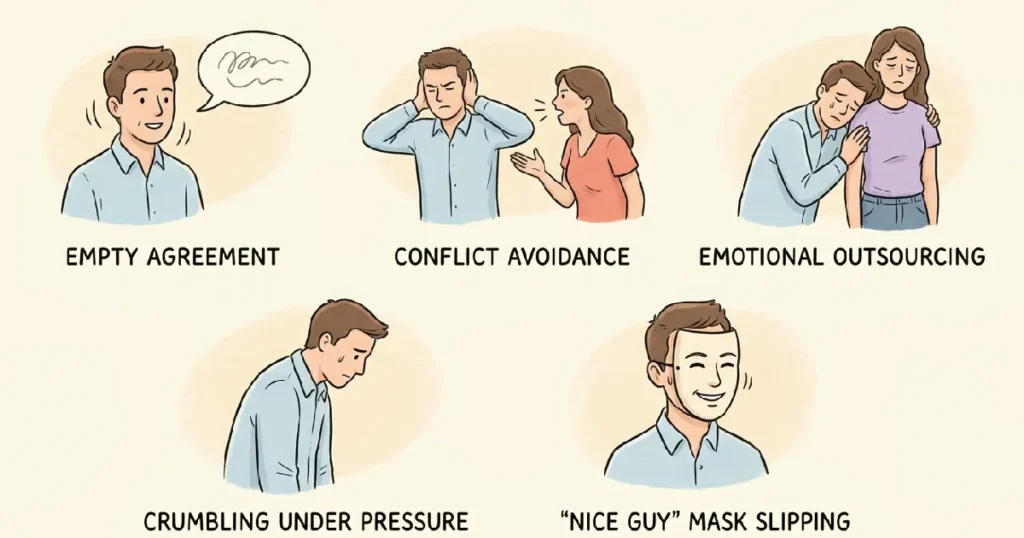
1. He Agrees With Everything and Stands for Nothing
There is a man I will call Daniel. He came to therapy because his girlfriend of three years had ended the relationship and told him she no longer felt “a spark.” Daniel was devastated. He had spent three years going wherever she wanted to go, watching whatever she wanted to watch, and enthusiastically endorsing every opinion she held — even when he privately disagreed.
He thought he was being selfless. She experienced him as having no self at all.
This is the trap of chronic agreeableness. When you never push back, never share a contradictory view, never draw a line you stop being a person and start being a mirror. And you cannot build a real relationship with your own reflection.
According to research from the University of California, Berkeley, authentic self-expression — including respectful disagreement — is one of the strongest predictors of long-term relationship satisfaction. Partners who can voice their real opinions, even conflicting ones, report deeper trust and emotional connection than those who keep the peace at all costs.
Here is the thing no one tells you: having a firm opinion is not aggression. It is self-respect made visible. If she says she thinks it is perfectly fine for her to have close male friends who text her daily, and you genuinely feel differently about that, say so. Not with anger. Not with ultimatums. But with calm, grounded honesty. “That is not something I am comfortable with, and here is why.” That is not controlling behavior. That is a man with values. And values are attractive.
2. He Cannot Handle Conflict Without Crumbling or Exploding
A man who lacks emotional strength shows up in conflict in one of two ways. He either goes completely silent and shuts down — what psychologists call stonewalling or he escalates into defensiveness, blame-shifting, or emotional outbursts. Both responses have the same root: he has never learned to sit with discomfort and respond from a regulated place.
Stonewalling, in particular, is one of the four behaviors that relationship researcher Dr. John Gottman identified as predictors of relationship failure he called them the “Four Horsemen.” It communicates to your partner that her feelings are not worth engaging with.
The cost of this pattern is enormous. Each unresolved conflict becomes a brick in a wall that eventually separates you from the person you love most.
But here is what no one tells you.
Conflict is not the enemy of intimacy. Avoidance is. The couples who fight well who stay in the room, stay curious, and stay connected even when it is hard are the ones who last.
3. He Outsources His Emotional Regulation to His Partner
This sign of a weak man is perhaps the most damaging, and the least talked about. It happens when a man relies on his partner to manage his moods, calm his anxiety, and give him a reason to feel okay about himself.
When she is happy, he feels good. When she is upset, he panics. When she is distant, he becomes desperate for reassurance. His internal emotional world is entirely dependent on her emotional state.
This is called emotional fusion the inability to self-soothe or self-regulate without another person’s input. It feels like love from the inside. It feels like suffocation from the outside.
Over time, a partner in this dynamic begins to feel less like a girlfriend or wife and more like an emotional caretaker. Research from the American Psychological Association confirms that partners who carry this kind of unequal emotional load report significantly higher rates of burnout, resentment, and eventual disengagement from the relationship.
She did not sign up to be your therapist. She signed up to be your partner.
4. He Collapses Under Pressure Instead of Growing Through It
Life will test you. Job loss. Family crises. Health scares. Financial stress. The question is not whether these moments will come it is who you are when they arrive.
A man who avoids accountability, blames external circumstances, and looks for someone else to solve his problems signals to his partner that she is carrying the relationship alone. This is not about toxic stoicism — suppressing every emotion and “man up” culture. That is its own brand of weakness.
True strength is the ability to feel the full weight of difficulty, stay emotionally present, and take purposeful action anyway. It is saying “I do not know how we will get through this, but I am not going anywhere” — and meaning it.
5. He Uses Niceness as a Mask for Avoiding Accountability
This is the insight differentiator the sign that almost no one writes about directly.
Being “too nice” is not a virtue when it is used to avoid being honest. Many men who display the signs of a weak man are not unkind people. They are afraid people. They are terrified of disapproval, conflict, and rejection so they cover that fear with an exhausting performance of agreeableness.
The mask looks like kindness. But underneath it, there is no real accountability, no genuine vulnerability, and no honest self-expression.
Think of it this way: chronic niceness is like painting over a crack in the wall. It looks smooth for a while. But the structural problem underneath keeps growing, and eventually, the whole surface gives way.
Real kindness comes from security, not fear. It is generous because it chooses to be not because it is afraid of what happens if it says no.
How to Build the Kind of Strength That Holds a Relationship Together
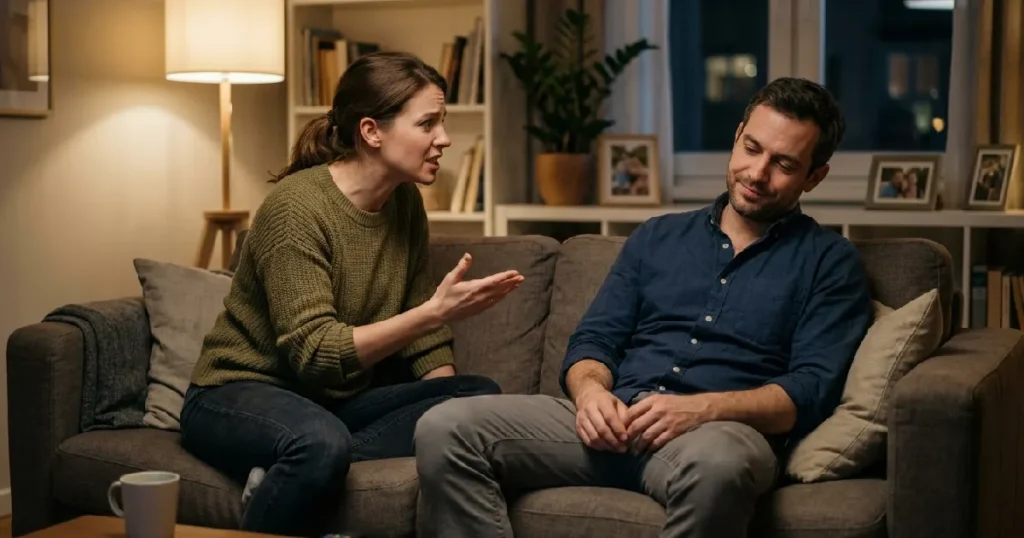
The Grounded Opinion Practice
Start small. The next time you are asked your opinion on a restaurant, a movie, a decision give a real one. Not the one you think she wants to hear. Yours. This is not about being contrarian. It is about practicing the habit of knowing what you actually think and saying it out loud.
Over time, extend this into larger conversations. When you disagree with something she says, try: “I see it a bit differently. Can I share why?” That sentence opens a conversation instead of closing one.
The Pause and Name Method
When conflict arises and you feel the urge to shut down or explode, pause for ten seconds. Name what you are feeling internally — even just to yourself. “I am feeling defensive right now.” That moment of self-awareness is the difference between reacting and responding.
Emotional labeling, as studied by UCLA psychologist Matthew Lieberman, has been shown to reduce the intensity of emotional reactivity in the brain. Naming the emotion literally calms the neurological storm. It works. Try it.
The Identity Audit
A useful question to ask yourself: “What do I actually believe, value, and want when no one is watching and nothing is on the line?”
If you cannot answer that with confidence, the work begins there. Because a man who knows who he is does not need to perform niceness to earn approval. He can be kind from a place of genuine strength and that kind of man is someone worth staying with.
The Relationship You Want Is Built on the Man You Become
Here is the honest truth: the signs of a weak man are not character flaws written in stone. They are patterns — learned, practiced, and deeply familiar. Which means they can be unlearned.
The goal is not to become harder, colder, or less caring. The goal is to become more fully yourself — grounded in your values, honest in your opinions, and present in your emotions without being swallowed by them.
That kind of man does not beg for love. He earns it by being real.
A relationship cannot be built on the foundation of a man who has disappeared inside his own agreeableness.
Strength does not push love away. Pretending to have none does.
My Closing Remarks
I have sat with men in my office who genuinely believed that never disagreeing, never pushing back, and never taking up space was the safest way to be loved. And every single one of them was slowly being left — not because their partner stopped caring, but because there was no real person left to care about. I will say this as a friend: the bravest thing you can do in a relationship is show up as yourself opinions, edges, and all. That is not a risk. That is the only way love actually works.
More Related Stories for You
- Want to understand another way men quietly drive women away? Read about why girls dislike men who are overly stingy it is more about character than money.
About The Author