
 Sara Carmen
Sharing too much, too soon, signals something she can’t ignore and it isn’t vulnerability. It’s instability.
Key Points
- You should never tell a woman your problems in the early stages of dating because it shifts the dynamic from attraction to caretaking before a real bond exists.
- When you vent your stress, complaints, and worries to her too soon, you inadvertently signal emotional dependence and that quietly erodes her sense of safety with you.
- The men who build lasting attraction lead with emotional steadiness, not emotional absence. There is a critical difference between being open and being a burden.
She Asked How You Were Doing. You Told Her Everything.
You are three weeks into dating someone new. She texts you on a Tuesday afternoon “How’s your day going?” and something in you just opens up.
You tell her about your difficult boss. The financial stress you have been carrying. The frustration with your apartment situation. The argument you had with your brother last month that still hasn’t been resolved.
She responds warmly. She seems caring. You feel relief.
But something shifts after that. Her replies get a little slower. The energy between you feels slightly different. You can not quite name it, but something is off.
You didn’t do anything wrong on the surface. But beneath it, something important happened that most dating advice completely ignores.
The Psychology Behind What She’s Actually Checking For
Here is what no one tells you.
When a woman asks how you are doing in the early stages of dating, she is not just making conversation. On a deeper, instinctual level, she is running a quiet check. The question she is really asking not consciously, but emotionally is: “Is he someone I can feel safe with?”
This is not a manipulation. It is wiring. Research in evolutionary psychology suggests that women, across cultures, place high value on a partner’s capacity for emotional regulation and social competence particularly in the early stages of relationship formation. A 2021 study published in Evolutionary Psychological Science found that emotional stability consistently ranked among the top traits women assessed when evaluating a potential long-term partner.
Emotional regulation simply means the ability to manage your feelings without being overwhelmed by them or offloading them onto others. It does not mean suppressing emotion. It means handling stress in a way that does not destabilize the people around you.
When you unload your problems early, before trust and deep connection have been built, you are not showing vulnerability. You are showing that you have not yet developed the container to hold your own life. And that reads, on a very primal level, as instability.
The Difference Between Openness and Emotional Dumping
This is where the conversation gets more honest and more useful.
There is a version of emotional openness that is deeply attractive. It looks like a man who can say, “Work has been intense lately, but I’m figuring it out,” and then genuinely move on. That communicates self-awareness without dependency. It tells her: I have weight in my life, and I carry it.
Then there is emotional dumping. That looks like cataloguing your grievances, venting about the country, complaining about your friends, describing your financial anxieties in detail, and doing it all before you have even established a real foundation together.
Think of it this way: emotional sharing early in dating is like setting a table. You want to put a few meaningful things on it enough to show there is substance here, that you are a real person with a real life. But if you pile the entire contents of your kitchen onto that table before she has even sat down, the table collapses. And so does the impression.
In my clinical work, I have seen this pattern more times than I can count. A man who is genuinely good-hearted, interesting, and capable but who, because of loneliness or habit or a lack of close male friendships, has started using romantic relationships as his primary emotional outlet. And it costs him, every time.
What She Feels When You Constantly Vent to Her
Let’s walk through what actually happens inside her experience when you make this a habit.
Meet Daniel. He met someone he genuinely liked smart, warm, funny. On their third date, he started venting about his job situation. By the fifth, he was complaining about the economy, his family, and his general sense that things were not going his way. She was kind. She listened. She even offered advice.
But privately, she told her friend: “I feel more like his therapist than someone he’s dating.”
That sentence is the whole problem, captured perfectly.
When you use a woman as your primary emotional dumping ground especially before deep intimacy has been earned through time, trust, and mutual investment you shift her role from romantic partner to emotional caretaker. Research on relationship dynamics consistently shows that this imbalance, where one person provides emotional labor disproportionately, creates resentment and emotional fatigue in the caretaker, and reduces attraction significantly.
She stops seeing you as someone who adds to her life. She starts seeing you as someone who needs to be managed.
And desire does not live in that space.
But Here’s What No One Tells You.
Constant negativity and venting do not just lower your attractiveness. They signal something specific to her nervous system: “I am not safe here.”
Not unsafe in a threatening sense. Unsafe in the sense that she cannot relax around you. Because if you are always in distress, always complaining, always offloading emotional weight onto her, she can never fully settle. She is always bracing for the next download.
A landmark study by psychologist John Gottman found that emotional flooding the state of being overwhelmed by a partner’s negative emotion is one of the strongest predictors of relationship breakdown. Even in the early stages of dating, chronic negativity from one partner creates a stress response in the other that slowly erodes connection.
She asked how you were doing because she was hoping to feel good being with you. When the answer is always heavy, always frustrated, always someone else’s fault she stops asking. Not because she is cold. But because self-preservation is not a character flaw.
The Insight Most Men Miss: Where Your Problems Actually Belong
Here is the reframe that changes everything.
Your problems are real. Your stress is valid. Your frustrations deserve to be expressed and processed. This is not about stuffing it all down and performing a fake happiness that fools no one.
It is about where those conversations belong.
Men need other men. Not because women are incapable of support they are often extraordinarily good at it but because your male friendships, your mentors, your accountability partners, are the correct first container for your problems. You process with them. You seek solutions with them. You work through the weight of your life in spaces built for exactly that.
Then, when you come to her, you bring something different. Not a performance. Not a mask. But a version of yourself that has already done the internal work who can share from a place of reflection rather than raw reaction.
There is a reason that men with strong male friendships consistently report higher relationship satisfaction and are rated as more emotionally attractive by their partners. It is not a coincidence. Those friendships act as a pressure valve, so no single relationship especially a new one has to bear the weight of everything.
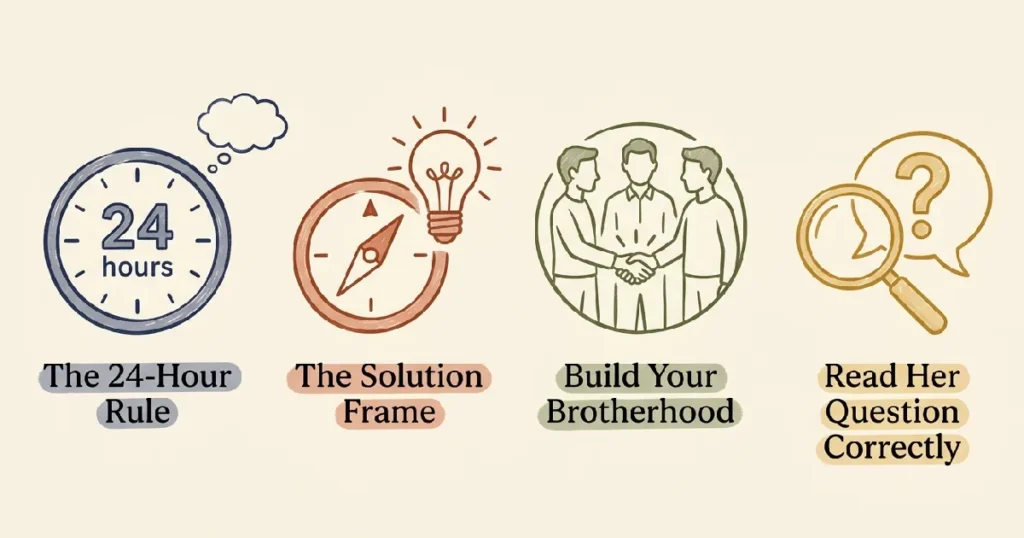
Four Practical Shifts You Can Make Starting This Week

1. The 24-Hour Rule
When something heavy happens, give yourself 24 hours before you bring it to her. Use that time to talk it through with a friend, write it out, or sit with it long enough to have some perspective. What you bring to her after that window will be insight, not raw venting.
2. The Solution Frame
When you do share a challenge, frame it around what you are doing about it, not just what is wrong. “Work has been rough this month, but I’ve been thinking about how to approach it differently” is entirely different from “My boss is impossible and nothing is working.” One shows leadership. The other shows helplessness.
3. Build Your Brotherhood
One place to start is identifying one or two men in your life a friend, a brother, a mentor with whom you can speak honestly about what you are carrying. If those relationships do not yet exist, building them is one of the most important investments you can make, both for yourself and for your romantic relationships.
4. Read Her Question Correctly
The next time she asks how your day was, notice what is happening in you before you answer. Are you about to share, or are you about to unload? There is a difference. Sharing is intentional. Unloading is reflexive. You get to choose which one you do.
The Man She Wants to Stay With
Emotional steadiness is not about being a stoic wall. It is not about pretending life is perfect or hiding who you are.
It is about being the kind of man she can lean on not because you have no problems, but because you handle your problems with enough grounded ness that being with you feels like solid ground, not shifting sand.
That is what she is looking for when she asks how you are doing. Not perfection. Not performance.
Just someone who holds himself together well enough that she feels safe enough to hold herself together around him.
The men who understand this do not just become more attractive. They become the kind of partner someone genuinely does not want to lose.
Your emotional leadership is the most quietly powerful thing you bring to any relationship. Start using it.
My Closing Remarks
I am going to be direct with you the way I would with a close friend sitting across the table from me. I have watched brilliant, kind, genuinely lovable men lose real connections because no one ever told them that their loneliness was showing up at the wrong door. Not because they were weak but because they were isolated, and she was warm, and it felt like relief. I get it. But a woman cannot be your therapist, your best friend, and your romantic partner all at once not in the beginning. Build the network that holds you. Then bring her the best of what that man looks like.
More Related Stories for You
- If you found this useful, you might also want to read about why girls dislike men who are overly stingy another subtle pattern that quietly signals low value early in dating.
About The Author