
 Sara Carmen
The real issue isn’t how much money you have. It’s what your relationship with money says about you.
Key Points
- Girls dislike men who are overly stingy not because they want luxury, but because extreme tightness signals fear, insecurity, and a closed emotional world.
- The psychology of generosity in relationships shows that how a person gives or refuses to give reveals their deeper capacity for emotional openness and partnership.
- Stinginess in dating is often a symptom of financial anxiety that can be addressed with both mindset shifts and practical income changes.
Contents
Table of Contents
The Moment She Stopped Calling Back
You take her out. Dinner goes well. The conversation flows. Then the bill arrives, and something shifts in you — a familiar tightness in your chest. You calculate. You hesitate. You suggest splitting it, even though you asked her out. She smiles and agrees, but something in her eyes has changed.
She texts a little less after that. You wonder why.
Here is what almost no one will tell you directly: it probably was not the split bill itself that pushed her away. It was what that moment revealed about how you move through the world — how freely, or how fearfully.
What Stinginess Actually Communicates
Let us be precise here, because “stingy” is a word that gets thrown around loosely. There is a big difference between being financially responsible and being chronically withholding. Responsible people make thoughtful choices. Stingy people grip every dollar as if releasing it costs them something beyond money.
And that grip — that emotional tightness around resources is what women tend to pick up on. Not always consciously, but consistently.
According to a study published in the Journal of Personality and Social Psychology, generosity is one of the top traits people seek in long-term romantic partners, ranking alongside kindness and emotional warmth. Researchers at the University of Notre Dame have found that generous behavior in relationships predicts higher relationship satisfaction for both partners. The act of giving, it turns out, is not just a nicety. It is a form of relational communication.
When you are overly stingy, the message you send is not “I am careful with money.” The message is “I am not sure you are worth it.” And whether or not that is what you mean, it is what she hears.
The Deeper Psychology: Why Stinginess Develops
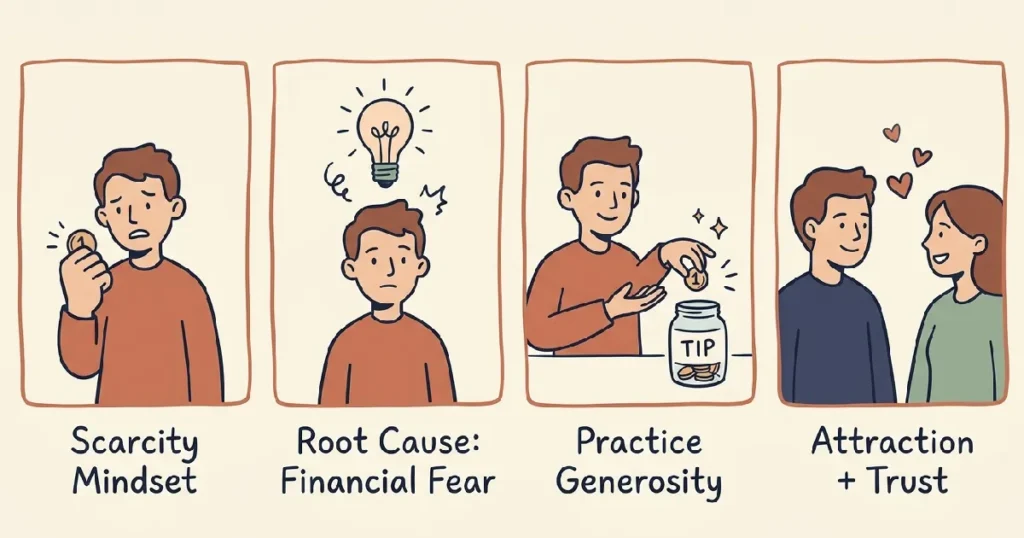
Here is something that most dating advice skips entirely: stinginess is rarely about greed. In my clinical experience, extreme financial tightness almost always traces back to anxiety specifically, a scarcity mindset. This is the deeply held belief that resources are always running out and that generosity is a threat to your own survival.
Scarcity mindset is not a character flaw. It is a learned response, often developed during years of financial stress or instability. When money has been genuinely tight for a long time, the brain learns to protect every dollar like a soldier guarding a post. The problem is that this protective mechanism does not switch off just because your financial situation improves or even because you are on a date with someone you care about.
Think of it this way: a stingy heart is like a fist that has been clenched for so long it has forgotten how to open.
That image matters. Because the goal is not to force the fist open through willpower. The goal is to understand why it closed in the first place and then address that root cause directly.
Why Girls Really Dislike Men Who Are Overly Stingy
1. Stinginess Signals a Closed Emotional World
Generosity and emotional openness are psychologically linked. This is not a theory it is well-supported in relationship science. According to research featured on Psychology Today, people who score high on generosity also tend to score high on empathy, emotional availability, and relational trust. These are exactly the qualities that make someone feel safe to love.
When a woman notices that a man is extremely reluctant to give whether that is money, time, compliments, or effort she begins to wonder about his emotional availability too. Is he going to be stingy with his affection? His time? His vulnerability?
The money is just the first data point. What she is really scanning for is the pattern.
But here is what no one tells you.
A man who is generous does not always have more money. He simply has a different relationship with what he has.
2. The Way You Handle Small Expenses Speaks Loudly
Consider Marcus, a composite example I will use to illustrate this. Marcus earns a modest income. He is not wealthy. But when he goes out with friends, he tips generously. When a colleague needs help, he gives his time without keeping score. When he dates someone new, he does not calculate every dollar he focuses on the experience he wants to create.
Women who dated Marcus consistently described him as “someone who makes you feel valued.” He did not have the biggest paycheck. He had the most open hands.
Research from the Greater Good Science Center at UC Berkeley confirms what Marcus lived out: generosity activates the brain’s reward centers not just in the receiver but in the giver. Practicing generosity literally changes how you feel about yourself and how others perceive you. It is one of the most underrated confidence builders available to any man.
The practical takeaway? Start small. Tip a little more than feels comfortable. Buy a coffee for someone without expecting recognition. These are not grand gestures they are recalibrations. You are teaching your nervous system that generosity is safe.
3. Financial Insecurity Is Often the Real Root And It Has a Real Solution
This is the insight differentiator most dating articles will not touch: the reason many men become stingy is not a moral failing. It is a structural one. When your income feels precarious when you are trading hours for a paycheck that barely stretches hoarding makes logical sense. You are not cheap. You are scared.
And that fear is valid. But it is also solvable.
According to the U.S. Bureau of Labor Statistics, the fastest-growing income opportunities in the modern economy are increasingly tied to digital skills freelancing, online services, remote consulting, and specialized technical knowledge. Men who have expanded their income through learning new online skills report not only better financial outcomes but also measurable reductions in financial anxiety.
Here is the honest truth: if stinginess is your default setting right now, the most powerful thing you can do is not force yourself to spend more. It is to build a financial foundation that makes generosity feel safe.
That might mean learning a new skill online copywriting, web development, digital marketing, a new language that opens international opportunities. It might mean taking a course that positions you for higher-paying work. The goal is to stop operating from a position of scarcity and start building from a position of capacity.
When money feels less like a shrinking resource and more like a renewable one, your fist begins to open on its own.
4. Generosity Is a Practice, Not a Personality Type
One of the most freeing things you can understand is that generous people are not born that way. Generosity is a behavior — and like any behavior, it can be practiced until it becomes natural.
research-backed content on relationships consistently shows that generosity not physical looks, not wealth ranks among the top traits that sustain long-term attraction. What women describe as “attractive generosity” is not expensive dinners. It is attentiveness. It is the small, consistent acts of giving that accumulate into trust.
You can begin practicing this today. The next time you are with someone, ask yourself: “What can I offer this moment?” It might be your full attention. It might be picking up the check. It might be a genuine compliment. Generosity is not a single transaction. It is a posture toward the people in your life.
Practical Application: Building a More Generous Version of Yourself

The Tip Test. For the next two weeks, tip 5% more than your usual amount at every restaurant or service interaction. Notice how it feels — the initial discomfort, then the small satisfaction. You are not wasting money. You are rewiring your scarcity response, one small act at a time.
The Skill Audit. Take 30 minutes this week and write down every skill you currently have and every one you have been curious about developing. Ask yourself: “If I learned this, could I earn more from it?” Identify one online course, certification, or skill that could open a new income stream within 90 days. Financial confidence is the foundation of emotional generosity.
The Presence Practice. Generosity is not always financial. The next time you are with someone you care about, put your phone away for the entirety of the interaction. Give them the one thing money cannot buy your undivided attention. Watch how it changes the dynamic.
The Reframe Question. When you feel that familiar tightness around spending, pause and ask: “Am I protecting myself from a real threat or a remembered one?” This question is not about guilt. It is about accuracy. Your present situation may be safer than your past feelings suggest.
You Are Not Stuck Here
Attraction is not a fixed formula. It is a living, breathing response to how you show up — your openness, your confidence, your willingness to give without calculating the return.
Girls dislike men who are overly stingy not because they are shallow or materialistic. They dislike it because stinginess communicates scarcity and no one wants to build a life with someone whose hands are always closed.
The good news is that the fist you have been carrying can open. Not through forcing yourself to spend money you do not have, but through building the financial foundation and the emotional habits that make giving feel natural — even joyful.
Your generosity is not just a dating strategy. It is a measure of who you are becoming.
Open hands attract open hearts.
My Closing Remarks
I want to say something to you directly, the way a friend would over coffee, not the way a therapist writes in a report: I have worked with men who were so financially anxious they could not tip a server without feeling physically ill. And every single one of them believed the problem was money. It was never money. It was the story they had been telling themselves for years about what would happen if they let go even a little. The moment they started building real income through real skills, and the moment they started practicing small acts of generosity, something in their entire presence changed. Women noticed. They always do. You are not broken. You are just operating an old program. And old programs can be updated.
More Related Stories for You
- Wondering if control plays a role in how men show up in relationships? You might find this deeply relevant: Is Control a Masculine Trait?
About The Author