
 David Wall
The story men are told about power, control, and strength has one critical flaw, it was never true to begin with.
Key Points
- Is control a masculine trait? Research suggests it is a learned cultural script, not a biological reality, and that script carries a heavy psychological cost.
- The psychological “illusion of control” our tendency to overestimate how much we influence complex, unpredictable events makes the grip tighter even as the outcomes slip further away.
- The most effective form of personal power today is not external dominance. It is the ability to stay grounded when you cannot control the outcome.
Contents
Table of Contents
The Moment Nobody Talks About
You are sitting across from someone you love a partner, a colleague, a friend and they are telling you something is wrong. Your instinct kicks in immediately. You start scanning for solutions. You map out the problem, line up possible fixes, and prepare your response before they have even finished speaking.
You think you are being helpful.
But something in their face shifts. They go quiet. And suddenly the conversation that was supposed to bring you closer has pushed you further apart.
This moment this specific, familiar, gut-punch moment is where the myth of control as masculine power stops being philosophical and starts being personal.
Where Did This Script Come From?
The idea that control is a masculine trait did not emerge from nature. It was assembled over centuries of cultural storytelling reinforced by war narratives, religious hierarchies, economic structures, and eventually, the media.
Boys are socialized early to associate emotional steadiness with strength and vulnerability with failure. “Be a man.” “Don’t cry.” “Figure it out.” These are not neutral phrases. They are instructions for building a psychological wall and calling it a fortress.
Sociological research from the American Psychological Association confirms that traditional masculine norms including emotional restriction, dominance, and the avoidance of help-seeking are significantly linked to higher rates of depression, anxiety, and relationship breakdown. Not because men are weaker. But because those norms were never designed for human flourishing. They were designed for survival in a very different world.
The trap is this: you were handed a map that was drawn for a territory that no longer exists.
The Illusion You Were Never Warned About
Here is something that changes everything once you understand it.
Psychologists call it the illusion of control a cognitive bias first studied in depth by researcher Ellen Langer in the 1970s, which describes our tendency to believe we have more influence over unpredictable events than we actually do. In plain terms, it is the mental trick that makes you feel responsible for things that were never fully yours to manage.
In everyday life, this shows up quietly. It looks like the manager who micromanages every detail of a project because delegation feels like losing ground. It looks like the partner who becomes irritable when plans change unexpectedly, not because the disruption is catastrophic, but because unpredictability itself feels threatening. It looks like the person who works 70-hour weeks convinced that if they just push harder, the anxiety will stop.
But the anxiety does not stop. It grows.
The more tightly you grip what you cannot fully control a partner’s emotions, a market shift, a child’s choices the higher your baseline stress becomes. This is not a character flaw. It is a predictable psychological response to a system that was never built to be controlled in the first place.
Left unexamined, this pattern does not just create personal stress. It quietly becomes the mechanism through which promising careers stall, relationships fracture, and health quietly erodes.
Three Real-Life Traps of the “Masculine Control” Script
Trap One: “Fixer” Mode Kills Emotional Connection
Consider Marcus. He is 41, a project manager, and by every external measure, a high-functioning adult. His team respects him. His boss trusts him. But at home, every time his wife tries to share her frustrations about work or parenting, he moves into problem-solving mode within seconds. He suggests strategies. He offers timelines. He presents solutions.
She stops telling him things.
Not because he is cold. But because the impulse to fix what someone else is feeling is, at its core, a refusal to simply be present with them. And presence not solutions is what emotional intimacy actually requires.
This is what the masculine control script costs in relationships. It replaces empathy with efficiency. And efficiency, however well-intentioned, does not make people feel loved.
Trap Two: Strength and Help-Seeking Cannot Coexist Or So You Were Told
Men who tie their self-worth to maintaining total control over their careers, finances, and emotional world show significantly higher rates of chronic stress and are measurably less likely to seek medical or mental health support until a crisis forces them to, according to research published in the Journal of Health and Social Behavior.
Asking for help has been coded as a loss of authority. So men wait. They push through. They white-knuckle it. And the cost of that wait in physical health, emotional availability, and relational safety is staggering.
Here is the pattern interrupt that most productivity culture will not print:
Asking for help is not a concession. It is a skill and an advanced one.
Trap Three: The Boardroom Myth Is Collapsing
The traditional image of masculine leadership commanding, decisive, emotionally closed off, always certain — is not just outdated. It is becoming an operational liability.
Modern organizational psychology consistently shows that psychological safety, the quality of a team environment where members feel safe to speak up, disagree, and take risks, is the single strongest predictor of high-performing teams. That kind of safety is not created through dominance. It is created through openness.
The leaders who are thriving in today’s collaborative, fast-changing workplaces are not the ones who project certainty they do not have. They are the ones who can say, “I don’t know let’s figure it out together,” without feeling their identity collapse in the process.
The Insight Nobody Else Is Naming
Here is the piece that most articles on this topic skip over entirely.
The desire to control is not really about control. It is about the intolerable feeling of not knowing what comes next.
Control is anxiety management in disguise.
When you trace any hyper-controlling behavior back to its root, you almost always find fear at the bottom fear of failure, fear of abandonment, fear of being seen as incompetent, fear of not being enough. The control behavior is not the problem. It is the symptom of an internal world that never learned to tolerate uncertainty without panicking.
This is the distinction that changes everything: the difference between external control trying to manage people, outcomes, and environments and internal agency the capacity to regulate your own responses when the world behaves unpredictably.
Think of it this way. External control is like trying to stop a river with your hands. Internal agency is knowing how to swim.
One exhausts you. The other carries you forward.
What “Controlled Vulnerability” Actually Looks Like
The most psychologically resilient people are not the ones who feel no fear. They are the ones who have learned to act with intention even when they do feel it.
Researchers who study emotional resilience describe this quality as the ability to experience uncertainty, discomfort, and even failure without those experiences defining your sense of self-worth.
That is a radically different proposition than “stay in control.” It asks something harder and more honest: Can you stay grounded when you are not in control?
This is what I call controlled vulnerability not emotional exposure for its own sake, but the strategic choice to remain open, present, and adaptable even when every instinct tells you to armor up.
It is not softness. It is one of the most demanding and genuinely powerful psychological postures a person can develop.
Practical Moves: From Illusion to Agency

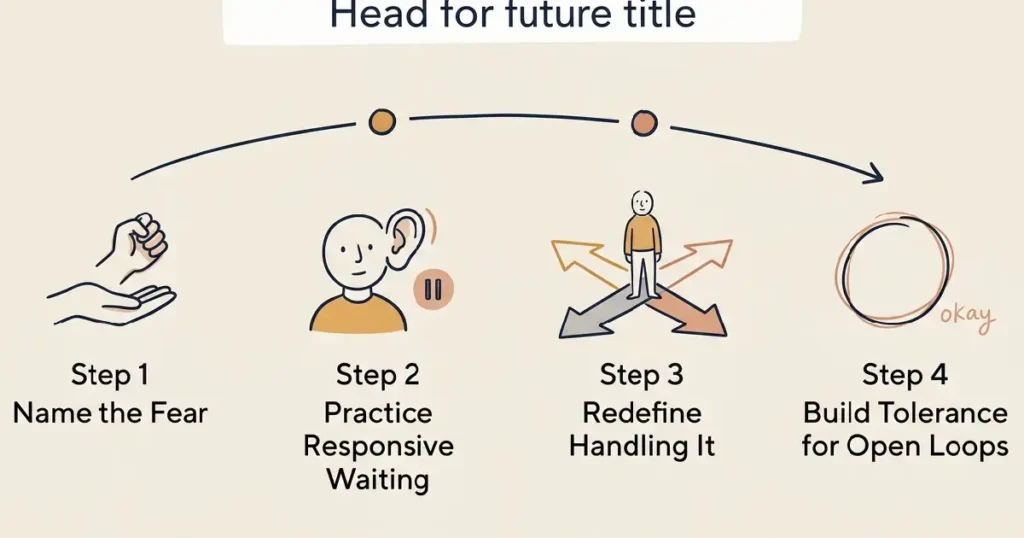
Name the Real Fear Underneath the Urge to Control
The next time you notice the impulse to micromanage a situation, a conversation, or an outcome, pause and ask yourself honestly: What am I actually afraid will happen if I let this go?
Write it down if you can. The answer is almost never about the situation itself. It is usually about your sense of worth, safety, or identity. Naming the fear does not eliminate it. But it stops the fear from driving while you sit in the passenger seat.
Practice “Responsive Waiting”
Instead of immediately offering solutions when someone shares a problem with you, try staying in the discomfort of simply listening for 60 seconds longer than feels natural. This is harder than it sounds, especially if you have been trained to treat silence as a vacuum that needs filling.
One place to start is asking: “Do you want me to help you think through this, or do you mostly need me to hear you?” That single question has repaired more conversations than almost any communication strategy I know.
Redefine What “Handling It” Means
Consider rewriting your internal definition of strength. Not as the absence of struggle, but as the presence of honest response. Handling something difficult does not always mean solving it. Sometimes it means sitting with it long enough to respond wisely rather than react defensively.
A useful question to ask yourself in high-pressure moments: “Am I responding to what is actually happening right now, or am I reacting to what this situation means about me?”
That distinction, between reality and self-narrative, is where real agency begins.
Build a Tolerance for Open Loops
For many people who over-rely on control, the most distressing thing is not the problem itself but not knowing how it will resolve. Practice leaving small things unresolved intentionally. Let a conversation end without a final answer. Let a plan remain loose. Notice that you survived the uncertainty. Repeated exposure to low-stakes ambiguity gradually expands your capacity to tolerate higher-stakes uncertainty without the psychological system going into emergency mode.
The Arrival
Remember Marcus, the project manager who was fixing instead of listening?
He is still the same man. He still solves problems for a living. But something shifted when he recognized that his impulse to fix was not about his partner it was about his own discomfort with feeling helpless in the face of her pain.
That recognition did not make him less capable. It made him more present. And presence, it turns out, was exactly what she needed.
You do not have to give up your strength to stop needing control. You just have to find out where your strength actually lives.
It does not live in the grip. It lives in the willingness to stay.
Real power was never about holding the world still. It was always about being steady enough to move with it.
My Closing Remarks
I will be honest with you in a way that most articles will not dare to be: the men I have seen crumble most completely were not the ones who faced the hardest circumstances. They were the ones who had spent decades believing that needing nothing and controlling everything was the same as being strong. By the time they reached out, the cost was already paid in lost relationships, in bodies broken by chronic stress, in a loneliness so deep it had no name. The script that told you control equals power has been lying to you. And you deserve to know that before the price gets higher.
More Related Stories for You
- If the idea that exaggerated masculinity shapes how men relate to power struck a chord with you, that piece goes even deeper into how performed toughness becomes a barrier to real connection and identity.
About The Author