
 David Wall
You were never meant to carry that armor. Here is the liberating, honest guide to escaping the prison of exaggerated masculinity forever.
Key Points
- Exaggerated masculinity is not a sign of strength it is a learned defense mechanism that quietly destroys your health, relationships, and identity.
- True masculinity is not built on volume, aggression, or emotional shutdown; it is defined by calmness, emotional control, and the courage to think before you react.
- Breaking free from toxic masculine norms is not about becoming less of a man it is about finally becoming a complete one.
Contents
Table of Contents
You Are Exhausted. And It Makes Perfect Sense.
You are standing in the middle of an argument maybe with your partner, your boss, your teenage son — and something shifts inside you. Your jaw tightens. Your voice goes up a register. You say something harder than you meant to, or you go completely cold and shut down. Either way, the moment passes, and you are left with that hollow feeling in your chest.
You know the one.
It is the feeling that what just happened was not really you. Or worse that maybe it is.
Here is what most conversations about masculinity get wrong: they focus entirely on behavior. They tell you to stop doing certain things. Stop being aggressive. Stop shutting down. Stop performing. But no one asks the real question: Why does it feel so necessary to perform in the first place?
That question is where this article begins.
What Exaggerated Masculinity Actually Is (And Why It Exists)
Exaggerated masculinity sometimes called hypermasculinity or toxic masculine norms in psychological literature is not simply “being manly.” It is a pattern where a man amplifies stereotypically male behaviors to an extreme: dominance, emotional suppression, physical toughness, aggression, and the rigid refusal to show vulnerability.
Think of it like this: real strength is a steady flame. Exaggerated masculinity is someone blowing a leaf blower at that flame to prove it exists.
It is not authentic. It is performance. And performance is exhausting.
But here is what makes this genuinely difficult to address: the pattern is not chosen out of stupidity or weakness. Research published in the Journal of Counseling Psychology found that men who endorse hypermasculine norms are significantly more likely to have experienced emotional invalidation in childhood meaning they learned, early and painfully, that emotional expression led to rejection, ridicule, or punishment. The mask was not vanity. It was survival.
That is important to hold onto. You did not build that armor because something was wrong with you. You built it because something hurt you and no one gave you a better tool.
The problem is that the armor you built for a younger version of yourself is now the thing keeping the adult version trapped.
The Body Keeps the Score — And So Do Your Relationships
Left unexamined, this pattern does not just strain relationships. It can quietly become the reason they end.
Men operating inside exaggerated masculinity experience measurably worse health outcomes. According to data from the American Psychological Association’s report on men and masculinity, adherence to traditional masculine norms — especially emotional stoicism and self-reliance is linked to higher rates of depression, cardiovascular disease, and reluctance to seek medical or psychological help.
Read that again. The very posture designed to project strength is systematically weakening you.
And relationally? The cost is just as real. Partners of men who suppress emotion consistently report feeling emotionally abandoned even when everything on the surface looks stable. Children of emotionally unavailable fathers internalize that distance as a personal failure. The armor protects nothing. It just keeps everyone, including you, at arm’s length.
But here is what no one tells you.
The men who finally put the armor down do not become weaker. They become more respected, more connected, and more capable of leading in every area of their lives.
The Insight Engine: Five Faces of Exaggerated Masculinity And What to Do Instead
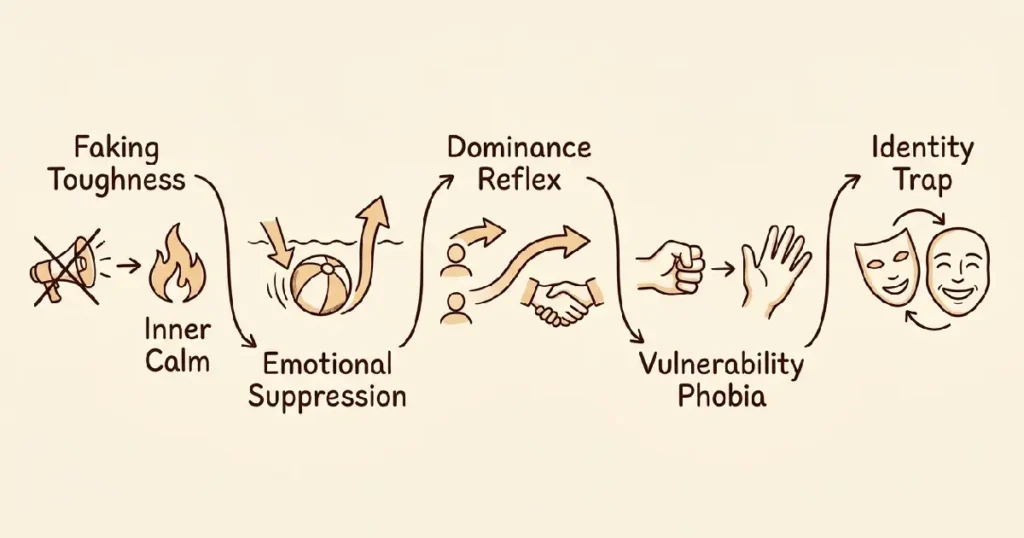
1. Faking Toughness (The Loudest Trap)
This is the habit most people recognize first: raising your voice, acting aggressive, posturing with body language, or projecting an image of hardness when you feel anything but.
Marcus, a 38-year-old father of two who came to couples counseling with his wife, described it this way: “I thought being loud meant I was being clear. I thought if I backed down, even once, everyone would stop taking me seriously.” His wife sat across from him and said, quietly, “I stopped feeling safe years ago. I just never told you.”
That sentence changed everything for Marcus.
Here is the psychological reality: research on emotional regulation consistently shows that reactive outbursts do not project confidence they signal a loss of internal control. People around you do not feel led by someone who is loud. They feel managed. There is a profound difference.
True masculinity is not built on volume. It is built on calmness.
A man who can sit with discomfort, process it without explosion, and respond with intention is not soft. He is operating at a level of self-mastery that most people never reach. Emotional control is not the absence of feeling it is the presence of power.
The next time you feel the urge to raise your voice or puff up, try what therapists call the Pause and Name technique: stop, take one full breath, and silently name what you are actually feeling beneath the anger. Is it fear? Embarrassment? Helplessness? Name it. That single act engages your prefrontal cortex the thinking part of your brain and begins to interrupt the reactive cycle.
2. Emotional Suppression (The Invisible Damage)
Many men who struggle with exaggerated masculinity are not aggressive on the outside. They are simply… absent. Checked out. They have become experts at neutralizing their emotional responses so efficiently that they no longer feel much of anything.
This is sometimes called emotional numbing, and it is not peace. It is a slow erosion.
The psychological mechanism here is important to understand: when you chronically suppress emotion, you do not eliminate it. You delay it and the delayed version is often larger, messier, and far less manageable. Suppressing an emotion is like holding a beach ball underwater. The harder you push, the more force it builds against you.
One place to start is building what researchers call emotional granularity the ability to identify and name feelings with precision rather than just registering a vague sense of “fine” or “stressed.” Studies by psychologist Lisa Feldman Barrett at Northeastern University suggest that people who can label their emotions with more specificity report lower emotional reactivity and better psychological resilience. Naming your experience does not make you fragile. It makes you precise.
3. The Dominance Reflex (When Control Replaces Connection)
This face of exaggerated masculinity is subtler and, in many ways, more damaging in long-term relationships. It shows up as needing to be right in every disagreement, dismissing your partner’s perspective, controlling household decisions, or feeling genuine anxiety when someone else leads.
The dominance reflex feels like strength. It functions like fear.
Men who need to control every room are, at their core, terrified of what happens if they do not. They were often taught directly or by example that yielding equals losing. But in relationships, the need to always win is a guaranteed strategy for losing the most important thing: trust.
A useful question to ask yourself in your next conflict: Am I trying to be right, or am I trying to understand? Those two goals are not compatible in the same moment. Choosing understanding is not defeat. It is the foundation of every meaningful connection you will ever have.
4. The Vulnerability Phobia (The Strength You Are Refusing)
Here is the insight differentiator most discussions of masculinity miss entirely: vulnerability is not the opposite of strength. Vulnerability requires more courage than aggression ever will.
Anyone can get loud when they are scared. It takes genuine fortitude to say, “I am struggling with this,” or “I made a mistake and I am sorry,” or simply, “I need help.”
The research on vulnerability conducted by Dr. Brené Brown at the University of Houston found that people who allow themselves to be vulnerable report significantly higher levels of connection, creativity, and — notably — leadership effectiveness. The most respected leaders in every field are not the ones who never show doubt. They are the ones who engage honestly with difficulty and remain present anyway.
Vulnerability, practiced with discernment, is not exposure. It is intimacy. And intimacy is the one thing that exaggerated masculinity will never be able to manufacture, no matter how hard it performs.
5. The Identity Trap (When “Being a Man” Becomes a Prison)
This is perhaps the deepest and least-discussed dimension of exaggerated masculinity: the fusion of self-worth with a performance of manhood.
When your identity depends entirely on being the provider, the protector, the unflinching one any crack in that performance feels existential. Job loss becomes a personality collapse. A moment of sadness feels like proof of inadequacy. Needing support from your partner feels like a transaction gone wrong.
Psychologists refer to this as contingent self-worth your sense of value is not internal and stable; it is contingent on meeting external standards. And those standards, when set by hypermasculine norms, are both impossible and constantly moving.
The reframe is this: you are not the role you were handed. You are the man who chooses which parts of that role to carry forward and which parts to put down. That choice is available to you. It has always been available to you.
The “Now What?” Four Practices to Start This Week

Practice 1: The Pause and Name Technique
Described above but worth repeating: before reacting, stop, breathe, and name the emotion beneath the surface reaction. Do this once a day not just in conflict, but in quiet moments too. Build the muscle before you need it.
Practice 2: The 10-Second Honesty Check
Before any important conversation, ask yourself: What do I actually want the other person to understand about how I feel? Not what you want to win. Not what you need to prove. What do you want them to understand? Speaking from that place changes everything about how the conversation lands.
Practice 3: One Deliberate Act of Asking for Help
This week, ask someone for help with something you would normally handle alone and silently. It can be small. The point is to practice the behavior and notice that the feared consequence being seen as weak does not materialize.
Practice 4: The Mirror Question
At the end of each day, ask yourself: Was I being genuine today, or was I performing? No judgment. Just honest observation. Over time, this single habit builds a level of self-awareness that quietly transforms how you show up everywhere.
You Were Never the Armor. You Were Always the Man Underneath It.
Remember Marcus, sitting in that therapist’s office when his wife told him she had not felt safe in years? He did not argue. He did not defend himself. For the first time in a long time, he just sat with it.
That was not weakness.
That was the bravest thing he had done in their entire marriage.
The beach ball of emotion he had been holding underwater for decades finally surfaced and instead of chaos, what came up was grief. And grief, when met with honesty, becomes the beginning of something real.
You do not have to keep performing. The version of strength you were taught, loud, dominant, unyielding, closed was never the whole story. It was a chapter someone handed you before you were old enough to write your own.
The armor kept you safe once. You do not need it anymore.
Real strength is not what you project. It is what you become when you finally stop pretending.
My Closing Remarks
I will be honest with you in a way most articles will not be: I have sat with men who have spent thirty years inside that armor and genuinely believed the armor was them. Watching someone realize, often through tears, that the person they suppressed was the most powerful version of themselves, that moment never stops being profound. You are not too far gone. You are not too old. You are not too broken. You are just overdue for a conversation with yourself that no one ever taught you how to have.
More Related Stories for You:
- Feeling nervous around girls is often rooted in the same performance anxiety that drives exaggerated masculinity and understanding that connection might be the most honest place to start
About The Author