
 David Wall
Your nerves around women aren’t a personality flaw. They’re a signal your brain has misread, and you can change that.
Key Points
- Being nervous around girls is driven by a threat-detection error in your brain, not a lack of confidence or character.
- The most effective way to stop being nervous around girls is not to eliminate the feeling but to rewire how you interpret it.
- Eight specific, research-informed strategies can shift your nervous system from threat mode to genuine connection mode, starting today.
Contents
Table of Contents
You Know Exactly How This Feels
You see her across the room. Maybe she’s standing in line at the coffee shop, laughing at something on her phone. She glances up. Your heart rate doubles. Your mouth goes dry. Your mind, which was perfectly functional two seconds ago, suddenly goes completely blank.
You want to say something. Anything. But the words won’t come, and by the time you’ve rehearsed seventeen different openers in your head, the moment is gone.
Sound familiar? You are not broken. You are not hopeless. And you are definitely not alone.
Why Your Brain Treats a Pretty Girl Like a Predator
Here is the psychological truth behind what happens when you get nervous around girls: your brain’s threat-detection system, called the amygdala, cannot always tell the difference between a dangerous situation and a high-stakes social one.
The amygdala is a small, almond-shaped structure deep in your brain that evolved to keep you alive. It detects threats and triggers your body’s fight-or-flight response. The problem is that it often fires in social situations the same way it would if you were facing a real physical danger. Your palms sweat. Your heart races. Your thinking brain goes offline.
This process is called social anxiety, and according to the National Institute of Mental Health, it affects roughly 12% of American adults at some point in their lives. For many men, it shows up specifically and intensely around women they find attractive.
The reason is simple: the brain registers romantic interest as high-stakes. You care about the outcome. And the moment you care deeply, the amygdala goes on red alert.
But here’s what no one tells you.
The nervousness you feel is not evidence that something is wrong with you. It is evidence that you are paying attention. The question is not how to make the feeling disappear. The question is how to change what the feeling means.
8 Ways to Stop Being Nervous Around Girls
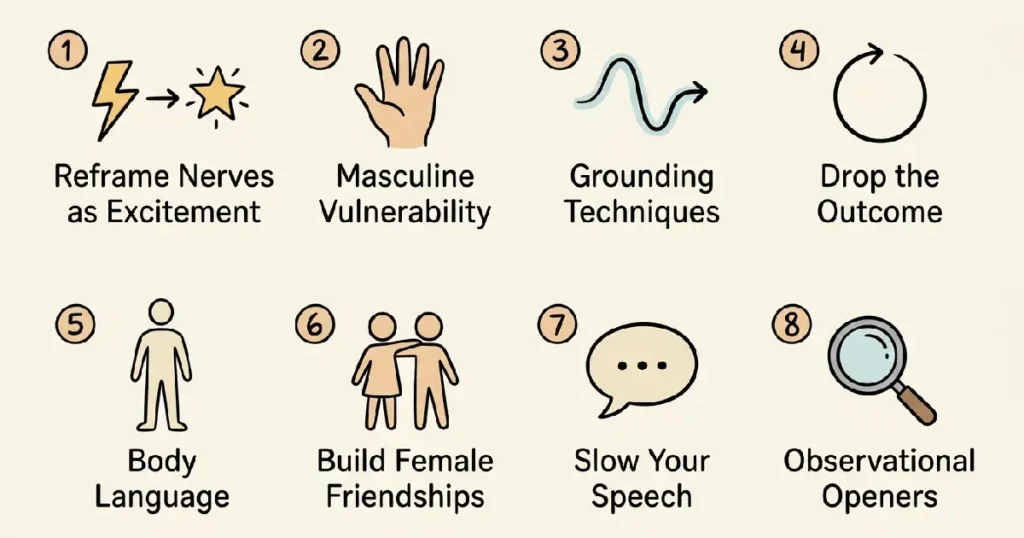
1. Reframe Your Nerves as Excitement
Your body cannot physically tell the difference between nervousness and excitement. Sweaty palms, a pounding heart, a dry mouth: these are identical in both states. The only difference is the story you attach to those sensations.
Psychologist Alison Wood Brooks at Harvard Business School found in a 2014 study that people who reframed their anxiety as excitement before a stressful performance significantly outperformed those who tried to calm themselves down. Telling yourself “I’m excited” rather than “I’m terrified” keeps your brain in an approach state rather than an avoidance state.
The next time you feel that familiar surge before approaching a woman, try silently saying to yourself: “I’m excited to see what happens here.” It sounds simple. It works because it is biologically accurate, and your brain responds to the story you tell it.
2. Practice What I Call Masculine Vulnerability
Consider Marcus, a 29-year-old engineer who came to me completely stuck in his head around women. He was intelligent, kind, and quietly funny, but the moment attraction entered the picture, he would freeze, overcorrect, and perform a version of himself that felt hollow. One afternoon, he tried something different. He walked up to a woman at a bookstore event, felt the familiar wave of nervousness, and instead of hiding it, he said simply: “I’m a little nervous approaching you, but I didn’t want to not say hello.”
She smiled, visibly relaxed, and they talked for forty minutes.
Vulnerability is not weakness. In the context of social confidence, being transparent about your nerves removes the performance pressure entirely. It signals emotional intelligence, self-awareness, and courage. Most women find that combination quietly magnetic. If you feel the rush of anxiety, you do not have to hide it. You can name it briefly and keep moving.
3. Ground Yourself Before You Speak
Anxiety lives in the future. It is fueled by “what if” thinking: What if she rejects me? What if I say something stupid? What if I blank out?
Grounding techniques pull your awareness back into the present moment, which is the only place confidence can actually exist. One of the most effective tools is a breathing pattern used in clinical settings: inhale slowly for a count of four, then exhale for a count of six. The extended exhale activates your parasympathetic nervous system, which is essentially your body’s built-in calm-down mechanism.
You can also try pressing your feet firmly into the floor before speaking, noticing the physical sensation of standing. It sounds small. It interrupts the anxiety spiral at the neurological level. Do this once before you walk over, and your voice will be steadier, your posture more open, your words more natural.
4. Drop the Outcome, Keep the Curiosity
This is the insight differentiator most dating advice misses entirely.
Nervousness spikes when you treat a woman like a goal to achieve rather than a person to meet. The moment you walk toward someone thinking “I need to get her number,” you have already created a success-failure binary in your mind, and your nervous system responds to that pressure like an exam you haven’t studied for.
The shift is this: replace the outcome goal with a curiosity goal. Instead of asking “How do I get her interested in me?”, ask “What is interesting about her?” Genuine curiosity is magnetic because it turns your attention outward. Women consistently report that men who seem genuinely interested in them, not as romantic targets but as actual human beings, are the ones they remember.
Think of it like this: nervousness is a spotlight pointed at yourself. Curiosity is a spotlight pointed at the other person. One creates pressure. The other creates connection.
5. Let Your Body Lead First
Physical tension communicates discomfort before you say a single word. Rolled-forward shoulders, a rigid stance, a clenched jaw: these are signals your nervous system broadcasts loudly, and people pick them up unconsciously.
To project ease without faking it, start with your posture before you start with your words. Drop your shoulders. Let your hands hang loose or rest comfortably. Maintain soft, natural eye contact: hold it for three to four seconds, glance away briefly, return. You do not need a rehearsed expression. A slight, relaxed smile communicates something a forced grin never can: that you are genuinely comfortable being here.
Your body is talking before you open your mouth. Make sure it is saying the right thing.
6. Build Platonic Friendships With Women
One of the most underrated strategies for overcoming nervousness around women is regular, low-stakes interaction with women you are not pursuing romantically.
When women are consistently part of your daily social world, as colleagues, friends, gym acquaintances, neighbors, the category of “attractive woman” stops being a rare and therefore high-pressure event. The anxiety around women is often sustained by unfamiliarity. Familiarity dissolves it.
You can learn more about how social exposure reduces anxiety through a process called habituation. Put simply, the more your brain encounters something without negative consequences, the less it flags it as a threat. Building genuine friendships with women is not a strategy to eventually convert into something romantic. It is an investment in your own social ease, regardless of where it leads.
7. Slow Down. Seriously, Slow Down.
Anxiety has a signature in speech: it makes you rush. You feel the social pressure, the silence feels unbearable, and your words start tumbling out faster and faster in an attempt to fill the void. The result is a frantic energy that communicates discomfort even when your words are perfectly fine.
Slowing your speech is one of the most powerful and immediate shifts you can make. It signals that you are not in a hurry to impress anyone. It gives your thoughts space to form properly. And, perhaps most interestingly, a comfortable pause before answering builds attention. It tells the person you are speaking with that what you are about to say is worth waiting for.
Practice this in low-stakes conversations first: at the grocery store, with a coworker, on the phone. Train your default speaking pace to be unhurried. When you bring that pace into a charged interaction, it reads as confidence, because in a very real way, it is.
8. Use Observational Openers Instead of Rehearsed Lines
The best opening line is never a line at all. It is an observation.
Rehearsed pick-up openers create pressure the moment you deliver them, because some part of you knows they are a performance. And women, who navigate these interactions far more often than most men realize, can feel the performance immediately.
Observational openers, grounded in the immediate shared environment, feel natural because they are natural. “Have you been waiting long?” at the coffee counter. “What do you think of this neighborhood?” at a street market. “Is this your first time at this event?” at a class or meetup.
These are not tricks. They are the actual architecture of how human beings start talking to each other. They are low-barrier, require no courage beyond showing up, and create genuine conversational momentum without any agenda attached.
You can read more about building social confidence through conversation skills and how natural communication beats scripted approaches every time.
Putting It All Together: Your 24-Hour Practice Plan

You do not need to overhaul your personality. You need one small, deliberate experiment.
In the next 24 hours, find one low-stakes interaction with a woman you do not know: a cashier, a barista, a coworker in the hallway. Practice one thing from this list. Just one. Maybe it is slowing your speech. Maybe it is making a simple observational comment. Maybe it is taking a four-count breath before you speak.
Notice what happens. Not to her, but to you. Notice whether the anxiety loosens even slightly when you stop trying to manage the outcome and start simply showing up.
A useful question to ask yourself afterward: “Was I focused on how I came across, or was I focused on the other person?” The answer will tell you everything you need to know about where your attention needs to go next.
For a deeper dive into this specific skill set, you might also find it helpful to overcome shyness toward girls through the approaches covered in our related guide.
You Were Never the Problem
Remember the coffee shop moment from the beginning? The blank mind, the missed window, the quiet frustration that follows you home?
Here is the new way to read that scene.
That surge of nervousness was not proof that you are socially incapable. It was proof that you are a human being with a nervous system that cares about connection. The brain that froze up on you is the same brain that, once it feels safe, can be genuinely warm, funny, curious, and present.
The nervousness was never the enemy. The meaning you gave it was.
And meaning is something you can change. Starting today. Starting with one breath, one observation, one honest moment of showing up as you actually are.
Confidence is not the absence of nerves. It is the decision to move toward someone anyway.
My Closing Remarks
I want to be honest with you in a way that most articles on this topic are not willing to be. I have worked with men who spent years convinced there was something fundamentally wrong with them because they got nervous around women. Brilliant, kind, deeply capable men who kept shrinking themselves based on a feeling that was never the whole truth. Here is what I have seen again and again: the men who break through this are not the ones who found a magic technique. They are the ones who got tired of letting a nervous system response make their decisions for them. You are allowed to be nervous and still walk over. That is not recklessness. That is courage.
More Related Stories for You
- Feeling this in a deeper way? Read our guide on how to overcome shyness toward girls for a step-by-step approach to building real confidence from the ground up.
About The Author