 Elena Garcia
Key Points:
- Petite fashion tips are not about hiding your height they’re about directing how the eye moves across your body to create the visual impression of length.
- The right petite fashion tips use your brain’s own perception wiring against itself, making strategic clothing choices more powerful than any pair of heels.
- Following proven petite fashion tips can shift not just how you look, but genuinely how confident and at ease you feel in your own skin.
Contents
Table of Contents
Your Clothes Are Either Working For You or Against You Here’s the Difference
You open your closet on a Tuesday morning, already running late. You grab your favorite wide-leg trousers and an oversized sweater, and for a split second, you feel good. Then you catch a glimpse of yourself in the hallway mirror and something just feels… off. Shortened. Swallowed up. You can’t quite name it.
It’s not your body. It’s the proportion math.
This is the single thing most petite fashion guides won’t tell you: looking taller has nothing to do with being taller. It has everything to do with how you guide a viewer’s eye up and down the length of your frame rather than across it. That’s not a styling opinion it’s visual psychology, and it works every single time.
Here’s what no one tells you.
Your brain reads clothing before it reads your actual body. In a 2012 study published in Social Behavior and Personality, researcher Viren Swami at the University of Westminster confirmed that 9wearing a garment with vertical stripes gives the wearer a taller and slimmer appearance a finding rooted in how our visual cortex processes lines and proportion. What the study also showed is that people wearing clothes with horizontal or vertical stripes are believed to be perceived as wider and shorter, or slimmer and taller, respectively. In other words, two people of the exact same height can look like they differ by two inches simply based on the direction of lines in their clothing.
That’s the power you’re about to put to work.
Why Proportion Is the Real Language of Fashion
Think of your silhouette like a sentence. If there are too many commas waistbands in the wrong place, hemlines cutting at awkward spots, bags that visually sever your torso from your hips the eye stops and restarts. It reads you as broken into pieces. And short pieces feel shorter. Research from Florida State University’s Ridgway study found that how you dress affects body image and women’s overall psychological health not just how you appear to others, but how you feel about yourself from the inside. This is the part that matters most. A well-proportioned outfit creates what psychologists call a *coherent visual schema* basically, your brain sees one fluid story rather than a fragmented puzzle. And a coherent story reads as confident, composed, and yes, longer. According to a 2013 study published in *Psychonomic Bulletin and Review*, researchers confirmed that visual cues and human psychology heavily influence perceived height and those cues are almost entirely within your control when you know what you’re doing.
So here are the 9 petite fashion tips that actually move the needle.
9 Petite Fashion Tips That Create the Illusion of Height
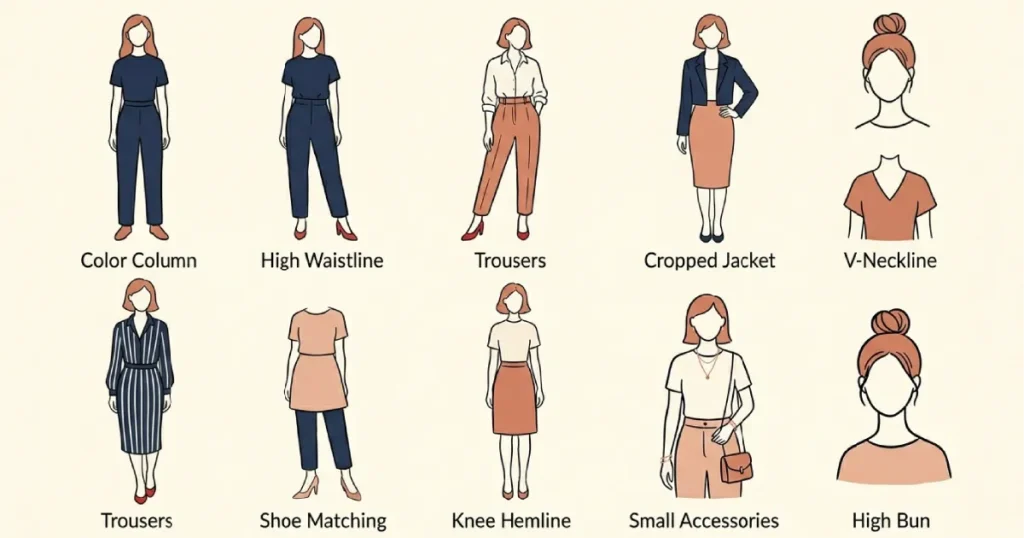
1. Dress in One Color From Shoulder to Shoe The “Column Effect”
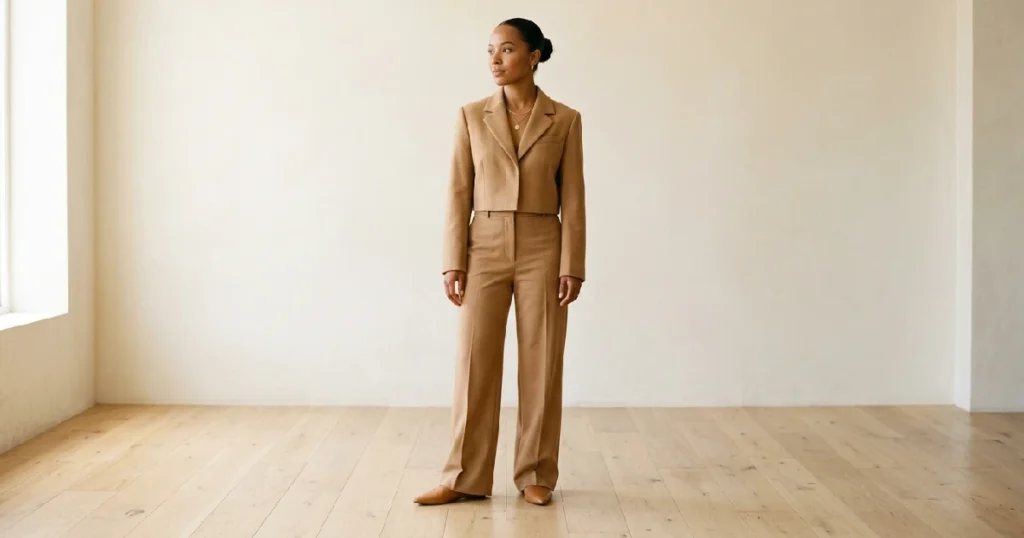
This is possibly the most powerful tool in your wardrobe, and the most underused one. Dressing in a single color creates an uninterrupted vertical line which helps to elongate the frame. When your outfit has no horizontal color break no white top with dark jeans, no navy trousers with a cream blouse the eye has nowhere to stop. It travels the full length of your body in one sweep.
That visual sweep reads as height. Some of the best color choices for elongation are black, navy blue, beige, and pastels. And here’s the nuance most articles skip: you don’t need a perfect match. Varying textures and tones within the same color family actually adds depth and sophistication while maintaining the lengthening illusion. Try a camel knit with camel tailored trousers and bone-colored pointed flats. You’ll feel like you grew two inches before you leave the house.
2. Raise Your Waistline Create a Higher “Visual Equator”
Your waist is not just a body part. In fashion proportion, it’s a dividing line and where it sits on your body determines how long your legs look. High-rise pants, skirts, and shorts lift your waistline and make your legs appear longer. Think of your waist as a fulcrum. The higher it sits, the more visual length falls below it and legs are what communicate height most powerfully to the human eye. Dresses with a high waistline shift your body proportions upward, making your legs appear longer. The trick is to always tuck your top in even just a half-tuck at the front so the waist is defined and visible. A defined waist tells the eye where to divide your body, and a higher division means more “leg” on show.
3. Embrace Vertical Lines, Seams, and Front Panels
This is pure visual neuroscience. Vertical lines, slits, and center seams guide the eye vertically rather than horizontally. The eye follows lines the way water follows a groove automatically, without effort. When those lines run top to bottom, so does the viewer’s gaze.
Look for:
- Trousers with a center front crease
- Tops with button plackets running down the middle
- Dresses with front-seam detailing or a long zipper
- Vertical stripe prints in fine widths
Front slits on dresses, front creases on trousers, and vertical patterns or buttons on tops all work to guide the eye upward and elongate the frame. This is not about bold graphic prints even subtle seaming works. Your eye doesn’t care how obvious the line is; it follows it anyway.
4. Choose a V-Neckline to Add Vertical Space Above the Bust
Most petite women focus all their energy from the waist down. But the neckline is just as important. A V-neckline opens up the chest area and elongates the neck, creating the illusion of height. The V-shape is an arrow pointing upward it draws attention toward the face while creating a vertical channel that visually lengthens the upper body. It’s one of the few styling tricks that works on the top half of your body *without* adding bulk or structure. V-neck dresses and tops add verticality to your outfit and help balance your proportions. Deep V-necks, modest V-necks, V-neck knitwear, V-neck blazers all of it works. If you want one wardrobe rule to apply immediately, start here.
5. Match Your Shoes to Your Leg The Leg-Extension Trick
Here is the “insight differentiator” most petite guides bury or miss entirely: it’s not about wearing heels. It’s about matching your shoe color to your leg or trouser color so the leg appears to continue past the ankle. A low-cut front on your shoes (called a vamp) makes your legs look longer, and nude tones help blend with your skin tone. But the real magic happens when your shoe color closely matches your trousers or bare skin. A pair of camel-toned loafers worn with camel wide-leg trousers creates the impression that the trouser never ends your leg just flows straight into the ground. Shoes with pointed toes are all the rage, and they’re perfect for those with a smaller build, as they make legs look longer and add a touch of sophistication. A pointed flat in a skin-tone or trouser-matching shade is more elongating than a chunky platform in a contrasting color. Always.
6. Opt for Fitted, Cropped Jackets Over Long Cardigans
This is where most petite women make their biggest everyday mistake.
Long, open cardigans or longline blazers that hit at the hip or below are like placing a horizontal shelf across your widest point. They stop the eye right there and wherever the eye stops, it measures. Choosing structured styles that follow your natural shape such as cropped jackets, high-waisted pants, and fitted blazers helps define your silhouette and prevent fabric from overwhelming your frame.
A fitted blazer that ends at your natural waist or just above the hip keeps the visual line unbroken from shoulder to leg. It creates the long, uninterrupted column effect that reads as height. Think of it like this: a longline cardigan is a pause in your silhouette. A cropped blazer is a comma that keeps the sentence going.
7. Wear Your Hem at the Knee or Above The Leg-to-Torso Equation
This one challenges some conventional petite advice, so stay with me.
Midi hemlines those that hit between the knee and ankle have become massively popular, and many petite women avoid them. But when a midi skirt has a front slit or sits high on the waist, it absolutely can work. The issue isn’t the midi itself; it’s a midi without vertical detail and without a defined waist, which creates a wide horizontal band of fabric that shortens the appearance. Petite women can absolutely wear maxi dresses the trick is to pick styles that emphasize the waist and incorporate vertical designs or slits. For shorter hemlines, mini or above-the-knee dresses visually elongate the legs and high-waisted styles raise the waistline to balance proportions. When in doubt, go shorter or go high-waisted not both mid-length and low-waisted at the same time.
8. Keep Accessories Proportional Small Bags, Delicate Jewelry
This is the most overlooked petite tip, and it’s one I’ve seen derail otherwise perfect outfits countless times. When choosing accessories like bags and jewelry, keep them in proportion to your frame opt for smaller handbags and delicate jewelry to maintain balance, because oversized accessories can overwhelm your look and make you appear shorter.
A massive tote bag worn on a petite frame visually cuts your torso in half and creates a visual weight that pulls the eye down and out. A small structured bag, crossbody at the waist, keeps the proportion tight and the eye moving vertically. Delicate necklaces that follow the V-line of your neckline? Even better. They reinforce the upward direction your clothes are already creating.
9. Use Your Hairstyle as a Vertical Tool
Most petite fashion guides stop at the collar. But your silhouette extends all the way to the top of your head and that final few inches matter more than you think. Shoulder-length or shorter cuts can add height, and top knots or high ponytails add visual height above the head. Hairstyles like high ponytails, buns, or voluminous waves create the illusion of height. Conversely, overly flat, long hairstyles that drag the face down work against your overall lengthening strategy.
A sleek high bun worn with a monochromatic outfit and pointed-toe shoes is the equivalent of a standing optical illusion. You’ve added vertical interest at both ends of your body, with a continuous column in between. That is proportion mastery.
The “Now What?” Putting This Into Practice Starting Today
Reading about petite fashion tips is one thing. Opening your wardrobe tomorrow is another. Here are three simple frameworks to make this real:
The Column Check: Before you leave the house, stand back from the mirror and squint slightly. Does your outfit read as one continuous column, or do you see horizontal bands breaking it up? If you see bands, swap one piece to match the adjacent color. It takes thirty seconds and it works.
The Waistline Test: Is your waist visible? If you’re wearing a top untucked and it covers your waistband, your visual equator just dropped six inches. Front-tuck it, belt it, or swap it for something cropped. Defining the waist is non-negotiable for petite proportions.
The Eye-Travel Exercise: A useful question to ask yourself: where does my eye stop when I look at this outfit? If it stops at the hip, the ankle, or the shoulder seam, that’s a proportion break you can fix. The goal is to let your eye travel from top to bottom without interruption.
Consider starting with just one change this week. Not nine. One. Pick the monochromatic column it’s the lowest effort and highest reward of all the petite fashion tips listed here.
You Were Never the Problem
Let’s return to that Tuesday morning mirror moment.
You now know that what felt “off” wasn’t your body. It was a proportion conversation your clothes were having without your permission. The oversized sweater was creating horizontal weight. The wide-leg trousers were fighting the shoe color. The eye was stopping and restarting three times before it reached the floor.
Now you know how to change that conversation.
You have nine tools that use your brain’s own visual wiring to create length, flow, and elegance — no heels required. And more than that: you have a new way to see yourself. Not as someone who needs to look taller, but as someone who understands her frame deeply enough to dress it with intention.
That is its own kind of power.
Your clothes should always tell the story you want told.
My Closing Remarks:
I’ll be honest with you I spent years watching women apologize for being petite, buying clothes two sizes too big thinking it “balanced” their frame, and walking out of stores feeling defeated. It broke my heart every time. Because the truth is, a petite frame is one of the most beautifully versatile canvases in fashion. When you stop fighting your proportions and start working with them, something shifts not just in the mirror, but in the way you carry yourself into a room. I’ve seen it happen in ten minutes. I want that for you.
More Related Stories for You:
- Loved these petite fashion tips? If you want to master the full art of dressing with intention, don’t miss our deep dive into men’s style tips and clothing essentials because great proportion dressing is for everyone.
About The Author