
 Elena Garcia
You don’t need a new wardrobe. You need a new way of seeing the one you already have.
Key Points:
- Fashion styling tips are not about buying more they’re about understanding proportion, intention, and how clothing communicates before you say a word.
- Most people skip the foundational steps of personal styling and go straight to trends, which is why their outfits feel “almost right” but never quite land.
- With the right fashion styling tips, you can create a wardrobe that feels cohesive, confident, and completely yours starting today.
Contents
Table of Contents
You’re Standing in Front of Your Closet Again
You’re standing in front of a closet full of clothes and you have absolutely nothing to wear.
Not because the clothes aren’t there. They are. Piles of them. Pieces you bought on sale, things that looked great on the mannequin, basics you thought would “go with everything.” And yet, nothing comes together. You get dressed, look in the mirror, and feel… off. Not terrible. Just not you.
That feeling is more common than you think. And it has nothing to do with your budget, your body, or your taste. It has everything to do with a few foundational styling principles that most people have never been taught.
Why Getting Dressed Feels So Hard
Here’s something most fashion articles won’t tell you: the frustration you feel getting dressed is not a personal failure. It’s actually a psychological phenomenon called “decision fatigue,” where too many choices without a clear framework leads to paralysis and dissatisfaction.
A 2012 study published in the Journal of Consumer Psychology found that when people lack a personal style identity a clear sense of what they want to communicate through clothing they default to impulsive buying and trend-chasing, which leads to wardrobes that feel scattered and incoherent.
In other words, the problem isn’t your clothes. It’s the absence of a styling strategy.
Clothing is a form of nonverbal communication. Before you speak in a room, your outfit has already made an impression. Researchers at the University of Hertfordshire have found that what we wear directly affects not just how others perceive us, but how we perceive ourselves a concept called “enclothed cognition.” When your clothes feel intentional, your confidence follows.
The good news? You don’t need to start over. You need seven specific shifts in how you think about and put clothes together.
The 7 Fashion Styling Tips That Actually Work
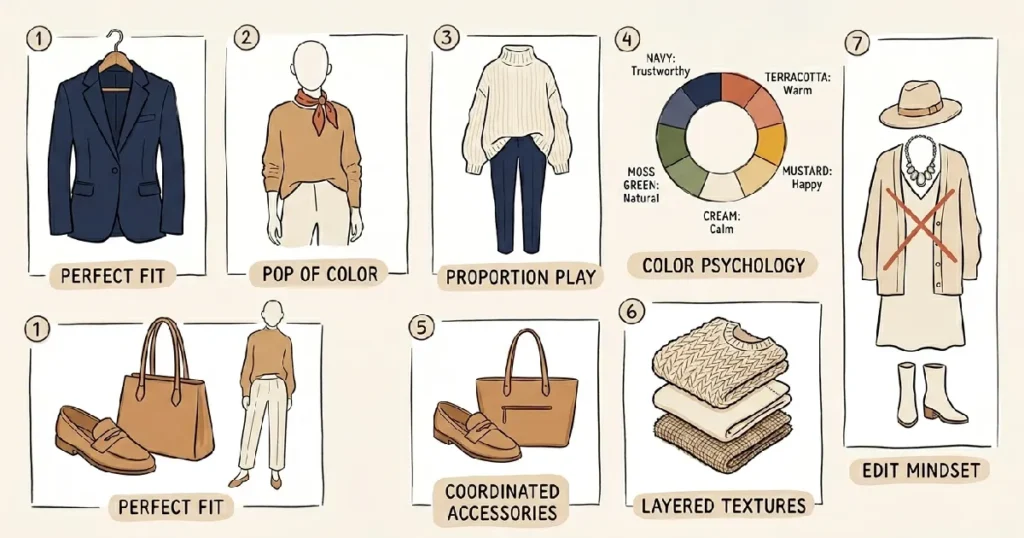
1. Fit Is the Only Thing That Matters First
Before color. Before trend. Before anything else fit wins every time.
A $30 blazer that fits your shoulders perfectly will always look more polished than a $300 one that pulls across the back. This is the single truth that separates styled people from people who own a lot of clothes.
The fix is simpler than you think. Find a good tailor and spend $15–$40 on basic alterations: hemming trousers, taking in a waist, shortening a sleeve. Suddenly, off-the-rack clothes look like they were made for you. Because in a way, they now are.
Consider Maya, a 34-year-old teacher who came to me feeling invisible in her own wardrobe. She hadn’t bought anything new in a year. We didn’t go shopping. We took three pieces she already owned to a tailor. The transformation was immediate — not because the clothes changed, but because they finally fit her actual body, not the body the manufacturer imagined.
2. Build Around a Neutral Foundation, Then Add One Statement
This is where most people get it backwards.
They buy the bold leopard print top first and then can’t figure out what to wear it with. Instead, build your wardrobe on a core of neutrals navy, white, camel, grey, black and then let one statement piece per outfit do the talking.
One vivid scarf. One pair of interesting earrings. One textured handbag. That’s it.
This approach, sometimes called the “capsule wardrobe method,” is backed by fashion psychology research showing that cohesive, limited palettes reduce decision fatigue and increase satisfaction with daily outfit choices. You end up feeling more creative, not less, because you’re working within a structure rather than drowning in options.
3. Proportion Is Your Secret Weapon
Here’s what no one tells you.
The reason an outfit looks effortless on someone else isn’t their body it’s the proportion between their pieces. Oversized top with slim-fit bottom. Cropped jacket with wide-leg trousers. Fitted dress with a voluminous coat. These contrasts create visual balance that your eye reads as “put together.”
When everything is the same volume baggy top and baggy pants, tight top and tight jeans the eye has nowhere to rest. The outfit reads as flat.
Try this: before you leave the house, ask yourself, “Where is the volume in this outfit?” There should be one area of structure and one area of ease. That tension is what makes an outfit interesting.
4. Wear Color the Way Psychologists Say It Works
Color is not decoration. It’s information.
According to color psychology research cited by the American Psychological Association, different colors activate different emotional and social responses in both the wearer and the observer. Red signals confidence and presence. Blue communicates calm reliability. Earthy tones terracotta, olive, warm brown — project groundedness and approachability.
This doesn’t mean you should dress strategically for every situation like you’re a chess player. It means being aware. If you have a presentation and you want to feel authoritative, a navy or deep burgundy blazer is not an accident — it’s an informed choice.
The rule of thumb: wear the color that matches the emotional tone you want to set, not just reflect.
5. Shoes and Bags Don’t Need to Match They Need to Speak the Same Language
Matching your shoes exactly to your bag is a styling rule from decades past.
Modern styling is about coordination, not replication. Your shoes and bag should feel like they belong to the same story similar undertones, compatible textures, or a shared level of formality. A structured leather tote pairs with a clean leather loafer. A woven raffia bag speaks the same relaxed language as canvas sneakers.
The moment you stop forcing exact matches and start thinking about “does this feel like the same world?”, your outfits take on a level of sophistication that’s hard to explain but immediately visible.
6. Texture Is the Dimension That Makes Flat Outfits Come Alive
Most people think about color when building outfits. Almost no one thinks enough about texture.
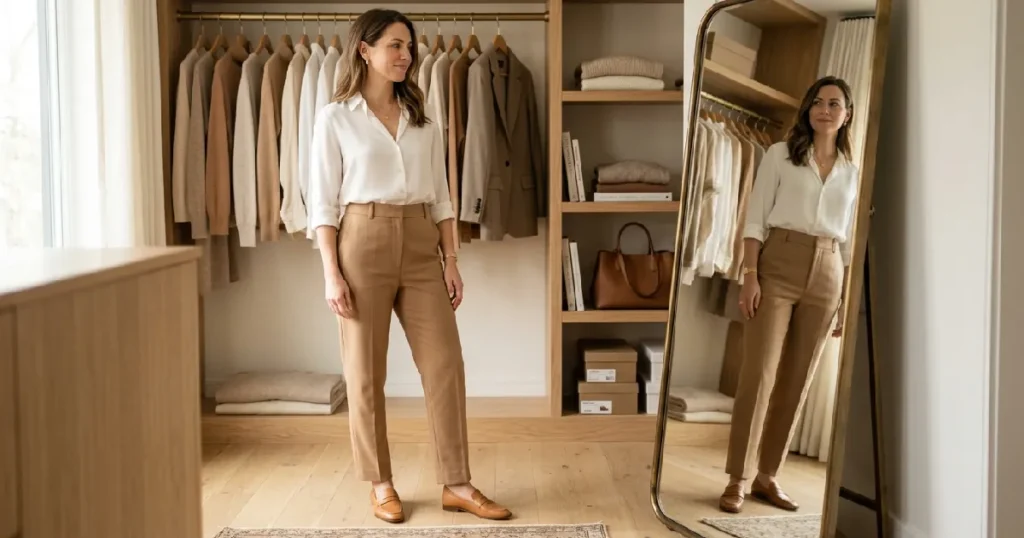
A monochromatic outfit all black, all cream, all camel can look stunning when you mix textures: a silk blouse, tailored wool trousers, a suede loafer. The color harmony holds the look together while the texture contrast gives it depth and visual interest.
This is especially useful for petite dressing or for anyone who wants to look intentional without wearing anything loud or complicated. Texture does the work quietly.
Run your eyes over your outfit before you leave. If everything looks “flat” same weight, same surface add one textural layer. A chunky knit over a smooth dress. A linen blazer over a cotton tee. It takes 30 seconds and changes everything.
7. The “One Remove” Rule Will Save Every Outfit
In my years of working with personal styling clients, this is the single tip that gets the most immediate, visible results.
Whatever you’ve put together take one thing off.
The extra necklace. The third layer. The belt you added because you thought it needed something. More often than not, the outfit was already complete before that last piece. Overcrowding an outfit is the most common styling mistake, and it’s entirely invisible to the person making it because you added each piece one at a time.
Step back. Look at the whole. Then remove the one element that feels like it’s competing for attention rather than contributing to the story.
Simplicity is not minimalism. It’s confidence. And confidence is the most elevated thing you can wear.
How to Start Using These Tips Right Now
You don’t need to overhaul everything at once. That’s overwhelming and unnecessary.
The “Outfit Audit” Exercise: Pull out five outfits you wore last month that you felt good in. Look at each one through these seven lenses. What do they have in common? You’ll start to see your own styling instincts more clearly — and you can build from there intentionally.
The “One Fix” Challenge: Pick one piece from your closet that you love but never wear. Apply just one of these tips to it — adjust the proportion, change the pairing, add a textural contrast. Wear it this week. Notice how it feels different.
A useful question to ask yourself before leaving the house: “Does this outfit tell a story, or does it look like I couldn’t decide?” That question alone will sharpen your instincts faster than any shopping trip.
You Already Have More Than You Think
Remember that feeling standing in your closet, overwhelmed, invisible?
You now have seven specific tools to change it. Not someday. Not after you lose weight or get a raise or find the perfect piece. Right now, with what’s already hanging there.
Style isn’t something you buy. It’s something you practice. And the more you practice seeing your clothes with proportion, intention, and clarity, the more effortless it becomes.
Your wardrobe is not the problem. It never was.
The right outfit has been waiting. Now you know how to find it.
My Closing Remarks
I’ll be honest with you I spent years thinking stylish people just had something I didn’t. Some innate gift, some extra money, some body that clothes loved. And then I realized: they just knew the rules. All seven of them. Once I learned to stop chasing trends and start dressing with intention, everything changed. Not just how I looked in the mirror, but how I walked into rooms. That shift is available to you. Today. Right now.
More Related Stories for You
- If you found these tips helpful, you’ll also love this guide on dressing for your petite frame with confidence because great style should work for every body, at every size.
About The Author