
 Elena Garcia
Your wardrobe is not a costume. It is a conversation with yourself before you ever walk into the room.
Key Points
- Men Style Tips Clothing Men’s Fashion must start with fit, because the cut of your clothes shapes how others see your competence and confidence in under three seconds.
- The colors and textures you choose send silent signals about trust, power, and approachability, so dressing well is a practical skill, not a vanity project.
- When you build a small wardrobe of intentional pieces, you reduce decision fatigue and free up mental energy for the parts of life that actually matter.
Contents
Table of Contents
The Hook
You are standing in front of your closet fifteen minutes before you need to leave. A work dinner. A first date. A family gathering where someone will ask what you are doing with your life. You pull out a shirt that looked fine online. Then pants that fit three years ago. Then a jacket that never sat right on your shoulders. Nothing feels like you. A quiet panic rises, the kind that whispers you are not ready for whatever comes next.
If that scene feels familiar, you are not alone. Most men have been taught that fashion is frivolous, that real confidence comes from achievement, and that clothes are just fabric. But that story is incomplete. Your clothes shape your mood, your posture, and the first impressions you leave behind.
That is where Men Style Tips Clothing Men’s Fashion becomes useful. Not as a list of rigid rules, but as a way to dress like the man you already are, or the one you are becoming. This article is not about buying expensive things. It is about making small, deliberate choices that help you feel steadier in your own skin.
Context and Problem Definition
For years, psychologists have studied something called enclothed cognition. In plain language, this means the clothes you wear can change how you think and behave. In a 2012 study, researchers Hajo Adam and Adam Galinsky found that people wearing a white lab coat labeled as a doctor’s coat made fewer errors on attention tasks than those wearing the same coat labeled as a painter’s coat. The clothing carried meaning, and that meaning changed the wearer’s mind. Research published in PMC also shows that clothing practices shape personality and body image in ways that go far beyond surface appearance.
This matters for you because most men are not walking around in lab coats. You are walking around in jeans, button-downs, sneakers, and jackets. Each piece carries a quiet meaning. When your clothes feel off, you carry that tension into the room with you. People sense it, even if they cannot name it.
A 2013 study by Howlett, Pine, Orakçioğlu, and Fletcher made this clearer. Participants looked at faceless images of a man in either a bespoke suit or an off-the-rack suit. The differences were tiny. Yet viewers rated the man in the tailored suit as more confident, successful, and higher-earning after just three seconds. That is the power of fit. As psychologist Karen Pine explains, what your clothes are saying about you starts before you open your mouth.
The problem is not that you lack taste. The problem is that most style advice is either too shallow or too snobby. It tells you to buy more, spend more, follow trends. It rarely tells you the deeper truth: dressing well is a form of self-respect that changes your internal state. And when your internal state shifts, the world tends to respond.
The Core Content: 9 Powerful Men Style Tips
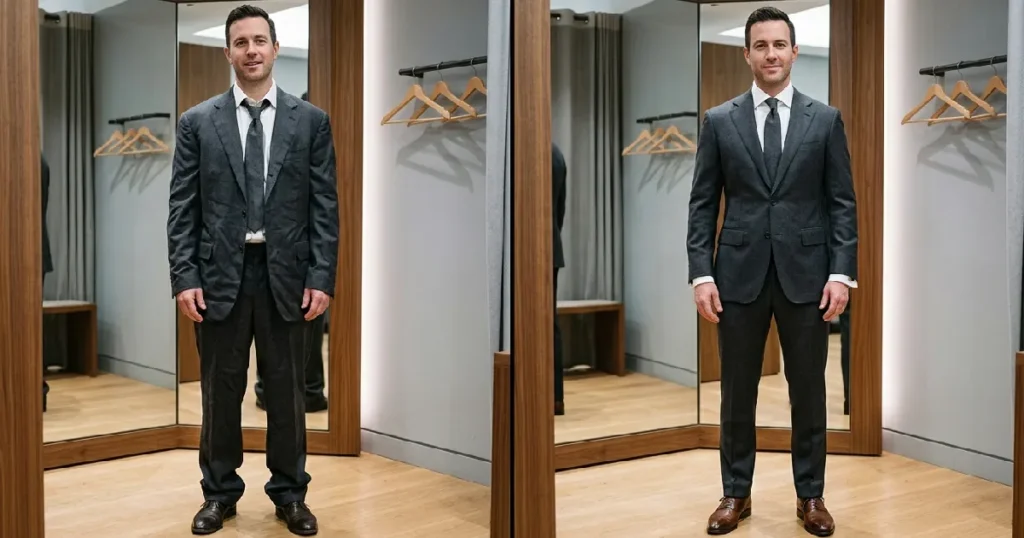
1. Fit Is the Foundation of Everything
You can wear an expensive suit and still look cheap if it does not fit. You can wear a simple t-shirt and look put together if it does. Fit is the silent language of style. It tells people you pay attention to details, that you respect yourself, and that you understand your own body.
Think of Marcus, a 34-year-old history teacher. He avoided social events because he felt invisible in crowds. His shirts ballooned at the waist. His pants pooled at the ankles. He assumed he was just not stylish. Then he took three jackets and two pairs of pants to a tailor. The change was subtle. But people started commenting that he looked sharper, more confident, more like himself. The clothes had not changed much. The relationship between his clothes and his body had.
The practical step is simple: find a local tailor. Get sleeves shortened, waists taken in, hems raised. A $50 shirt that fits well looks better than a $500 shirt that does not.
2. Build a Color Palette That Speaks for You
Color is not decoration. It is communication. Before anyone hears your name, they see your color choices. A navy jacket sends trust and calm. A black shirt sends edge and authority. A small red accent, like a tie or pocket square, can signal confidence and energy. The research on color psychology shows that red and black are often rated as more attractive and dominant on men, while blue is associated with trust and competence.
But color must fit your skin tone and your context. A bright red suit at a funeral is a mistake. A muted navy suit at a creative pitch might look too corporate. The goal is to choose colors that align with the message you want to send.
Start with a base of navy, charcoal, white, gray, and black. Add one or two accent colors that feel like you. When your palette is intentional, getting dressed becomes easier.
3. Shoes Are the Anchor of the Whole Outfit
People look at your shoes more than you think. Scuffed shoes can undermine an otherwise polished look. Clean, well-chosen shoes can make a simple outfit feel complete. Shoes ground the outfit, literally and visually.
You do not need a dozen pairs. You need four that work hard: a clean white leather sneaker, a brown or tan dress shoe, a dark boot for colder months, and one pair that feels personal, like a loafer or a desert boot. Keep them clean and rotate them so they last.
Shoes also signal attention. Polished shoes tell people you notice the small things. That detail creates a halo effect.
4. Grooming Is Part of the Outfit, Not an Afterthought
Your clothes end at your neck and wrists. Your grooming starts there. A well-fitted shirt with unkempt hair or neglected skin sends a mixed message. It is like writing a beautiful letter in messy handwriting.
Grooming does not mean perfection. It means intention. A consistent skincare routine, a haircut that suits your face shape, trimmed nails, and a beard that is either shaped or cleanly gone. These details signal that you take care of yourself, which is one of the most attractive traits a person can display.
This is especially true in close settings. In a meeting, a date, or a family dinner, people are within three feet of you. They notice texture, scent, and neatness. Grooming is what makes your outfit believable up close.
5. Mix Textures to Add Depth Without Noise
Many men dress in flat color blocks. It is safe, but forgettable. Texture is the secret ingredient that makes an outfit interesting without making it loud. A wool blazer over a cotton shirt. Suede shoes with denim. Linen in summer, corduroy in fall.
Texture adds dimension and catches light differently. The best-dressed men are not necessarily wearing the most expensive clothes. They are wearing the most interesting combinations of materials. Start with one textured piece per outfit. Small choices create big visual interest.
6. Use the Three-Foot Rule for Details
From across the room, people see silhouette, color, and proportion. Within three feet, they see details. The buttons on your jacket. The stitching on your jeans. The watch on your wrist. The condition of your collar. These details do not need to be flashy. They need to be consistent.
The three-foot rule means: look at yourself from close range before you leave the house. Are your buttons loose? Is your collar frayed? Is your belt older than your shoes? These tiny flaws create a subconscious impression of carelessness. Fixing them is low cost and high reward.
This is also where accessories matter. One good accessory beats three cheap ones. Choose quality over quantity, and keep each piece in good condition.
7. Dress for the Occasion, Not the Mood
There is a difference between dressing how you feel and dressing for where you are going. Some days you want to hide in a hoodie. But showing up underdressed for a wedding, a job interview, or an important dinner can signal disrespect, even if you do not mean it that way.
The goal is not to become a different person for every event. The goal is to show that you understand the context. A blazer over a t-shirt can bridge casual and polished. When in doubt, slightly overdress. It is easier to loosen a tie than to wish you had worn one.
This is also about respect for others. When you dress appropriately, you are saying, I see where I am. That awareness builds trust faster than any outfit alone.
8. Create a Personal Uniform to Reduce Decision Fatigue
Some of the most stylish men in history wore versions of the same thing. Barack Obama limited his suit colors to reduce decisions. A personal uniform is not boring. It is a strategic choice that frees up mental energy.
Your uniform might be dark jeans, a white oxford, and a navy blazer. Or charcoal trousers, a black crewneck, and a camel overcoat. The point is to have a repeatable formula that always works. On busy mornings, you just need to execute the formula.
A uniform also helps you buy less. You stop buying random pieces that do not fit your life. You invest in versions of the same trusted items. This saves money, reduces clutter, and makes you look more consistent.
9. Wear the Clothes, Do Not Let the Clothes Wear You
The final tip is the deepest one. You can follow every rule and still look uncomfortable. Style is not about wearing a costume. It is about wearing clothes that feel like an extension of who you are. If a trend makes you feel ridiculous, skip it. If a color drains your energy, do not wear it. If a suit makes you feel like you are playing dress-up, the suit is wrong for you.
Psychologist Jeremy Nicholson writes about fashion secrets for romance and notes that how you feel in your clothing may be half the story when it comes to how others perceive you. When you feel right in your clothes, your posture changes, your voice changes, your presence changes.
So the ultimate goal is alignment. Clothes that fit your body, your personality, your life, and your aspirations. That is when dressing well stops being a performance and starts being a practice.
Practical Application: The “Now What?”

One place to start is the closet audit. Pull everything out. Try on each piece. Ask yourself three questions: Does it fit? Does it feel like me? Would I wear it tomorrow? If the answer is no to all three, let it go. Donate, sell, or recycle. Create physical space for mental clarity.
Consider building a small capsule wardrobe. Start with ten pieces that work together: two well-fitted pants, three shirts, one blazer, one sweater, one pair of shoes, one jacket, and two accessories. This is not a limitation. It is a foundation.
A useful question before buying anything new is: What person am I dressing for? If the answer is someone you do not want to be, put it back. Buy clothes that support the person you are becoming, not the person you think you have to impress.
The next time you get dressed, try the three-foot check. Stand in front of a mirror. Look at the details. Adjust your collar. Check your shoes. Notice how you feel. If you feel steady, you are ready. If you feel off, change one thing. One small adjustment can change the whole day.
The Close: Emotional Landing
Remember that closet scene from the beginning? You do not have to live there. Style is not something you are born with or locked out of. It is a skill you build, one choice at a time. The reward is not just looking better. It is feeling more like yourself.
When you dress with intention, you stop hoping people will see you. You start trusting that they will. That trust changes how you walk into a room, how you speak in a meeting, how you show up for the people you love. The clothes are just the beginning.
So here is the final reframe: you are not trying to become stylish. You are trying to become visible to yourself. Once you are visible to yourself, the world tends to catch up.
Dress like the man you already are.
My Closing Remarks
I have spent years watching men believe that style is for other people, while they are stuck with whatever is clean. That is a lie I want to burn down. In my own closet, the days I feel most capable are rarely the days I am wearing the most expensive things. They are the days I am wearing the things that fit my body, my mood, and my life. One good pair of trousers has carried me through job interviews, difficult conversations, and first dates where I was genuinely nervous. Style is not armor. It is a mirror. Look into it honestly, and you will see the man you are becoming.
More Related Stories for You
- If you enjoyed this guide, you might also love these reads. Check out our New Year’s men’s outfit ideas for fresh looks that start the year with confidence.
About The Author