
 Elena Garcia
The clothes you reach for every morning are quietly shaping how others see you and how you see yourself. Here is how to make them work for you instead of against you.
Key Points
- Men style tips and fashion advice work best when you stop chasing trends and start dressing with intention.
- Your clothing acts like a thermostat for your mood and confidence, not just a mirror of it.
- Looking sharp is less about money and brands and more about fit, grooming, and the signals you choose to send.
Contents
Table of Contents
You Are Not Standing in Front of That Closet for the Reason You Think
You are standing in front of a closet stuffed with shirts, pants, and jackets. You have worn most of them. You like almost none of them. It is 7:15 in the morning, you are already running late, and the only thought in your head is, “I have nothing to wear.”
So you grab the same safe combination you wore last Tuesday. The dark jeans. The wrinkled button-down. The shoes that have seen better days. You tell yourself it does not matter. You tell yourself nobody notices.
But you noticed. You noticed the moment you caught your reflection in the car window and felt that small sink in your stomach. The one that whispers, “You look like you gave up before the day even started.”
It is not that you do not care. You care more than you admit. And that quiet gap between how you want to look and how you actually show up is exactly what we need to talk about.
The Real Reason Men Struggle With Style
Here is something most men style tips articles never tell you. The struggle is not really about fashion. It is about vulnerability.
When you put real thought into how you dress, you are making a statement. You are saying, “This is who I am today.” That requires you to be seen. To commit to a version of yourself. To risk getting it wrong. And for a lot of men, that small risk feels worse than just blending in with another forgettable outfit.
Psychologists have a name for what happens when you put on clothing that carries meaning for you. They call it enclothed cognition. That is a clinical way of saying that what you wear does not just change how others see you. It changes how your own brain operates.
In a now-famous 2012 study, researchers Hajo Adam and Adam Galinsky found that participants who wore a white coat described as a “doctor’s coat” performed better on attention tests than people wearing the exact same coat described as a “painter’s coat.” Same fabric. Same fit. Different meaning attached to it. Different result. Your clothing sends signals to your nervous system about who you are and what you are capable of. When you dress like you are scattered, your brain follows the script. When you dress with intention, your posture lifts, your voice steadies, and your mind sharpens.
This matters more than you might think. The way you show up in the world shapes the opportunities, relationships, and respect that come your way. Left unchecked, the habit of reaching for “whatever is clean” does not just make you look tired. It can quietly become the reason you feel tired, too.
Most men in this situation do not realize that style is an emotional skill, not just a technical one. You already have enough information. What you are missing is permission to take it seriously.
The Thermostat: A Different Way to Think About Your Wardrobe

Let me give you a way to think about your closet that most guides skip entirely.
Your wardrobe is like a thermostat.
A thermostat does not just read the temperature in a room. It sets it. Most men treat their wardrobe like a thermometer. They reach for whatever matches their current mood. Tired? Grab the hoodie. Unmotivated? Reach for the old tee. The outfit becomes a passive reflection of how they already feel.
But a well-chosen outfit works like a thermostat. You set the climate of your day before it even begins. You decide what temperature you want to live at, and your clothing helps hold you there.
That shift, from passive to intentional, is the whole game. Here is how to play it well, using four men style tips and fashion advice principles that actually move the needle.
1. Fit Beats Brand, Every Single Time
The Claim. The fit of your clothing matters more than the label inside it. A sixty-dollar shirt that follows the lines of your body will always look sharper than a three-hundred-dollar shirt that billows and bunches.
The Evidence. Most men wear clothes that are too big. Somewhere along the way, they learned that loose means comfortable and fitted means showing off. Neither is true. Good fit simply means the shoulder seam sits on your shoulder, the shirt lightly traces your torso without clinging, and your pants break once at the shoe. The research backs this up powerfully. A 2013 study published in the Journal of Fashion Marketing and Management found that strangers rated a man in a well-tailored suit as more confident, more successful, and even a higher earner than the same man in an off-the-rack suit. The differences between the two suits were tiny, and researchers controlled for color and fabric. As Psychology Today reported on this study, people saw competence in the fit alone.
So What? Before you spend another dollar on a new shirt, take the ones you already own to a tailor. Hemming pants and taking in a shirt costs less than most people think. It is the single highest-return investment you can make in how you look. You do not need a bigger wardrobe. You need a better-fitting one.
2. Build a Core Wardrobe That Mixes Itself
The Claim. The second problem most men face is not having too few clothes. It is owning forty random items that do not work together.
The Evidence. Enter the capsule wardrobe. That is just a term for a small, coordinated set of versatile pieces that combine easily. Think of it as building blocks rather than random purchases. When everything in your closet plays well with everything else, getting dressed takes two minutes instead of twenty. A strong starting point includes neutral colors that never clash: navy, white, grey, black, and olive. A couple of well-fitted t-shirts. Two button-down shirts, one solid white and one light blue. Dark-wash jeans. A pair of chinos. A navy blazer. Clean white sneakers and one pair of leather shoes.
Psychologists have a name for the mental drain that comes from making too many small choices. They call it decision fatigue, which means your brain literally runs low on fuel after a long string of decisions, even trivial ones like picking a shirt. When your clothes already work together, you save that fuel for things that matter more.
But here is what no one tells you.
The real benefit of a capsule wardrobe is emotional. When every option in your closet is something you feel good in, you stop dreading the mirror. You start your day from a place of quiet confidence instead of low-grade frustration.
So What? Pull out ten pieces that already work together and wear only those for two weeks. Notice how much mental energy you save. Notice how your mornings feel different when getting dressed is not a battle.
3. Let Your Grooming and Color Speak Before You Do
The Claim. You can wear the most expensive outfit in the world and still look unfinished if the details are off. Grooming and color are the two elements that separate “dressed” from “sharp.”
The Evidence. Color does not require a degree in design. A few principles carry you far. Darker tones like navy and charcoal communicate authority and steadiness. Lighter neutrals like white and cream signal cleanliness and approachability. Earth tones like olive and brown read grounded and warm. You do not need a rainbow. Three or four colors that work together will outperform a closet of twenty that fight each other.
Grooming is where most men lose points without realizing it. A fresh haircut, trimmed nails, clean shoes, and clothes that are actually pressed send a signal that researchers have documented again and again. People subconsciously connect neatness with competence. In fact, a peer-reviewed analysis in Personality and Social Psychology Review confirmed that dress is a fundamental component of how people perceive you, affecting judgments about your status, your intelligence, and even your trustworthiness.
So What? You are not trying to look like a magazine cover. You are trying to look like someone who respects himself enough to show up prepared. Add a weekly grooming check to your calendar. Polish your shoes. Press your shirts. These small habits compound fast.
4. Read the Room Before You Dress for It
The Claim. The sharpest dressers share one habit that has nothing to do with clothes. They think about context.
The Evidence. Dressing well is not about being the best-dressed person in every room. It is about matching the moment. A tailored suit at a backyard barbecue makes you look out of touch, not sophisticated. Ripped jeans at a client meeting send the message that you did not care enough to try. The skill is calibration, and it applies to dating and relationships just as much as work. As the relationship experts at Marriage.com explain when discussing whether looks matter in a relationship, physical presentation creates the first pull of attraction, and effort signals that you value the person in front of you.
So What? Before you get dressed, ask yourself one question. “What is the room, and what does it need from me?” A first date wants approachable but put together. A job interview wants clean and structured. A weekend with friends wants relaxed but intentional, not sloppy. When your outfit fits the occasion, people stop noticing your clothes and start noticing you.
That is the whole point.
A Quick Story About Marcus
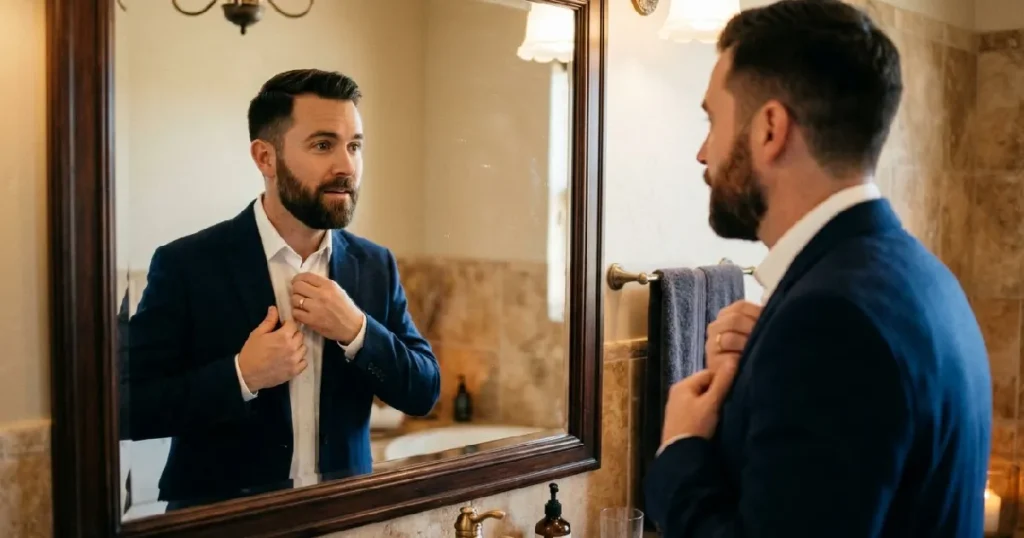
Marcus was thirty-four and worked in sales. He had a closet full of clothes and wore the same three outfits on rotation. He told me he did not care about style, that it was superficial. But on the days he wore his one well-fitted navy blazer to client meetings, he noticed something. He spoke more clearly. He made more eye contact. He closed more deals.
Marcus thought the blazer made his clients treat him differently. The truth was simpler and more surprising. The blazer made Marcus treat himself differently. Once he understood that, he stopped seeing his wardrobe as vanity. He started seeing it as preparation. Within three months, he built a simple capsule of pieces that fit and coordinated. He did not become a fashion person. He became a person who showed up on purpose.
The Thermostat Framework: Your Three Moves This Week
Now you have the why and the what. Here is the how.
Move One: The Fit Audit. Take every shirt, jacket, and pair of pants you own and ask one question. “Does the shoulder seam sit on my shoulder, and does the fabric lie flat?” If not, it goes to the tailor or the donation bin. No exceptions.
Move Two: The Capsule Trim. Pull out ten pieces that already work together. Two shirts, two pairs of pants, one blazer, one pair of shoes, and a few basics in neutral colors. Wear only those for two weeks. Notice how much lighter your mornings feel.
Move Three: The Night-Before Check. The simplest habit of all. Lay out tomorrow’s outfit tonight. It takes ninety seconds. It removes the morning panic. And it lets you wake up already set to the temperature you chose, not the one your tired self defaults to.
A useful question to sit with: if your outfit is a thermostat, what temperature are you setting for your life right now? You do not need a new wardrobe overnight. You need to start making one intentional choice at a time.
The Arrival ” Men Style Tips Fashion Advice”
Remember that morning. The overstuffed closet. The same safe combination. The quiet sink in your stomach when you caught your reflection and looked away.
Picture it again, but this time you reach for a shirt that fits. The shoulders land where they should. The color works with the pants. You glance in the mirror and instead of that small sinking feeling, something else happens. A quiet nod. The sense that you showed up as the version of yourself you actually want to be.
That is not vanity. That is not superficiality.
That is self-respect, worn on the outside.
You now know something most men never figure out. Your clothes are not a costume. They are a daily decision about who you are becoming. And that decision, made on purpose, day after day, is the most underrated men style tip there is.
Dress like the man you are becoming, not the one who gave up at 7:15 this morning.
My Closing Remarks
I will be honest with you. For years, I treated getting dressed as a chore, something to push through so I could start my real day. Then I watched the research, watched my own clients, and watched myself in the mirror on the good days and the bad ones. The men who showed up sharp were never the ones with the biggest budgets or the flashiest brands. They were the ones who simply decided that how they presented themselves mattered. That one decision rippled into everything else: their confidence, their relationships, their presence in a room. It can do the same for you, starting with what you choose to wear tomorrow morning.
More Related Stories for You
- Looking for fresh outfit inspiration to put these ideas into practice? Check out these New Year’s men’s outfit ideas to start your year looking sharp and intentional.
About The Author