
 Sara Carmen

Most marriages don’t end in one big fight. So which small daily habits actually keep two people close for decades?
Key Takeaways
- Mastering how to keep a strong marriage depends far less on grand romantic vacations and far more on how you respond to six-second daily micro-moments.
- Replacing vague chore favors with true domain ownership eliminates the silent resentment that slowly turns loving spouses into exhausted roommates.
- Simple, repeatable repair scripts can halt an escalating argument in under thirty seconds before your nervous system hits fight-or-flight overload.
Quick Answer: Understanding how to keep a strong marriage requires shifting from passive romance to intentional daily systems. Resilient couples protect emotional safety by starting difficult conversations gently, turning toward small bids for attention, sharing the invisible mental load fairly, maintaining a five-to-one ratio of positive interactions, and scheduling distraction-free connection time.
Contents
Table of Contents
We often assume marriages collapse from sudden, dramatic explosions. In reality, most relationships quietly drift apart in the daily shuffle of utility bills, packed calendars, and unspoken frustrations. You might look across the dinner table on a Tuesday night and realize that while you still care deeply about your spouse, the easy warmth you once shared feels buried under household logistics.
That heavy fatigue is rarely a sign that you married the wrong person. When couples experience chronic daily stress, the brain naturally shifts into self-preservation mode, causing minor misunderstandings to register as personal rejections. Figuring out how to keep a strong marriage is not about waiting around for effortless passion to strike again.
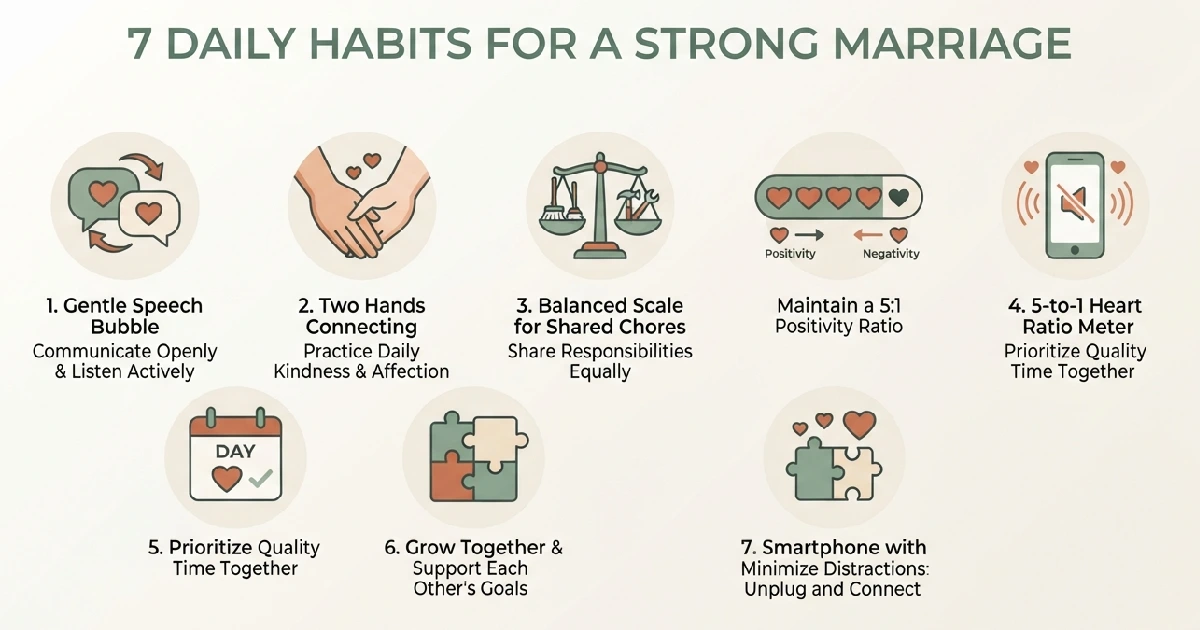
Lasting intimacy is built on small, practical habits that protect your bond when life gets noisy. Grounded in behavioral relationship psychology and decades of clinical observation, this seven-step blueprint gives you the exact tools and conversation scripts needed to rebuild trust, defuse tension, and feel like a unified team again.
Step 1: Master the Art of the “Gentle Start-Up” and Safe Repair
Breaking the Cycle of Criticism and Defensiveness
In our clinical observation of long-term couples, the first sixty seconds of a disagreement reliably predict how the entire conversation will end. Observational studies show that over 90% of conflict discussions conclude on the exact same emotional note with which they began. When you open a tough topic with an accusation like “You never think about anyone else’s schedule,” your partner’s amygdala registers an immediate threat and triggers defensiveness.
According to psychological insights on healthy relationship maintenance, eliminating harsh start-ups is the fastest way to protect the emotional safety of your home. Instead of attacking your partner’s character, describe your own internal state and ask for a concrete positive action. This subtle shift keeps your spouse’s prefrontal cortex engaged so they can hear your request rather than preparing a counterattack.
Even the healthiest couples lose their patience when exhausted, which is why normalizing mid-argument micro-repairs changes everything. Using gentle humor, reaching for your partner’s hand, or admitting “That came out way too sharp, let me try that again” acts as an emotional brake pedal. When heart rates climb above 100 beats per minute, adrenaline floods the bloodstream and blocks empathy, making a twenty-minute physiological break essential before continuing the talk.
Step 2: Establish Daily Micro-Connections to Keep Your Marriage Strong
Turning Toward Bids for Connection
A common pitfall we frequently see is couples saving all their affectionate energy for a once-a-year vacation while ignoring each other in the kitchen every morning. Knowing how to keep your marriage strong means recognizing that deep trust is built in mundane transitions. Psychologist John Gottman discovered that couples who remain happily married after six years respond warmly to each other’s minor “bids” for attention 86% of the time, compared to just 33% among couples who eventually divorce.
A bid for connection is rarely a direct request for affection. It often looks like a quiet sigh while reading an email, pointing out a funny dog outside the window, or sharing a random thought while making coffee. Turning toward that bid simply means pausing what you are doing, looking up from your screen, and offering two seconds of genuine engagement.
Over months and years, these tiny exchanges wire your nervous system to view your spouse as a safe harbor. You can anchor this habit by trading hurried pecks on the cheek for a full six-second kiss every time you leave for the day and reunite in the evening. Six seconds is just long enough to quiet the mental checklist in your head and trigger a measurable release of oxytocin, the bonding hormone that lowers cortisol and restores warmth.
Step 3: Dismantle the Mental Load and Share Emotional Labor
Moving from Polite Roommates to Co-Captains
Nothing erodes romantic attraction and goodwill faster than one spouse acting as the household manager while the other waits for instructions. Unspoken domestic imbalance breeds silent contempt, which relationship researchers identify as the single strongest predictor of marital breakdown. When one partner carries the invisible cognitive burden of tracking pediatric appointments, meal planning, and family birthdays, they gradually stop experiencing their spouse as an equal adult partner.
When evaluating couples who successfully resolve this friction against those who stay trapped in resentment, the difference comes down to replacing ad-hoc chore favors with full domain ownership. Asking your spouse to “help out” still leaves the exhaustion of noticing and planning squarely on your shoulders. True equity means one person takes ownership of an entire domestic category from start to finish, including anticipating the need, organizing the steps, and executing the task without reminders.
Rather than bringing up unpaid bills or overflowing laundry at 10 p.m. when you are both trying to sleep, run a twenty-minute operational meeting once a week. Sit down on Sunday afternoon to review the calendar, divide meal responsibilities, and troubleshoot logistical bottlenecks together. Containing household management inside a brief weekly meeting keeps your evenings and date nights free for genuine romance.
Step 4: Protect the 5:1 Magic Ratio in Daily Interactions
Balancing the Relational Bank Account
The human brain evolved with a stubborn negativity bias designed to scan for threats and hold onto painful memories far longer than pleasant ones. Because of this hardwired survival reflex, a sharp sigh, an eye-roll, or a dismissive comment carries roughly five times the emotional impact of a kind remark. Landmark research on the 5:1 magic ratio reveals that stable, happy partnerships maintain at least five positive interactions for every single negative exchange during disagreements.
Think of this ratio as an emotional bank account that compounds through small, steady deposits. Building a cushion does not require extravagant gifts or poetic speeches. Vocalizing specific appreciation, resting a warm hand on your partner’s shoulder as you walk past, sharing a brief laugh over a chaotic morning, and offering empathy after a rough workday all count as high-value deposits.
When your relational balance is high, you naturally give your spouse the benefit of the doubt when they speak shortly out of fatigue. Instead of keeping an internal scoreboard of who worked harder today, challenge yourself to catch your partner doing two small things right each day and thank them out loud. That single adjustment shifts the emotional climate of a home within days.
Step 5: Implement Intentional Reconnection Frameworks
How to Maintain a Happy Marriage on a Busy Calendar
Leaving quality time to chance guarantees that careers, children, and household chores will swallow every spare hour on your calendar. Learning how to maintain a happy marriage requires protecting your couple time with the same gentle authority you give an important doctor’s appointment. Extensive findings on intentional couple time and marital happiness show that spouses who carve out dedicated, recurring time strictly for one another report substantially higher communication quality and marital stability.
Many relationship counselors recommend the 7-7-7 rhythm as a structured baseline: go on a date every seven days, take an overnight getaway every seven weeks, and plan a longer romantic trip every seven months. In the middle of tight budgets or demanding parenting seasons, expensive travel is not always realistic, so adapt the framework to match your actual resources. The goal is uninterrupted presence, not luxury.
When a formal dinner reservation feels like one more exhausting task on your to-do list, choose low-cost, low-pressure alternatives that invite relaxed conversation. Sitting on the porch with mugs of tea for thirty minutes after the house goes quiet, taking an evening stroll around the block, or doing a puzzle together with music playing restores your emotional closeness without adding financial stress.
Step 6: Accept Perpetual Differences Without Resentment
How to Keep a Happy Marriage Through Dialogue, Not Total Agreement
One of the most relieving discoveries in clinical couple therapy is that roughly 69% of relationship conflicts are perpetual. These recurring tensions grow out of core personality traits, sensory needs, and family-of-origin values that will never completely vanish. Whether one of you craves spontaneous social plans while the other needs predictable quiet time, trying to re-engineer your spouse’s temperament only creates chronic gridlock.
Understanding how to keep a happy marriage across decades requires shifting from trying to win the argument to managing ongoing differences with curiosity and humor. When we label a partner’s natural personality wiring as a character defect, every minor disagreement turns into a courtroom battle. Stepping back and acknowledging that you simply process the world through two contrasting, valid styles immediately lowers the emotional temperature.
When an old disagreement resurfaces, look for the deeper personal value hiding underneath your partner’s stubborn stance. A recurring debate over household spending is rarely just about dollars; itusually reflects a tug-of-war between the need for security and the need for freedom. Once both spouses feel their core values are respected rather than judged, finding a practical middle ground becomes much easier.
Step 7: Guard Your Marriage from “Technoference” and Outside Intrusion
Setting Firm Boundaries for the Digital Age
Modern partnerships face a quiet competitor that sits right on the bedside table. Behavioral researchers use the term “technoference” or “phubbing” (phone-snubbing) to describe how frequent smartphone glances interrupt couple intimacy. Looking down at a notification while your spouse is speaking activates the exact same neural regions associated with social rejection, silently signaling that the screen matters more than their presence.
Safeguarding your connection requires physical habits around technology rather than relying on willpower when your brain is tired at night. Create clear phone-free zones at the dinner table and in the bedroom during the final thirty minutes before sleep. Plugging both phones into a charger in the kitchen overnight clears the way for spontaneous bedtime conversation, physical affection, and better sleep.
A resilient marriage also relies on a firm perimeter around extended family and workplace demands. When well-meaning in-laws overstep boundaries or work emails creep into Sunday family dinners, both partners need the reassurance that their primary loyalty belongs to each other. Standing together as a united front tells your nervous system that your marriage is a protected sanctuary.
Putting It Into Practice: 4 Immediate Tools to Try Tonight

Knowing the psychology behind how to keep a strong marriage is helpful, but real change happens in the words you choose when you are tired or frustrated. You do not need to apply every concept at once. Pick one of these four tested clinical tools to experiment with over the next forty-eight hours:
1. The Non-Defensive Sentence Starter
One place to begin is upgrading how you bring up everyday frustrations so your partner does not feel attacked. Instead of starting with “You always leave everything for me,” use this three-part script: “I feel [emotion] about [specific situation], and I need [clear, positive request].” For example: “I feel overwhelmed when the kitchen counter is piled with mail after work, and I need us to spend five minutes clearing it together before we sit down for dinner.”
2. The 20-Minute Physiological Reset
Consider testing a pre-agreed pause phrase the next time a conversation starts heating up and your chest feels tight. Before either of you says something regretful, try saying: “I really want to hear your perspective on this, but I am feeling defensive right now. Can we take twenty minutes to cool down so I can actually listen to you?” Spend those twenty minutes calming your nervous system with a walk or quiet breathing, rather than rehearsing your rebuttal, and always return to the conversation when the timer ends.
3. The Stress-Reducing Decompression Question
During your 15-minute evening catch-up, resist the reflex to jump in with unsolicited solutions when your spouse vents about an outside frustration. Instead, ask this clarifying question first: “That sounds exhausting. Do you want me to help troubleshoot solutions right now, or do you just need me in your corner listening and venting with you?” This simple pause prevents accidental invalidation and makes your partner feel deeply understood.
4. The Sunday Co-Captain Warm-Up
When you sit down for your weekly twenty-minute logistics check-in, protect the emotional tone by opening with appreciation before touching the calendar. Try starting with: “Before we dive into this week’s schedule, what was one moment from the past few days where you felt really supported by me?” Anchoring household planning in gratitude reminds you both that you are playing on the same team.
Frequently Asked Questions
What is the 7-7-7 rule for marriage?
The 7-7-7 rule is a proactive scheduling framework where couples plan a date night every seven days, an overnight or weekend getaway every seven weeks, and a romantic vacation every seven months. It counteracts everyday routine, prevents drift, and ensures intentional intimacy remains a recurring priority on your calendar.
What is the 3-3-3 rule for marriage?
In marriage, the 3-3-3 rule provides weekly operational balance: couples spend three dedicated hours together on a date or meaningful conversation, grant each partner three uninterrupted hours alone for personal recharge, and dedicate three hours to managing joint domestic duties. It protects individuality while sustaining emotional connection.
How to coexist in an unhappy marriage?
Coexisting peacefully requires establishing clear psychological boundaries, treating your spouse like a polite roommate or coparent, and letting go of expectations for emotional validation. Focus on radical personal autonomy, fair division of household finances, and outside support networks, ensuring your personal identity and well-being remain intact while living together.
Marriage Is an Intentional Daily Choice, Not a Static State
That quiet drift across the Tuesday night dinner table does not have to be the permanent story of your relationship. Now that you hold a clear map of how emotional safety, micro-connections, and shared mental labor actually work, you can spot the small moments where intimacy is either built or missed. You have the scripts to soften a hard conversation, the boundaries to keep digital distractions out of your bedroom, and the structure to share life’s load as true co-captains.
A resilient marriage is never built on finding a flawless partner; it is built by two imperfect people who consistently choose to turn toward each other when it would be easier to look away.
My Closing Remarks
I used to believe strong marriages ran on big gestures and good chemistry. The longer I study couples, the more I see that they run on boring, repeatable kindness. Please go easy on yourself if your marriage feels worn at the edges right now. That is not failure, only a sign that it needs attention, and attention is something you can start giving tonight.
More Related Stories for You
Curious what else shapes lasting love? Read the everyday habits behind a happy marriage.
About The Author