
 Sara Carmen

Why does a decent paycheck still vanish by the 20th, and what quietly stops it?
Key Takeaways
- Learning how to manage money starts with removing the daily decisions your tired brain keeps getting wrong.
- One 20-minute weekly check-in with your partner can do more than a tense monthly budget showdown.
- Automating a small saving, then raising it with every raise, beats any burst of willpower.
How to manage money comes down to four moves: give every dollar a job on payday, automate saving and bills, delay impulse purchases for 48 hours, and review spending weekly with your partner. Systems beat willpower because they remove the daily decisions where most overspending happens.
Contents
Table of Contents
Most of us have stared at a banking app on a Thursday, wondering where Friday’s paycheck went. Nothing big was bought. You can’t point to a single mistake, which is exactly why it feels so personal.
That feeling often arrives with a side of embarrassment. You picture people who seem to know a secret, and you suspect they were taught something you missed. If you share finances with a partner, the silence gets heavier, because each of you is guessing at the other’s numbers.
The cause is rarely character. Behavioral economists call it present bias: the brain overweights rewards that are close and underweights savings that sit years away. Add decision fatigue after a long workday, and the easy tap on “buy now” wins.
This guide shows you how to manage money by building around that wiring. You will find where small habits do the heavy lifting, what to do on a thin or uneven paycheck, and how to keep money from becoming a marital fight. Every step comes with words you can use today.
Why Good Earners Still Wonder Where Their Money Went
When people ask how do you manage money on an ordinary salary, they expect a spreadsheet. A spreadsheet only works once the structure underneath it is sound.
In the household budgets we have reviewed, one pattern repeats. Fixed costs (housing, car, insurance, debt minimums) swallow 60 percent or more of take-home pay, and the owner blames daily coffee. Tracking a $6 latte will never repair a 65 percent fixed-cost ratio.
Run the fixed-cost check first
Add up everything that leaves your account automatically each month, then divide by take-home pay. Under 50 percent leaves real room for habits to matter. Between 50 and 65 percent, pair small trims with one large lever such as housing, the car, or high-interest debt. Above 65 percent, raising income or cutting one big cost is the only math that closes the gap.
Find the three leaks that matter
Pull 90 days of statements and sort by merchant instead of category. Categories hide repetition, while merchants expose it. Most people uncover the same three leaks: a forgotten subscription, a convenience or delivery habit, and a fee such as overdraft or late charges.
Closing those three usually frees more cash than a month of strict tracking.
How Do I Manage Money on a Small or Irregular Paycheck?

How to manage money on a thin paycheck starts with a different order of operations. Build a $500 to $1,000 buffer before anything else. Its only job is to keep one flat tire from becoming a credit card balance charging 25 percent interest.
Pay yourself a salary when income swings
Freelancers and tipped workers often tell us that strong months make them careless and lean months make them panic. One fix is to deposit every payment into a holding account, then transfer yourself the same “salary” on the 1st and 15th. Base it on your lowest month from the past six, and let the surplus build until it covers three months of that salary.
Let raises do the saving
The best evidence here comes from Thaler and Benartzi (2004), whose Save More Tomorrow program asked employees to commit part of future raises to retirement. Average saving rates climbed from 3.5 percent to 13.6 percent over 40 months, partly because nobody ever felt a pay cut.
Consider testing the same idea at home. Each time income rises, one place to begin is sending half the increase to savings before your lifestyle notices.
How to Manage Your Money as a Couple Without Constant Fights
Money tension rarely stays about money. Dew and colleagues found that couples who reported disagreeing about finances weekly were more than 30 percent more likely to divorce than couples who disagreed a few times a month (Dew et al., 2012). How often the conflict happens seems to wear on a marriage as much as what it concerns.
A common pitfall we see is one partner becoming the “finance person” while the other avoids the topic. Money talks then happen only when something has gone wrong, so the mind pairs the subject with dread. A scheduled, predictable conversation takes the ambush out of it.
Give each person a “yes number”
Agree on an amount each of you can spend without explaining it. Even $50 a week ends the micro-policing that breeds resentment. When nobody has to justify a $12 lunch, the big conversations stay about big things.
When it stops being a budgeting difference
Different spending styles are normal. Hidden accounts, blocked access to shared funds, or being made to account for every purchase belong in another category. Those patterns limit a person’s ability to leave, which is why professionals treat them as financial control instead of a style clash.
If that sounds familiar, a trusted counselor or a domestic violence hotline can help you plan safely.
How to Manage My Money Starting This Week: Four Simple Systems
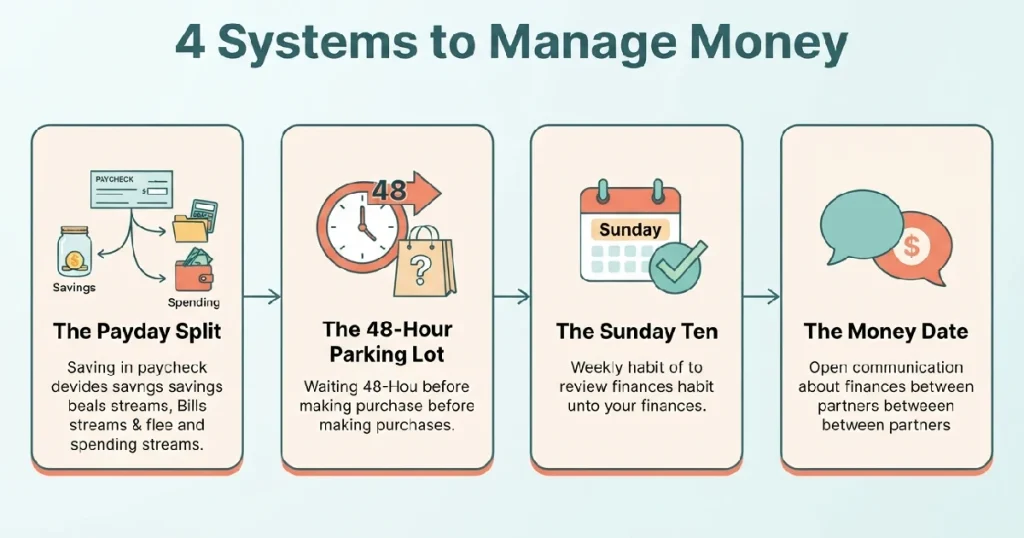
1. The Payday Split
One place to begin is a single sitting within 24 hours of payday. Set up three automatic transfers: savings first, a bills account second, and a spending account for everything else. Whatever sits in spending is yours to use without guilt.
Say to yourself: “Before I see this money, it already has a job.” With a partner: “Can we set these transfers up together tonight so neither of us has to remember?”
2. The 48-Hour Parking Lot
Consider testing a waiting rule for any non-essential purchase over $50. Write the item and price in a notes app, then leave it for two days. Many items stop feeling urgent by day two, and the ones that still matter get bought without regret.
“I’m parking this for 48 hours. If I still want it Friday, I’ll buy it and enjoy it.”
3. The Sunday Ten
Set a calendar alert for ten minutes every Sunday. Check three things: your spending balance, bills due in the next seven days, and one adjustment for the week ahead. Weekly reviews work better than daily checks, which often turn into scolding yourself over single purchases.
Ask yourself: “What surprised me this week, and what would I do differently with the same money?”
4. The Money Date
Notice what shifts when a money talk has a set time, a snack, and a start with good news. Keep it to 20 minutes on the same day each week, and end with one decision.
Try opening with: “What’s one thing about money that worries you that I might not know?” Then: “Can we each pick a yes number this month?”
Frequently Asked Questions
How do I manage money if I live paycheck to paycheck?
Start with a $500 buffer, then automate a small transfer on payday, even $10. Pick one large cost to reduce, since small trims rarely close a gap this tight.
Does the 50/30/20 rule actually work?
It works as a rough check when fixed costs stay under half of take-home pay. In high-cost cities, a 60/20/20 split may be realistic for a while.
How can I manage money with a partner who overspends?
Start with a shared goal and individual yes numbers instead of accusations. If overspending comes with secrecy or hidden debt, a couples counselor or financial therapist can mediate.
Picture that Thursday again. Friday’s paycheck landed, and three automatic transfers fired before breakfast: savings, bills, spending. When you open the app, the spending balance is modest but expected, with no mystery and no quiet math.
Sunday’s ten minutes caught a subscription you forgot. Tonight’s money date with your partner takes twenty minutes and ends with one decision. Knowing how to manage money turns out to be a short list of repeatable habits, and you already hold the list.
Once every dollar has a job, Thursday stops being a mystery and starts being a plan.
My Closing Remarks
I wish someone had taught us how to manage money in school, because I have watched smart, kind people carry shame about it for decades. The ones who improved rarely found a clever hack. They built one small automatic habit and found one safe person to talk to about it. Start smaller than feels worthwhile. Ten dollars moved on payday beats a perfect budget you never open.
More Related Stories for You
If money talks at home leave you feeling controlled or second-guessing yourself, this look at everyday patterns may help: How a narcissistic man really acts in a relationship, and the early signs people miss
About The Author