
 Sara Carmen

You’ve asked five times and heard silence. Here’s how to end the loop without doing everything yourself.
Key Takeaways
- How to stop nagging your husband starts with handing him a whole task, not one more piece of your to-do list.
- One real deadline and zero follow-ups often beats five gentle reminders.
- Some dropped balls are plastic and some are glass, and knowing the difference gives you permission to rest.
Quick Answer: How to stop nagging your husband comes down to replacing repeated reminders with clear ownership. Give him a whole task, agree on a minimum standard, attach one deadline, ask once, and let natural consequences do the follow-up. This ends the demand-withdraw cycle without lowering your standards or doing everything yourself.
Contents
Table of Contents
We’ve all been there. It’s 8:05 on a Tuesday, the trash is still by the door, and you hear yourself say “Can you take that out?” for the fifth time, in a voice you barely recognize.
He sighs, or goes quiet, or says “I said I would.” Suddenly you feel like a warden and he feels like a teenager. Neither of you applied for those jobs.
Here’s what rarely gets said. Nagging is not a character flaw. It’s what happens when one person carries the entire mental checklist, a burden covered in research on the psychological impact of cognitive domestic labor and marital distress, while the other only sees the single item handed over.
This guide shows how to stop nagging your husband without quietly doing everything alone. You’ll get seven shifts, exact scripts you can copy into a text, and a way to sort which dropped balls actually matter.
Why You Keep Nagging Even When You Hate Doing It
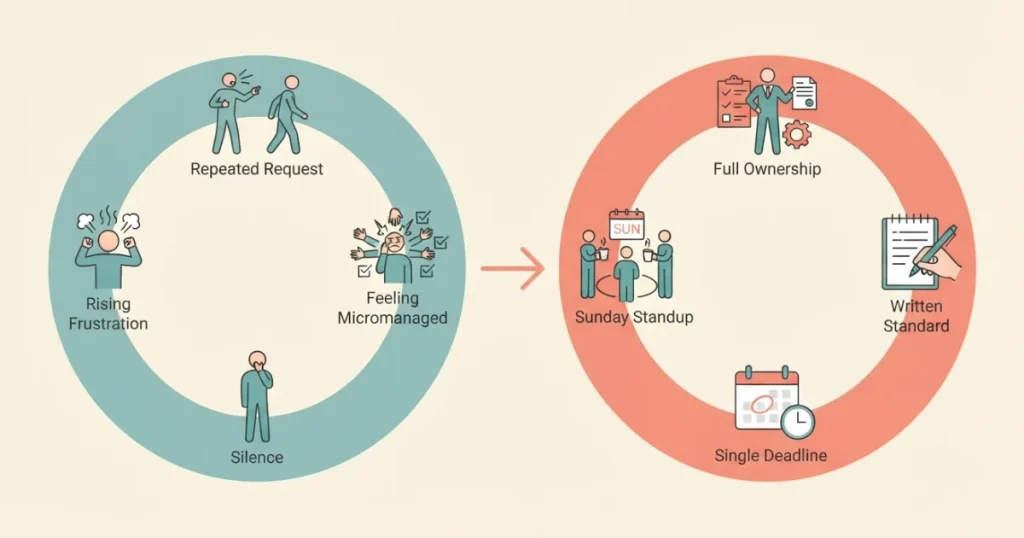
Psychologists call the pattern demand-withdraw. One partner pursues, the other retreats, and each move makes the other more likely. The research on the demand-withdraw communication pattern shows it’s one of the most predictable loops in marriage, and when the issue is something the wife wants changed, she’s more often the one pursuing (Christensen & Heavey, 1990).
Here is how it runs at your kitchen counter. You repeat the ask because you feel unheard. He hears the repetition as “I don’t trust you,” so he goes silent to protect his autonomy, and the silence convinces you to ask again.
If you’re asking how can I stop nagging my husband, or why can’t I stop at all, the answer is the dynamic, not your delivery. A softer tone won’t fix a loop that rewards both of you for staying in it.
There’s a cost beyond irritation. Couples therapists often observe that desire struggles when one partner becomes the other’s supervisor.
The line between nagging and accountability is simple. Accountability has an agreed outcome, one request, and a known consequence. Nagging is the same request repeated with nothing new attached.
How to Stop Nagging Your Husband by Changing Who Owns the Work
Secret 1: Resign as Household COO
Stop asking him to “help.” The word quietly says the job is yours and he’s doing you a favor.
Hand over a full domain instead, using the CPE framework popularized by Eve Rodsky: Conception, Planning, Execution. If he owns the trash, he notices the bin is full, buys the bags, tracks collection day, and cleans the bin. Sociologist Allison Daminger found the invisible part, anticipating, deciding, and monitoring, is where the load hides (Daminger, 2019).
Surveys on the division of domestic responsibilities and gender dynamics from Pew Research Center consistently show women reporting more of the household load. That gap rarely closes on its own.
In our experience, the first two to three weeks look worse than before. He’ll do it differently than you would. That wobble is the price of no longer being the foreman.
Secret 2: Write Down a Minimum Standard of Care
“Clean” means one thing to you and another to him. Unspoken standards create steady disappointment on both sides.
A common pitfall we see is arguing in adjectives like “tidy” or “decent.” Choose a calm hour and define done in things a camera could capture: sink empty, counters wiped, stove clear, by 9 p.m. If you’re wondering how do I stop nagging my husband about dishes, begin here, because a shared benchmark takes opinion out of the room.
Secret 3: Let Plastic Balls Drop and Guard the Glass Ones
You can’t stop nagging if you keep rescuing. If he forgets to wash his work shirts, don’t wash them and don’t lecture. Let Monday morning teach what your reminders couldn’t.
The fear of dropping the ball is real, so sort them. Plastic balls bounce: folded laundry, weeds, an unanswered group chat. Glass balls shatter: medication, tuition payments, car registration, a child’s school forms.
Glass balls deserve a safety net agreed in advance, like a shared calendar alert on both phones, so you’re not the only alarm. A child should never pay for the lesson. Consequences build accountability, while repeated reminders mostly build resentment.
How Do I Stop Nagging My Husband When I Ask? Fix the Ask
Secret 4: Give One Deadline and Skip the Follow-Up
“Sometime today” guarantees a missed expectation, because there’s no moment to miss. A real deadline makes the ask complete, so the deadline does the following up for you.
If it passes, a fallback you both agreed on happens, like hiring someone, instead of a second reminder. That’s how to stop nagging at your husband in practice: one ask, one time-stamp, zero pings.
Secret 5: Drop “Always” and “Never”
Statements like “you never respect my time” attack character, and Gottman’s work on harsh startups shows conversations that open this way tend to end in stonewalling. Offer an observation and its logistical consequence instead: “The car was left on empty last night, which made me 15 minutes late to my team meeting this morning.”
No adjectives, no sarcasm. Sarcasm works as emotional bait, and it usually gets defense instead of action. This is how to stop nagging my husband without turning every request into a debate.
How to Stop Nagging My Husband When Reminders Keep Failing
Secret 6: Move Requests Out of the 8 p.m. Kitchen
Chore requests tossed across the counter at 8 p.m. land on two depleted people, so they sound like attacks. The fix is structural. A problem that surfaces on Tuesday goes on the Sunday agenda instead of being argued over dinner.
Containing logistics in one scheduled slot also protects the rest of your week from becoming a project meeting.
Secret 7: Diagnose Forgetting Versus Weaponized Incompetence
Two different problems wear the same outfit. Genuine forgetting is inconsistent, comes with real apology, and improves when you add a system, especially under work stress. Weaponized incompetence is selective: he manages complex projects at work but somehow can’t load a dishwasher, and the poor result makes you take over.
Never finish or redo his domain, because stepping in rewards the pattern. If conversation keeps failing, stop talking and change the structure. Outsource the service and adjust the household budget to pay for it.
What to Do Next: Four Moves for This Week

One place to begin is choosing a single move below. Consider testing it for two weeks before judging.
1. The Thursday-Evening Text (Secret 4)
Send this and then say nothing more: “I need the gutters cleared before the storm arrives Thursday evening. Can you commit to that window, or should we hire someone out of the shared account?”
2. The Photo-of-Done Coffee (Secret 2)
Over Sunday coffee, try: “Can we each describe what ‘done’ looks like for the kitchen in things a camera could see? I’d like us to agree on one version.”
3. The Sunday 15-Minute Standup (Secret 6)
Bring a notepad and a timer. Cover the calendar, domain updates, a glass-ball check, and meals. Anything that came up midweek goes here, and the meeting ends when the timer does.
4. The Fork Question (Secret 7)
Try: “The bathroom has gone undone three weeks running. Is this a time problem, a standards problem, or something you’d rather not own? I’d rather hear any of those than guess.” His answer tells you which fix to use.
Frequently Asked Questions
How do I stop being a nag to my husband?
Transfer full ownership of a task, then agree on a minimum standard and deadline during a calm moment. Ask once, and let natural consequences handle the rest instead of repeating yourself.
What is silent husband syndrome?
It’s an informal label for a husband who meets conflict or requests with withdrawal and stonewalling instead of conversation. It isn’t a clinical diagnosis, but the pattern often intensifies his partner’s pursuit.
What are some traits of a toxic husband?
Chronic contempt, blaming you for household breakdowns, deliberate incompetence, and punishing silence when you ask for accountability. An overwhelmed husband improves with structure, while a toxic one resists shared power. If you feel controlled or unsafe, consider a licensed counselor.
Back to Tuesday, 8:05
The trash is still by the door, but you now hold a different map. He owns the whole trash domain, the standard is written down, and any request arrives once with a deadline attached. Anything fragile has a backup alert, and everything else waits for Sunday.
None of this lowers your standards. It moves them out of your voice and into a system, which is where they last. You also hand back a job you never applied for, and that makes room to be his partner, his flirt, and his intellectual equal again.
Pick one move tonight. The deadline text takes ninety seconds.
A marriage runs better on agreements than on reminders.
My Closing Remarks
I’ve sat across from many wives who apologized for sounding harsh, when what they really sounded was tired. If that’s you, there’s nothing wrong with your voice. The loop was never about your patience.
Go slowly and expect an awkward first month. Be kind to yourself on the days the old pattern returns, because it usually does once or twice. Start again with one clear ask and a little quiet.
More Related Stories for You
Once the logistics feel lighter, bring some play back with these would you rather questions for couples.
About The Author