
 David Wall
Picture this exact moment. You are standing on a third-floor hotel balcony. The view is beautiful, but you cannot see it. Your legs are turning to weak jelly. Your stomach is dropping like a stone in a glass elevator. Your friends are leaning against the railing, laughing and taking photos. You are pressed flat against the sliding glass door, heart pounding, feeling a crushing wave of embarrassment because everyone else seems perfectly fine.
You probably feel a deep sense of shame. You think you should be over this by now. I want to validate exactly what you are feeling right now. This reaction is not a weakness. It is not a lack of courage.
Actually, let me back up. The reason you are still struggling is a controversial truth most people ignore. Standard advice fails because many people are doing exposure in a way that trains panic instead of safety. If you want to know how to get over fear of heights, you have to stop gripping hard, looking straight down, and escaping at peak fear. That just reinforces your internal alarm response. Most articles tell you to simply face your fear. Few explain how to do that without accidentally rehearsing terror.
To get over fear of heights, use graded exposure, body positioning, and thought retraining so your brain learns that elevated places are uncomfortable but not dangerous. If dizziness dominates, rule out height vertigo and consider vestibular therapy or guided treatment.
This guide is going to show you what fear of heights really is. You will learn how to tell acrophobia from height vertigo. I will walk you through a safe seven-step process and explain exactly when to seek professional help. Most people do not fail because they are weak. They fail because they have been doing exposure badly. They go too high, too fast, while white-knuckling, holding their breath, staring downward, and escaping at peak fear. We are going to fix that today.
The Core Concept: How To Get Over Fear Of Heights Redefined
You do not overcome fear of heights by magically becoming fearless overnight. You overcome it by retraining three systems together. You have to retrain your threat response, your attention, and your balance confidence. If you skip one of these, the fear comes rushing back.
Table of Contents
What Is Fear Of Heights Really?
Normal caution at heights is completely healthy. You should not want to dance on the edge of a cliff. However, acrophobia is when the brain overpredicts danger in everyday height-related situations. For some people, the distress is mostly a psychological threat. For others, it includes a strong physical dizziness or a severe instability component.
Here is how the avoidance loop traps you. A height triggers your internal alarm. You escape the situation immediately. Your brain then learns that escaping is what saved your life. As a result, the fear strengthens for next time. This is the difference between ordinary caution and a specific phobia. It explains why open spaces, solid railings, hotel balconies, escalators, bridges, and stairwells can all trigger absolute panic. It also explains why you might feel shame even when the danger is objectively low. Your logical brain knows a sturdy balcony is safe, but your nervous system is screaming at you to run.
The Science And Data: What Experts Know That Most Readers Do Not
Fear of heights can involve both anxiety and balance-processing issues. Looking straight down can physically intensify symptoms for some people because of how the eyes and ears communicate. The goal is not to feel zero fear. The goal is to teach the brain and body that height is survivable and manageable.
According to the American Psychological Association, exposure therapy is a specialized treatment designed to help people safely face their fears in a controlled environment. But science is evolving rapidly. A major Oxford University VR research study showed that virtual reality can simulate height safely and successfully help treat acrophobia without forcing patients onto an actual roof.
Furthermore, clinical reports from PubMed and the NCBI highlight a massive overlooked factor. Some height-related distress is linked directly to visual dependence and height vertigo. This means your vestibular system gets confused when it cannot see the ground nearby. For these individuals, vestibular physical therapy may help far more than talk therapy alone.
7 Actionable Steps To Retrain Your Brain And Body Around Heights
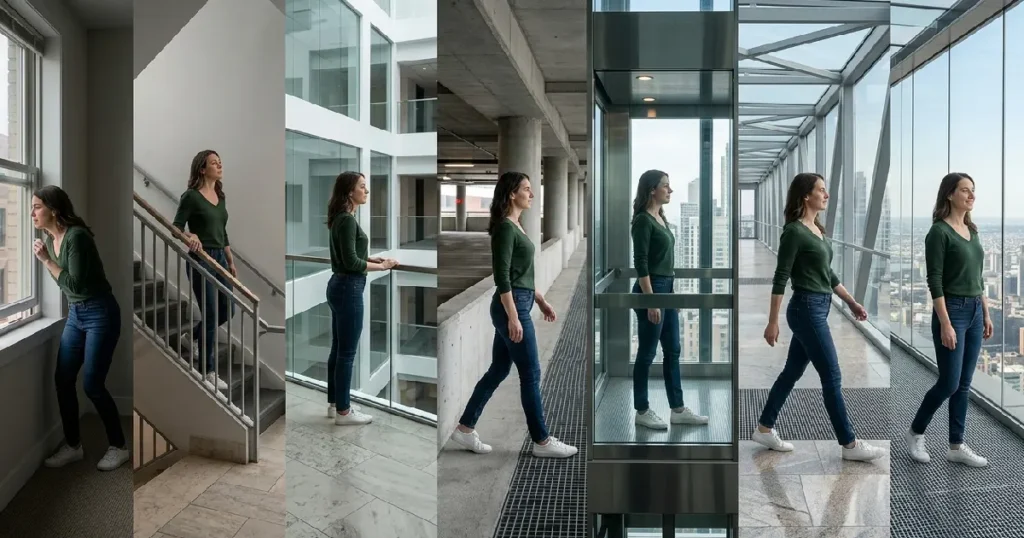
If you want to rewire this response, you need a precise strategy. These seven steps use clinical concepts to help you slowly rebuild your tolerance.
Step 1: Figure Out Whether It Is Fear, Vertigo, Or Both
You need to know your exact enemy. Ask yourself a simple question. Is your first reaction panic, dizziness, or both? If your main thought is a terrifying assumption that you might fall, your issue may be more fear-driven. If your main sensation is swaying, spinning, or severe visual disorientation, height vertigo may be heavily involved. If these symptoms happen even when you are totally calm, a vestibular evaluation might be your next best move.
- Do this: Track your triggers, body sensations, and fear level from 0 to 10 on a piece of paper.
- Not that: Do not assume every height-related symptom is just all in your head.
Step 2: Build A Height Ladder Inside Your Window Of Tolerance
You have to start with situations that feel challenging but manageable. This is called an exposure hierarchy. You want to target a discomfort level around 4 to 6 out of 10. This specific zone is your window of tolerance. It is where exposure teaches the nervous system new rules instead of overwhelming it completely.
Here is a mini sample ladder you can use.
- Stand near a second-floor window for 30 seconds.
- Pause on an indoor staircase landing.
- Stand a few feet back from a balcony edge.
- Walk a parking garage level with a support person.
- Ride a glass elevator for exactly one floor.
- Cross a wide pedestrian bridge.
- Look out from a safe, enclosed overlook.
- Do this: Break the fear into very small, boring rungs.
- Not that: Do not jump straight to rooftops, cliffs, or glass floors just because you want quick results.
Step 3: Use A Stabilizing Body Routine Before And During Exposure
This is the secret most people miss. I call this The 3-Step Anchor Protocol. When you are up high, open spaces remove your familiar visual cues. This lack of visual dependence disturbs your balance confidence. Your posture and your gaze can actually reduce the physical feeling of instability.
To use The 3-Step Anchor Protocol, you must physically ground yourself. First, soften your knees instead of locking them tight. Keep your feet grounded and shoulder-width apart. Second, exhale longer than you inhale to slow your heart rate. Third, lightly touch a railing if needed, but do not cling to it with a death grip. Look at a stable point or the horizon instead of staring straight down between your shoes.
- Do this: Use a relaxed, grounded posture and a soft forward gaze.
- Not that: Do not hold your breath, lean over the edge aggressively, or force yourself to look down immediately.
Step 4: Stay Long Enough For The Alarm To Drop
The goal is not to survive the height for two seconds and then flee in terror. You must stay in the situation long enough for your nervous system to learn that you can handle this. A practical marker is to remain in place until your fear drops by 20 to 30 percent. You want to wait until your heart rate clearly levels off.
Leaving at peak panic accidentally rewards your escape reflex. Your brain says, “Thank goodness we ran, we almost died.” On the flip side, staying too long while totally overwhelmed can also backfire.
- Do this: Step back one rung on your ladder if you are flooded, take a breath, and then repeat.
- Not that: Do not bail instantly or force yourself to stay until you feel deeply traumatized.
Step 5: Challenge One Catastrophic Thought At A Time

Your brain lies to you when you are scared. Cognitive restructuring means replacing those catastrophic predictions with more accurate, testable thoughts.
Common thoughts include assuming you will lose control, thinking your legs will give out, or believing that feeling dizzy means you will definitely fall. Replace these with testable statements. Tell yourself, “My body is sounding an alarm, but it is not predicting reality.” Tell yourself, “Dizziness is uncomfortable, but it is not the same as falling.” Remind yourself, “I can stay here, breathe, and let this wave pass.” Test these new beliefs in safe, graded settings.
- Do this: Challenge your specific worst-case prediction logically.
- Not that: Do not try to think positive in a vague, useless way.
Step 6: Practice Short, Repeated Exposures Instead Of Dramatic Ones
Repetition rewires fear much faster than one heroic moment. It is significantly better to practice for 10 to 15 minutes several times a week than to do a massive two-hour session once a month. You must vary your settings so the brain does not learn that only one specific location is safe. Practice on normal stairs, parking decks, observation windows, pedestrian bridges, open escalators, and hotel balconies.
“The brain learns from what you do, not what you wish you could do.”
This quote highlights a harsh reality. Reading about heights will not change your brain. Physically placing your feet on a second-floor landing is the only way your neurology actually updates its threat assessment.
- Do this: Repeat your practice in multiple safe environments.
- Not that: Do not do one giant exposure test and then avoid heights for a month.
Step 7: Know When To Bring In Professional Help
You do not have to do this alone. If your fear is intense or avoidance is shrinking your life, seek cognitive behavioral therapy. If real-world exposure feels way too big initially, try virtual reality exposure therapy. If dizziness, balance disruption, or visual dependence seem dominant, look into vestibular physical therapy.
Speak to a clinician immediately if you experience severe panic attacks, fainting sensations, an inability to work or travel, major daily avoidance, or if your symptoms worsen despite trying self-help.
- Do this: Get targeted professional help when your personal progress stalls out.
- Not that: Do not keep forcing solo exposures that leave you feeling more afraid.
Exposure That Rewires Vs Exposure That Backfires
| Element | Do This | Not That | Why It Matters |
|---|---|---|---|
| Intensity | Start at 4 to 6 out of 10 discomfort. | Jump to 9 or 10 out of 10 terror. | Too much intensity trains panic. |
| Body posture | Soft knees, grounded feet, slow exhale. | Lock knees, grip hard, hold breath. | Reduces body-based instability. |
| Gaze | Look ahead or at a stable point. | Stare straight down immediately. | Helps reduce visual overload. |
| Duration | Stay until fear eases or levels out. | Escape at peak fear. | Prevents escape from becoming the lesson. |
| Frequency | Short, repeated practice. | One big courage test. | Repetition builds safer memories. |
| Self-talk | Challenge specific predictions. | Demand instant confidence. | Flexible thinking works better than pressure. |
| Referral | Seek CBT, VR, or vestibular help when stuck. | Keep guessing alone for months. | Faster progress, less frustration. |
The Simplified True Story: How Nadia Stopped Letting Gravity Dictate Her Life

Nadia is a 34-year-old project manager who spent a decade carefully orchestrating her life around gravity. She avoided parking garages, hotel balconies, and glass elevators like the plague. It was exhausting. On corporate retreats, she felt humiliated when colleagues gathered at rooftop bars. She would force a polite smile and tell people she just preferred taking the stairs, even though open, winding stairwells secretly terrified her just as much.
Her struggle was deeply physical. The moment she approached an edge, her body would jolt. Her hands would sweat so badly she had to wipe them on her jeans. She genuinely thought the spinning dizziness she felt meant she was about to lose control of her motor functions. She kept trying to just push through the terror through sheer willpower, only to retreat fast and lock herself in a bathroom. This endless cycle of rushing and retreating only made her symptoms worse.
Everything changed when she applied one specific tactic. She used Step 2 and built a height ladder.
Instead of forcing herself onto a roof, Nadia started with a quiet, second-floor indoor landing at her local library. The first time, she stayed for exactly 60 seconds. She rated her fear a solid 8 out of 10. She focused on keeping her knees soft and her gaze forward. Over three weeks, she repeated this tiny challenge every Tuesday and Thursday morning. By the sixth attempt, her fear rating dropped to a manageable 4.
Within six weeks, Nadia successfully crossed a glass hospital skybridge without freezing in place. She still felt alert, but her brain was no longer hijacked by panic. The biggest shift was purely emotional. She stopped seeing herself as fundamentally broken and finally started seeing herself as trainable.
“What you resist, persists.”
Carl Jung was right. The harder you try to fight the physical sensations of dizziness and panic, the louder your nervous system screams. Acceptance is the first step toward actual recovery.
Comparative Analysis: Fear Of Heights Vs Height Vertigo
You need to know what you are actually dealing with because the treatments are different. Fear can cause dizziness. Dizziness can trigger fear. That is why many readers feel completely confused by generic online advice.
Fear of Heights (Acrophobia):
The main experience here is pure anxiety, dread, and a massive urge to escape. Your typical thought is usually, “I will fall,” or “I cannot handle this.” What usually helps most is CBT, an exposure hierarchy, and thought retraining. You should get checked if avoidance begins affecting your work, travel, or relationships.
Height Vertigo:
The main experience is physical swaying, spinning, visual instability, and disequilibrium. Your typical thought is, “The world feels off,” rather than “I am doomed.” What helps most is a solid gaze strategy, balance work, vestibular assessment, and gradual exposure. You should get checked if the dizziness persists even without strong emotional fear.
Both Together:
Often, anxiety and dizziness feed each other in a nasty loop. You think, “I feel unstable, so I must be in danger.” The best fix is a combined approach using exposure, cognitive work, and vestibular support. Get checked if your symptoms are intense, confusing, or rapidly worsening.
If your symptoms are mainly “my body feels pulled or visually disoriented,” your plan may need much more than just positive confidence advice. You might literally need to retrain your inner ear.
Frequently Asked Questions (FAQs)
1) Can fear of heights go away on its own?
Sometimes mild fear softens with repeated safe experience, but persistent fear of heights usually stays the same or grows through avoidance. Every time you escape quickly, your brain learns that height equals danger. Intentional, gradual exposure is what changes the pattern. If your life is shrinking around travel, work, or bridges, get professional support early.
2) What is the fastest way to overcome fear of heights?
Fastest does not mean forcing yourself onto the tallest rooftop. The quickest reliable path is a graded exposure plan that starts slightly uncomfortable, repeats often, and ends before overwhelm. Pair it with steady breathing, realistic self talk, and, if needed, CBT or virtual reality exposure. Big courage tests usually backfire for most people over time.
3) Is fear of heights the same as vertigo?
No. Fear of heights is an anxiety response to elevation or perceived falling risk. Vertigo is a sensation of spinning, swaying, or visual disorientation, often linked to balance processing. Many people have both, which is why advice feels confusing. If dizziness happens even when you are calm, ask whether vestibular issues are also at play.
4) When should I seek therapy for acrophobia?
Consider therapy when you avoid normal activities, have panic attacks at heights, or cannot make progress with guided practice alone. Therapy is especially helpful if the fear affects work, travel, parenting, hiking, or medical appointments in tall buildings. A clinician can tailor exposure, challenge catastrophic thinking, and assess whether medication or vestibular care fits your case.
5) Can virtual reality help with fear of heights?
Yes. Virtual reality can recreate bridges, balconies, elevators, and ledges in a controlled setting, making it useful for exposure therapy. Research suggests VR can reduce height fear, especially for people not ready for real world practice yet. It works best as part of a structured plan, not as a random thrill app or isolated experiment.
Final Takeaway
If you are serious about figuring out how to get over fear of heights, you cannot rely on willpower alone. You must respect the biology of your anxiety.
Do not wait until your next trip, bridge crossing, or balcony surprise to figure this out. Today, sit down and build a three-rung height ladder on a piece of paper. Choose one very first step that feels only mildly uncomfortable. Then, go spend exactly 60 seconds there. Keep your knees soft, use a slow exhale, and fix your eyes on a stable point straight ahead.
You do not need a giant, cinematic leap of faith. You need one repeatable, boring win that teaches your brain a new reality: I can stay here, and I can handle this.
Before you close this page, ask yourself this one reflection question. What is one beautiful experience or destination I have been denying myself because I let a false alarm dictate my boundaries?
My Closing Remarks
Look, I am going to be painfully honest with you. Avoiding heights feels safe in the moment, but it is a quiet thief. It steals your vacations, your career opportunities, and your spontaneous moments with people you love. I have seen incredibly smart, capable adults cry in stairwells because they thought they were broken. You are not broken. You just have a miscalibrated alarm system. Stop waiting for the fear to completely vanish before you take action. The confidence does not come first. The action comes first, and the confidence quietly follows behind it. Go take your life back.
More Related Stories For You
If you are dealing with an overactive nervous system, this height issue might just be one piece of the puzzle.
- I highly recommend checking out our guide on how to handle a public speaking fear if standing in front of crowds gives you that exact same dropping sensation in your stomach.
- Similarly, if your avoidance extends to travel, you need to read our breakdown on how to cure fear of flying using structured exposure techniques.
- Finally, anxiety loves to bleed into major life transitions. If you are feeling overwhelmed by big commitments, our piece on managing anxiety about getting married explores how catastrophic thinking hijacks our joy and how you can stop it.
About The Author