
 Nicole Adkins

Stop the guilt spiral. Here’s how to protect your peace without blowing up the whole family.
Key Takeaways
- Learning how to deal with toxic family members starts with containment, not confrontation.
- You can love someone and still need serious distance from them. That’s not betrayal.
- The right scripts and a few boundaries can change how your whole nervous system handles family contact.
Quick Answer: To deal with toxic family members, stop trying to change their behavior and shift toward emotional containment instead. Set firm boundaries using neutral language, limit what personal info you share (an “information diet”), detach from guilt trips, and use low-contact or no-contact when the relationship is hurting your mental health.
Contents
Table of Contents
Reclaiming Your Peace: When Family Stops Feeling Like Home
We’ve all sat in the car in the driveway, engine off, just staring at the front door before a family dinner. That tight knot in your stomach isn’t nerves about small talk. It’s your body bracing for impact.
You know the feeling. The second your phone buzzes with your mom’s name or your brother’s, your shoulders go up around your ears before you’ve even read the text.
Here’s something nobody tells you growing up. Being related to someone by blood does not give them a backstage pass to your mental health. Genetics build a family tree. They don’t buy anyone an all access ticket to your nervous system.
Figuring out how to deal with toxic family members usually isn’t about dramatic blowups or slammed doors. It’s quieter than that. It’s the slow erosion of your sense of self after years of small jabs, guilt trips, and getting labeled “too sensitive” every time you open your mouth.
This article isn’t asking you to cut everyone off today. It’s giving you an actual plan. Rules, scripts, and a working framework so you stop reacting and start deciding.
The Reality Check: How Do You Deal with Toxic Family Members Without Constant Conflict?
Every family has friction. Your uncle has weird opinions at Thanksgiving. Your sister forgets your birthday half the time. That’s just being human, not toxic.
Toxicity is a pattern, not a single bad day. It shows up as chronic guilt trips, scapegoating, control dressed up as “concern,” and a flat refusal to own any part of a conflict.
Here’s the frustrating part. Toxic family members almost never believe they’re the toxic one. Ask directly and you’ll get blank stares or flat denial, because admitting the pattern would mean admitting they built it.
Clinical research on family boundary-setting and emotional individuation backs this up. Healthy family systems let people grow and shift roles over time. Toxic systems do the opposite. They hand you a role early (the scapegoat, the golden child, the fixer) and punish you the second you try to outgrow it.
This is where a simple filter helps. I call it the S.C.A.L.E. Protocol, short for Strategic Containment And Leverage of Energy. Before responding to a toxic relative, pause and ask yourself one question: is this interaction safe, volatile, or predatory? That half second pause changes everything about what comes out of your mouth next.
Recognizing Covert Manipulation and Emotional Triangulation
Toxic families rarely run solo. There’s usually a “flying monkey,” a sibling or grandparent who carries messages back and forth, stirring guilt on someone else’s behalf.
Take Priya. Every time she set a boundary with her mother, her aunt called within hours saying “you know how your mom gets, just apologize and keep the peace.” Priya wasn’t managing one difficult person. She was managing an entire relay team.
A lot of this runs on DARVO: Deny, Attack, and Reverse Victim and Offender. You bring up something hurtful. They deny it happened, attack your character for bringing it up, then somehow end up the victim while you apologize for a conversation you didn’t even start.
Difficult Conversation vs. Covert Manipulation
Difficult Conversation: Uncomfortable but honest. Both people get heard even if they disagree.
Covert Manipulation: One person controls the narrative, rewrites the facts, and makes you question your own memory.
How to Deal with Manipulative Family Members: 4 Tactical Defense Rules

Manipulative relatives aren’t looking for conversation. They’re fishing for a reaction they can use against you later, something behavioral researchers sometimes call reactive abuse, where your emotional response gets twisted into proof that you’re the unstable one.
Take Mark. His father brought up an old mistake at nearly every holiday dinner until Mark finally raised his voice. Within minutes the whole room agreed Mark was “the problem,” conveniently forgetting what started it.
The fix isn’t swallowing your feelings. It’s refusing to hand over the fuel.
The Neutral Scripting Method: Deploying BIFF Responses
BIFF stands for Brief, Informative, Friendly (or neutral), and Firm. Keep the reply short, factual, non emotional, and final.
Research on conflict de-escalation and chronic relationship defensiveness from the Gottman Institute shows that once a conversation turns defensive, both people’s ability to think clearly drops fast. BIFF works because it refuses to feed that spiral in the first place.
This matters just as much in a text thread as it does in person. A group chat guilt trip gets the same flat, boring reply a phone call would. No essay, nothing left that can be picked apart later.
If this pattern mostly comes from a parent specifically, it helps to also look into how to set healthy boundaries with difficult parents, since parental guilt runs on slightly different wiring than sibling or in law conflict.
How to Deal with Toxic Manipulative Family Members via the Tactical Information Embargo (T.I.E.)
Here’s the part most advice skips. Stop using a manipulative relative as a sounding board for your actual life.
Your new job, your relationship, your therapy progress, none of it is information they need in real time. Every detail handed over becomes a future comparison point or ammunition.
This is the “Grey Rock” method, upgraded. Instead of going fully silent (some relatives escalate against silence), you become purposefully boring. Weather. Traffic. What’s for dinner. Nothing usable.
Three scripts worth saving in your phone:
Deflecting guilt: “I understand you see it that way. However, my schedule won’t allow it.”
Stopping unsolicited criticism: “I’m not looking for feedback on my life choices right now. Let’s talk about something else.”
Shutting down triangulation: “If mom has an issue with me, she can call me directly. I’m not discussing this through you.”
Living in the Crosshairs: How to Deal with Toxic Family Members You Live With
Let’s be honest about something most advice columns ignore. Telling someone to “just move out” when rent in London or New York eats half a paycheck isn’t advice. It’s a joke that makes the writer feel useful.
If you’re sharing a roof with a toxic relative, your whole strategy shifts from escape to containment. Treat it less like a family dynamic and more like a temporary unpleasant business arrangement you’re managing until circumstances change.
Establishing Physical Micro-Boundaries and Psychological Buffer Zones
Take Jordan, who moved back home after a layoff. He couldn’t leave right away, but he could lock a small box for important documents, keep his bedroom door closed as a quiet “do not enter” signal, and wear headphones while cooking to create distance even standing in the same kitchen.
Small physical signals matter more than people expect. They quietly say “this is still my space” without a single confrontation.
An “off site recharge habit” helps too. A coffee shop, a library, a long walk after work, anything that gets you physically out of the house for even an hour resets your nervous system in a way four walls never will.
The Silent De-escalation Protocol for Daily Survival
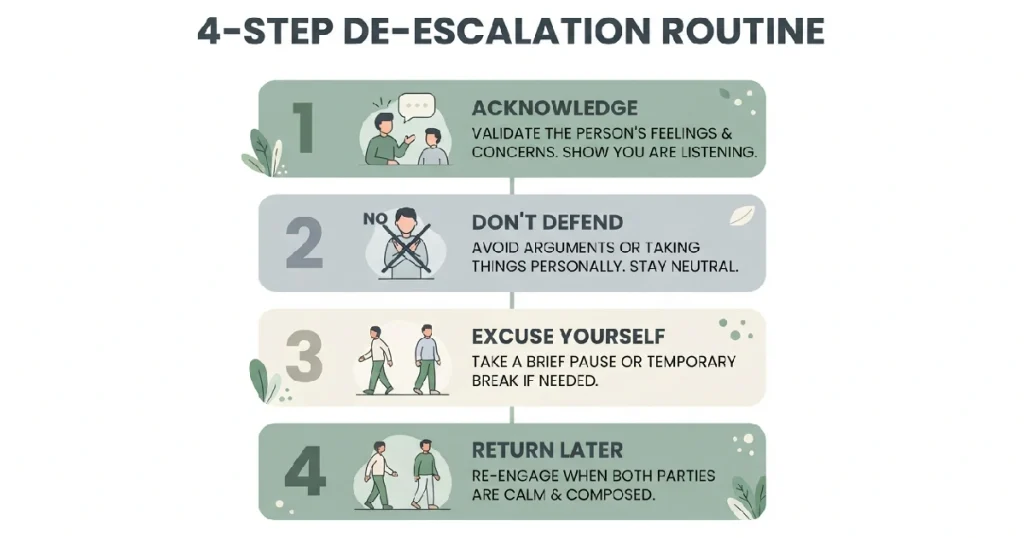
When a hostile relative starts something in a shared kitchen or living room, a simple four step routine works:
Acknowledge neutrally (“okay”). Don’t defend or explain. Excuse yourself to a private space. Return only once things have cooled.
It sounds almost too simple. But defending yourself is exactly the reaction a toxic housemate wants, and refusing to supply it usually ends the scene faster than any comeback would.
Quietly building a financial exit plan, a savings cushion, a backup room, a friend’s couch on standby, matters just as much. You don’t have to announce it. You just need it ready.
Low Contact vs. No Contact: How to Cope with Toxic Family Long-Term
Contact with toxic family isn’t an on off switch. Think of it as a dial. Full access, structured low contact, very low contact, and full estrangement.
Full access fits a relative who’s occasionally difficult but generally safe. Low contact fits scheduled, short, topic restricted interactions. No contact becomes necessary when the relationship actively damages your safety or mental health and scripting hasn’t changed that.
Weddings and funerals complicate this. You’re allowed to attend on your own terms, with a set arrival time, departure time, and a mental list of topics that are simply off limits that day.
How to Deal with Toxic Family Dynamics When Guilt Creeps In
Here’s the part nobody warns you about. Distance doesn’t feel like freedom right away. It often feels like grief, mourning a parent or sibling who was never going to become the person you needed.
That ache has a name, ambiguous grief, mourning someone who’s still alive. There’s no funeral for it, no casseroles from neighbors, just a quiet private loss most people never see.
If guilt is the loudest voice before every family gathering, it’s worth looking into how to overcome chronic people-pleasing and filial guilt, since a lot of that guilt got installed long before you had any say in it.
A quick self audit before any family event: What time am I arriving and leaving? What topics are off limits today? What’s my exit line if a boundary gets crossed?
Frequently Asked Questions
How do I deal with a toxic family member who refuses to admit they did anything wrong?
Stop waiting for the apology before setting the boundary. Use neutral, BIFF style language, state the boundary once, and let your actions enforce it instead of a debate about who’s “right.”
Is it normal to feel guilty for going low contact with toxic family?
Extremely normal. That guilt usually reflects years of conditioning that equated obedience with love, not actual evidence you’re doing something wrong.
How do you deal with toxic family members you live with when you can’t move out yet?
Focus on micro boundaries inside the home, limit shared personal information, build small daily breaks away from the house, and quietly work on a financial exit plan in the background.
Three Places To Start Today
The Three Minute Pause. Before replying to a guilt trip text or loaded phone call, give yourself three full minutes before answering. One place to begin is setting a literal timer. That pause interrupts the automatic nervous system reaction long enough for your thinking brain to catch up.
The Non-Defensive Sentence Starter. Consider testing a line that doesn’t explain or justify anything, like “I hear you, and I’m still going to do it this way.” No over explaining, just a calm statement of fact.
The Weekly Energy Check. At the end of each week, ask which family interactions left you drained and which ones didn’t. Over a month or two a pattern shows up, and that pattern tells the truth faster than any single bad night does.
None of these fix things overnight. But each one chips away at the automatic guilt response toxic family systems depend on to keep running.
The Cycle Ends With You: Reclaiming Autonomy and Peace
That knot in your stomach from the driveway doesn’t vanish overnight. It does loosen once you stop waiting for a toxic relative to change and start managing your own side of the equation instead.
Learning how to deal with toxic family is not an act of war against your own blood. It’s the deliberate decision to stop inheriting a pattern that was never yours to carry in the first place.
If you’re the first person in your family tree saying “this stops with me,” that’s not failure. That might be the bravest job in the whole system.
Three non negotiables to carry forward: protect your information, protect your time, and protect your right to walk away from any room that stops feeling safe.
My Closing Remarks
I’ve sat across from enough people untangling this exact mess to know something for certain. The guilt you feel about pulling back from a toxic relative is proof you have a conscience, not proof you’re doing something wrong. You get to love someone from a distance. You get to protect your peace without writing anyone a villain origin story. Take what’s useful here, leave the rest, and move at whatever pace keeps you sane.
More Related Stories for You
If a difficult boss drains you the same way a difficult relative does, this breakdown on how to deal with a narcissistic manager walks through the workplace version of these exact same tactics.
About The Author