


Postpartum depression is a real, treatable medical condition, not a reflection of how much you love your baby.
Key Points:
- Learning how to deal with postpartum depression starts with understanding it as a hormonal and neurological event, not a personal weakness.
- Word-for-word scripts in this guide make it easier to tell your partner, your family, and your doctor what you actually need.
- New treatments, including fast-acting neurosteroid medication, mean you no longer have to white-knuckle through weeks of suffering before feeling relief.
We don’t talk enough about the mother who smiles at the pediatrician’s office while silently counting the minutes until she can cry in the car. We don’t talk about the father staring at the ceiling at 3 a.m., furious at a baby he adores. We rarely name the rage that shows up uninvited, the numbness that replaces the joy everyone promised, or the flash of a terrifying thought that arrives and leaves you shaking.
You’ve tried to push through it. You’ve told yourself it’s just exhaustion, just hormones, just a phase that will pass if you smile hard enough at the right moments. And yet the heaviness keeps returning, sometimes worse than before. You start to wonder if something is fundamentally wrong with you.
There isn’t.
Someone might look at your Instagram and think you’re handling new parenthood beautifully. What they don’t see is you standing in the shower for twenty minutes just to have a reason to be alone. Someone might hear you say “I’m just tired” and believe you. What they don’t see is the intrusive image that flashed through your mind an hour ago, one so disturbing you haven’t told a single soul.
Someone might watch you rock your baby at 2 a.m. and assume you’re at peace. What they don’t see is the numbness underneath, the feeling that you’re watching your own life from behind glass.
This is what postpartum depression often looks like. Not always sadness. Sometimes rage. Sometimes a fog so thick you can’t remember what you ate for breakfast. Sometimes fear so sharp it feels like your body is bracing for a disaster that never comes.
Postpartum depression, often shortened to PPD, is a mood disorder triggered by the dramatic hormonal shift that happens after childbirth. It is one of the most common complications of pregnancy, and yet it remains one of the most hidden. Learning how to deal with postpartum depression means learning to see it clearly, name it honestly, and treat it the way you would treat any other medical condition that showed up uninvited after delivery.
Understanding Postpartum Depression: Biology, Not Failure
Here’s what almost nobody explains clearly enough. During pregnancy, your body produces enormous quantities of progesterone and a related compound called allopregnanolone, a neurosteroid that calms the brain by boosting the activity of GABA receptors. GABA is your brain’s main “brake pedal,” the chemical messenger that slows down anxiety and overstimulation.
Within 24 to 48 hours of delivery, those hormone levels crash. Not gradually. Not gently. They plummet, and your brain’s GABA-A receptors, which had adjusted to a flood of calming neurosteroids, suddenly can’t find them anymore.
Add thyroid fluctuations, blood loss, disrupted sleep architecture, and the sheer physical toll of childbirth, and you get a nervous system in genuine crisis. This isn’t a metaphor. It’s measurable neurochemistry.
Researchers studying perinatal mood disorders have connected this exact mechanism, the rapid depletion of allopregnanolone and its effect on GABA-A receptor sensitivity, to the onset of postpartum depression in vulnerable brains. That single sentence should change how you talk to yourself. You are not weak. Your brain went through an acute chemical event, similar in physiological seriousness to gestational diabetes or postpartum hemorrhage.
It matters because most mothers spend weeks blaming their personality, their marriage, or their parenting instincts for something that started in their bloodstream.
The “baby blues” affect up to 80 percent of new mothers and typically resolve within 10 to 14 days. You might cry easily, feel weepy, or overwhelmed, but you can still function and the fog lifts on its own. Clinical postpartum depression is different. It lingers past two weeks, it intensifies rather than fades, and it interferes with your ability to eat, sleep, connect, or function, according to the National Institute of Mental Health’s overview of perinatal depression.
And postpartum depression doesn’t always look like sadness.
It can look like snapping at your partner over a dish left in the sink and feeling terrified by the size of your own anger. It can look like watching your baby and feeling nothing at all, then panicking about that nothingness. It can look like scanning every room for danger, unable to relax even when everyone is safe.
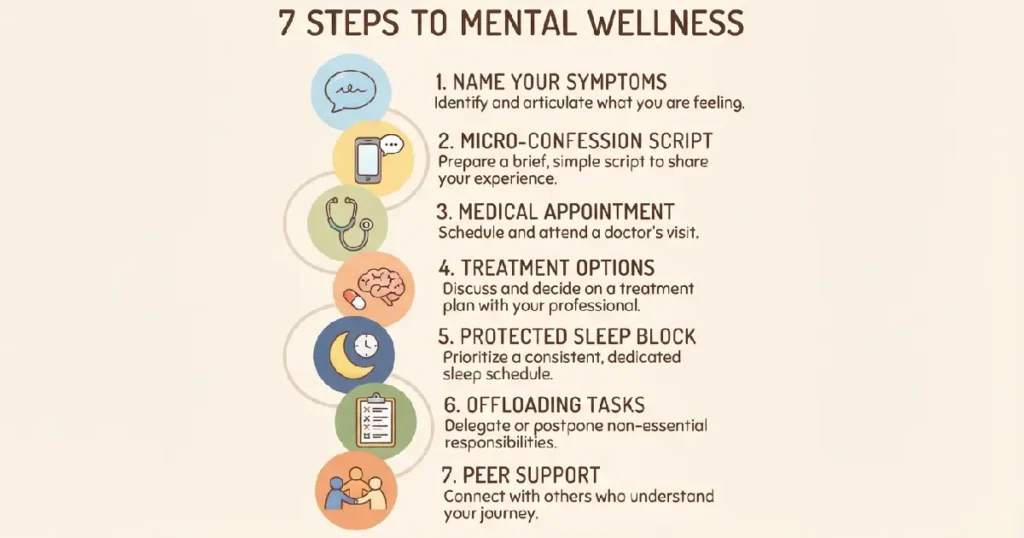
Step 1: Name Your Invisible Symptoms
The first act of courage is honesty with yourself. You cannot get help for something you refuse to name.
Loving your baby and struggling with the biological weight of new parenthood are two completely separate things. You can adore your child and still be suffering. These are not contradictions. They coexist constantly in postpartum recovery.
If you’ve had a thought about your baby getting hurt, or worse, you may be carrying it in silence, terrified of what it says about you. Here’s the term you need: ego-dystonic. It means a thought that clashes violently with your actual values and desires, causing distress rather than temptation.
Research on perinatal mental health shows that a striking majority of new mothers, somewhere between 70 and 90 percent, experience intrusive thoughts involving accidental or intentional harm to their infant. The distinguishing factor in postpartum depression and postpartum OCD is that these thoughts horrify the person having them. There is zero desire to act on them.
That’s not weakness. That’s wiring.
Your brain, running on fumes and flooded with stress hormones, is misfiring worst-case scenarios the same way smoke detectors sometimes go off from steam in the shower. The alarm is loud. It doesn’t mean there’s a fire.
One practical tool worth using this week is the Edinburgh Postnatal Depression Scale, a short, validated questionnaire used by clinicians worldwide. Treat it like a thermometer, not a test you can fail. It simply gives language to what you’re already feeling.
Step 2: Use the Micro-Confession Script With Your Partner or Ally
Here’s the part nobody prepares you for. Knowing you need help and being able to say it out loud are two entirely different skills, and exhaustion strips away the second one fast.
You don’t need a perfect, articulate speech. You need a short, honest sentence that opens the door.
For your partner or spouse, try this exact script: “I am experiencing physical symptoms of postpartum depression. I love our child, but my brain and body need medical and practical support.” This sentence works because it separates your love from your illness, which removes the guilt trap immediately.
For a friend or relative who keeps offering the wrong kind of help, try this: “I’m having a hard time right now. Instead of visits to hold the baby, I need help with meals and household tasks.” This redirects support toward what actually lightens your load.
And for the days you genuinely cannot form sentences, keep a one-line text ready to send: “Red day. Need backup.” A simple phrase like that, agreed on ahead of time with someone you trust, lets you signal distress without having to explain yourself while you’re drowning in it.
In my practice, I’ve watched a single sent text change the entire trajectory of a mother’s week, simply because someone finally knew what she needed instead of guessing.
Step 3: Schedule the Medical Appointment and Speak Without Filtering
You do not have to wait for your six-week postpartum checkup. Call your OB-GYN, midwife, or primary care provider and ask specifically for a perinatal mental health appointment. Say those exact words. It moves you up the priority list.
When you’re in the room, resist the urge to minimize. Lead with function, not feelings, because functional impairment is what triggers clinical action. Say things like “I cannot sleep even when the baby sleeps” or “I feel panic that doesn’t go away.”
Here’s the fear I hear most often in session: “If I tell them the truth, will they take my baby?” No. Healthcare providers trained in maternal mental health are trained to stabilize you, not separate you from your child. Disclosure leads to treatment plans, not child welfare investigations, according to guidelines from the American College of Obstetricians and Gynecologists.
Silence protects nothing. Honesty gets you help faster than you think.
Step 4: Explore Evidence-Based Clinical Treatments for Postpartum Depression Symptoms

This is where the insight differentiator matters most, because most articles stop at “talk to your doctor” without telling you what treatment actually looks like now.
Perinatal Cognitive Behavioral Therapy, often called CBT, and Interpersonal Psychotherapy, known as IPT, remain the gold standard non-medication treatments. CBT helps you identify and interrupt the anxious thought loops feeding your despair. IPT focuses on the relationship strain and identity shifts that often accompany new parenthood.
For many mothers, therapy alone isn’t enough, and that’s completely normal. First-line antidepressant medications, particularly SSRIs like sertraline and escitalopram, have decades of safety data behind them, including for breastfeeding mothers, per FDA and CDC maternal health resources.
But here’s what’s changed the landscape recently, and it’s genuinely worth knowing about. In 2023, the FDA approved the first oral medication specifically for postpartum depression, a neurosteroid-based treatment called zuranolone, taken as a 14-day course. Unlike traditional antidepressants, which can take six to eight weeks to show effect, this treatment class works by directly restoring GABA-A receptor function, the same pathway disrupted by the hormonal crash after birth, often producing symptom relief within days.
You do not have to suffer for two months waiting for relief to kick in. That option genuinely exists now, and a conversation with a perinatal psychiatrist can tell you if it’s right for you.
Step 5: Implement the Protected 4-Hour Sleep Block
Sleep isn’t a luxury item on your self-care list. It’s a medical intervention.
Fragmented REM sleep, the sleep stage most connected to emotional processing, directly worsens depression and anxiety symptoms in the postpartum brain. When REM sleep is repeatedly interrupted, your brain loses its ability to regulate mood the next day. This isn’t about being tired. It’s about your nervous system losing its repair window entirely.
Here’s the practical version. Ask your partner, a family member, or a night doula to take one uninterrupted four-hour shift, ideally 8 p.m. to midnight, using pumped milk or formula. During that block, you sleep in a separate room, away from the baby monitor.
That last detail matters more than people realize. As long as you can hear every rustle and sigh, your nervous system stays on alert, and true REM sleep never arrives. Someone else needs to hold the vigilance so your brain can finally stand down.
Step 6: Offload Non-Essential Caregiving Demands
Somewhere along the way, new parents absorbed the idea that struggling means failing. It doesn’t. It means you’re human, and you’re allowed to lower the bar.
Consider what I call the Zero-Expectation Protocol. For the next 60 to 90 days, laundry doesn’t need folding, just clean. Meals can come from a freezer or a delivery app. Milestone tracking apps can wait. None of that determines whether you’re a good parent.
Visitors are often eager to help but unsure how. Give them a job instead of a role. Ask them to grab groceries, run a load of laundry, or walk the dog, rather than simply holding the baby while you clean up around them.
Step 7: Connect With Perinatal Peer Communities
Isolation is fuel for postpartum depression. Connection is often the fastest way to interrupt it.
Talking with someone currently living through the same fog you’re in does something therapy alone can’t always do. It tells your nervous system, in real time, that you’re not the only one, and that alone can lower the shame response significantly.
Postpartum Support International offers free, moderated virtual support groups every week, specifically for pregnant and postpartum parents. These are led by trained facilitators, not random strangers scrolling for engagement.
A word of caution here, because it matters. Unmoderated social media groups can quietly make things worse, feeding comparison and unrealistic standards exactly when your defenses are lowest. Choose spaces built for support, not performance.
A Quiet Reframe: The Household Isn’t Just Yours to Fix
Here’s something rarely discussed outside clinical circles. Postpartum depression doesn’t only affect birthing parents.
Approximately 10 percent of new fathers experience paternal postpartum depression, and that number climbs as high as 50 percent when their partner is also struggling, according to data highlighted by the CDC. Recovery, then, isn’t a solo project. It’s a household protocol.
Meet Daniela and Marcus, a composite of countless couples I’ve worked with. Daniela assumed her exhaustion and irritability were personal failures, while Marcus quietly spiraled into his own despair, believing he had to “hold it together” for her. Neither spoke up until Daniela used the micro-confession script during a pediatrician visit, which finally gave Marcus permission to admit he was struggling too. Within weeks, both were in treatment, and their home stopped feeling like a battlefield of silent suffering.
That’s the differentiator most guides miss entirely. Treating PPD as one parent’s private burden almost guarantees it lingers longer for everyone in the house.
Red Flags: When Postpartum Depression Becomes an Emergency

Most postpartum depression, while serious, is not an emergency. But you need to know the difference, because postpartum psychosis is.
Postpartum psychosis involves hallucinations, delusions, extreme confusion, rapid mood swings, or paranoia, and it develops fast, usually within the first two weeks after birth. This is rare, affecting roughly 1 to 2 in 1,000 births, but it is always a medical emergency requiring immediate intervention.
If you or someone you love shows these symptoms, call 911 or go to the nearest emergency room immediately. Do not wait for a scheduled appointment.
For urgent but non-emergency support, the National Maternal Mental Health Hotline (1-833-TLC-MAMA) and the 988 Suicide and Crisis Lifeline are both available 24 hours a day, staffed by people trained specifically in these situations.
Now What? Turning Insight Into Action This Week
One place to start is the Two-Text Rule. Pick one person you trust and send the micro-confession script today, not next week. Waiting for the “right moment” often means waiting forever.
Consider trying the Function-First Appointment approach. Call your provider’s office and use the exact phrase “perinatal mental health concern” when scheduling, which routes you toward faster, more targeted care.
A useful question to ask yourself tonight: what is one task I can hand to someone else in the next 24 hours? It might be dinner, a load of laundry, or a single night feed. Start absurdly small. Small is still real progress.
And if intrusive thoughts have been your secret, consider writing them down in a private note, just once, using the word ego-dystonic to describe them. Naming them on paper often loosens their grip before you ever say them aloud to another person.
You Deserve to Feel Like Yourself Again
Postpartum depression convinces you that this fog is permanent, that the mother or father you used to be is gone for good. It’s lying to you. The chemistry that crashed can be treated. The isolation that grew can be broken. The shame that’s been sitting on your chest has never once belonged to you.
You now know the difference between baby blues and something that needs real treatment. You know the scripts to break the silence, the treatments that actually work, and the sleep strategy that can change your brain chemistry within days. That knowledge is leverage you didn’t have an hour ago.
Healing doesn’t require you to have it all figured out today. It only requires one small, honest step.
You are not failing at motherhood or fatherhood. You are recovering from something real, and recovery is already available to you.
My Closing Remarks
Here’s the thing I wish someone had told every parent I’ve sat with in this exact fog: asking for help is not the moment you admit defeat, it’s the moment you take your power back. I’ve watched mothers apologize for crying in my office, as if needing support was some kind of betrayal of their child. It isn’t. Your baby doesn’t need a martyr. They need you, whole, rested, and treated. That’s not selfish. That’s the whole point.
More Related Stories for You
- Wondering when it’s the right time to move your baby to their own space at night? Here’s a guide on when to move your newborn to their crib that pairs well with the sleep strategies mentioned above.