
 Nicole Adkins

Protecting your peace and mental space without feeling like a bad person when someone drains you.
Key Takeaways
- Learning how to deal with negative friends starts with spotting the difference between healthy venting and chronic emotional dumping.
- Moods are contagious on a biological level so protecting your personal space is actual self preservation rather than selfishness.
- You can keep your empathy and stay kind without letting another person drag down your mental health every single day.
Quick Answer: To master how to deal with negative friends, you have to set clear limits on daily venting and stop feeding constant pessimism. Shift repetitive complaints toward real solutions, pull back when talk turns bitter, and use neutral replies. Good friendships need balance instead of unconditional tolerance for endless emotional dumping.
Contents
Table of Contents
We have all felt that sudden heavy feeling when our phone lights up with a specific name. You see that text pop up and your stomach drops before you even read the words. You want to be a loyal friend because you care about them and you share history together. Yet every conversation leaves you completely wiped out and carrying problems that do not belong to you.
Most caring adults get trapped in what psychologists call loyalty guilt. You tell yourself that good friends stick around through thick and thin no matter what happens. But there is a huge difference between helping someone through a hard season and becoming an unpaid therapist who absorbs daily bitterness.
When you constantly absorb someone else’s darkness you end up burning out your own nervous system. Recognizing this pattern is not an act of betrayal. It is just the first step toward building a relationship dynamic that does not leave you feeling empty inside.
The Biological Cost: What Research Reveals About Emotional Contagion
Negative energy is not just an annoying mood or some vague spiritual idea. It creates an actual chemical shift in your body. When you sit with someone who complains constantly your brain mirrors their distress signals through neural imitation.
Long-term research published by Harvard University on the social spread of emotional states shows that moods spread across social networks up to three degrees of separation. If your close friend stays cynical and bitter it actively drags down your own subjective happiness. You end up soaking up stress chemicals without anything bad happening in your own personal life.
Psychologists call this pattern co-rumination. According to clinical findings on co-rumination and interpersonal emotional fatigue published by the American Psychological Association, endlessly talking about problems without looking for solutions spikes cortisol and weakens your cognitive bandwidth. It creates a false feeling of closeness that actually breeds mutual exhaustion.
Take Sarah and Mark for example. Sarah spent two years listening to Mark complain about his boss every single evening over dinner. She thought she was being supportive untill she realized she felt anxious before every meal. Mark never wanted to change jobs or fix the problem. He just wanted a place to deposit his daily anger.
Social psychologist John Gottman found that stable bonds require roughly five positive moments for every single negative interaction. Chronically draining peers flip this math completely upside down. They hit you with ten complaints for every brief glimpse of gratitude.
To see where you stand, try the 30-minute aftermath test. Notice how your body feels half an hour after walking away from someone. If your shoulders are tense and your energy is flat, your body is telling you what your mind tries to rationalize away.
The 4-D Boundary Protocol: 7 Key Principles on How to Deal with Chronically Negative People
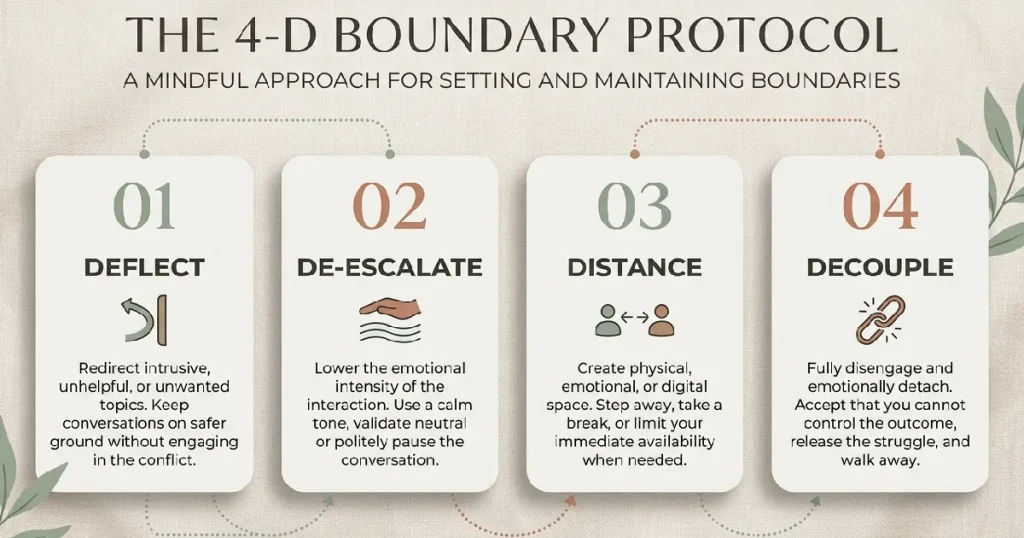
If you want to know how to deal with chronically negative people you need an actual system rather than vague hopes that they will change. The 4-D Boundary Protocol gives you a roadmap: Deflect their circular venting, De-escalate their drama, Distance yourself when conversations spiral, and Decouple your mood from their reactions.
Just like learning how to deal with toxic family members you must separate your obligations from another person’s chronic dysfunction. Here are 7 rules to apply every day:
1. The 10-Minute Venting Cap
Give someone ten minutes of focused listening and then shift the topic completely. You can say: “I hear how frustrated you are right now, but I only have ten minutes before I need to focus on work. What is the main thing on your mind?”
2. The Action-Check Pivot
Stop giving endless sympathy to repetitive gripes that never change. Put the responsibility back on them with a direct question: “That sounds completely exhausting. What are you planning to do next to handle it?”
3. The Success Guardrail
Never hide your personal wins or downplay your joy just to keep an insecure peer comfortable. If they offer a bitter remark when you share good news, hold your ground: “I worked really hard for this promotion and I am proud of it. I would love to celebrate it together.”
4. Digital Containment
Stop answering complaint texts within two seconds of receiving them. When you reply instantly to chronic pessimism you train people to treat your inbox like an emergency room. Let messages sit for a couple hours so their urgent panic cools off on its own.
5. Cease Giving Unsolicited Advice
Complainers rarely want advice because solutions ruin their habit of complaining. When you stop offering five different fixes to their problems, the conversation runs out of steam naturally. Neutral validation is far more effective.
6. Refuse Triangulation
Negative peers love gossiping about mutual acquaintances to build cheap alliances. Cut this off immediately by asking if they have talked to that person directly. Refusing to join a gripe session forces them to find another target.
7. Enforce the Quiet Downgrade
If someone refuses to respect your limits after multiple attempts, gently move them to an outer circle. You do not need a giant dramatic blowout. You simply stop sharing your private thoughts and limit your hangouts to short public coffee runs.
Handling Complex Scenarios: Tactical Answers for Real-World Friendship Dilemmas
How Can I Deal with Negative People When Their Cynical Comments Target My Achievements?
When someone disguises jealousy as sarcasm you must resist the urge to laugh it off politely. The best way to understand how to deal with people’s negative comments is to bring the hidden meaning straight into the light. When you wonder how can i deal with negative people who take passive-aggressive shots at you, use absolute calm.
Ask them flatly: “That felt like a subtle dig wrapped up in a joke. Did you mean it that way?” This question forces them to either stand behind their insult or back down and apologize. Most cynical people fold immediately when you remove their comedic shield.
How to Deal with Negative People Around You When Handling a Shared Friend Group?
Group dynamics make boundaries tricky because cutting ties completely can fracture your entire social circle. When learning how to deal with negative people around you at dinners or parties, avoid getting trapped in one-on-one corners. Stick to broader conversations that involve the whole group.
If someone starts spreading negativity around me at a gathering, I immediately pull another person into the chat or change the physical setting. Step away to grab a drink or check in with the host. You never owe anyone your captive attention just because you happen to share the same dinner table.
How to Deal with Negative People as a Christian or Faith-Based Friend?
Many believers struggle with this dynamic because they mistake enduring constant mistreatment for Christ-like charity. Understanding how to deal with negative people as a christian requires separating temporary burden-bearing from enabling someone’s chronic bitterness. Scripture commands believers to help those who fall into unexpected trials, not to supply an endless audience for destructive habits.
Even Jesus repeatedly stepped away from demanding crowds to protect his peace and pray in solitude. Loving someone does not mean allowing them to destroy your emotional well-being. True spiritual maturity means setting assertive boundaries without feeling guilty so you can continue serving others from a full cup.
Beyond Motivational Clichés: Rethinking How to Deal with Negative People Quotes
We have all seen those bright social media posts telling us to just cut off anyone who does not match our vibe. People love sharing how to deal with negative people quotes on Facebook and Instagram, but real life is rarely that tidy. Slapping a hollow slogan like “Good Vibes Only” onto real human pain is toxic and drives people away when they hit genuine hardship.
Real friendship makes plenty of room for sadness, grief, and real struggles. The issue is never that someone is having a terrible week or going through a painful divorce. The issue is chronic, unchanging cynicism that attacks everyone who tries to help.
Instead of sending passive-aggressive quotes or inspirational memes, choose direct honesty. Real maturity means saying: “I care about you alot, but our conversations have felt really heavy lately and I do not have the capacity to carry it.” That kind of clarity honors the relationship far more than any cheap internet graphic ever could.
3 Practical Strategies You Can Use Right Now

1. The Three-Minute Pause
When a friend sends you a massive wall of text filled with complaints, set a timer for three minutes before typing anything back. Take a slow breath and drink a glass of water. Breaking the reflex to fix their mood gives your brain time to choose a calm, neutral response instead of taking on their anxiety.
2. The Non-Defensive Sentence Starter
When someone tries to pull you into a negative spiral, use flat validation followed by a boundary. Practice saying: “I hear that you are having a rough day. I cannot get into a long talk right now, but I hope things settle down for you soon.” It acknowledges their feeling without offering up your afternoon as collateral.
3. The Relationship Energy Audit
Sit down tonight and write out your five closest friendships on a blank sheet of paper. Next to each name, write whether you feel recharged, neutral, or drained after spending two hours with them. If someone consistently leaves you completely wiped out, mark their name for a gentle schedule reduction this month.
Frequently Asked Questions
How do I tell a friend their negativity is draining me without ruining the relationship?
Focus on your own capacity rather than attacking their personality flaws. Say something like: “I care about our connection alot, but I notice I get overwhelmed when our talks focus mostly on venting. Can we focus on other topics when we hang out?” This approach sets a clear limit without making them feel attacked.
What should I do if a negative friend gets defensive when I set a boundary?
Expect some initial pushback because people often react with anger when you change the rules of a dynamic. Stay calm, avoid arguing about their reaction, and hold your ground quietly. If they throw a tantrum over a reasonable limit, they are showing you that they value your convenience more than your well-being.
Is it selfish to walk away from a long-term friendship because of constant pessimism?
Ending or downgrading a connection that harms your mental health is not selfish. Long history does not give someone an open pass to treat you like an emotional trash can. When a relationship stops having mutual care, stepping back is an act of honest self-respect.
Reclaiming Your Social Peace
You do not need anyone’s permission to protect your mental health. Learning how to deal with negative friends is not about becoming cold or uncaring. It is about realizing that your time and emotional energy are finite resources that deserve protection.
Friendships change as we grow and some bonds naturally run their course. Stepping back from relationships that bring nothing but bitterness is simply a healthy step toward growing up. You can wish someone well from a distance while keeping your daily life peaceful.
You are responsible for being a kind person, but you are never responsible for fixing someone who prefers to stay broken.
My Closing Remarks
I spent years feeling like a terrible friend whenever I did not pick up the phone to hear someone complain. I thought my empathy required me to absorb whatever dark mood my peers threw my way. It took a long time to realize that letting people dump their misery on me was not helping them at all. It was just keeping both of us stuck. Give yourself permission to step back, take a breath, and protect your peace. You deserve connections that give back just as much as they take.
More Related Stories for You
If you are working through difficult relationships across your broader circle, check out our guide on how to deal with toxic family members for practical advice on handling guilt and keeping your peace during family gatherings.
About The Author