
 David Wall
The strongest couples aren’t the ones who never fight. They’re the ones who mastered the small, invisible habits nobody talks about.
Key Points Box:
- Learning how to be a good partner means trading grand romantic gestures for consistent micro-habits that build emotional safety.
- Research shows the proportion of time couples spend talking directly predicts relationship satisfaction, not the intensity of date nights.
- The most overlooked rule? Balancing the shared mental load before resentment quietly poisons the bond.
Contents
Table of Contents
We all start the same way. The early months are a blur of late-night conversations, spontaneous plans, and a version of yourself that feels lighter. Then the lease gets signed. The schedules sync up. The dishes pile up. And somewhere between the third load of laundry and the fourth silent scroll through your phone at dinner, something shifts. You’re not unhappy. You’re just… coasting.
Here’s what nobody tells you about long-term love. The behaviors that keep it alive aren’t dramatic. They’re microscopic. A text sent just to say you’re thinking of them. A hand on the back while passing in the kitchen. A choice to listen instead of defend. These tiny moves compound over years. Their absence does too.
This isn’t about becoming a different person. It’s about remembering the rules you already know but have stopped practicing. Consider this your tactical manual.
Section 1: The Core Pillars of Relationship Self-Development
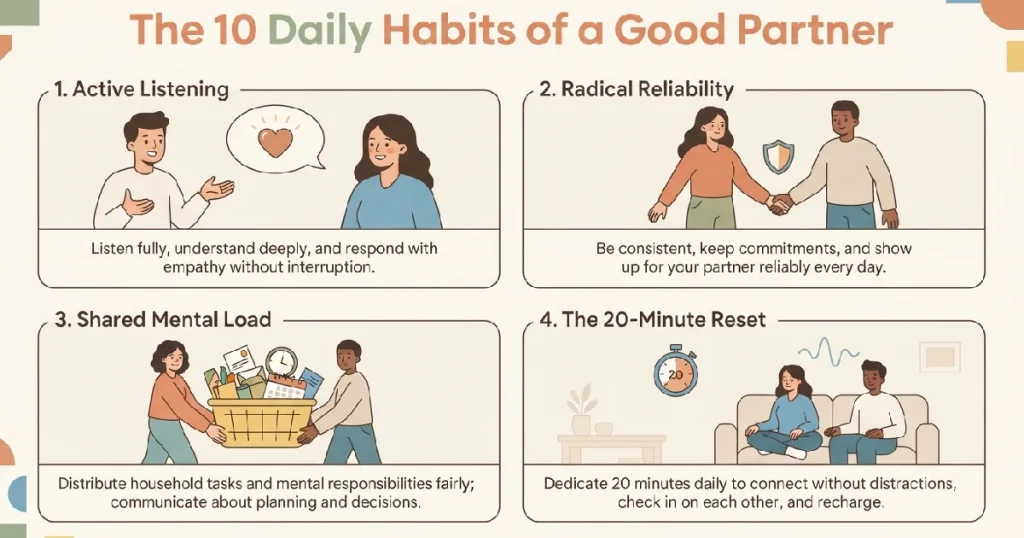
1. Use “I” Statements and Practice Active Listening
When your partner leaves their shoes in the doorway for the hundredth time, the first instinct is to say, “You always do this. You never think about me.” That sentence feels like a complaint. Your partner’s brain hears it as an attack. The nervous system responds accordingly. Defensiveness rises. Listening shuts down.
The antidote is a simple swap. Lead with “I feel frustrated when the shoes are in the doorway because I trip over them.” You’re describing your experience, not assigning blame. This lowers your partner’s threat response and opens a door for actual problem-solving.
Active listening takes this further. It means pausing your own mental rebuttal and reflecting back what you heard: “So you’re saying you feel overwhelmed when I bring this up after work.” You’re not agreeing. You’re proving you processed their emotional map. Research on couple communication shows that active-empathic listening skills are a foundational factor in healthy romantic relationships for adults navigating conflict and everyday stress. It’s a trainable skill, not a personality trait.
2. Build Trust Through Radical Reliability
Emotional trust isn’t built in a weekend retreat. It’s built in the boring moments. You say you’ll call at lunch. You call. You promise to handle the car registration. You handle it. These small follow-throughs send a signal to your partner’s nervous system: “This person is safe. I can predict them. I can rely on them.”
Researchers describe trust in close relationships as the confidence that your partner is dependable and predictable. When that predictability is consistent, your partner can relax into the relationship instead of scanning for disappointment.
The opposite is also true. Broken micro-promises “I forgot,” “It slipped my mind,” “I was busy” erode trust faster than one big betrayal. Each forgotten task teaches your partner to lower their expectations. Radical reliability means treating small commitments as seriously as you treat work deadlines.
3. Express Explicit, Outspoken Gratitude
There’s a quiet killer in long-term relationships. It’s not contempt or conflict. It’s assumption. The assumption that your partner will always cook dinner. That they’ll always manage the bills. That they’ll always remember your mother’s birthday. When contribution becomes invisible, resentment grows in the space where appreciation should live.
Our brains are wired for this. We have a natural negativity bias a tendency to focus on what’s wrong and overlook what’s stable and good. In relationships, this means the one forgotten chore dominates your attention while the hundred completed ones disappear into the background. UC Berkeley’s relationship research on foundational pillars confirms that mutual acceptance and positive habits are what counter this bias over time.
The fix is verbal and specific. “Thank you for handling bedtime tonight. I noticed you did it without being asked.” That sentence does more for intimacy than a surprise bouquet. It tells your partner their effort registers.
4. Respect Boundaries and Protect Personal Space
Enmeshment is a clinical term for when two people blur so completely that individual identities dissolve. It sounds romantic. It isn’t. When you lose your separate hobbies, your solo friendships, and your private time, you stop bringing new energy into the relationship. You start bringing only need.
Healthy couples maintain what researchers call a balance between proximity and autonomy closeness and independence. One partner goes to their pottery class on Tuesday nights. The other meets friends for a run on Saturday mornings. They come back with stories, fresh energy, and something to miss.
Boundaries aren’t rejection. They’re the walls that make a house feel safe. Without them, love suffocates.
Section 2: Navigating Friction and Deepening Connection
5. Pivot from “You vs. Me” to “Us vs. The Problem”
Every couple argues. The difference between couples who last and couples who fracture is what happens in the first five minutes of a fight. The research on relationship conflict resolution points to one clear killer: stonewalling. That’s when one partner withdraws, shuts down, and stops responding entirely. It’s not a pause. It’s a wall.
Dr. John Gottman’s research recommends a specific antidote: a minimum twenty-minute break during heated conflict. This isn’t avoidance. It’s biology. When your heart rate exceeds a certain threshold, your prefrontal cortex the part of your brain responsible for empathy and reason goes offline. Twenty minutes of physical cooling down brings it back online.
The reframe is simple. It’s not you against your partner. It’s both of you against the problem. “We’re both exhausted and the house is a mess. How do we handle this together?” That shift changes the entire emotional temperature.
6. Anchor the Relationship with Non-Sexual Intimacy
Physical touch gets loaded with expectation. A hug becomes a preamble. A hand on the leg becomes a question. When every touch carries a destination, couples stop touching casually. And that’s a loss.
Research from Harvard Health found that non-sexual intimate touch hugging, holding hands, cuddling among 184 couples was linked to stronger relationship quality. These gestures don’t need to lead anywhere. They’re not transactional. They’re anchors.
A hug at the door before you leave for work. Holding hands on the couch while you watch something terrible on TV. A hand on the shoulder while they’re cooking. These moments tell the nervous system: “We’re okay. We’re connected. You’re not alone in this.” During stressful weeks, that signal matters more than any conversation.
7. Proactively Support Individual Goals and Personal Growth
People change. That’s not a relationship problem. It’s a fact. The partner you married at twenty-five may want a completely different career at thirty-five. They may pick up new passions, new beliefs, new versions of themselves. The couples who thrive are the ones who make room for that evolution instead of treating it as betrayal.
Supporting a partner’s growth isn’t just cheerleading. It’s logistical and emotional backing. It’s taking over dinner on the nights they have class. It’s listening to them process a career pivot without immediately listing every risk. It’s trusting that their growth doesn’t threaten the relationship. It expands it.
8. Balance the Shared Domestic Mental Load
The dishes get done. The laundry gets folded. But who remembered that the dishwasher pods were running low? Who scheduled the pediatrician appointment? Who noticed the school form was due?
That invisible labor is called the mental load. It’s the cognitive and emotional work of anticipating needs, planning, and delegating. When one partner carries it all, the other becomes a helper instead of a co-manager. Resentment builds slowly, and it’s rarely about the tasks themselves. It’s about the exhaustion of being the default brain for two people.
Balancing the shared mental load in marriage means both partners own entire domains, not just tasks. One person handles all medical appointments and insurance. The other owns the car maintenance and grocery planning. Neither person has to ask. Neither person has to remind. Both are responsible for noticing what needs to be done.
Section 3: The Introspective Partner: Self-Awareness and Fun
9. Take Personal Responsibility for Internal Emotional Triggers
Your partner is not your emotional punching bag. That sounds obvious. It isn’t. When you come home after a brutal meeting with your boss, your stress doesn’t evaporate at the door. It follows you inside. And the smallest thing a question about dinner, a comment about the mail can trigger an outsized reaction.
Taking responsibility means recognizing the difference between what your partner did and what you brought into the room. It means saying, “I’m not upset at you. I’m carrying a bad day. Give me twenty minutes and I’ll come back better.”
Clean apologies matter too. No “I’m sorry, but you were…” No “I’m sorry, but I was stressed.” Just: “I was short with you. That wasn’t fair. I’m sorry.” Full stop. Defensive justifications turn an apology into another argument.
10. Protect Intentional Quality Time
Here’s the uncomfortable truth. Living together does not mean spending time together. You can share a home, a bed, and a Netflix account and still go weeks without a real conversation. The research is clear on this. A study published on PubMed Central regarding daily interaction quality found that couples who spend a larger proportion of their time together actually talking not scrolling, not watching, not coexisting report significantly greater relationship satisfaction.
The implication is direct. It’s not the total hours that matter. It’s the ratio of talking to everything else. A twenty-minute walk without phones where you actually ask questions and listen to the answers does more than four hours of parallel screen time.
Schedule it. Protect it. Treat it like a meeting you can’t cancel. Because it is.
Section 4: Being the Anchor When Your Partner Is Struggling

Depression and anxiety don’t just affect the person experiencing them. They ripple through the relationship. Your partner may withdraw. They may stop initiating. They may seem distant, irritable, or unreachable. The instinct is to take it personally. Please don’t.
Your role during a depressive episode is not to be a therapist. It’s to be a stable anchor. That means depersonalizing their withdrawal. It’s not about you. It’s about a nervous system that is running on empty. It means absorbing more of the tactical decisions what’s for dinner, when to schedule the appointment, whether to go to the party so their cognitive load drops. And it means matching them where they are without pushing for performance.
Two phrases help more than you might think.
“I know things feel incredibly heavy right now, and I don’t expect you to just snap out of it. I’m right here with you.”
“You don’t have to apologize for struggling. You are not a burden to me, and we are going to face this as a team.”
These statements do one critical thing. They remove shame from the equation. Shame is the fuel that keeps depression burning. Removing it creates a small opening for connection.
Practical Application: Three Habits to Start Tonight
You don’t need to overhaul your relationship. You need one small move. Pick one.
The Two-Minute Reconnection Ritual. When you see your partner for the first time after being apart, stop everything for two minutes. Look at them. Ask one real question. “What was the hardest part of your day?” Then listen without planning your response. This is a micro-dose of the intentional talking that research links to satisfaction.
The No-Defense Zone. The next time your partner brings up something that bothers them, resist the urge to explain, justify, or counter. Just say, “That makes sense. Tell me more.” You’re not admitting fault. You’re creating safety. You can problem-solve later.
The Boundary Check-In. Once a week, ask each other one question: “Is there anything you need more space for right now?” It’s a simple way to maintain the proximity-autonomy balance before resentment builds.
Conclusion: From Coasting to Choosing
So here you are. Same kitchen. Same routines. Same person. But now you have a map. You know that trust is built in micro-moments of follow-through. You know that gratitude needs to be spoken aloud or it disappears into the background. You know that the twenty-minute break during a fight isn’t weakness. It’s strategy.
The strongest relationships aren’t stumbled into by luck. They’re assembled, piece by piece, by people who choose connection over coasting. You don’t have to be perfect. You just have to be present.
Start with one thing. Tonight.
More Related Stories for You:
- Before you build daily habits together read about the things to discuss before marriage.
About The Author