
 David Wall
The raw, psychologically proven rules to end chronic arguing, restore mutual attraction, and build an unshakable partnership.
Key Points
- Most relationship advice for men pushes rigid rules and alpha-male scripts, when what actually works is emotional attunement.
- The loudest fight isn’t your biggest threat. Her silence is.
- One simple habit, practiced within 24 hours of any argument, predicts whether your bond survives better than who “won.”
Contents
Table of Contents
Everything you’ve been told about fixing a relationship might be the exact thing breaking it.
You listen. You offer a plan. You explain, calmly and logically, why her stress is solvable and what she should do about it. And somehow, she pulls away harder.
If that sounds familiar, nothing is wrong with you. You were just never handed a real manual. Most relationship advice for men floating around online is a stack of rigid rules: don’t text first, never apologize twice, act indifferent to seem desirable. None of it teaches you what actually keeps two people close.
This is the relationship advice for men nobody sat you down and explained: real connection is built through emotional attunement, not control. That means learning to validate before you fix, repair fast after a fight, and read silence, not shouting, as the real danger sign.
Why Most Relationship Advice for Men Fails Before It Even Starts
Here’s the pattern almost every man I’ve worked with falls into. In my practice, I call it the Problem-Solver Trap.
Your partner comes home upset. She starts venting about her boss, her sister, her impossible day. Your brain, wired for action, jumps straight to solutions. You say, “Why don’t you just tell him no?” or “That’s easy, just stop replying to her texts.”
You think you’re helping. She hears something different. She hears: your feelings are a problem I need to make disappear.
Here’s what no one tells you. Most people vent to process an emotion, not to request a fix. When you jump straight to logic, you skip the step her nervous system needs first, which is feeling heard. A racing, activated body does not calm down because you handed it a solid argument. It calms down because it feels safe.
How to Fix Emotional Distance by Pausing Before You Problem-Solve
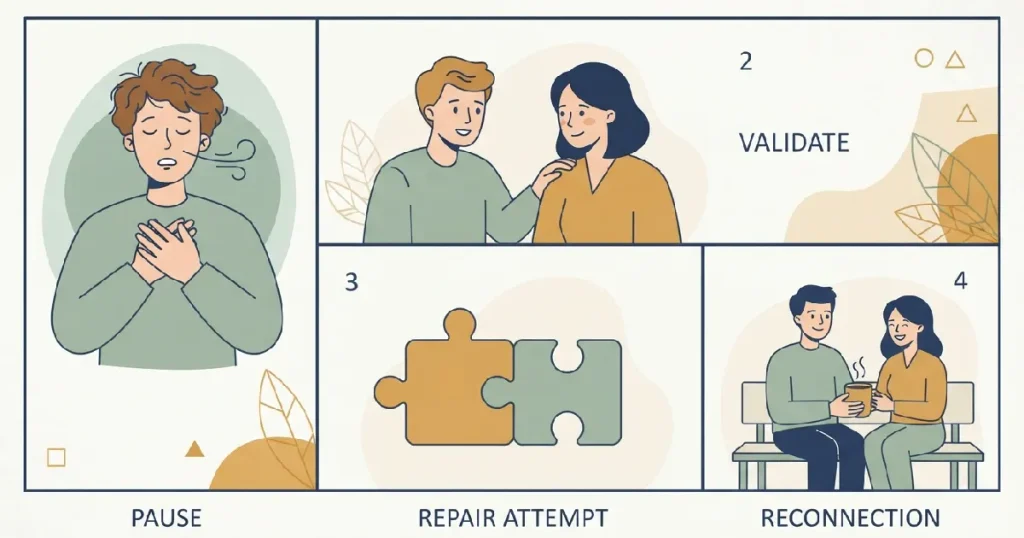
This is the real starting point for anyone searching for relationship advice for men that actually works in real time. Before you solve, you validate.
Try this instead: “That sounds incredibly frustrating. I’m sorry you’re dealing with that.” Or simply: “That’s a lot. I’m glad you told me.”
Validation is not surrender. It doesn’t mean agreeing she’s right about everything. It’s a nervous-system signal that says, I’m not your opponent right now. Research on emotional co-regulation shows that when one partner responds with calm acknowledgment instead of debate, the distressed partner’s heart rate and stress hormones measurably drop within minutes. The logical conversation works far better after that drop happens, not before.
The Real Warning Sign: Silence, Not Shouting
Most men assume a loud, venting partner is the five-alarm fire. It isn’t.
A partner who is still yelling, still crying, still bringing up the same fight three days later, is still fighting for the relationship. Frustration is a form of investment. She wouldn’t bother raising her voice about something she’d already given up on.
The real danger zone looks like quiet. Short answers. A partner who stops bringing up problems at all, who seems unbothered when you’re late, who no longer asks where things stand. That calm isn’t peace. It’s often the sound of someone emotionally preparing to leave.
Derek’s Wake-Up Call
Derek, a composite of several men I’ve worked with, spent two years thinking his marriage was improving because the arguments had stopped. His wife had simply gone quiet. She stopped asking him to help plan anything, stopped sharing her day, stopped reaching for his hand. By the time she told him she wanted a separation, Derek was blindsided. The fighting had ended because she had already emotionally left the relationship months earlier.
This pattern lines up closely with what researchers describe in adult attachment theory, the study of how early bonds with caregivers shape how adults handle closeness and conflict as grown-ups. A partner with an avoidant attachment style, or someone pushed into avoidant coping by repeated disappointment, tends to withdraw rather than confront when a relationship starts to feel unsafe. Withdrawal feels safer to them than another fight that goes nowhere.
This is far more common than most men realize, and it doesn’t mean the relationship is unsalvageable. It means the clock is more urgent than you think. If your partner is going quiet instead of loud, that shift deserves more attention than any argument ever will.
But silence isn’t the only trap hiding in this dynamic. The next one lives in your own body, not hers.
Stonewalling in Relationships: Master the Cooling-Off Pause
Picture this: your heart rate climbs past 100 beats a minute mid-argument. Your thoughts turn jagged. You stop listening because you physically can’t process one more sentence. Psychologists call this emotional flooding, a state where your nervous system floods your body with stress hormones until rational conversation becomes nearly impossible.
Flooding is why so many men go quiet or walk away mid-fight, a pattern researchers call stonewalling in relationships. To your partner, it feels like you’ve shut the door on her. To you, it often feels like a circuit breaker tripping in your chest, protecting the system from overload. Neither of you is wrong about what it feels like. You’re both describing the same moment from opposite sides of the wall.
The fix isn’t pushing through the flood. It’s calling a timeout before you hit it, in a way that doesn’t read as abandonment.
Ten low-pressure ways to do that:
- “I love you, but I’m too heated to be fair right now. Can we pause?”
- “I’m on your team. I just need a few minutes of quiet first.”
- “I want to get this right, not just win it. Give me twenty minutes?”
- “I’m shutting down, not shutting you out. Let’s come back to this.”
- “Can we take a break and revisit this in an hour?”
- “I need to cool off so I don’t say something I regret.”
- “This matters too much to me to mess up right now. Short pause?”
- “I’m not leaving. I just need a minute to think clearly.”
- “Let’s both take a breath and try again soon.”
- “I care more about us than winning this one. Give me a bit?”
Calling a pause isn’t weakness and it isn’t running. It’s relational leadership: protecting the relationship from a version of you that’s too flooded to be fair.
How to Stop Relationship Arguments With One 24-Hour Repair Habit
A cooling-off pause buys you time. It doesn’t fix anything by itself. What actually determines whether a couple survives conflict long term is what happens in the 24 hours after the fight ends.
According to The Gottman Institute, decades of research on thousands of couples found something counterintuitive. It isn’t the number of fights, or even how couples fight, that predicts divorce. It’s whether couples make and accept relationship repair attempts, small gestures that say “I still love you” in the middle of or right after conflict. Couples who stay happy long term aren’t the ones who avoid conflict. They’re the ones who get good at repairing fast.
A repair attempt doesn’t require admitting you were wrong about the facts of the argument. It requires declaring that the relationship matters more than winning it. Those are two different things, and confusing them is why so many men avoid repairing at all.
Try one of these within a day of any blow-up:
- “Things got heavy yesterday. I just want you to know I love you.”
- “I hate when we’re disconnected. Can I make you a coffee?”
- “I was thinking about what you said. Can we talk about it, calmer this time?”
- “I’m sorry the conversation got away from us. You matter more than being right.”
- “Can we start today over? I miss us.”
None of these demand a full resolution. They simply reopen the door. Most couples don’t drift apart because of one explosive fight. They drift because repair never happened, and the distance quietly became normal.
Escaping the Roommate Zone: Keeping Attraction Alive Long Term
Here’s a pattern almost every long-term couple falls into: the relationship turns into shared logistics. Who picks up the kids, who paid the electric bill, who’s doing the dishes. Somewhere between the calendar and the chores, the romance quietly checks out.
The fix isn’t a grand gesture. It’s one protected ritual: a weekly date, even 45 minutes, where household business and relationship logistics are completely off the table. No schedules. No budget talk. No in-law discussions. Just two people talking the way they did before they were running a household together.
There’s a second piece men often get backwards. Vulnerability keeps a relationship close, but constant emotional offloading, treating your partner as your only therapist, drains her reserves for being your romantic partner instead. The balance is sharing real stress openly while keeping some outlets, like a friend, a hobby, or an actual therapist, outside of her.
Flirting matters more than people admit. A one-line text in the middle of the day, a hand on her back while she cooks, a genuine compliment with zero agenda attached. Small, low-stakes playfulness, offered without expecting it to lead anywhere, often rebuilds chemistry faster than any big romantic gesture.
Now What? Three Experiments to Try Tonight

One place to start is the twenty-minute rule: the next time an argument starts climbing, call one of the pause scripts above before you hit full flooding, not after.
Another is the 24-hour repair check: set a silent phone reminder for the day after any real argument. If it goes off and nothing’s been said yet, send one repair line before you do anything else that day.
A useful question to ask yourself this week: when was the last time you and your partner spent real time together where nothing needed to be decided? If the honest answer is “I can’t remember,” that’s your sign to book the date before the week ends, not someday.
Consider naming what you’re doing out loud. Something as simple as “I’m trying to get better at this” tells your partner you’re in it with her, not performing a technique behind her back.
The Real Relationship Advice for Men Nobody Gave You
Picture that man from the start again, the one who thinks logic should fix an emotional partner. He isn’t failing because he doesn’t care. He’s failing because no one ever taught him that caring and fixing aren’t the same language.
That’s the real relationship advice for men nobody hands you early enough: validate first, watch for silence instead of volume, repair fast, and keep choosing each other on purpose. Not a rulebook from a forum. Not an algorithm’s version of masculinity. Just a man, paying attention, choosing connection over being right.
Even circuit breakers reset once the heat passes. So can the two of you, every single time, on purpose.
Pick one thing from this piece and try it tonight. Not all five. One.
A relationship is never saved in one grand conversation. It’s saved in a hundred small ones, repeated on purpose.
My Closing Remarks
I’ve sat across from enough men who thought their marriage was fine right up until it wasn’t. The quiet ones scare me more than the loud ones, every time. If there’s one thing I wish every man knew sooner, it’s this: she isn’t asking you to be a therapist. She’s asking you to notice her before the noise stops completely. That noticing, more than any technique, is what keeps people in love.
More Related Stories for You
- Some conflict never has to happen in the first place when couples handle the right things to discuss before marriage long before the wedding.
About The Author