
 Sara Carmen
Before the mortgage and the calendar quietly replace the marriage, try the 20-minute ritual that brings real closeness back.
Key Points
- These weekly marriage check-in questions follow a clinical four-part sequence, so they build closeness instead of accidentally starting a fight.
- You’ll get the exact words to say when your spouse rolls their eyes at the idea of a “check-in.”
- Learn the one habit that turns 20 minutes a week into the difference between drifting apart and staying a team.
Contents
Table of Contents
We sit two feet apart on the same couch, phones glowing, half-watching a show neither of us picked. We call this “spending time together.” Most weeks, it’s actually two people in the same room, alone.
You know this scene. Maybe you lived it last night. You’re not angry at your spouse. You’re not even sure anything is wrong, exactly. You just noticed, somewhere between loading the dishwasher and checking tomorrow’s schedule, that you’ve become excellent roommates. Efficient. Polite. Perfectly synced on logistics. And quietly, separately, a little lonely.
That ache has a name, and it has nothing to do with how much you love each other. It’s a structure problem, not a love problem.
Here’s the part no one tells you when you search “how to reconnect with your spouse” at 11 p.m.: scheduling connection isn’t a failure of romance. It’s the opposite of giving up on it.
Why Weekly Marriage Check-In Questions Actually Work
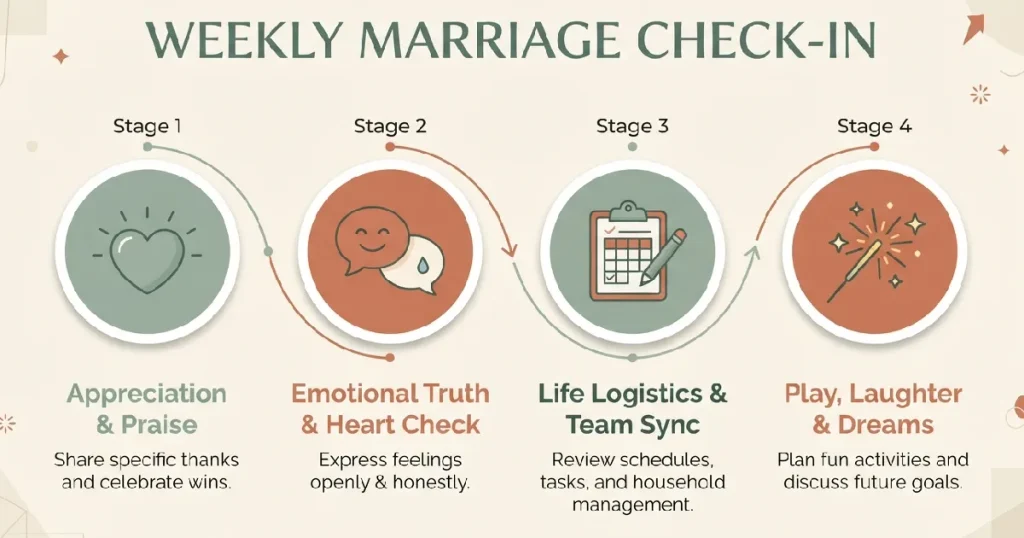
Marriage researcher John Gottman spent decades watching couples argue, repair, and drift inside his University of Washington lab, and he found something that surprised even him. Happy couples weren’t spending dramatically more hours together than unhappy ones. They were spending a small, specific amount of time differently, in what he called their State of the Union meeting. Four parts, always in the same order: appreciation, emotional check-in, practical problem-solving, and a plan to try again.
That order matters more than people realize. Appreciation goes first because of something researchers call positive sentiment override, a clinical term for a simple idea: when your brain already holds evidence that your partner is on your side, their next complaint lands as information instead of attack. Skip the appreciation and go straight to “we need to talk,” and your partner’s nervous system rarely hears curiosity. It hears a performance review.
Separately, the National Marriage Project at the University of Virginia found that couples who protect a consistent block of one-on-one time report meaningfully higher relationship quality than couples who let that time get swallowed by work and parenting. The ritual itself, done on purpose and on repeat, seems to matter more than how it’s spent.
The Difference Between Talking and a Real Relationship Check-In
Most married people only sit down for a real conversation once something has already gone wrong. A missed payment. A short answer that stung. By the time you’re talking, you’re already managing a small fire.
A weekly check-in works differently. You build the container before the pressure shows up. You’re not having “the talk.” You’re having the Tuesday talk, the one that happens whether or not anything is wrong.
That’s the real difference between talking and checking in, and it’s why relationship check-in questions for couples work when a vague “we should talk more” never does. A scheduled check-in removes the ambush. Nobody has to wonder what the conversation means before it even starts.
How to Set Up Your Weekly Marriage Check-In Without Forcing It
Pick a time you can actually keep. Sunday evening after the kids are asleep. Friday night before the takeout arrives. Consistency matters far more than finding the perfect moment, because a ritual that happens “whenever we remember” quietly becomes a ritual that never happens.
If you’re the one proposing this to a spouse who raises an eyebrow at anything with a label, keep the invitation small. Try: “I read about this 20-minute thing couples do once a week. Want to try it once, this Sunday? If it’s cringe, we never do it again.” That last sentence matters. You’re offering an exit ramp, not a commitment.
Then protect the setting. Phones go in another room, not silent, actually out of reach, because a phone buzzing face-down on the coffee table is still a phone in the room. Angle the couch at roughly 45 degrees instead of facing each other head-on, which reads to the nervous system as confrontation. Tea or coffee in hand helps too. Small, deliberate softness.
One more piece borrowed straight from Gottman’s lab: before you start talking, share a six-second kiss. It sounds almost silly written down, but six seconds is long enough to shift your body out of logistics brain and into connection brain. You’re not performing romance. You’re signaling to your own nervous system that this conversation belongs to a different category than the one about the plumber.
What to Say When Your Spouse Thinks This Is Ridiculous
Some spouses will say exactly that: “this is ridiculous” or “why do we need a worksheet to talk.” Don’t argue with the skepticism. Match it.
Try: “I know it sounds structured. Think of it like brushing your teeth. Boring, two minutes, and it’s the thing that prevents the expensive problem later.” Couples who roll their eyes in week one are, more often than not, the ones quietly defending the ritual by week four. The relief of being heard tends to outrun the awkwardness of getting started.
The Hidden Reason Weekly Check-Ins Turn Into Status Meetings
Here’s something almost no marriage guide mentions. Linguist Deborah Tannen spent her career studying how couples often use conversation for different primary purposes: what she called report talk, trading information and solving problems, versus rapport talk, trading feelings and building closeness (Tannen, 1990). Most married couples never had this explained to them. They just know that sometimes talking to their spouse feels satisfying and sometimes it feels like hitting a wall, without knowing why.
A weekly check-in usually fails not because anyone is avoidant or difficult. It fails because the couple never agrees, out loud, which mode they’re in. One partner opens with an emotional pulse question. The other answers with a logistics update about the car. Neither is wrong. They’re simply speaking two different conversational dialects at the same table.
That’s where naming the round out loud does more work than any single question on this list. Before you start, say which type of talking you’re about to do. “This one’s a feelings round.” “This one’s a planning round.” That one sentence prevents the classic check-in derail, where a question about appreciation quietly turns into a complaint and then into an argument about the calendar.
20 Weekly Marriage Check-In Questions to Stay Deeply Connected

These aren’t random questions pulled together for length. They follow the same four-part sequence as the Gottman State of the Union meeting: appreciation, emotional pulse, practical alignment, and intimacy with forward motion. Below are 20 weekly couple questions to ask, grouped into four short rounds so you’re never staring at a blank page wondering where to start. Treat them as marriage communication exercises you rotate through, not a checklist to finish. Pick four or five a week. You don’t need all 20 every Sunday.
Round 1: Appreciation and Recognition Questions
- What’s one thing I did this week that made you feel genuinely seen?
- What’s something you noticed about me this week but haven’t said out loud yet?
- When did you feel most proud of us as a team this week?
- What’s a small thing I do that you’d actually miss if it stopped?
- Did I handle a situation this week in a way that impressed you?
Push for specifics here. “Thanks for being you” trains nothing. “You got up with the baby at 3 a.m. without being asked, and I noticed” rewires your brain’s habit of scanning for what’s wrong. If you draw a blank on question one, that’s not failure. That’s data. It means appreciation needs more attention this week, not less.
Round 2: Emotional Pulse Check Questions
- What was the hardest part of your week, and did you feel supported in it?
- Is there something you’ve been carrying quietly that I should know about?
- On a scale of one to ten, how connected did you feel to me this week? What would move it up one point?
- Did anything I said or did this week land wrong, even slightly?
- What do you need from me next week that you haven’t asked for yet?
Question nine is the pressure valve of the entire list. It gives your spouse permission to flag a small irritation before it hardens into a resentment they bring up during an actual fight six weeks later. Your only job when you hear the answer is to say “thank you for telling me.” Not to explain yourself. Not to fix it on the spot. Just to receive it.
Round 3: Practical Alignment Questions
- Is there anything on your plate next week where I can lighten the load?
- Are we actually aligned on finances or parenting right now, or has there been quiet drift?
- What’s one thing on your mental to-do list that I didn’t even know was there?
- Is there a conversation we’ve been avoiding that would be easier to start gently right now?
- What’s one change that would reduce friction in our week?
This round exists because unspoken logistics quietly poison romance far more than an honest conversation about the calendar ever could. Question 13 tends to surface invisible labor, the mental tracking of appointments, birthdays, and school forms that one partner often carries alone. Naming it out loud, without turning it into an audit of who did more, does more for closeness than a dozen candlelit dinners.
Round 4: Intimacy and Play Questions
- What’s something new you’d like us to try together this month?
- When did you last feel genuinely drawn to me, not just love me but want me?
- What’s a goal or dream you quietly set aside that I could help you pick back up?
- If our marriage were a television series, what would this week’s episode be titled?
- What’s one thing I could do tomorrow that would make you feel loved?
Don’t skip question 19. It sounds like filler, but it’s doing real work. A check-in that’s all vulnerability and no play turns into a therapy session nobody volunteers for twice. Question 20 earns its place last because it hands you something to check on next week: did the thing happen, and did it land.
How Maya and Daniel Turned Sunday Dread Into a Ritual They Protect
Maya and Daniel had been married nine years when Maya found a version of this list on her phone one Sunday afternoon. Daniel’s first reaction was a flat “that sounds like a work meeting.” She didn’t argue. She just asked for one try, with the exit ramp built in.
The first attempt lasted eleven minutes and included one long silence Maya later called excruciating. They almost didn’t do it again. But Daniel noticed something on Tuesday: he’d caught himself thinking about what he’d say to question one the following Sunday, actively looking for a moment worth mentioning. That noticing was the whole thing working, quietly, before either of them called it a success.
Six months later, their Sunday check-in has survived two house moves and a layoff. Daniel still calls it “the meeting” as a joke. He also never misses it.
5 Mistakes That Turn Weekly Check-Ins Into a Complaint Session
If you recognize two or three of these signs your marriage needs better communication, you’re not alone, and you’re not broken. You just never had a structure for this before.
1. Treating it like a performance review. One partner asks, the other answers, and the roles never reverse. That’s an interview, not a check-in. Both of you answer every question, including the hard ones.
2. Re-litigating the same complaint every week. Gottman’s research found that roughly 69 percent of conflict in any long-term relationship is perpetual, rooted in differences in personality or needs that won’t fully resolve (Gottman & Silver, 1999). If the same issue shows up for the fourth week running, it’s probably a gridlock topic, not a solvable one. Say so, out loud: “I see this is still here. I’m not trying to fix it tonight. I just want you to know I see it.”
Most people assume defensiveness means their spouse doesn’t care.
It usually means the opposite.
3. Multitasking through it. Half-watching television while answering question six isn’t a check-in. It’s background noise with extra steps. The 20 minutes are protected, or they’re nothing.
4. Skipping appreciation because “nothing good happened.” Lower the bar. “You made coffee without being asked” counts. The brain needs the habit of scanning, not a grand event to find.
5. Waiting for the right mood. If you wait to feel like having a deep conversation, some weeks you’ll wait indefinitely. Schedule it the way you’d schedule a dentist appointment. The mood tends to follow the action, not the other way around.
Making Your Weekly Marriage Check-In Stick: The 4-Week Connection Ramp
One place to start is treating the first month as practice, not performance.
Week one: do it badly. Sit through the awkward silence. Showing up is the entire goal.
Week two: add the six-second kiss as a warm-up, and notice whether the conversation opens up faster.
Week three: hand the question list to your spouse and let them choose the round. Ownership changes how a ritual feels.
Week four: close with a two-minute “highlight reel,” where each of you names the single best moment of the week before you stop talking. End there, not on the hardest topic you discussed.
A useful question to ask yourself after four weeks: are we defending this ritual to a friend who thinks it sounds odd, or has it quietly slipped away? Both answers are useful information. Neither one means you failed.
Your Next 20 Minutes Start This Sunday
Picture that couch again. Phones glowing, a show nobody picked, two people in the same room. Except this time, at 8 p.m. on Sunday, the phones are in the other room, there’s a six-second kiss already behind you, and someone is asking what the hardest part of your week was.
Connection doesn’t usually disappear in one dramatic moment. It erodes the way a riverbank erodes, one quiet current at a time, so slowly that neither of you notices the ground moving until you’re standing several feet from where you started. You can’t stop that current completely. No couple can. But you can show up at the water’s edge every single week and build the bridge back across it.
Screenshot this list. Set a recurring Sunday reminder. Tonight, send your spouse one text: “New thing this week. 20 minutes, Sunday. You in?”
The couples who last aren’t the ones who never drift. They’re the ones who build the bridge back, on purpose, every week.
My Closing Remarks
I’ve watched couples dread this ritual for one session before it became the thing they protect hardest on a packed calendar. The awkward first try isn’t a bad sign. It just means you’re practicing something new. Give it four Sundays before deciding it isn’t for you. Most people quit right before it starts working, and that would be a shame. The version of your marriage on the other side of a little awkwardness is usually worth the wait.
More Related Stories for You
- Looking for more ways to strengthen your relationship between check-ins? Read our full guide on good marriage advice for more research-backed tools you can use this week.
About The Author