
 David Wall
True masculine growth happens from the inside out. Here are ten quiet mental shifts that actually change your trajectory.
Key Points
- Real self-improvement for men focuses on internal clarity rather than performative outward success.
- Mastering your mental diet and emotional boundaries prevents decades of chronic anxiety.
- Resolving your internal baggage before marriage and fatherhood breaks painful generational cycles.
Contents
Table of Contents
Someone might think that getting your life together as a guy requires endless gym sessions, high-octane hustle, and accumulating surface status symbols. But what they do not see is the quiet isolation of hitting external targets while your internal world feels hollow. Someone might think self-improvement for men is about learning psychological tricks to look confident in public. But what they do not see is the frantic overthinking that happens behind closed doors when you are terrified of losing control.
Here is the plain reality: Real growth has very little to do with public performance. Genuine self-improvement for men is the quiet rewiring of your inner life. It means taking responsibility for your thoughts, establishing clear personal boundaries, curating your daily mental inputs, and healing your old emotional wounds so you stop reacting to the world and start directing your own future.
When you are between the ages of 15 and 30, you inhabit a defining developmental window. Psychologists often call these the foundational adult years. During this phase, your brain finishes developing its prefrontal cortex, which governs judgment, impulse control, and long-term planning. If you spend this window chasing social approval, you build your adult identity on shifting sand.
1. Redefine Fun and Reclaim Your Calendar
Fun does not have to mean clubbing, drinking until dawn, or maintaining a packed social schedule. You are allowed to find deep pleasure in solitude, an absorbing book, an uninterrupted walk in the woods, building a craft, or working on a personal project. When you let peer pressure define your leisure, you surrender your autonomy.
Normalize saying a clean “No” without offering elaborate justifications. When you decline an invitation, you do not need to invent an excuse or offer a defensive apology. A simple “I cannot make it, but thank you for asking” respects your boundaries and your peers.
2. Setting Boundaries as a Man Means Dropping the Need for Approval
If someone feels irritated when you assert a healthy boundary, that irritation belongs to them. Boundary setting is not an act of aggression; it is simply clear communication about where your responsibilities end and another person’s begin.
One of the lightest moments of your adult life happens when you stop carrying other people’s opinions. Living to keep everyone comfortable is a guaranteed path to self-erasure. Let other people manage their own emotional reactions to your self-respect.
3. Treat the Ages of 15 to 30 as Your Developmental Bedrock

These fifteen years represent the golden era of your identity formation. During this window, you build the habits, financial behaviors, and relational patterns that will carry you through midlife.
You should understand the difference between enjoying your youth and ruining your foundation. Savoring your youth means collecting rich experiences and testing your limits. Ruining your youth means racking up debt, substance dependencies, and poor relational habits that take decades to undo.
Here is what nobody tells you about your twenties.
4. Overthinking and Anxiety in Men Stems From Confusing Thought With Fact
You will make friends and lose them. You will make painful errors, take corrective action, fall short, and get your heart broken. That is the normal price of psychological maturation. But you must distinguish between actual reality and your mental projections.
Nearly ninety percent of your mental suffering is generated inside your head by unexamined catastrophic narratives. Only a tiny fraction comes from actual outcomes. In clinical psychology, we call this cognitive distortion: the habit of mistaking an anxious thought for an objective fact. When you test your thoughts against evidence, your baseline anxiety drops.
5. Curate a Clean Mental Diet for Men
Everything shifts when you realize your diet is far broader than the food on your plate. Your mind consumes everything you give it: video feeds, forums, sensational headlines, books, and the daily conversations you entertain.
If your daily intake consists of outrage bait, hyper-sexualized content, and cynical gossip, your mind will naturally reflect that toxicity. Applying deliberate systems for self-improvement habits requires filtering what passes through your senses. Remove digital junk food from your attention and watch your mental fog lift.
Unaddressed emotional strain is like driving a truck with an uncalibrated steering rack. You can install a powerful engine, but you will waste massive amounts of energy just fighting the wheel to keep the vehicle in its lane.
6. Mental Depth Outweighs Surface Attractiveness
Spending hours in the gym to sculpt your physique while neglecting your character is an unbalanced strategy. Physical health matters, but physical vanity will not sustain an adult relationship.
Work to make yourself mentally attractive. Read widely, confront your recurring defensive reactions, resolve personal insecurities, and learn to enjoy your own company. A secure, self-contained man radiates a grounded presence that physical aesthetics can never duplicate.
7. Cognitive Appraisal: The Problem Is Rarely the Situation
Most of the time, the external dilemma is not your primary source of pain. Your cognitive appraisal of that dilemma is what creates distress. Cognitive appraisal is simply the subjective meaning your brain assigns to an event.
If you interpret a career setback as proof that you are fundamentally flawed, you will spiral into hopelessness. If you interpret that exact same setback as objective feedback on an ineffective strategy, you will adjust and move forward. You solve most problems by cleaning up the way you think about them.
8. Address Pre-Marriage Counseling Topics for Men Early
Before you commit your life to a long-term partner, you must discuss difficult operational realities. Love does not solve logistic mismatches.
Sit down and explicitly address monthly budgets, debt obligations, parenting philosophies, spiritual values, unresolved childhood trauma, physical intimacy expectations, and long-term career goals. Having these structured conversations prevents the slow erosion of your domestic peace later on.
9. Realize That Love Is Never Enough on Its Own
Popular culture tells young men that strong romantic feelings can conquer all obstacles. That is a dangerous myth.
Lasting partnerships require mutual emotional regulation, shared values, basic logistical compatibility, and reciprocal respect. When two people cannot resolve conflict without hostility, mutual affection will not save them. Love is merely the invitation; relational skill is the house you build together.
10. Learn How to Build Mental Resilience to Protect the Next Generation
You lose parts of your naive self during adversity, and through that process, you develop true psychological strength. True resilience is not cold detachment; it is the capacity to experience difficulty, adapt, and retain your core values.
Heal your psychological wounds before you bring children into this world. If you avoid dealing with your unaddressed anger, shame, and emotional avoidance, your children will spend their adult lives recovering from having you as an unhealed parent. Breaking that generational chain is the ultimate mark of masculine maturity.
Action Steps: Moving From Insight to Daily Practice
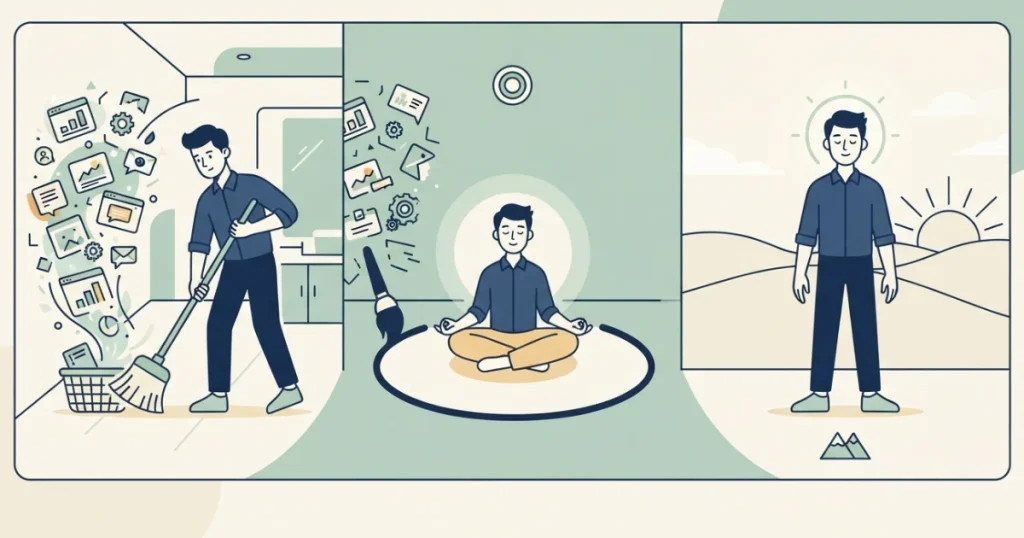
Building mental stability does not happen by accident. You need clear, repeatable practices to anchor your growth.
- Implement the Daily Information Fast. Set aside the first sixty minutes of your morning and the final forty-five minutes of your evening without digital screens. Use this time to read, reflect, or journal. This creates a psychological boundary between your thoughts and external stimulation.
- Practice the “Evidence on Trial” Technique. The next time you feel caught in an overthinking loop about a potential catastrophe, grab a notebook. Write down the catastrophic thought at the top of the page. Divide the page into two columns: “Facts That Prove This” and “Facts That Disprove This.” Force yourself to list only verifiable facts, not emotional feelings.
- Establish the Two-Second Boundary Pause. When an acquaintance, colleague, or friend asks you for an immediate commitment that you do not want to take on, do not say yes out of habit. Pause for two full seconds. Then say, “Let me look at my schedule and get back to you later.” This micro-pause breaks the reflexive pattern of people-pleasing.
Take a hard look at the uncalibrated steering rack you have been fighting. You do not need to white-knuckle your way through life trying to outrun your internal tension. By auditing your mental inputs, holding clean boundaries, and doing the quiet internal work, you take real command of your future.
My Closing Remarks
In my clinical practice, I regularly meet men who built impressive external lives while their internal worlds remained fragile. They believed that admitting confusion or setting boundaries was a sign of weakness. I want to reassure you that choosing to heal your unexamined wounds, step away from performative hustle, and question your daily habits is the bravest path you can take. Give yourself permission to slow down, build your internal foundation, and live life on your own terms.
More Related Stories for You
- To protect your relational peace and establish clear communication before making a lifetime commitment, explore these critical things to discuss before marriage to build a solid marital foundation.
About The Author