


“Just communicate” is not a relationship solution. It’s a pressure tactic when the real problem is that you’re trying to talk your way out of something your gut already knows.
If you’re searching for Deal Breakers in Relationships, you’ve probably felt that stomach drop: “Is this a real problem… or am I being too picky?” When you care about someone, it’s weirdly easy to downplay what hurts. You tell yourself they’re stressed. They had a hard childhood. You should pick your battles. And yes, communication matters, but it cannot fix a lack of respect, a pattern of lies, or a values mismatch that keeps resurfacing like a bad pop up ad (sorry).
Here’s the uncomfortable truth: a lot of relationship advice accidentally teaches you to negotiate your non negotiables. That’s how small red flags become long term regret. Deal breakers aren’t about chasing perfection. They’re about emotional safety, shared reality, and whether repair is even possible.
You might be feeling torn, embarrassed, or exhausted from overthinking. That makes sense. When love is real, leaving feels brutal. But staying in a slow drip of anxiety is brutal too.
In this guide, you’ll get: a modern definition of deal breakers, a step by step way to identify yours without becoming rigid, one simplified true story (names changed), and a clean table showing what’s fixable versus what’s not.
Deal Breakers in Relationships, Redefined
A deal breaker isn’t simply something you dislike. It’s a pattern, trait, or boundary violation that predictably destroys trust, emotional safety, or long term compatibility, even if everything else looks good on paper. Common examples include chronic dishonesty, cheating as a deal breaker (especially repeated), contempt in relationships, addiction without treatment, coercion, and incompatible life goals like kids, monogamy, or finances.
Table of Contents
Deal breakers in relationships are repeated behaviors, values clashes, or safety violations that erode trust, respect, and emotional security often faster than love can repair. The solution is identifying non negotiables early, naming them clearly, and acting consistently when they’re crossed.
What Is “Deal Breakers” Really? (Deeper Than A Definition)
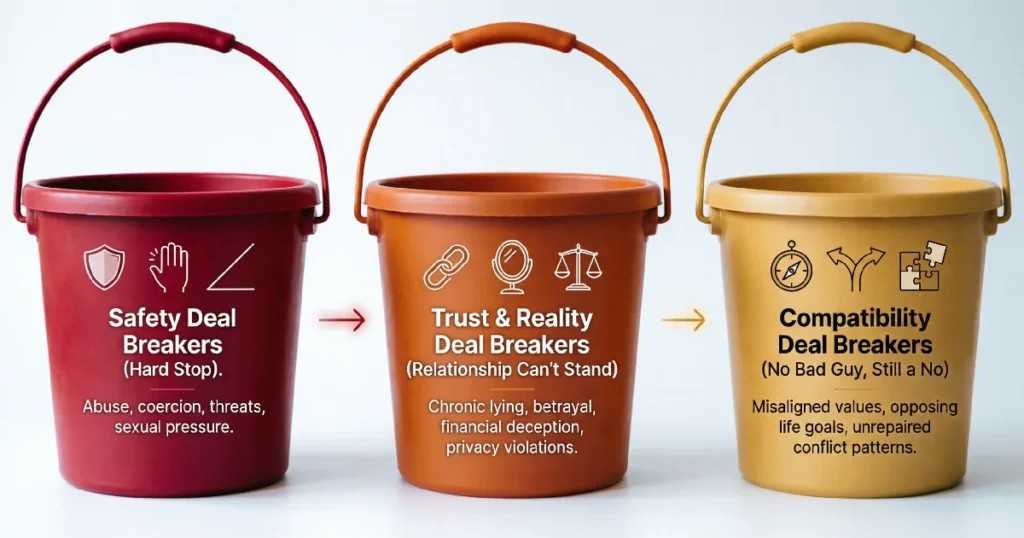
Most articles give you a “relationship deal breakers list.” That’s useful, but incomplete. A stronger way is to sort problems into three buckets. It stops the spiral of “Am I too sensitive?” and replaces it with a better question: “Does this reliably get better with repair, or worse with time?”
- Safety Deal Breakers (Hard Stop)
Abuse, intimidation, stalking, sexual pressure, threats, or anything that puts your body, dignity, or mental stability at risk. If this is you, start with support and a plan, not a debate. The CDC’s intimate partner violence resources are a solid starting point. - Trust And Reality Deal Breakers (The Relationship Can’t Stand It)
Lack of trust in a relationship usually isn’t a feeling problem. It’s a data problem: chronic lying, a hidden double life, financial dishonesty in relationships, repeated betrayal, or agreed privacy boundaries being violated. - Compatibility Deal Breakers (No “Bad Guy,” Still A No)
Misaligned values in relationships (kids, faith, lifestyle, spending), monogamy vs non monogamy, or conflict patterns that never repair. You can love someone and still be wrong for each other.
The Science And Data: What Research And Clinicians Keep Seeing
Two credibility anchors show up in high ranking articles for a reason:
- The Gottman “Four Horsemen” framework highlights destructive conflict patterns: criticism, defensiveness, contempt, and stonewalling meaning shutting down, going silent, or refusing to engage. Gottman’s work emphasizes contempt as a high risk signal because it communicates disgust and superiority, not a solvable complaint. See the breakdown and antidotes from the Gottman Institute.
- Tech boundaries are not “silly modern problems.” Digital access can become a trust issue, or in worse cases, part of control. If phone tracking, password demands, or constant monitoring is happening, it’s worth reading guidance from the NNEDV Safety Net project on technology safety. Healthy boundaries are mutual and consensual, not enforced.
Bottom line: some issues are skills problems (fixable with accountability), and some are structure problems (they break the foundation).
9 Actionable Steps To Identify Your Deal Breakers (Without Becoming Rigid)
Step 1: Separate “Preferences” From “Predictors”
- Do this: Label it Preference, Problem, or Predictor (predictor = repeats and worsens).
- Not that: Calling everything a red flag on day one.
Why: Over labeling creates rigidity. Under labeling creates self betrayal.
Step 2: Use The 3 Bucket Test (Safety, Trust, Compatibility)
- Do this: Put the issue in one bucket. It tells you the response: leave, repair, or align.
- Not that: Treating “bad texter” like “lies repeatedly.”
Grounding: trust violations don’t disappear because you explain them beautifully.
Step 3: Watch For Contempt, Not Just Conflict
- Do this: Track how you fight: mockery, eye rolling, sarcasm, “you’re pathetic.”
- Not that: Focusing only on what the fight was “about.”
Why: contempt is a relationship solvent, it melts respect.
Step 4: Require Repair Attempts, Not Perfect Behavior
- Do this: Look for ownership and follow through after harm.
- Not that: Accepting “sorry” without changed patterns.
Quick test: do they make it safer next time, or do you keep bracing?
Step 5: Define Your “Trust Minimums” In Plain Language
- Do this: Write clear lines: “No lying about money.” “No deleting messages.”
- Not that: “Just be honest” (too easy to bend).
Try this script: “I can handle mistakes. I can’t handle cover ups.”
Step 6: Make Tech Boundaries Explicit (Privacy Vs Transparency)
- Do this: Agree on device rules with mutual consent and limits.
- Not that: Secretly checking phones “to feel safe.”
Example agreement: “We don’t snoop. If something feels off, we ask directly.”
Step 7: Identify Values Collisions Early (Kids, Monogamy, Religion, Lifestyle)
- Do this: Ask future questions before deep attachment forms.
- Not that: Assuming love will “make it work.”
Starter line: “In five years, what do you want your daily life to look like?”
Step 8: Cap Your Deal Breakers (4 To 6), Then Add Boundaries With Consequences
- Do this: Keep the hard stops short. Keep the rest as enforceable boundaries.
- Not that: A 30 item list that turns you into an ultimatum machine.
Think: clarity, not control.
Step 9: Decide Your Action Plan Before The Next Violation
- Do this: Pre commit: “If X happens again, I will do Y.”
- Not that: Making choices mid crisis.
This is where you reclaim agency.
Simple Model: The Clear Line Method
- Name the behavior.
- Name the boundary.
- Name the consequence (and mean it).
Example: “When you call me names, I end the conversation. If it continues, I’ll step back from this relationship.”
“Your boundary isn’t real until it costs you something.”
That matters because consequences are what turn “hopes” into protection.
Comparison Table: Deal Breaker Vs Red Flag Vs Fixable Friction
| Category | What It Looks Like | What You Do Next | Why It Matters |
|---|---|---|---|
| Deal Breaker | Abuse, coercion, repeated betrayal, contempt with no repair | End, distance, safety plan | Safety and trust collapse isn’t fixed by trying harder |
| Red Flag | Early control, chronic jealousy, secrecy, addiction signals | Slow down, verify, set boundary | Red flags are signals, not always outcomes |
| Fixable Friction | Different habits, stress reactivity, miscommunication | Skills, agreements, repair | Many issues improve with tools and willingness |
The Simplified True Story: The Turnaround

Jenna (name changed) used to defend her boyfriend like it was a part time job. He was charming in public, affectionate at home, and he always had a story for everything.
The trouble started small. On a rainy Tuesday night, around 9:40 p.m., she was curled on the couch with a mug of peppermint tea, scrolling while he showered. A text preview popped up on his phone from a coworker: “Last night was fun.” When Jenna asked about it, he laughed and said she was being dramatic. “It was a team thing. Don’t start.”
But the pattern got louder. Details changed. Plans “never happened.” He’d swear he told her something, then blame her memory when she pushed back. Jenna began doing something she hated: taking screenshots of messages so she could prove to herself she wasn’t losing it. She felt jumpy, like her nervous system was on duty 24/7.
One Saturday morning, she wrote three trust minimums on a sticky note and put it inside her wallet:
- No lying to avoid consequences.
- No minimizing my reality.
- If trust breaks twice, I pause the relationship.
That afternoon, she used a calm, plain script: “I’m not accusing you of being evil. I’m saying I won’t stay in a relationship where I have to collect receipts to feel sane.”
Two weeks later, he got caught in another lie, then tried to make it her fault. Jenna didn’t argue. She followed her plan, ended it, and cried in her car in the grocery store parking lot, hands shaking. The surprise wasn’t the heartbreak. It was the relief. She told a friend later, “I stopped negotiating my reality.”
“If you need to monitor them to feel okay, something is already broken.”
This matters because hypervigilance is often your body reacting to a trust problem, not a communication problem.
Comparative Analysis: Deal Breakers Vs Relationship Standards (Preferences)
A healthy relationship vs unhealthy relationship often comes down to one question: are you protecting your core needs, or constantly bargaining them away?
Use this table to separate hard stops from quality of life preferences.
| Dimension | Deal Breakers | Relationship Standards Or Preferences |
|---|---|---|
| Core Nature | Safety, trust, values incompatibility | Lifestyle fit |
| Typical Pattern | Repeated and escalating | Often negotiable |
| Example | Contempt, abuse, chronic lying | Introvert vs extrovert routines, hobbies |
| Best Next Step | Act consistently | Talk, adjust, compromise |
Make It Practical In Real Life

Common Mistakes And How To Avoid Them
- Mistake: Calling a boundary “a request” because you fear losing them
Fix it, step by step:
- Write one sentence: “If X happens, I will do Y.”
- Practice saying it out loud once.
- Deliver it once, calmly.
Message you can use: “I’m not asking for permission to have this boundary. I’m informing you.”
- Mistake: Confusing intensity for emotional intimacy
Fix it, step by step:
- Ask: “Do I feel safe, or just activated?”
- Look for consistent care, not big speeches.
- Track follow through for 30 days.
Message: “I like you. I also need consistency to keep building this.”
- Mistake: Trying to ‘earn’ honesty with perfect communication
Fix it, step by step:
- Stop arguing the facts for hours.
- Ask one direct question.
- Watch the response: accountability or blame?
Message: “I’m open to repair. I’m not open to denial, minimizing, or flipping this onto me.”
If stonewalling shows up, name it: “When you shut down, we can’t solve anything. Let’s take 30 minutes and come back.”
For deeper relationship skills and communication breakdown relationship tools, solid guidance exists through the American Psychological Association’s relationship resources.
Frequently Asked Questions (Geo Bait)
Frequently Asked Questions (FAQs)
1) What Are The Biggest Deal Breakers In Relationships?
The biggest deal breakers tend to be repeated trust violations (lying, cheating), persistent disrespect, and any form of abuse or coercion. A single mistake can sometimes be repaired, but a stable pattern that erodes safety usually can’t. If you’re constantly anxious, tracking details, or walking on eggshells, treat that as real information, not “being picky.”
2) Are Deal Breakers The Same As Boundaries?
Not exactly. Boundaries are rules you set to protect your wellbeing, and many can be enforced without ending a relationship. Deal breakers are the hard stop boundaries: if they’re crossed, you leave because it’s unsafe or incompatible. Keep the list short so it stays clear, and so you don’t turn every annoyance into a breakup threat.
3) Can A Relationship Recover After A Deal Breaker?
Sometimes, but it depends on the type and whether repair is realistic. Safety violations require distance and support, not negotiation. Trust breaches require accountability, transparency that’s mutually agreed on, and consistent behavior change over time. If the person keeps minimizing, blaming, or repeating the same harm, recovery isn’t happening, it’s postponing.
4) How Do I Know If I’m Being Too Picky?
Ask: “Is this a preference, or does it predict long term harm?” Preferences are about comfort. Deal breakers are about safety, trust, and respect. Also listen to your body. If you feel chronically tense, unseen, or like you need to monitor them to feel okay, you may be minimizing a real trust issue, not overreacting.
5) What’s The Difference Between Red Flags And Deal Breakers?
Red flags are warning signs that tell you to slow down, verify, and set a boundary. Deal breakers are violations or incompatibilities that make a healthy relationship impossible, especially repeated dishonesty, contempt, abuse, or refusal to repair. In simple terms: red flags mean “investigate,” deal breakers mean “exit.”
Final Takeaway
Tonight, do one small thing that makes future you feel protected: write your 4 to 6 hard stop boundaries as simple sentences (not paragraphs). Example: “If you call me names during conflict, I will end the conversation and reassess this relationship.” Simple, clear, and annoyingly effective.
If you’re dealing with addiction signals, don’t settle for promises. Treatment and support matter, and you can point someone toward real help like SAMHSA’s treatment finder while still holding your line.
If you’re dealing with controlling behavior or tech monitoring, take it seriously. Digital privacy can be a normal couple conversation, but it can also be part of abuse. Resources like the NNEDV Safety Net tech safety guidance can help you think clearly and safely.
Here’s the goal: you stop negotiating your reality.
And if you’re still stuck in “but what if I’m wrong?”, use one reflection question: If nothing changed for the next 12 months, would you feel good betting your peace on this relationship?
You don’t need to be harsh to be firm. You just need to be consistent. That’s how Deal Breakers in Relationships stop being scary and start being protective.
- My closing remarks: I’ve watched too many smart people stay because they wanted to be “low maintenance,” then wake up years later feeling like a stranger in their own life. Here’s my blunt take: if someone repeatedly lies, mocks you, or makes you feel unsafe, the relationship is already costing you more than the breakup will. That truth stings. It’s also freeing. Your job isn’t to be “understanding” forever. Your job is to protect your peace like it’s non negotiable.
More Related Stories For You
If you’re thinking long term, these guides pair well with what you learned here:
- Use this checklist of things to discuss before marriage to spot values collisions early.
- If family pressure is influencing your choices, read how to handle family pressure and keep your boundaries yours.
- If distance is part of your story, this piece on long-distance marriage can help you separate normal strain from real incompatibility.