


She never raises her voice. She never breaks a rule you can point to. And that is exactly why you can’t figure out what’s wrong.
Key Points
- The most damaging characteristics of a female narcissist rarely look like narcissism at all. They look like sensitivity, exhaustion, or love.
- Vulnerable narcissism uses tears, silence, and self-sacrifice as tools of control instead of the loud entitlement most people expect to see.
- Once you learn to recognize the actual behavioral loop, you can protect your peace of mind without needing her to ever change.
Contents
Table of Contents
We have been trained to look for narcissism in volume. The interrupting voice. The grand claim. The person who cannot share a spotlight. That training is why so many of us stay confused for years.
You sit across from someone who looks fragile. She cries easily. She talks about how hard she tries. Friends call her devoted. And you still leave the room feeling smaller, guilty, and unsure of your own memory.
Someone might think she is just insecure. But what they don’t see is how that insecurity always ends with you apologizing.
Someone might think she is exhausted from carrying the home. But what they don’t see is that your exhaustion never makes the list.
Someone might think the silent days are her “processing.” But what they don’t see is that the silence arrives the moment you stop complying.
The short answer: The core characteristics of a female narcissist are rarely loud. They show up as weaponized hurt, selective warmth, and a public mask that hides private control. She does not need to shout to own the room. She only needs you to doubt yourself first.
That doubt is the point. Left unnamed, this pattern can hollow out your sense of self until you no longer recognize your own preferences.
The Hidden Psychological Profile of Female Covert Narcissism
Clinical checklists were built around a loud, masculine-coded picture: boastfulness, open entitlement, obvious rage. Female presentations often miss that picture. The engine can be the same. The delivery is different.
Covert narcissism (also called vulnerable narcissism) is a pattern where the need for special treatment and the shortage of real empathy arrive wrapped in fragility. Instead of “I am superior,” the message sounds like “I am wounded, and you caused it.” Entitlement still sits underneath. It just wears a softer face.
In my practice I meet capable people who have slowly handed over the right to define reality. Most of them did not marry a villain from a film. They married someone who looked sensitive, loyal, and tired.
Research on gender and dark traits keeps making the same uncomfortable point. A 2024 analysis from City St George’s, University of London notes that women can use traditional nurturing roles to mask harmful control. The PTA smile. The volunteer hours. The “I do everything for this family” story. That story is not always care. Sometimes it is cover.
Vulnerable narcissism is not ordinary insecurity
True insecurity wants comfort so it can settle. Vulnerable narcissism uses hurt so it can steer.
If you reassure her, the peace is brief. If you name a problem, the tears arrive first and the issue disappears. If you hold a boundary, you become the aggressor in a story she tells with impressive detail.
That is the diagnostic dividing line. Healing seeks closeness. Control seeks compliance.
A useful way to picture it is a dimmer switch on the wall. A healthy partner leaves the lights on even during conflict. A covert narcissist stands at the switch. Every time you speak up, the room gets a little darker. You start whispering so the light will come back.
Most people in this situation don’t realize they have been dimming themselves for years. They call it patience. They call it being a good man.
It is neither. It is survival.
The public saint and the private climate
Watch the split.
Outside the house she is warm, civic, maternal, and easy to like. Inside the house she is cold, exacting, and easily injured. That split is not hypocrisy for its own sake. It is insulation. If everyone else thinks she is the wounded hero, you will sound unstable when you describe the nights.
This is why so many men search phrases like “why does my wife ignore me for days” long before they ever type characteristics female narcissist. They are looking for a name for a fog they already live in.
7 Subtle Characteristics of a Female Narcissist That Signal Control
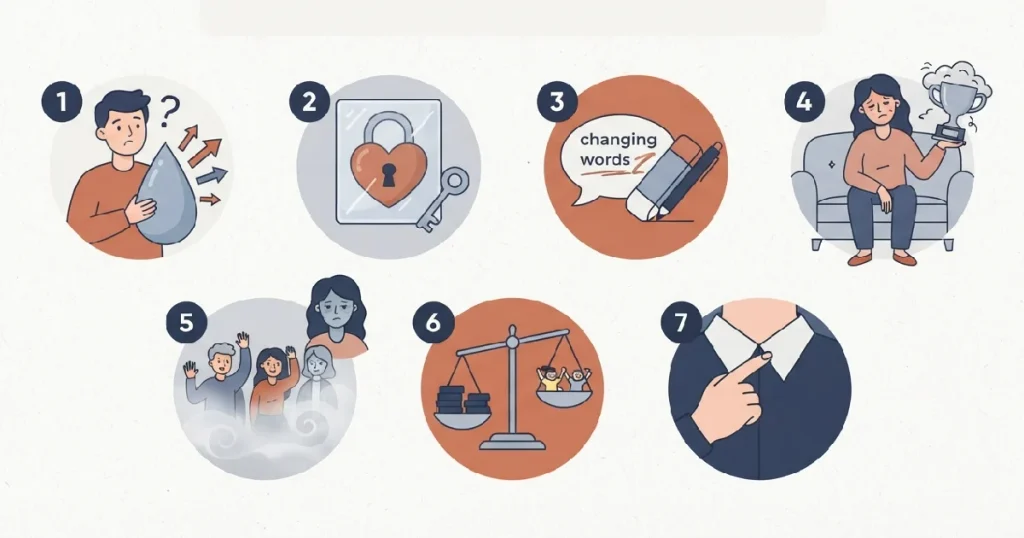
These are not cinematic blowups. They are daily micro-moves. Each one is easy to excuse. Together they train you.
1. Weaponized hypersensitivity: the defensive shield
She treats ordinary feedback as a character assassination.
You say, “Can we try to spend a little less on groceries this month?” She hears, “You are a failure as a wife and a mother.” The original topic dies. You spend the next hour comforting her for a wound you did not create.
The control loop is simple. You stop raising anything real because the emotional bill is too high. Silence starts to look like kindness. It is actually surrender.
2. Selective emotional withholding as currency
Affection, eye contact, sex, and even basic conversation become tokens. When you comply, the room warms. When you don’t, she stays polite in public and unavailable in private.
This is intermittent reinforcement, a learning pattern where rewards arrive on an unpredictable schedule. Slot machines use it. So do trauma bonds, which are intense attachments formed through cycles of warmth and withdrawal. You work harder for a baseline of human warmth that should never have been a prize.
Notice the tell. Love feels like a paycheck for obedience, not a climate you both live in.
3. Rewriting emotional intent (micro-gaslighting)
She does not always invent events. She rewrites motives.
You clean the kitchen as a gift. She says you did it to shame her housekeeping. You plan a weekend away. She says you only care about what you want. You apologize for the thing you meant as care.
Over time you stop trusting your own intent. You wait for her verdict on whether you were good. That is not communication. That is custody of meaning.
Clinicians sometimes call the smaller version of this micro-gaslighting: tiny re-framings of tone, timing, and history that make you the problem in scenes you remember differently. Warning signs of female covert narcissism often cluster right here, in the gap between what happened and what she says it “really” meant.
4. The martyrdom competition
She keeps the household ledger of suffering. If you mention a brutal day at work, she answers with a longer list. Illness, chores, sleep, the children, the mental load. There is only room for one victim, and it is never you.
Your needs fall off the page. You start prefacing every feeling with an apology. You become a supporting character in a play about her endurance.
That is not partnership. That is a monopoly on pain.
5. Quiet social poisoning
She rarely bans your people. She sours them.
“Your brother takes advantage of you. It makes me sad to watch.” “Your friends don’t respect your time.” After every visit there is a debrief that lasts longer than the visit. You cancel next time because you are tired, not because you were ordered.
Watch your circle. If it is shrinking and you cannot point to a single dramatic fight, this is often why. Isolation does not need a lock on the door. It only needs the cost of connection to feel too high.
Parenting can enter the same tactic. She may hint that the children are “safer” in her emotional weather than in yours, or that questioning her is confusing them. That is not always protection. Sometimes it is a quiet threat of exile inside your own home.
6. Double-standard accountability
Rules run downhill.
She wants your location, your passwords, your tone, your timing. When you ask a parallel question, she calls it distrust, control, or cruelty. A past exception appears. An emotional justification appears. Her breach becomes understandable. Yours remains evidence.
You live as the defendant. She lives as the judge. That hierarchy is the relationship.
7. Micro-critiques masked as help
A drip of corrections. Your shirt. Your joke. Your driving. The way you load the dishwasher. Always framed as care: “I only say this because I want people to respect you.”
You start checking yourself before she does. That is anticipatory self-erasure. You edit the sentence in your mouth. You change clothes twice. You lose the feeling of being a person who can occupy space without permission.
Confidence does not usually collapse in one fight. It leaks.
That is not sensitivity. That is strategy.
Daniel’s kitchen notebook
Daniel was 41, a project manager with two kids and a wife everyone praised for school events. Claire cried if he mentioned money. She went ice-cold if he made plans without a full briefing. She told mutual friends he was “under a lot of stress,” which made him sound unstable before he ever told his side.
He developed reflux, brain fog, and a habit of rehearsing texts for twenty minutes. One night he wrote three conversations down word for word. In the morning her version had already changed. He was not crazy. He was being edited.
The notebook did not fix the marriage. It gave him a floor to stand on. That is often the first real win: not a dramatic exit, but a private record that your mind still works.
The Invisible Cost: Somatic Stress From Female Narcissist Dynamics

Your body keeps the score of a house where the weather can change without notice.
Walking on eggshells is not a metaphor for your nervous system. It is a chronic threat state. Cortisol stays high. Sleep thins. Digestion rebels. Attention scatters. People describe “brain fog” because the mind is busy scanning for the next emotional trap instead of living the day.
Cognitive dissonance sits on top of that. That term simply means holding two colliding truths at once: She looks kind and I feel erased. The mind tries to resolve the collision by blaming the easier target, which is you.
This is why so many partners look “too sensitive” to outsiders. They are not fragile. They are adapted to an unstable climate.
If your gut, sleep, and focus collapsed after years of this, that is not a coincidence. It is physiology answering a relationship that never lets you rest.
How to Set Boundaries With a Covert Narcissist Without Feeding the Cycle
Do not open with a diagnosis. Calling her a narcissist hands her a new wound to perform and a new story to tell other people. You do not need her to agree with the label. You need your own footing.
One place to start is reducing the emotional fuel she uses.
The BIFF method (from high-conflict communication work) keeps necessary talk Brief, Informative, Friendly, and Firm. No essays. No character analysis. No chasing her mood.
The grey rock technique means becoming uninteresting when a reaction is the goal. Short answers. Neutral tone. No fresh personal detail. You are not being cold for sport. You are taking the prize off the table.
Rigid private boundaries matter as much as spoken ones. A journal she cannot read. Money she cannot monitor. One person outside the house who knows the unedited version. Privacy is not betrayal when the home rewrites history.
Neutral scripts you can use without lighting a fuse
For the silent treatment:
“I want to discuss this when you are ready. I am going to step out for an hour, and we can look at options together when I return.”
For micro-critiques:
“I understand you would do this differently, but I am comfortable handling it this way. Let’s see how it turns out.”
For rewritten intent and guilt:
“My goal was simply to help. I see we have different viewpoints, and that is okay. I will let you handle it your way next time.”
For martyrdom pressure:
“I see how much you have on your plate today. I am happy to handle dinner tonight so you can rest.”
Then stop. Do not keep talking to earn a warmer climate. The dimmer switch is not yours to manage.
A useful question to ask yourself after any of these moments: Did I abandon a true thing about myself to buy peace? If the answer is yes, the peace was priced too high.
Meaningful change in this pattern is rare because the whole structure is built to avoid shame and push blame outward. Your job is not to complete her insight. Your job is to keep a self.
You were never required to live by her dimmer switch.
Confusion was never proof that you failed. It was the method.
You can sit at that same table and see the scene clearly now. The tears. The saint story. The quiet freeze. None of that has to decide what is real.
Clarity is not an attack. It is how you come back.
You were not losing your mind. You were living in someone else’s story.
My Closing Remarks
I have sat with men who could run companies and still could not talk about their marriage without watching the door. That is not weakness. That is what years of quiet rewriting does to a body. If these pages named something you have been circling, treat that recognition as data. You do not need her permission to trust what you feel. Clarity is not cruelty. It is how you come back to yourself.
More Related Stories for You
- If chronic walking on eggshells has left you stuck in high alert, these mindfulness exercises for anxiety can help settle your nervous system while you sort out what comes next.