
 Nicole Adkins

A simple guide to stopping the eggshell walking, cutting through manipulation, and getting your peace back.
Key Takeaways
- Spotting manipulation early is the first step in learning how to deal with a toxic partner without losing your sanity.
- Arguing back or over-explaining never works with people who use your feelings against you.
- Clear boundaries and personal backup plans protect your peace far better than trying to change someone else.
Quick Answer
To deal with a toxic partner, you must stop absorbing their volatility and set firm boundaries. Spot manipulation early, stop over-explaining yourself, secure your money and private life, and step out of circular arguments. Protecting your peace means choosing your reality and personal safety over winning their approval.
Contents
Table of Contents
You know that feeling when you sit in your car in the driveway after work and just stare at the steering wheel?
We have all done that when home does not feel like home anymore. You sit there trying to guess which version of your partner is waiting on the other side of the front door. Are you getting the sweet, funny person you fell for, or the cold, critical stranger who turns every single word into an argument?
Living like that wears you down to nothing. You start second-guessing your own memory and running conversations in your head before saying a word out loud. You tell yourself that if you just phrase things a little better or try a little harder, things will calm down.
Here is the hard truth. You are not dealing with standard relationship stress. You are dealing with a pattern where one person needs control, and no amount of gentle patience can fix someone who uses your empathy as a weapon against you. Learning how to deal with a toxic partner starts the moment you stop trying to fix them and start protecting yourself.
The Toll of Chronic Manipulation: What Clinical Psychology Reveals
Living with emotional mistreatment changes how your brain works on a daily level.
When your partner alternates between blowing up, giving you the silent treatment, and showering you with affection, your nervous system stays stuck in overdrive. That hot-and-cold cycle is called intermittent reinforcement. It creates a powerful biochemical bond that makes walking away feel almost physically impossible.
Clinical research shows this is not just harmless relationship bickering. Long-term studies on couples from The Gottman Institute show that contempt and persistent stonewalling are the single greatest predictors of psychological breakdown in relationships. Contempt acts like acid on emotional safety. It tells your brain that you are under constant attack in your own living room.
Over time, that reality creates what psychologists call cognitive erosion. You hear “that never happened” or “you are way too sensitive” so many times that you stop trusting your own gut. Data indexed by the American Psychological Association shows that chronic emotional coercion spikes your daily cortisol levels, wrecks your sleep, and ruins your focus at work. You end up feeling exhausted, shaky, and completely isolated from everyone who actually loves you.
| Accountable Partner | Toxic Partner |
|---|---|
| Listens to your hurt without attacking back | Flips the blame back onto you right away |
| Takes real ownership and changes bad habits | Makes big apologies but repeats the exact same harm |
| Gives you space to have your own feelings | Uses guilt, rage, or icy silence to punish you |
| Wants both of you to win arguments together | Only cares about dominating and winning control |
The B.O.U.N.D. Protocol: 5 Top Rules on How to Deal with a Toxic Partner
When you live with daily manipulation, standard couples-therapy advice backfires. Telling someone who is manipulative how much they hurt your feelings just gives them a roadmap of where to strike next.
Take Sarah and Mark. Every time Sarah brought up their shared credit card balance, Mark would explode, bring up a mistake Sarah made three years ago, and storm out. Sarah would spend the rest of the evening crying, texting apologies, and paying the bill herself. Mark was not confused about the budget. He was using anger to make Sarah back off.
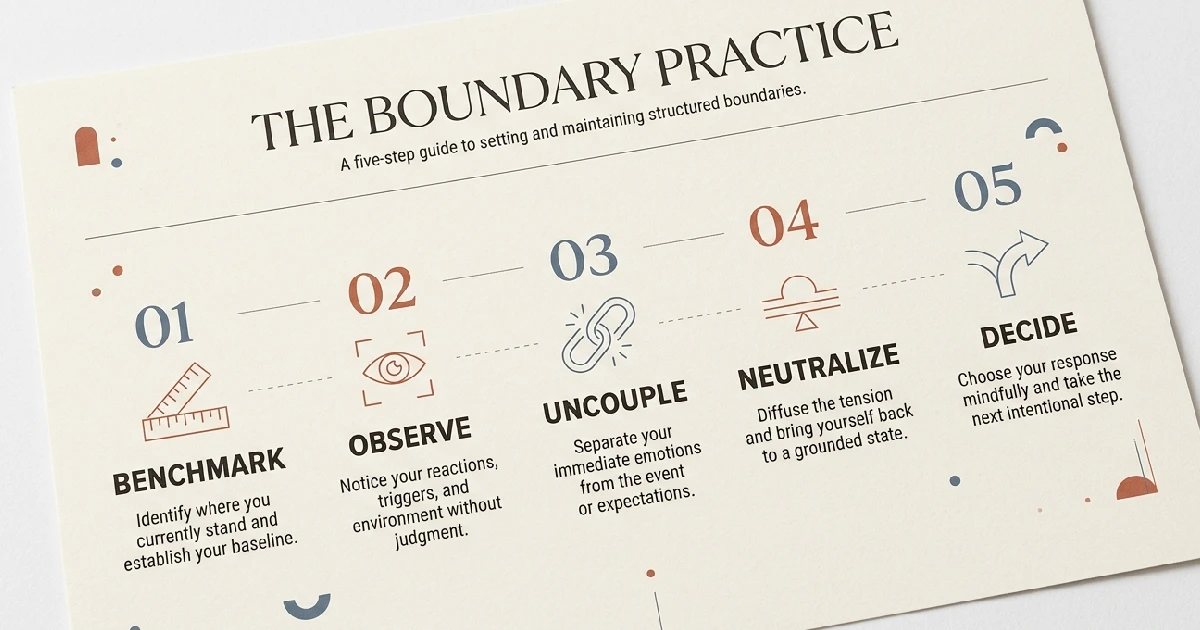
To stop that cycle, you need the B.O.U.N.D. Protocol. These are the 5 top rules on how to deal with a toxic partner in day-to-day life:
Rule 1: Benchmark the Baseline (Benchmark)
Stop grading your relationship on their best days or empty apologies. Look at their real actions over the last six months. If someone is sweet for two days and cruel for five, their baseline is inconsistent and unsafe. Tracking patterns instead of words protects you from falling for false promises.
Rule 2: Observe, Don’t Absorb (Observe)
Treat their outbursts like a scene in a movie. When they raise their voice, roll their eyes, or try to pick a fight, step back mentally and just watch the performance. Their anger is their issue, not your emergency. You do not have to swallow every bitter pill they hand you.
Rule 3: Uncouple Your Identity and Logistics (Uncouple)
A controlling partner wants you completely dependent on them. Start rebuilding your own separate life right now. Keep your own private savings account, protect your hobbies, and call your old friends without asking for permission. When you have your own solid foundation, their threats lose alot of their power.
Rule 4: Neutralize Conversational Traps (Neutralize)
Drop the habit of J.A.D.E.-ing (Justifying, Arguing, Defending, Explaining). Manipulative people do not want an explanation; they want an argument they can twist. Give flat, boring responses. When you stop giving them emotional fuel, the fire dies down fast.
Rule 5: Decide Consequences in Advance (Decide)
Never throw out empty threats during a fight. Decide in your own mind ahead of time what line cannot be crossed and what you will do when it happens. A boundary is not what you tell them to do. A boundary is what you do with your own body and time.
Here are three direct scripts you can use right away:
- When they try to deflect blame: “We are talking about what you just said right now. I am not going down memory lane, and I am not changing the subject.”
- When they drag you into circular arguments: “I said what I needed to say. I am not debating this back and forth, so I am going to step outside for a bit.”
- When they use passive-aggressive silence: “I see you are not in a space to talk normally. I will be reading in the living room whenever you want to talk with respect.”
Critical Questions Answered: Breaking Relational and Family-of-Origin Traps

Question 1: How Do You Deal with a Toxic Parent Whose Conditioning Leads You to Toxic Partners?
Most people who find themselves trapped with an unloving partner did not land there by accident. When you grow up in a house where love was conditional, unpredictable, or tied to your silence, mistreatment feels familiar.
Learning how do you deal with a toxic parent starts with recognizing what psychologists call repetition compulsion. You unconsciously pick partners who treat you like your family did, hoping that this time you can finally earn their love and fix the past.
To break that loop, you have to learn how deal with toxic parents by taking them off the emotional pedestal. You stop expecting emotional maturity from people who never gave it to you as a child. When you read about how to deal with toxic family members, you start to see that separating your self-worth from family approval is the exact same skill you need to stand up to a romantic partner.
Question 2: How to Deal with Living with Toxic Parents While Trying to Rebuild Personal Independence?
Living in an abusive home as an adult while trying to save cash is a daily test of endurance. You cannot do deep emotional healing while sleeping in the same room where your boundaries get smashed every morning.
The practical way on how to deal with living with toxic parents comes down to physical and digital privacy. Put password locks on your devices, get a secure post office box for your mail, and spend as many hours out of the house as humanly possible through work, the gym, or the library.
When they try to pick apart your life or pry into your personal choices, use this simple script: “I know you have your own views on that, but my finances and personal choices are private. Let’s talk about dinner instead.”
Question 3: How to Cope with Toxic Parents Who Continually Interfere in Your Adult Life?
Controlling parents hate losing their grip when you grow up. If you wonder how to cope with toxic parents who meddle in your marriage, career choices, or parenting, the answer is a strict information diet.
Many adult children ask how do i deal with toxic parents who use guilt, dramatic emergencies, or inheritance money to control their weekends. You deal with them by treating personal news like classified information.
Give them weather updates, talk about sports, or share surface-level gossip, but keep your deep plans, career moves, and relationship problems completely to yourself. If they demand answers, schedule a short phone call once a week and stick to a hard twenty-minute limit.
The Dual-Front Defense: How to Deal Toxic Parents and Partners Simultaneously
Facing boundary battles at home while getting zero support from your relatives is an exhausting spot to be in. Often, learning how to deal toxic parents means realizing they might actually side with your abusive partner just to keep the peace and tell you to stop making waves.
When a toxic mother or father tells you to forgive bad behavior because “marriage is hard,” they are defending their own unresolved baggage. Learning how to cope with a toxic mother means recognizing that family loyalty should never cost your mental sanity. Your highest duty is to your own safety and your own peace of mind.
Take a look at this quick Autonomy Checklist:
- Your Money: You have a separate bank account that nobody else can see or touch.
- Your Words: You never explain or defend your adult decisions to anyone who disrespects you.
- Your Network: You keep at least two friendships that have zero connection to your partner or family.
- Your Physical Space: You have a safe place to go when home gets loud, unsafe, or cold.
What to Do Next: 3 Simple Grounding Tools
Taking back your autonomy does not require dramatic confrontations. Small, consistent moves will definately shift the balance of power back into your own hands.
1. The 3-Minute Neutral Pause
The next time your partner tries to bait you with a sarcastic comment or a sharp accusation, count backward from sixty in your head before saying a word. In that pause, drop your shoulders and take a slow breath. That short window stops your survival reflexes from taking the bait, keeping you in complete control of your reaction.
2. The Broken-Record Script
Avoid giving long explanations when saying no. Pick one short sentence and repeat it three times without changing a single word. If they demand you cancel your plans with your sister, say: “I am going to dinner with my sister tonight.” When they yell, say it again in the exact same calm tone: “I am going to dinner with my sister tonight.” It cuts the fight short instantly.
3. The Private Emergency Fund
Financial control is a silent chain that keeps people stuck in miserable dynamics. Open a clean checking account at an entirely different bank from the one you share. Route twenty or fifty dollars from each paycheck into it, and choose paperless statements sent to a private email address. Having even a little financial cushion gives you the quiet confidence to enforce real consequences.
Stepping Back into Your Unshakeable Worth
Learning how to deal with a toxic partner is not about finding a magic trick to make them a kinder person. It is about realizing that your peace of mind is worth protecting, even if it disappoints someone who was using you.
Setting real boundaries will feel uncomfortable and scary at first. The people who get angry at your new lines are always the ones who benefited from you having no lines at all. You deserve a life free from eggshells, screaming matches, and silent treatments.
“A boundary is never an attack on someone else; it is the simple price of admission to your life.”
My Closing Remarks
Sitting on my therapy couch over the years, I have listened to so many bright people ask me if they are just crazy or demanding too much. You are not asking for too much. Wanting basic honesty, kindness, and emotional safety is the bare minimum for any relationship. Take things one small step at a time, trust what you see with your own eyes, and give yourself grace while you learn to walk away from chaos.
More Related Stories for You
If family dynamics are tangled up in your story too, our guide on how to deal with toxic family members walks through specific scripts for holidays, guilt trips, and relatives who ignore your boundaries.
About The Author