
 Nicole Adkins

A step by step method to stop absorbing his chaos and protect your peace, without a script you’ll never actually use.
Key Takeaways
- You can’t fix a toxic husband, but learning how to deal with a toxic husband starts with changing the pattern you keep feeding back to him.
- The ANCHOR Method turns vague advice into five sequential rules you can actually use tonight, not someday.
- Enforcing a consequence, not just announcing a boundary, is the thing that shifts what happens in your house.
Quick Answer
To deal with a toxic husband you name the behavior without absorbing blame, remove yourself from the escalation window, enforce one clear consequence, protect your financial and emotional independence, and set a private exit threshold. Consistency works better than confrontation. You don’t need his permission to start.
Contents
Table of Contents
It’s almost midnight and the fight from dinner is still playing on a loop in your head. You already typed “how to deal with a toxic husband” into your phone before the lights went out, and part of you feels silly for even searching it. We’ve all sat in that exact spot at some point, phone brightness turned all the way down so he doesn’t wake up and ask what your doing.
The question underneath the question is usually closer to “how do i deal with a toxic husband without becoming someone I don’t recognize.” You’re not asking because you want permission to leave. You’re asking because you’re tired of waking up and recalculating the whole day based on his mood.
This happens because toxic dynamics run on unpredictability. One night he’s warm and funny and reminds you why you married him. Two days later he’s cold or dismissive over something small. The confusion that creates is sometimes called a trauma bond, a term used to describe how intermittent kindness and cruelty from the same person builds a stronger attachment than consistent kindness ever could.
That’s not weakness. That’s wiring. It’s also the reason generic advice like “just set a boundary” falls apart at your own kitchen table.
Why This Hurts So Much (The Reality Behind The Numbers)
The APA’s research on emotional abuse and controlling behavior in intimate partnerships shows a significant share of divorces list ongoing emotional control as a primary factor, not just “growing apart.” In the UK, Relate’s own research found 1 in 5 adults has experienced emotional abuse from a partner.
Read that again. One in five. Your not an anomaly and your not being dramatic.
Take Mia, a nurse in her thirties who spent two years thinking she was “too sensitive” because her husband could switch from affectionate to ice cold inside an hour. She kept asking herself how do i deal with a toxic husband who also makes me laugh, because the warm moments made the cold ones feel like her fault.
That confusion isn’t a character flaw. It’s the predictable result of intermittent reward, the same mechanism that keeps people pulling a slot machine handle long after the odds turn against them. Your brain isn’t broken. It’s reacting exactly how a human brain reacts to unpredictable reward and punishment coming from the same source.
The 5 Key Rules: How To Deal With Toxic Husband Using The ANCHOR Method
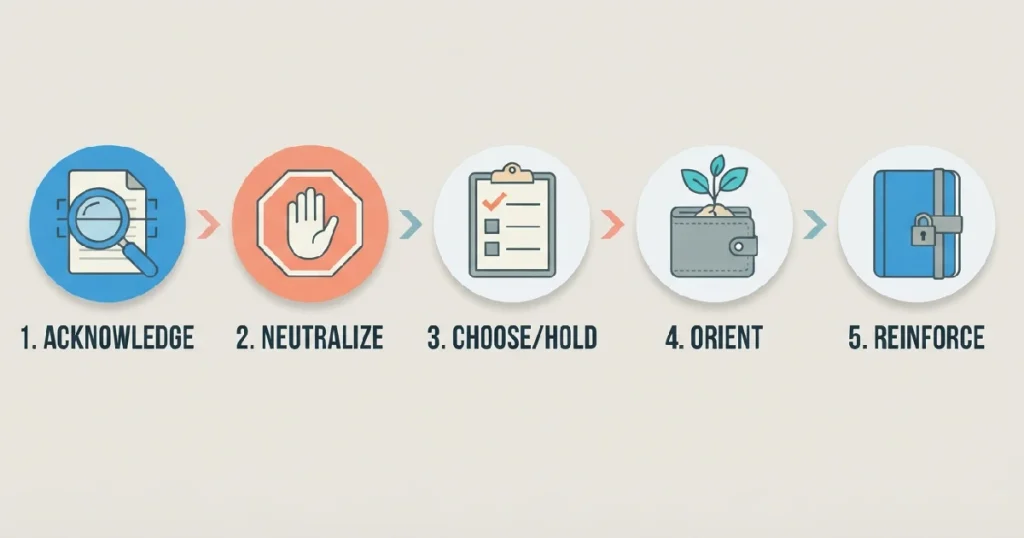
So how do you deal with a toxic husband in the actual moment, not in theory? These five rules make up what I call the ANCHOR Method, and they’re built to be used in order.
Rule 1: Acknowledge Without Absorbing
Name what’s happening in your head without pulling the blame into your body. If he goes quiet and refuses to engage, you tell yourself: “He is stonewalling. This is a tactic, not my reality.”
The Gottman Institute’s research on the Four Horsemen, criticism, contempt, defensiveness, and stonewalling, identifies these exact patterns as reliable predictors of relationship breakdown. Naming them isn’t you overthinking. It’s you finally seeing clearly.
Try this internal script next time it happens: “I notice what is happening. I do not have to solve it right now.” Say it like a fact, not a plea.
Absorbing blame is often the entire point of the behavior. The moment you stop defending and start observing, you take away the thing he’s fishing for.
Rule 2: Neutralize The Escalation Window
There’s a window, usually ten to ninety seconds, right after he says something built to provoke you. Whatever you do in that window either feeds the fight or starves it.
Instead of arguing back, physically leave the room. Say something like, “I’m going to step into the other room, we can talk in twenty minutes,” calmly, then actually walk away. No negotiating.
A lot of women ask what if he follows me. If that happens, or he ever blocks a doorway, this has stopped being a marriage problem.
Safety Override: If his behavior includes threats, physical intimidation, or destroying property, skip the method entirely and call the National Domestic Violence Hotline (US: 1-800-799-7233) or Refuge (UK: 0808 2000 247). This is no longer a communication problem.
Once you’ve figured out how to cope with a toxic husband in the heat of the moment, the next rule picks up after things cool down.
Rule 3: Choose One Consequence And Hold It
Announcing a boundary without a consequence attached is just a request he’s free to ignore. “Don’t speak to me like that” means nothing if nothing happens when he does it again anyway.
Take Sarah and Mark. Sarah said that sentence at every dinner that went sideways, and Mark kept raising his voice because there was never a cost. She changed her script to this instead: “If you raise your voice at me during dinner, I will take the kids and go to my sister’s for the night. No warning. No second chance tonight.” Then she actually did it.
This is also the real answer to how to deal with a toxic husband and teach him a lesson. The lesson was never going to be a clever comeback. The lesson is the quiet, repeated withdrawal of her energy.
Rule 4: Orient Your Independence
A toxic marriage usually comes with shared everything, shared accounts, shared friends, shared calendar. That shared infrastructure is part of why leaving feels impossible even when staying feels unbearable.
Start small. Open a separate account, even if it’s only twenty dollars a week. Text one friend you haven’t talked to in months, just to say hi. Take a ten minute walk alone daily, no phone, no replaying the fight.
None of this is about proving a point to him. You’re building your own exit ramp whether or not you ever drive on it.
If isolation has worn down how you see yourself, how to rebuild self esteem after emotional abuse is a good next read. This is the real foundation of how to deal with a toxic relationship with husband long term, not just tonight.
Rule 5: Reinforce Your Private Threshold
The last rule removes the nightly agonizing. Instead of deciding every single night whether tonight is “bad enough,” set one private threshold in advance and write it down somewhere he’ll never find it.
Something like: “If he does X three more times in the next ninety days, I file.” No drama, no ultimatum delivered across the table.
This one piece of paper does more work than a thousand arguments because it turns an emotional decision into a mechanical one. Your freeing yourself from relitigating the same choice at 11pm, every single night.
What To Do Next

Reading five rules is one thing. Using them tonight is another thing entirely. Here are three specific tools to start with.
The 20 Minute Return
One place to begin is picking your exit line before you need it, not during the fight. Write “I’m stepping into the other room, we’ll talk in twenty minutes” on a sticky note in your bathroom. Consider testing it the next time his voice changes, even over something small like dishes.
The Non-Defensive Sentence Starter
Instead of defending yourself mid argument, try opening with “I hear you, and I’m going to think about that,” then stop talking. This isn’t surrender. It’s refusing to hand him a live performance of your emotions to critique later.
The Private Threshold Journal
Buy a cheap notebook, or use a locked notes app, and write your one sentence threshold this week. Date it. Don’t show it to anyone, because the power is in it being entirely yours. Revisit it only when something actually crosses the line you named.
None of these require him to change, agree, or even notice. That’s the whole point. You’re not managing him anymore, your managing your own responses, and that’s the only variable that was ever fully in your hands.
Frequently Asked Questions
How do you deal with a toxic husband when you have kids and can’t just leave?
You build a slow, quiet exit infrastructure while still running the household. Start with Rule 4, open a separate account, reconnect with one relative, and research housing options in a private browser window. Planning ahead isn’t abandoning your kids, it’s showing them love doesn’t require disappearing into someone else.
How to cope with a toxic husband who refuses couples therapy?
Go to individual therapy without him. A licensed therapist can help you practice the ANCHOR responses and reality check what he tells you about yourself. His refusal to attend is already an answer about his willingness to change.
Is it possible to deal with a toxic husband and teach him a lesson without making things worse?
The only lesson a toxic partner actually respects is a calm, consistent consequence. Matching his anger just proves his point. Withdraw your energy per Rule 3 and let that absence speak louder than any argument could.
You Deserve A Marriage That Doesn’t Require A Survival Strategy
That night you first typed “how to deal with a toxic husband” into your phone, you weren’t overreacting. You were setting your very first boundary, the decision to look for a better answer than “just deal with it.”
The ANCHOR Method won’t fix him. It was never built to. What it does is hand you back five small decisions each day that used to belong entirely to his mood.
You do not owe him your silence in exchange for his comfort.
You get to decide how to deal with a toxic relationship with husband, on your own timeline, starting with whatever he says to you next.
My Closing Remarks
I’ve sat across from alot of women telling this exact story, usually around year five or six, usually crying in a bathroom between the fight and the apology that’s coming next. You’re not broken and you’re definately not alone in this. The method here won’t make him different. It will make you steadier, and that tends to change everything else anyway. Start with Rule 1 tonight if that’s all you have in you.
More Related Stories For You
If the chaos stretches beyond your marriage into your own family, how to deal with toxic family members covers a similar approach for parents, siblings, and in-laws who drain you the same way.
About The Author