
 Sara Carmen
The conversations that quietly decide whether your marriage thrives or unravels rarely show up on any engagement checklist.
Real scripts, psychological frameworks, and boundary strategies to protect your peace when your family cannot stop asking, “So when’s the wedding?”
Key Points
- Learning how to handle family pressure about getting married starts with understanding that the pressure is rarely about you and mostly about your family’s own unfinished anxiety.
- You can hold a firm line on your timeline while still showing up for holidays, phone calls, and Sunday dinners with love intact.
- One calm, repeated script does more damage control than any argument you could ever win at the dinner table.
Contents
Table of Contents
Somewhere between the mashed potatoes and the second round of coffee, it happens. We have all sat at that table watching a relative’s eyes light up the moment they spot an opening. Your shoulders tighten before a single word gets spoken. Within seconds, a conversation about your job, your apartment, or even your dog gets steered, gently or not so gently, toward one question: when are you finally getting married.
You love these people. You also dread these gatherings in a way that surprises you every single time.
Someone at that table might think you are being stubborn or picky. What they do not see is the spreadsheet of student loan payments you manage so carefully that you refuse to start a marriage already buried in debt.
A well-meaning aunt might think you are afraid of commitment. What she does not see is the divorce you watched your own parents survive, and the quiet vow you made never to rush into something that permanent.
If this feels familiar, you are not broken and you are not ungrateful. According to a 2024 Pew Research Center analysis, most young adults without children now rank career stability and close friendships above marriage or parenthood when asked what makes a life feel full. Your timeline is not a rebellion. It is a reflection of the world you actually live in.
Why Family Pressure About Marriage Runs So Deep
Most parents do not nag because they enjoy it. They push because an unmarried adult child stirs up something old in them: fear.
In many households, a child’s marriage works like proof. Proof they raised you correctly. Proof someone will care for you once they are gone. In some families, it also protects a reputation that feels tied to the whole household, not just to you.
This is where a concept called enmeshment becomes useful. Enmeshment describes a family pattern where personal boundaries blur so much that one person’s choices start to feel like everyone’s business. Psychology Today’s coverage of enmeshment schema explains that adult children raised in these tightly wound households often struggle to tell their own desires apart from their family’s expectations, sometimes well into their thirties and forties.
That confusion is not a character flaw.
It is wiring, built over years of close proximity and blurred roles.
Here is the part almost nobody warns you about. Family pressure about marriage rarely works like a light switch you can flip off by finally giving in. It works more like a thermostat. Satisfy the current setting, and someone quietly resets it a few degrees higher. Marriage turns into grandchildren. Grandchildren turn into the size of the house you should buy next. The temperature never actually settles, because the demand was never really about a wedding date.
How to Handle Family Pressure About Getting Married: 15 Scripts and Strategies That Work
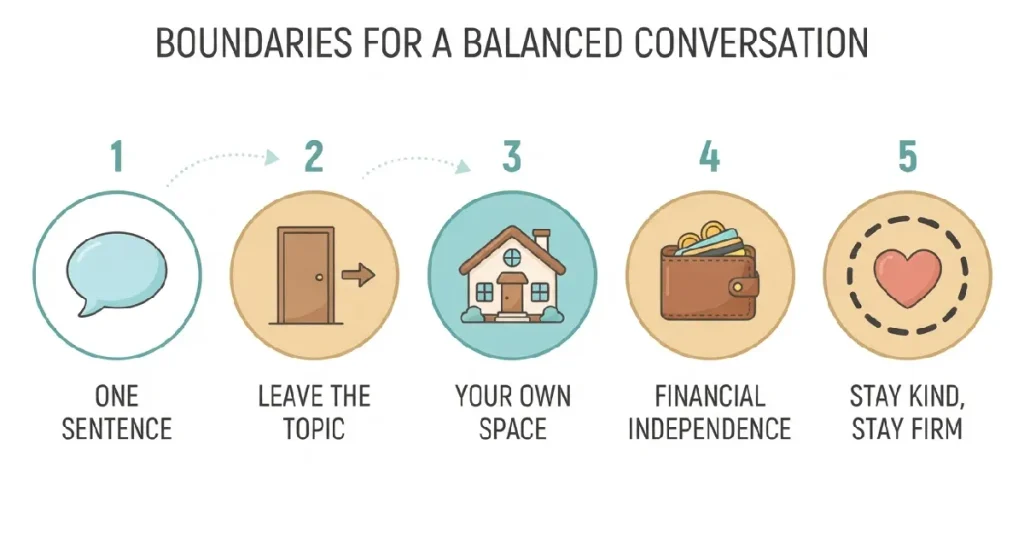
You do not need to win the argument. You need a handful of tools you can reach for automatically, the way you reach for your keys on the way out the door.
Core Boundary-Setting Strategies for Family Pressure About Marriage
1. The Broken Record Script. Choose one calm sentence and repeat it word for word every time the topic comes up, without defending or expanding on it. Something like, “I’ll marry when I’m ready, and I’m not discussing this today,” stops the debate before it starts. Repetition removes the need to justify yourself, which is exhausting and rarely changes anyone’s mind anyway.
2. The Instant Conversation Ender. Say clearly what will happen if the topic gets pushed again, then follow through the moment it does. Hang up the phone or step out of the room without anger. This gives an immediate consequence that teaches the behavior far faster than any lecture.
3. The Separate Lodging Rule. Book a nearby hotel or Airbnb during family visits instead of staying under the family roof. A neutral space means you always have somewhere to retreat, which keeps you from feeling cornered at eleven at night with nowhere to go.
4. The Partner-Shield Protocol. Agree with your partner that each of you manages your own family’s questions separately. Do not let your parents contact your partner directly to drop hints. This keeps pressure from doubling and protects your relationship from being pulled into two family systems at once.
5. Strategic Ignorance. Do not respond to indirect comments, group chat hints, or unsolicited matchmaking profiles. Some therapists call this the grey rock method, staying so flat and unreactive on the subject that it eventually stops feeling worth bringing up. Silence, used this way, is not avoidance. It is a decision.
How Maya Learned to Stop Defending Her Timeline
Maya, a 29-year-old marketing manager in Chicago, used to spend every family dinner defending her decision to wait until after business school to get married. Her mother would bring up her cousin’s wedding, her father would mention grandchildren, and Maya would explain herself for twenty minutes each time, leaving exhausted and resentful. One December, she tried something different. When her mother asked the familiar question, Maya simply said, “I’ll marry when I’m ready,” and changed the subject to the pie. She repeated that same sentence, word for word, at every gathering for three months. By spring, her mother had stopped asking altogether, not because she agreed, but because the sentence stopped giving her anything new to push against.
Conversational Pivots to Defuse Family Marriage Pressure
6. Flip the Interrogation. Turn the question back with genuine curiosity, asking something like, “Why does my relationship status worry you so much?” This often uncovers the real fear underneath, whether it is loneliness, community judgment, or something they never worked through themselves.
7. Negotiate a Grace Period. Ask for a specific, time-bound truce tied to a real goal, such as, “Give me until my promotion next year, and we won’t discuss this until then.” A defined end date feels more tolerable to anxious parents than an open-ended no.
8. The Terrible Example Mirror. Gently reference a rushed marriage that ended in resentment or divorce within your own family or social circle. This reminds them that speed does not guarantee happiness, and sometimes it guarantees the opposite.
9. Validate the Care, Reject the Delivery. Acknowledge their love while holding your ground: “I know you want me to be secure, but rushing this will make me miserable.” This keeps the conversation from turning into a fight about who cares more.
10. Name the Moving Goalposts. Point out directly that marriage will not end the pressure, since children or a house purchase usually follow right behind it. Naming the pattern out loud often makes family members pause, because most of them have never actually noticed it themselves.
Most people in this situation do not realize there is an actual clinical framework for what you are trying to do here. Family therapist Murray Bowen, who developed family systems theory decades ago, called it “differentiation of self,” which means staying calm and emotionally connected to your family while still holding onto your own thoughts and choices under pressure. It is a different skill than simply setting a boundary. A boundary blocks a behavior. Differentiation lets you stay warm in the room while quietly refusing to absorb someone else’s anxiety as your own.
Building Autonomy So Family Pressure Loses Its Grip
11. Accelerate Financial Independence. Make financial independence a personal priority, since relying on family money often comes with strings attached, whether stated out loud or not. Once you are not financially dependent, a major source of family bargaining power disappears on its own.
12. Set Pre-Screening Filters. If your family insists on introductions, agree to meet the person alone first and give honest, immediate feedback without letting relatives sit in on the process. This turns an overwhelming family project back into a normal, low-stakes first date.
13. Reframe Marriage as an Act of Kindness. Remind your family that marrying someone before you are ready is not fair to that person either. You are protecting a future partner from being loved by someone who is only half present.
14. The Casual Misdirection. At larger gatherings, deflect nosy relatives with light humor and a quick topic change, such as, “Not planning to marry until I find the right fit, but tell me about your garden.” A laugh often disarms a room faster than a serious answer ever could.
15. The Direct, Calm Ultimatum. When pressure crosses into repeated disrespect, state a clear consequence without yelling: they can choose a relationship with you that does not include constant marriage talk, or accept less contact. This is a last resort, used only after gentler tools have been tried and ignored.
Holding Boundaries Without Losing the Relationship to Family Pressure

Setting a limit is not the same thing as rejecting your family. In my practice, I have watched clients confuse the two constantly, assuming that saying no to a wedding timeline means saying no to love itself. It does not.
A boundary is information about your own limits. It is not a punishment aimed at someone else.
The guilt that follows a new boundary is almost guaranteed, especially in families with a strong history of enmeshment. Expect a cold shoulder, a passive comment, or a wounded phone call. That reaction is not proof you did something wrong. It is proof the old pattern is losing its grip, and the system is trying to reset itself back to familiar ground.
One useful way to stay grounded here is repeating a simple internal script: their disappointment is real, and it is still not your job to manage. You can hold both truths at once. Warmth and firmness are not opposites. They can sit in the same sentence, the same phone call, the same holiday dinner.
What to Try in Your Next Family Conversation
One place to start is picking a single script from the list above and writing it on a sticky note before your next family call. Do not try all fifteen at once. One tool used consistently beats fifteen tools used badly.
Consider practicing your chosen phrase out loud, alone, before you need it. Athletes rehearse before the game starts, not during it. Your calm delivery matters as much as the words themselves.
A useful question to ask yourself before any family gathering: what is the one boundary I am willing to enforce tonight, no matter how uncomfortable it gets? Naming it in advance makes it far easier to hold when the moment actually arrives.
The next time someone brings up your wedding date, try pausing for one full second before you answer. That single pause interrupts the old, automatic urge to over-explain yourself.
The Table Looks Different Now
Picture that same family dinner again, the mashed potatoes, the second cup of coffee, the familiar opening someone is about to take.
This time, your shoulders stay down.
You are not walking in to win an argument or defend a spreadsheet full of loan payments. You are walking in with one sentence, one exit plan, and the quiet knowledge that satisfying a moving goalpost was never actually the point. The thermostat only resets when you keep chasing its number. You can simply stop reaching for the dial.
Your timeline is still yours. It always was.
My Closing Remarks
I have sat across from so many clients who believed loving their family meant surrendering their own pace. What I have seen, again and again, is that the families who adjust best are not the ones who got their way. They are the ones whose adult child stayed calm, kind, and unmovable at the same time. That combination changes everything.
More Related Stories for You
- If you want more grounded guidance on communication and connection in your relationships, check out this good advice for a relationship to keep building the skills that protect the bonds you care about most.
About The Author