
 David Wall
You don’t need a bigger life to feel better in it. You need seven small, daily shifts backed by real research.
Key Points
- What makes people happy has less to do with big wins and more to do with small, repeatable daily choices.
- Your brain runs on a biological happiness “thermostat,” but research suggests you control up to 40 percent of where it settles.
- These seven low-effort habits are backed by real data, not vibes, and you can test the first one tonight.
Contents
Table of Contents
You got the promotion. You bought the house. You hit the number on your savings app that used to feel like the finish line.
For about three weeks, you felt good. Then the feeling quietly packed up and left, and you were back to scrolling your phone at midnight, wondering what’s actually wrong with you.
Nothing is wrong with you.
You’ve been chasing happiness like it’s a destination. Research suggests it actually works more like a habit you build with your hands, one small repeated action at a time.
The Neuroscience of Joy: Why Your Brain Has a Happiness Set Point
Here’s the part almost nobody explains clearly: your brain doesn’t just “feel happy.” It manufactures the feeling out of four specific chemicals, and knowing their names changes how you chase them.
Psychologists sometimes call this the DOSE model. Dopamine drives reward and motivation, the little hit you get from finishing a task or seeing a notification. Oxytocin builds trust and bonding during physical touch or genuine connection. Serotonin stabilizes your mood and regulates sleep, appetite, and self-worth. Endorphins mask pain and stress, often released through movement or laughter.
Most people try to spike dopamine through achievement alone. That’s where the trouble starts.
Your brain has a set point, a baseline mood it keeps returning to, kind of like a home thermostat set to 68 degrees. Open a window and the temperature shifts for a bit. Close it again, and the house drifts right back. Psychologists call this drift the phenomenon known as the hedonic treadmill, the tendency for humans to quickly adapt to positive or negative changes and return to a fairly stable level of happiness.
That’s not weakness. That’s wiring.
According to research by psychologist Sonja Lyubomirsky and her colleagues, genetics account for roughly 50 percent of your happiness baseline, and life circumstances such as income or job title account for only about 10 percent. The remaining 40 percent comes from your daily, intentional behavior. You can read more about this pattern of hedonic adaptation, which explains why raises and new relationships stop feeling exciting after a while.
That 40 percent is the entire point of this piece. It’s the part of the equation you actually get to touch.
7 Daily Habits for Mental Health That Raise Your Baseline Mood
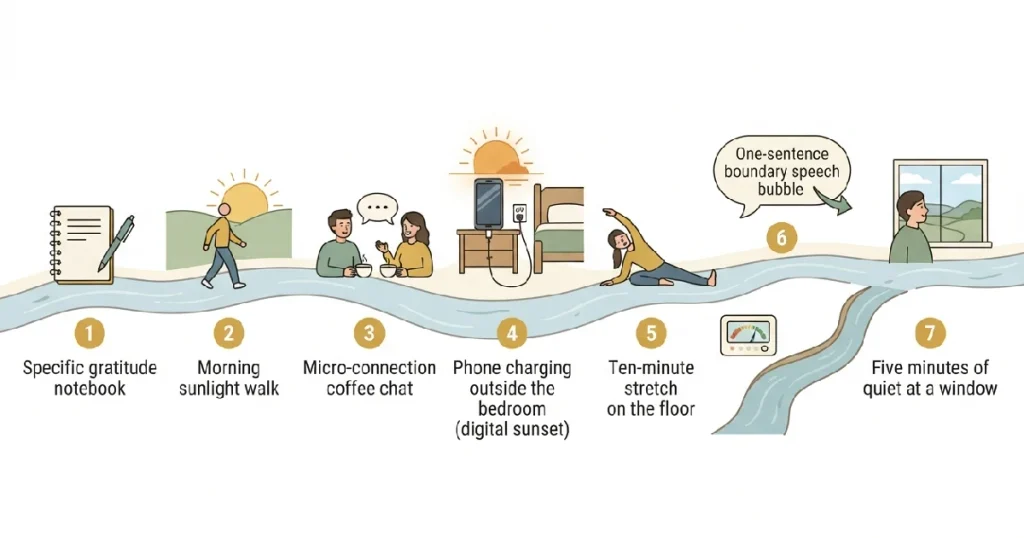
None of these require a retreat, a supplement stack, or a personality transplant. They require about five to twenty minutes and a willingness to try something small before deciding it won’t work.
1. Anchor Mornings With a 3-Item Specific Gratitude Practice
The claim: Generic gratitude lists (“family, health, coffee”) barely move the needle. Specificity does the work.
The evidence: Writing down why one hyper-specific moment from the last 24 hours happened forces your brain to trace cause and effect. This retrains the same threat-monitoring circuitry that usually scans for what went wrong, redirecting it to scan for what went right instead.
The so what: Instead of “grateful for my friend,” try “grateful my coworker Priya covered my 9 a.m. call because I mentioned I was exhausted.” One sentence. One reason why. Three times a week is enough to notice a shift.
2. Secure a Non-Negotiable 15-Minute Natural Light Walk
The claim: Getting outside within an hour of waking does more for your mood than most morning routines combined.
The evidence: Early sunlight exposure resets your circadian rhythm, your internal 24-hour clock, which in turn optimizes serotonin production during the day and melatonin release at night. Poor light exposure is one of the most overlooked contributors to low mood and disrupted sleep.
The so what: You don’t need a sunrise hike. You need fifteen minutes, no sunglasses, ideally before checking your phone. In my practice, this is the single habit clients resist the most and report benefiting from the fastest.
3. Practice Low-Stakes Micro-Connections
The claim: Brief, casual interactions with people outside your inner circle carry more oxytocin benefit than you’d expect.
The evidence: A short exchange with a barista, a neighbor, or a delivery driver counts as real social contact. Studies on urban isolation show these micro-interactions measurably reduce loneliness, even among people who consider themselves introverted.
The so what: Make eye contact. Ask one real question. It costs nothing and it quietly tells your nervous system you’re not alone out here.
4. Establish a Strict “Digital Sunset” One Hour Before Bed
The claim: Your brain cannot fully unwind from a stream of comparison and unfinished work threads while it’s also trying to produce sleep-inducing hormones.
The evidence: Late-night scrolling keeps cortisol, your primary stress hormone, elevated at exactly the moment it should be dropping. Algorithmic feeds are engineered around dopamine spikes, which is precisely why they interfere with the wind-down process your brain needs.
The so what: Set a phone curfew one hour before sleep. Charge it outside the bedroom if you have to. Consider what you’d do with that hour instead, and don’t say “nothing,” because that’s actually the answer that helps most.
Here’s where most happiness advice quietly stops, and where the more interesting research begins.
The Habit Nobody Talks About: Learning to Tolerate Boredom
Most people assume the goal is to stay stimulated. The data says the opposite.
Researchers studying attention and mood have found that people who can sit through low-stimulation moments, waiting in line, a quiet commute, without immediately reaching for a screen, report higher day-to-day satisfaction than those who fill every gap with input. Constant stimulation keeps your dopamine receptors firing at a low simmer all day, which dulls their sensitivity to the good stuff when it actually shows up.
This is the part of the happiness conversation that gets skipped because it isn’t exciting. But building a tolerance for stillness may be doing more for your baseline mood than any single productivity hack you’ve tried.
5. Reframe Physical Activity as “Movement Over Exercise”
The claim: You don’t need a gym membership to get the mood benefits of physical activity.
The evidence: Endorphin release, your body’s built-in stress mitigator, gets triggered by short bursts of movement almost as effectively as a full workout. A ten-minute walk or stretch break activates the same physiological response as a longer session, without the mental barrier of “doing it properly.”
The so what: Stop waiting for the 45-minute window that never comes. Stand up. Stretch for two minutes between meetings. Your nervous system doesn’t grade on effort, it responds to motion.
6. Enforce the One-Sentence Boundary
The claim: Overcommitting quietly drains the same mental resources you need for genuine well-being.
The evidence: People who over-explain declines tend to internalize guilt and second-guess themselves afterward, which extends the stress response long after the actual conversation ends. A clean, brief boundary shortens that entire cycle.
The so what: Try, “I can’t take this on right now, but thank you for thinking of me.” No apology tour required. Say it once, and let it stand.
7. Dedicate 5 Minutes Daily to Conscious Stillness
The claim: Five unstimulated minutes a day give your overworked dopamine system a genuine chance to recalibrate.
The evidence: This isn’t meditation in the formal sense, though it borrows from it. It’s five minutes with no podcast, no notifications, no music, just you and the room. That quiet gap is where your nervous system actually downshifts out of alert mode.
The so what: Sit in your car for five minutes before walking inside after work. Notice what comes up when nothing is competing for your attention. It’s uncomfortable at first. That discomfort is the point.
What 85 Years of Data Reveal About Human Connection and Psychological Well-Being

If there’s one study that should end every debate about what actually predicts a good life, it’s the Harvard Study of Adult Development. Researchers have tracked the same group of participants, and eventually their children, for over 85 years, making it the longest-running study of adult life ever conducted.
Its central finding is almost embarrassingly simple: the strength of your close relationships predicts your long-term health and happiness far more accurately than wealth, career status, or IQ ever did.
People with warm, dependable relationships in their 50s were the healthiest and happiest in their 80s. Not the wealthiest. Not the most accomplished. The most connected.
Most people don’t realize that loneliness functions almost like a chronic physical stressor. It’s linked to accelerated cognitive decline, higher inflammation, and increased physical pain sensitivity. Strong relationships appear to work as a genuine buffer against all three.
Now What? Turning the Data Into Your Week
You don’t need all seven habits starting tomorrow. One place to start is picking the single habit that felt the most uncomfortable to read, since discomfort usually points to where the actual gap is.
The Two-Week Test: Choose one habit. Commit for fourteen days, not forever. Fourteen days is long enough to notice a real shift without the pressure of a lifetime commitment.
The Connection Audit: Consider naming the two or three people your future self will thank you for staying close to. A useful question to ask yourself: when’s the last time you reached out first?
The Bathtub Check: Picture your happiness like a bathtub with the drain left open. Achievements pour water in, but adaptation drains it right back out. The habits above don’t add more water. They close the drain.
The next time this happens, try noticing which drain you’re standing next to.
Stepping Off the Happiness Treadmill: How These Habits Make Joy Last
You cannot rewrite your genetics. Nobody can. But the 40 percent that’s actually yours to work with is bigger than most people ever use.
Real life satisfaction isn’t a mountain peak you plant a flag on once. It’s closer to a garden you tend in small, boring, repeated ways most days of the week.
Pick one habit from this list. Just one. Give it seven days before you decide whether it’s working.
You spent years chasing a feeling that kept slipping through your fingers. It turns out the feeling was never the goal. The daily habit was.
My Closing Remarks:
I’ve sat across from enough burned-out professionals to notice a pattern: the ones who get better rarely do it through one big change. They do it through the fifteen-minute walk they almost skipped, or the phone they finally left in another room. If you take nothing else from this, take this: you’re not broken for feeling empty after achieving something you worked hard for. You’re just human, running on a system that was never built to be satisfied by achievement alone.
More Related Stories for You
- Looking for the relational side of well-being? Read about the qualities of a good partner and how connection shapes long-term happiness.
About The Author