


You can’t cure your partner’s depression, but you can become the safest place they land while they heal.
Key Points
- Learning how to help a depressed spouse starts with releasing the idea that you’re supposed to be their therapist.
- Small logistical acts, like booking the appointment yourself, often do more good than any pep talk ever could.
- Protecting your own mental health while you support theirs isn’t selfish. It’s what keeps your marriage standing.
Contents
Table of Contents
Loving someone through depression is one of the loneliest jobs inside a marriage. We picture ourselves as the steady one. We cook, pay bills, answer the school emails, and keep the household from collapsing while we wait for the person we chose to come back. Then the waiting stretches. You still share a bed. You do not share a life the way you used to.
Someone might think their spouse is being lazy because the laundry sits for days. But what they don’t see is that starting a simple task can feel like pushing a stalled car.
Someone might think a warmer pep talk will snap the fog. But what they don’t see is that cheerfulness can land like a verdict: you are failing at being well.
Someone might think asking “How can I help?” is the kindest question in the house. But what they don’t see is that an open-ended question can freeze a brain that already has no fuel for choices.
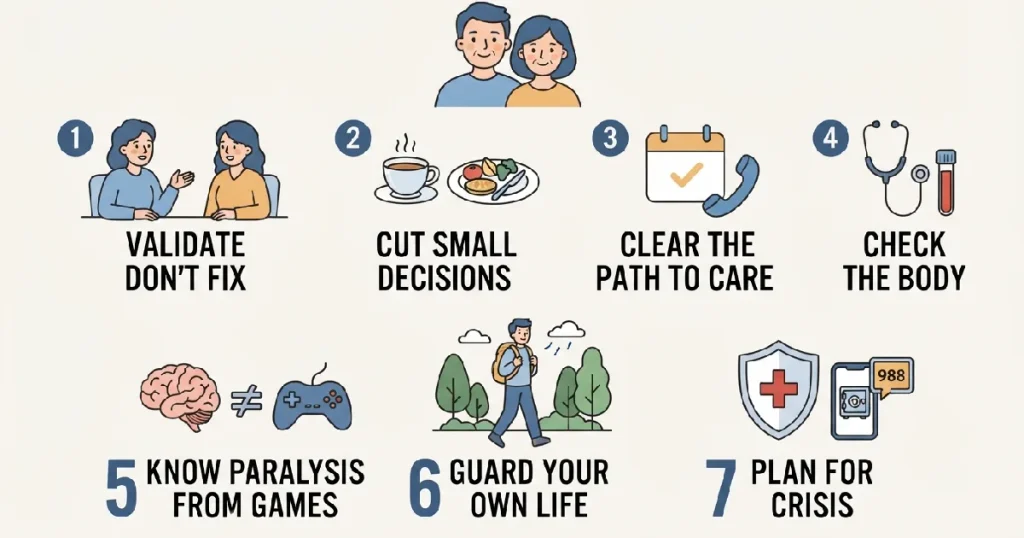
You help a depressed spouse by lowering the cost of each day. Validate without fixing. Take over small decisions. Clear the path to care. Check physical causes. Keep a life of your own. You are their partner, not their therapist, and that boundary is part of the help.
Depression is not a mood they are choosing. It is a clinical condition that can slow thinking, flatten pleasure, and stall the brain’s start button. Psychologists call that stall executive dysfunction, which simply means the mental skills used to plan, begin, and finish tasks are offline. Anhedonia often sits beside it. That is the loss of pleasure in things that used to feel good. When those two show up together, advice sounds like criticism even when you mean love.
That is why the emotional temperature of your home matters so much. Research on expressed emotion, a term for criticism, hostility, and over-involvement in the family, has found that a high-criticism climate is linked with higher relapse risk in depression. Your tone is not a side issue. It is part of the treatment environment.
The goal is not to become a live-in clinician. The goal is to become a safe harbor with a clear map.
Elena Stopped Asking What He Needed
Elena, 41, was doing the work of two adults and a case manager. Her husband Marcus still went to his job some days, then came home and sat in the same chair until midnight. He showered twice a week. He said he was “just tired.” She left tidy lists on the counter. He stared at them like they were written in another language. She felt herself getting sharp, then guilty, then sharp again.
One Tuesday she stopped asking what he wanted for dinner. She put a bowl of soup and a glass of water in front of him, touched his shoulder, and left the room. She booked a doctor’s visit and drove. She told one friend the truth. She kept Thursday evenings with her sister. Marcus did not spring back in a week. He did start treatment. The house stopped feeling like a hospital and a courtroom at the same time. That was the first real shift.
1. Shift From Advice to Validation When You Help a Depressed Spouse
Unsolicited fixing often deepens isolation.
When you say “Just go for a walk” or “Look on the bright side,” you may think you are offering hope. A depressed spouse often hears, “You are not trying hard enough.” Shame then makes them hide more, not less. Toxic positivity, the pressure to appear grateful and upbeat, can shut down the one person who still has access to their inner world: you.
Try scripts that name the effort without demanding a personality change.
Instead of “Why can’t you just try?” try “I see how much it takes for you to get through today. I am here.”
Instead of “Other people have it worse,” try “This looks heavy. You do not have to perform feeling better for me.”
Instead of “You need to snap out of this,” try “I am not going anywhere. We can take the next hour, not the whole year.”
Match your face to your words. Depressed partners track micro-expressions with painful accuracy. If your mouth says support and your jaw says disgust, they will believe the jaw. Soften your shoulders. Slow your voice. Sit beside them rather than standing over them. Safety is a body-language job as much as a language job.
2. Reduce Decision Fatigue for a Depressed Husband or Wife
A depressed brain treats small choices like large ones.
Decision fatigue is the mental drain that comes from making choice after choice with too little energy. Add a dopamine deficit, meaning the brain’s motivation-and-reward chemical is running low, and even “What do you want to eat?” can feel like a test. This is not stubbornness. It is task paralysis, a freeze at the point of starting.
Stop handing them a menu of options when their battery is at 3 percent.
A depressed brain is like a phone that still has every app open. You cannot yell it to 100 percent. You can close some apps.
Bring tea. Make a simple, nutrient-dense meal. Restock milk and bread without a survey. Lay out a clean towel and a shirt near the bathroom. Put the bin bag in their hand rather than asking if they “feel up to trash night.” The NHS guidance on helping someone with depression notes that simplifying daily routines and gently supporting balanced eating can form a practical base for recovery.
Closed choices still leave dignity. “I made grilled chicken or I can heat soup. I am doing chicken unless you say soup.” That is help. “Tell me how to help you” is often more work for them.
3. Make Treatment Easier When Your Spouse Has Depression
The paperwork of getting well can be harder than the wish to get well.
A depressed mind may agree, in theory, that therapy would help. Then it has to find a clinician, check insurance, compare fees, fill forms, and dial a stranger. That sequence can collapse before the first session. If your spouse refuses help, do not turn the kitchen into a courtroom. Lower the steps until one of them is small enough to take.
Do the heavy lifting. Vet two local therapists. Check who is covered. Set up a virtual consult. Offer to sit in the waiting room or stay on the drive. Frame it as teamwork: “I found a 15-minute intro slot Thursday. I will handle the forms. You only have to show up.”
If they still refuse, keep the door open without daily debate. One calm sentence, then space: “I love you, and I will not pretend this is fine. The appointment is there when you are ready. I will keep our home as steady as I can until then.” Repeated lectures raise expressed emotion. A clear offer, repeated occasionally, leaves a path.
4. Check Physical Causes of Depression in a Spouse

Mood is not only a mind story.
Major depressive disorder can be worsened, and sometimes mimicked, by problems in the body. Severe vitamin D deficiency, thyroid disease, sleep apnea, iron problems, and hormone shifts such as low testosterone or perimenopause can all drag energy, sleep, and outlook into the ground. Jumping straight to the idea that “this is only psychiatric” can miss a treatable piece of the picture.
One place to start is a routine physical with comprehensive bloodwork. Ask the physician about vitamin D, thyroid function, B12, iron studies, and, when relevant, sex hormones. If your spouse snores, wakes unrefreshed, or falls asleep in the daytime, raise sleep apnea. Talk therapy still matters. Medication may still matter. The body deserves a seat at the same table.
This is not a hunt for a magic lab result. It is a refusal to treat a whole person as a diagnosis on a screen.
5. Tell Depressive Paralysis From Weaponized Incompetence
Not every undone chore means the same thing.
Depressive paralysis is an executive-function crash. The person may want to move and cannot start. Weaponized incompetence is a pattern of performing helplessness so the other partner takes over for good. One is an illness feature. The other is a relationship strategy. Mixing them up will either shame a sick person or enable a selfish one.
Look at history and pattern, not one ugly weekend. Were they reliable before this episode? Do they avoid only chores, or also things that used to bring joy? Do they hide, or do they look ashamed in a way that feels real? When you remove friction, do they use the opening, even a little?
Here is the piece most advice skips.
If they can game, scroll, or binge a show, that is not proof they are faking. Low-effort, high-dopamine activities can still run when high-effort tasks cannot. Showering, calling a doctor, and cooking use initiation, planning, and delayed reward. A video game pays the brain immediately. That split is wiring, not a courtroom exhibit.
That’s not laziness. That’s a brain running on fumes.
Boundaries still belong here. You can bring the sandwich and refuse to become the only adult forever. “I can handle dinner this month while you get care in place. I will not quietly take over our whole life as the new normal.” Support the recovery steps. Do not sign a permanent contract with the depression.
6. Protect Yourself From Caregiver Burnout in a Marriage
The healthy partner can get sick in slow motion.
Caregiver burnout is the exhaustion, irritability, and numbness that come from giving more than you can restore. It is common. It is understandable. It is also a marital risk. Left alone, resentment does not stay polite. It turns into coldness, scorekeeping, and a quiet wish to escape a person you still love.
Self-care in this context is not bubble baths. It is dynamic preservation: keeping enough of a self that you can stay kind. Maintain one hobby that does not involve their mood. See a friend without reporting every detail back. Leave the house on a schedule, not only when a crisis allows it. Vent somewhere that is not your marriage.
The National Alliance on Mental Illness speaks directly to families who love someone with depression and need a place to put grief, fear, and anger. Those feelings do not make you disloyal. They mean you are still a person. A spouse who never gets a break eventually has nothing left to give but bitterness. That helps no one, including the person who is ill.
7. Build a Crisis Plan for a Spouse With Depression

Hope needs a backup plan.
Most days will not be an emergency. Some signs should never be folded into “just a bad week.” Watch for sudden recklessness, giving away valued things, talking about being a burden, researching methods of harm, or a strangely bright calm after a long dark spell. Trust a sharp change more than a reassuring shrug.
Write the plan before you need it. Include the clinician’s number, the nearest emergency department, who can watch children or pets, and how you will get there. In the United States, call or text 988 for the Suicide and Crisis Lifeline. In the United Kingdom, call 999 or go to A&E if there is immediate danger, and keep 116 123 for Samaritans when you need urgent talk support.
Say the plan out loud on a stable day: “If I am scared for your safety, I will get emergency help. That is love, not betrayal.” You do not negotiate with a life-or-death moment in the hallway at 2 a.m.
Three Moves You Can Use This Week
The Closed Menu. Pick one daily loop and stop asking open questions inside it. Meals work well. Announce the plan, make the food, set it down, and let silence be allowed.
The Face-Voice Match. Before you offer care, drop your shoulders and unclench your jaw. Then speak. If you cannot do that yet, wait ten minutes. Honest delay beats fake warmth.
The Protected Window. Block one short stretch this week that belongs only to you. A walk, a class, coffee with a friend. Put it on the calendar as if it were a medical appointment, because it is one.
A useful question to hold, not as an interrogation but as a compass: “Am I being a partner today, or am I trying to run a treatment program from the kitchen?”
The next time the house goes quiet and you feel that old urge to deliver a speech, try one sentence of validation and one practical act. Then stop. Let the act be the rest of the paragraph.
You may still walk on eggshells some nights. You may still wait for the person you married to fully return. Waiting with a plan is different from waiting with a pep talk. You now have a way to lower the day’s cost, protect the emotional climate, and refuse the job of unpaid therapist.
Keep closing apps on that 3 percent phone. Sit close enough that the charger is not a long reach. Stay a spouse.
Be the harbor. Not the rescue boat.
My Closing Remarks
I have sat with many partners who whispered the same confession: I still love them, and I am so tired of being the strong one. That mix of loyalty and resentment does not make you cruel. It makes you human. If you take nothing else from our time together, take this. You can stay kind without disappearing. You can hold the door to treatment without dragging anyone through it. Your life still counts, even on the weeks their illness takes up most of the room.
More Related Stories for You
If you want steady, practical good advice for a relationship while you support a struggling partner, start there and keep building the marriage you both still live in.