
 Sara Carmen
The chilling signs that go far beyond vanity, and the real reason you keep questioning your own sanity..
Key Points:
- The true narcissist meaning in a relationship has nothing to do with selfies or ego. It describes a survival system built on control, not love.
- Reactive abuse, hoovering, and love bombing aren’t random cruelty. They follow a predictable conditioning pattern that keeps you hooked.
- Once you recognize the ten real patterns underneath the confusion, you stop asking “what’s wrong with me” and start asking the right question instead.
Contents
Table of Contents
We toss the word narcissist around as if it only means vanity. A person who loves their reflection. A coworker who dominates every meeting. A date who talks only about their job. The label has become so cheap that it barely stings.
You did not land here because of vanity.
You landed here because the person you love can make you feel chosen at breakfast and erased by dinner. You replay conversations hunting for the moment you became “too much.” You apologize for needs that used to feel ordinary. A quiet question follows you from room to room.
Are you crazy, or is it abuse?
Narcissist meaning in a relationship is not selfishness. It is a one-way emotional contract. Your partner takes admiration, control, and care while offering little real empathy back. The bond is built to keep you confused, self-blaming, and easy to manage.
Someone might think they simply married a difficult person who needs patience. But what they don’t see is the personality change after the lease, the ring, or the pregnancy. The warmth that won them over thins out once you are attached.
Someone might think they are bad at communication. But what they don’t see is how every concern they raise comes back as a defect in them. The original wound never gets discussed. You do.
Someone might think the public version of their partner is the real one, and the cold private version is only stress. But what they don’t see is that the saint in the living room and the critic behind closed doors are both part of the same strategy.
Left unnamed, this pattern does not stay as “relationship friction.” It becomes the reason you lose your memory of who you were before them.
What Narcissist Meaning in a Relationship Actually Describes
Clinical narcissism is not a mood and it is not a selfie habit. Narcissistic Personality Disorder, or NPD, is a rigid personality pattern. The core features are a hungry need for admiration, a thin ability to feel with other people, and self-esteem so fragile that any slight feels like an attack.
A partner can show highly damaging narcissistic traits without ever holding a formal diagnosis. You do not need a clipboard to recognize the cost in your own home.
For a narcissistic partner, the relationship is not a mutual bond. It is a supply line. Psychologists call this narcissistic supply: the attention, status, caretaking, and emotional fuel they pull from other people to keep their self-image stable. You are not a beloved equal in that setup. You are a source.
Living with that setup feels like standing in front of a one-way mirror. They look and see a reflection that confirms them. You look and see glass. You keep waiting to be seen through it. You never are.
Narcissistic Supply Turns the Bond Into a Transaction
Affection arrives when you are useful, impressive, or admiring. It fades when you are tired, sick, or simply human. They can drop everything and expect you to do the same for their sudden need. When you need support, they become annoyed, distant, or gone.
This is why so many highly empathetic people, including partners with ADHD or autism, get stuck. You assume goodwill. You take language literally. You work on yourself. They use that sincerity as a tool.
The Blame Spotlight Behind Narcissistic Abuse
Accountability does not work the same way on both sides of this dynamic.
Their inner spotlight snaps outward. If they lie, you were “too insecure.” If they forget, you “never told them.” If they rage, you “provoked” it.
Your inner spotlight snaps inward. You scan for your fault first. You write the apology. You promise to communicate better.
Most people in this situation do not realize they are running two different operating systems. They think they are in a disagreement. They are in an extraction.
In my practice, partners often arrive asking how to be less reactive. They almost never arrive naming narcissistic abuse. They arrive trying to fix themselves.
The Narcissistic Relationship Cycle Most People Misread

Popular advice says these relationships start as a fairy tale and then collapse overnight. That story is incomplete.
Research by Wurst and colleagues found that narcissistic admiration (charm, confidence, early heat) can keep a romance looking viable longer than people expect. Narcissistic rivalry (competition, contempt, put-downs) then eats the bond from the inside. The drop is real. It is often slow.
That delay is not evidence that you imagined it.
Love Bombing Is Not Romance
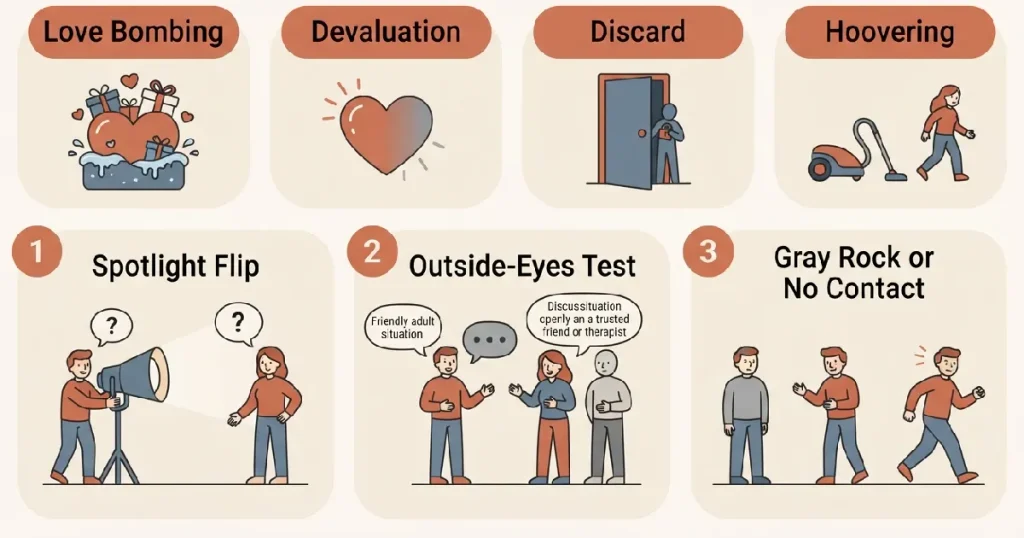
Love bombing is intense early idealization. Grand declarations. Constant texting. Future talk that skips the ordinary work of knowing you. The goal is speed. Fast attachment bypasses your usual caution.
Devaluation Does Not Arrive as a Single Crash
Then the temperature changes. Jokes that sting. Affection that is withheld. Rules you were never told you had broken. You work harder. You become easier, quieter, more useful.
This is devaluation: the slow replacement of worship with contempt. Because it drips rather than explodes, you explain it as stress, new-parent fatigue, or your own neediness.
A full map of this loop is laid out in Psych Central’s breakdown of the narcissistic cycle of abuse, including how the same person can injure you and then temporarily soothe you.
The Discard, Then the Pull Back In
Discard is the cutoff. They leave, ice you out, or rewrite history so you were the villain all along. Then hoovering can start. Sudden sweetness. A crisis. A promise that they have changed. The kindness is often a refill, not a repair.
Intermittent warmth after cruelty is how a trauma bond forms. Your nervous system treats the relief like love. It is closer to a slot machine. Unpredictable reward keeps you pulling the lever.
Maya Kept Googling How to Be a Better Wife
Maya was 34, newly married, and sure the problem was her tone. After they moved in together, her husband went flat. He sighed when she asked about his day. He mocked her memory in front of friends, then called it teasing.
She bought communication books. She apologized first. Every time. She had ADHD and already distrusted her recall, so when he said “that never happened,” she believed him.
She was not searching for narcissistic abuse. She was searching for scripts to be less “difficult.”
A coworker asked to read a week of their texts. The coworker went quiet. That silence was the first time Maya considered that the problem might not be her sensitivity. It might be the one-way mirror.
10 Realistic Signs of a Narcissist in a Relationship
Textbook arrogance is easy to spot. Covert control is not. Watch for these micro-tactics.
1. The accountability ping. You bring a clear hurt. Within minutes the topic is your insecurity, your tone, or your timing. “You lied to me” becomes “Your jealousy forced me to hide things.”
2. The post-attachment personality shift. Dating felt golden. After moving in, marriage, joint money, or a pregnancy, warmth drops. The mask was for the audition. The contract, in their mind, is signed.
3. Reactive abuse behind closed doors. They poke until you yell. Then they point at your explosion as proof you are the unstable one. Reactive abuse means your outburst was provoked, then used as evidence against you.
4. Weaponized empathy, especially with neurodivergence. If you have ADHD or autism, they use your literal thinking, memory gaps, or strong empathy against you. You start treating your own mind as the unreliable witness.
5. The audition dynamic. You never feel securely chosen. You feel evaluated. Lucky to be there. One mistake from being replaced.
6. Asymmetric resource use. Your time, money, body, even the dog, exist to serve their comfort. When you are sick, they are inconvenienced. Care flows one direction.
7. The public saint, private critic. Friends think they won the lottery. At home you walk on eggshells. The public charm is social insurance. If you ever speak, you sound ungrateful.
8. Spotlight sabotage. You get a promotion, a birthday, a moment of praise. Suddenly there is a fight, a mysterious illness, or a tantrum. The room must face them again.
9. Boundaries held hostage. You try to pause a fight or leave a room. They hold keys, money, the children, the pet, or your things until you communicate on their terms.
10. Chronic micro-abandonments. No mature repair. Only silence, cold cutoffs, or threats to end it over small issues. The freeze keeps you anxious enough to perform.
A covert narcissist may never look loud or grandiose. They can look wounded, generous, even humble in public. The private scorekeeping is the tell.
Healthline’s guide to narcissistic personality disorder is clear on this point: spotting covert control early protects long-term mental health, whether or not anyone ever writes NPD on a chart.
The Hidden Psychological Toll of Narcissistic Abuse
Cognitive dissonance is the mental split of holding two clashing truths. They love me. They erase me. Your brain burns energy all day trying to make those sentences coexist. That burn is cognitive fatigue. It shows up as fog, insomnia, startle responses, and a body that never stands down.
You shrink your hobbies. You pre-edit every sentence. Your identity becomes a peacekeeping job.
This is common. It is not a personal failure. It is what happens when a human nervous system lives on a one-way mirror for months or years.
Recovery: How to Reclaim Your Reality
You cannot treat this like a standard communication problem. Couples counseling often backfires because a skilled manipulator can perform insight in the room and punish you after it.
One place to start is the Spotlight Flip. When self-blame floods in, ask a colder question: If a friend described this exact scene, whose behavior would I flag? You are not looking for cruelty toward them. You are looking for accuracy.
Consider the Outside-Eyes Test. Cognitive distortion loves secrecy. Show unedited texts to a trusted person who is not charmed by your partner. Ask only, “Is this ordinary conflict or control?” Borrow their nervous system until yours comes back.
The next time a conversation turns into a courtroom, try Gray Rock if you cannot leave yet. Short. Factual. No emotional fuel. If you share children, this is often safer than open war. Where you can leave, No Contact is not drama. It is a medical-grade boundary for a bond that feeds on access.
A useful question to sit with tonight: What would I have to stop explaining for my life to get quieter?
Dedicated trauma-informed therapy helps you process the bond without handing your private world to the person who already distorts it. The National Domestic Violence Hotline can help you plan for safety if money, housing, or children are being used as pressure.
You Were Never Crazy
Go back to that morning-and-dinner whiplash. It was not proof that you are hard to love. It was the one-way mirror doing what it was built to do: keep them confirmed and keep you guessing.
You now have a name for the contract you were living inside. Naming it does not make you cold. It makes you accurate.
You were never asking for too much. You were asking the glass to become a window.
My Closing Remarks
I have sat with people who loved someone they could never quite reach. The hardest part was rarely the logistics of leaving. It was grieving a person who had mostly been a performance. If that stings, it also means you can still tell a mask from a human being. You do not need their diagnosis to get your mind back. You need one honest record of the pattern, one safe person who is not dazzled by them, and one step toward a life where your feelings are not treated as a glitch.
More Related Stories for You
- If early intensity still confuses you, read what it can mean when a guy calls you beautiful before you have even been known.
About The Author